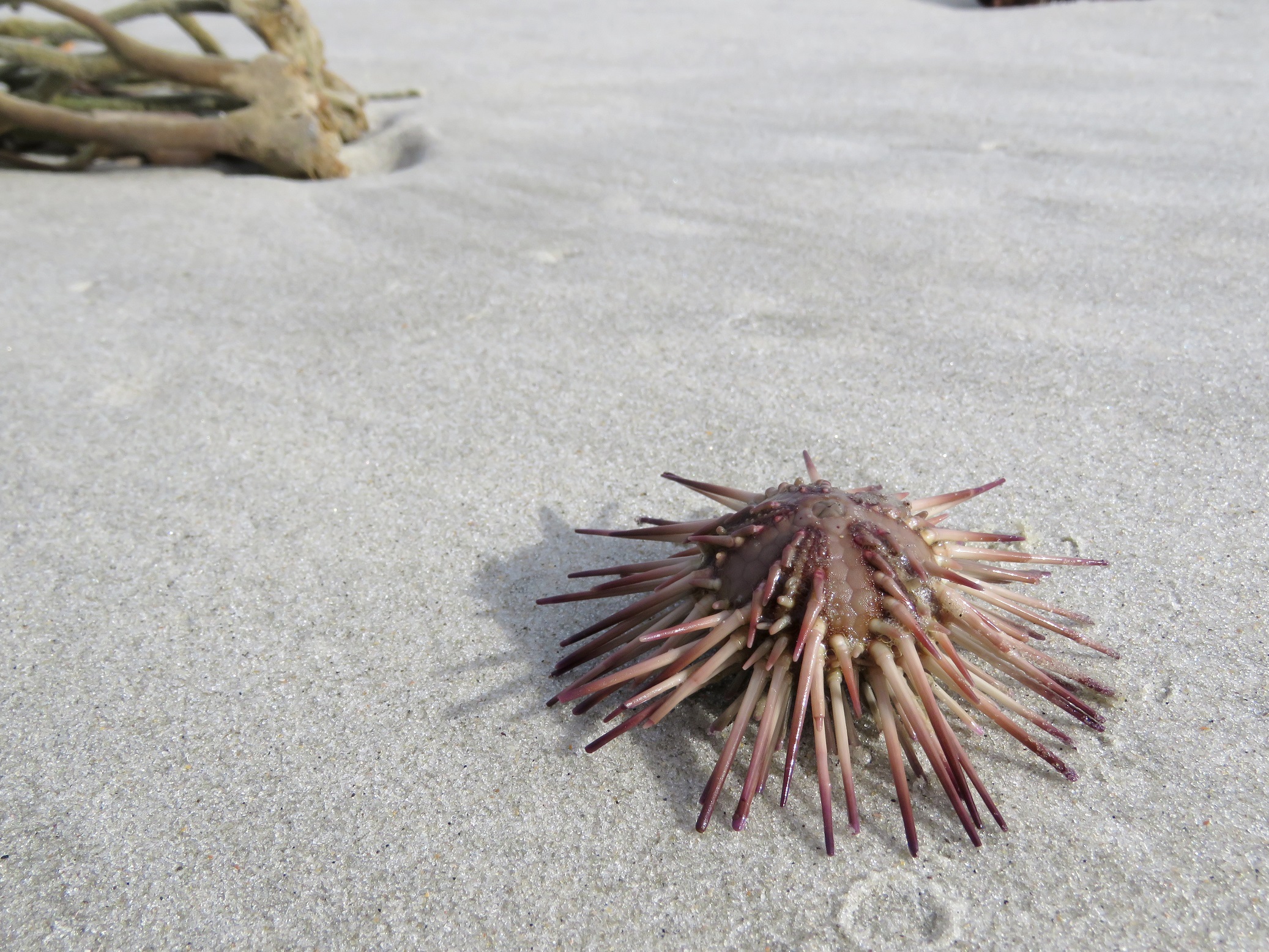
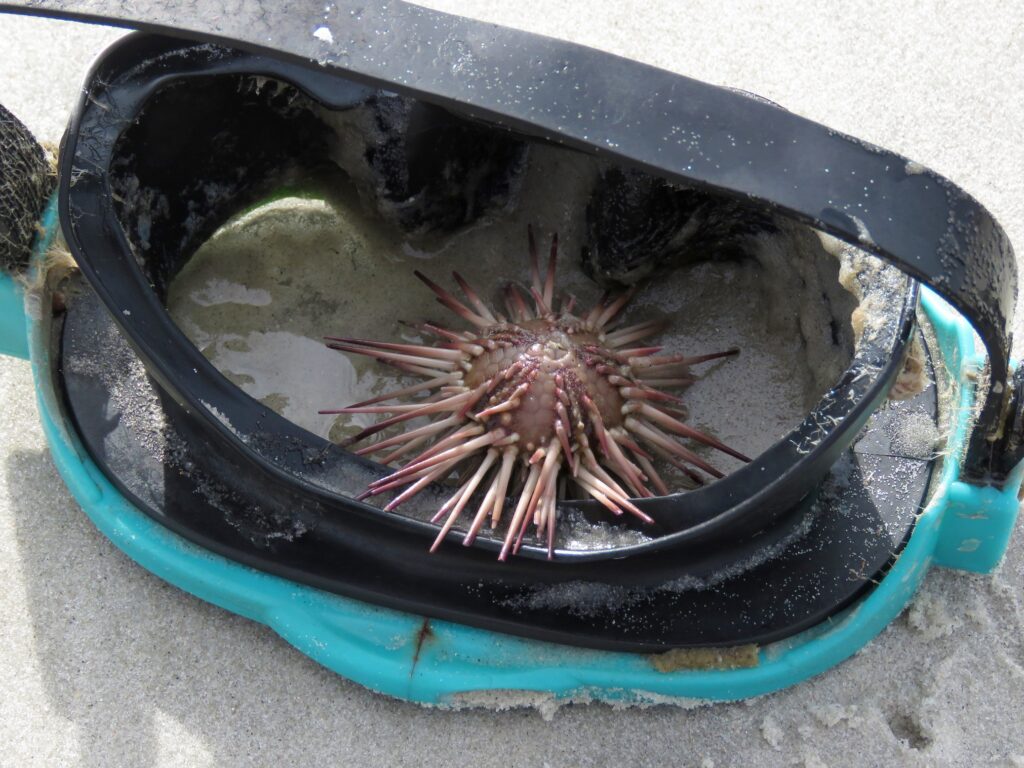
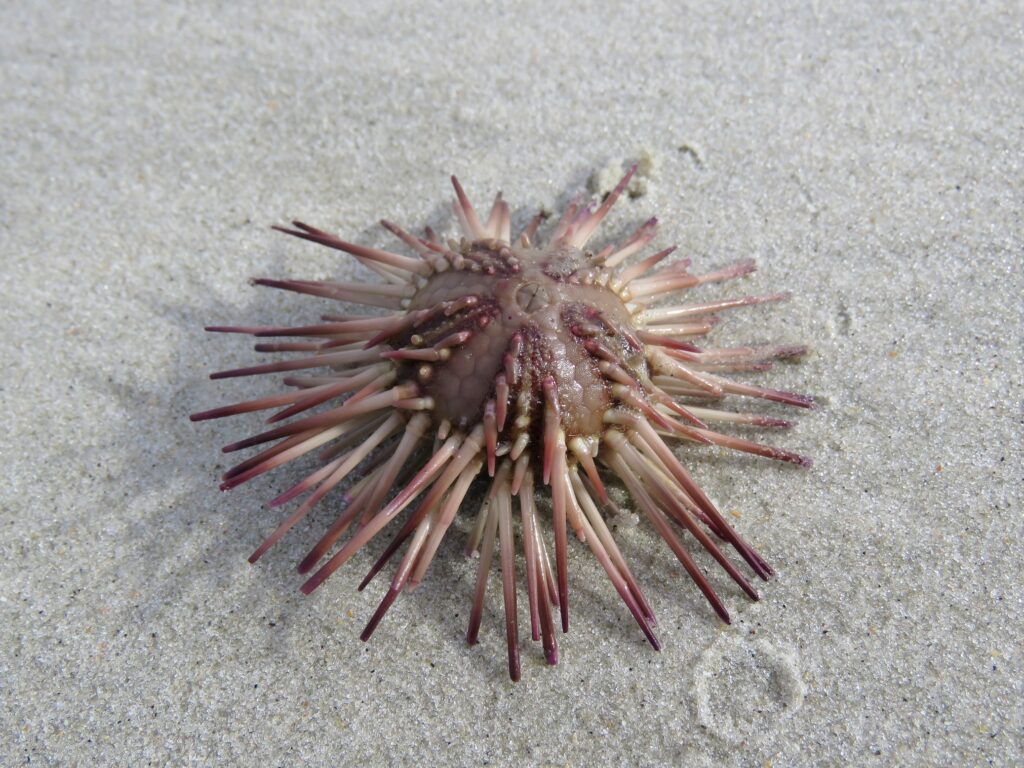
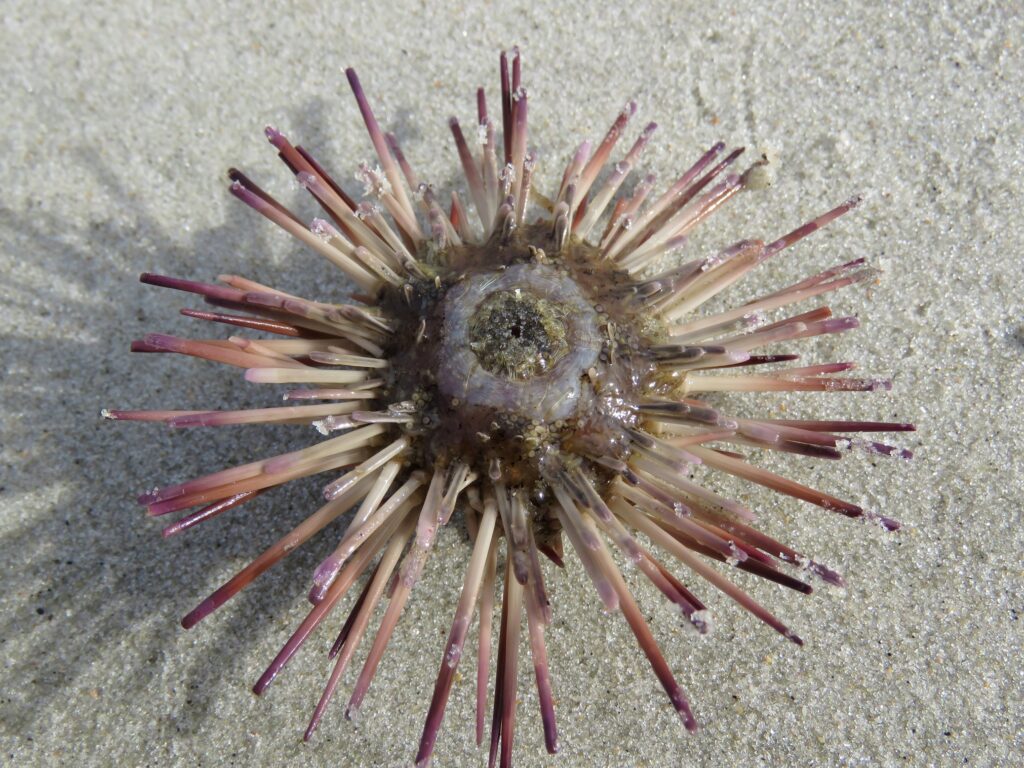
This week for Flora and Fauna Friday it’s the pincushion of the East Coast, the Atlantic Purple Sea Urchin (Arbacia puntulata).
The Atlantic Purple Sea Urchin is found all up and down the United States East Coast, from the Keys to Boston. It’s our most oft encountered Urchin on the Lowcountry’s coastline and can be found along the beachfront year round. They are readily recognized by their dark purple-brown, dome-like body studded in a profusion of stout pink-purple spines. Fully grown, this urchin is roughly four inches wide from spine to spine. However, more often than not, you’ll encounter not a live Urchin but its calcareous skeleton washed upon the beach. In Urchins, this is called a “test” and is the outer skeleton of their body that lies just below their skin. For Purple Sea Urchins, their test is about an inch-and-a-half wide and bone-white with five pairs of burgundy bands running from top to bottom.
Purple Sea Urchins live their lives in the intertidal zone right up near the beach, clinging to hard structures like the stones and pilings of jetties, groins, and piers. Below the waves they comb these hard surfaces for sessile plant and animal life, scraping away and eating anything edible encountered with their five-sided chisel-like beak. They can also be found nibbling on carrion they chance upon. Purple Sea Urchins use their spines to deter predators, lifting them upright and pointing them towards predators to discourage hungry mouths, like a phalanx of spears. They move around using a combination of short, blunt spines and flexible, tube feet on their underside. These propel them forward at a blistering pace of one mile per month, or about eight feet per hour.
The tiny tubular feet of the Purple Sea Urchin are a common trait to the Echinoderms, the Phylum of invertebrates to which all Urchins, Sand Dollars, Star Fish, Crinoids, and Sea Cucumbers belong. These tube feet are articulated using water pressure from the animal’s circulatory system, rather than muscles. Each foot is tipped with a tiny suction cup, allowing them to grab onto a surface or manipulate a piece of food. Some of the tube feet of the Purple Sea Urchin can also secrete a strong, but reversible, adhesive. This allows them to glue themselves to hard surfaces during rough waters and stay attached at any angle indefinitely.