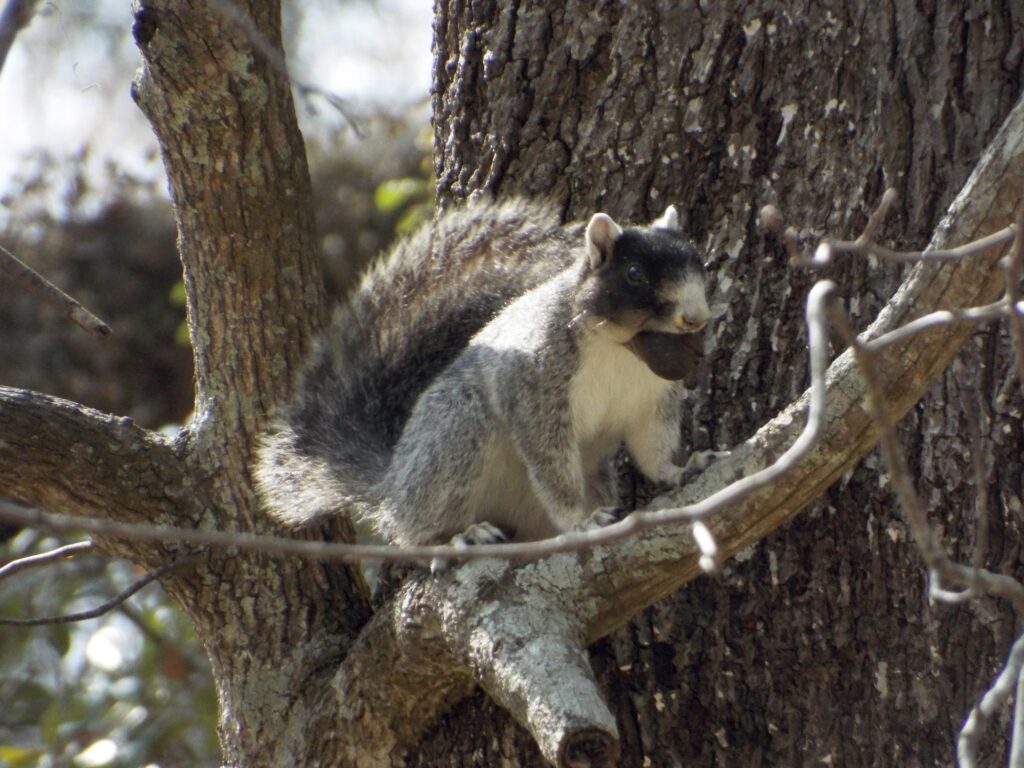
This week for Flora and Fauna Friday we have our largest arboreal rodent, the Southern Fox Squirrel (Sciurus niger niger).
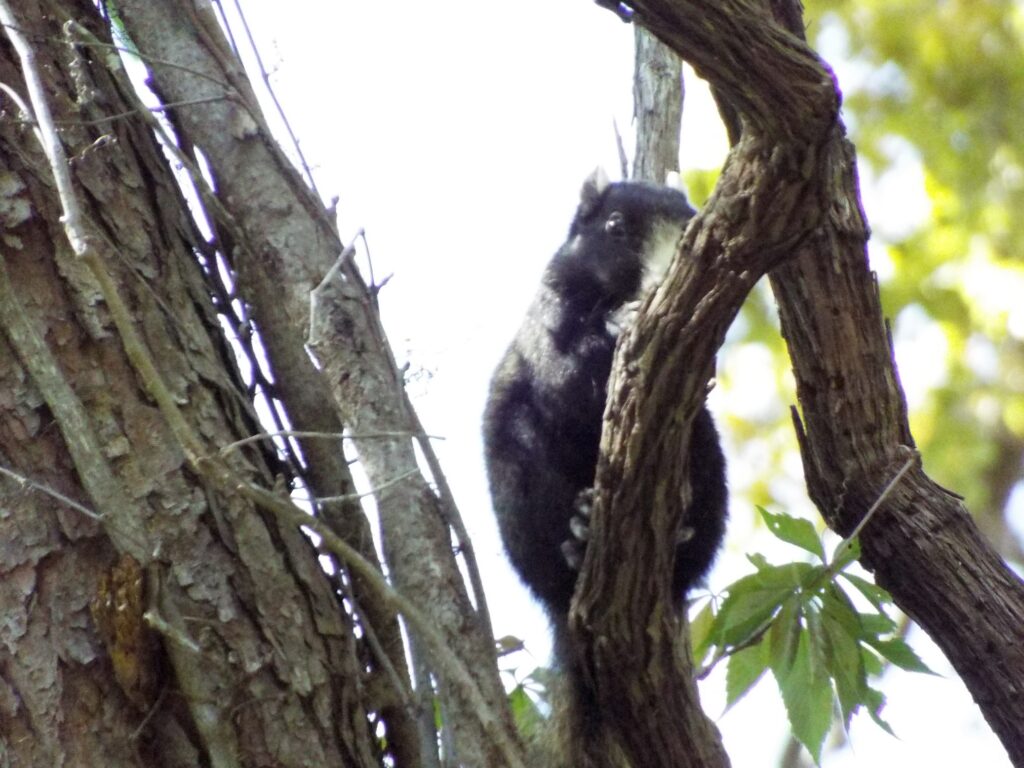
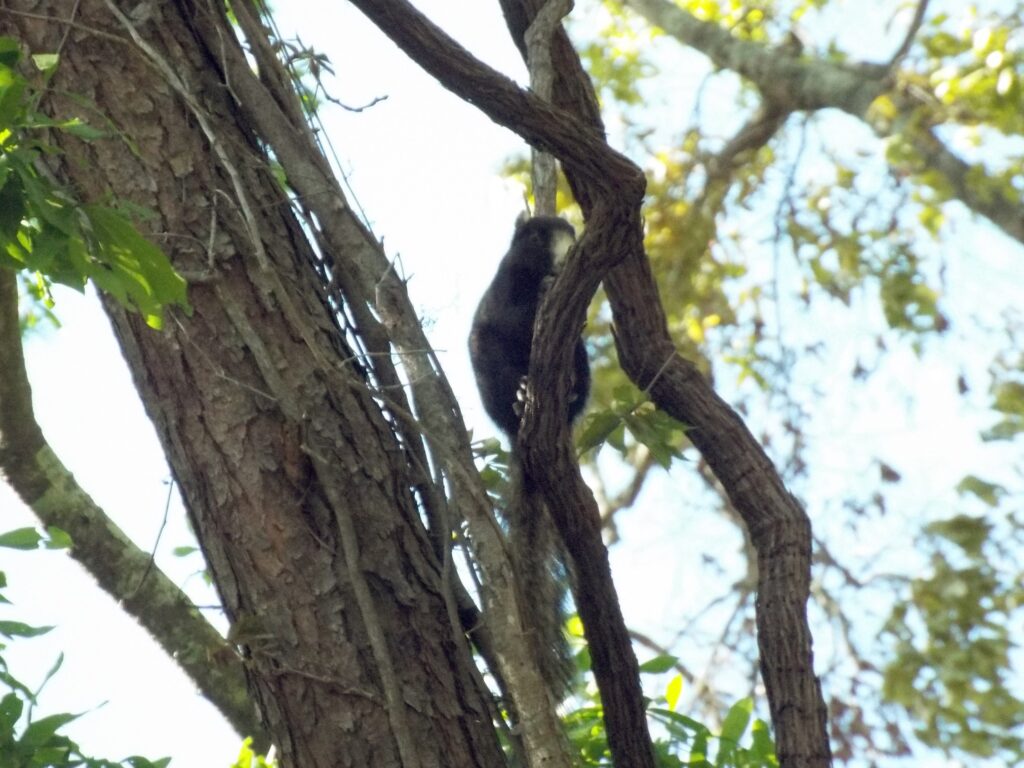
Fox Squirrels are the largest species of tree squirrel in North America. They’re twice the size of your run of the mill Eastern Gray Squirrel, Sciurus carolinensis. (Although I’ve seen some pizza-stealing Gray Squirrels upstate that give them a run for their money.) In South Carolina se have a distinct Southern subspecies. Most are a salt-and-pepper gray on the back and tail with a black mask across the face and white ears, nose and belly. Fox Squirrels also come in a black morph that retains the white ears and nose and mottled tail but otherwise has a pure black coat. Fox Squirrels spend more time on the ground then most tree squirrels. Here they forage for food. Like most Squirrels, they subsist off of a diet of nuts, seeds, fruits, vegetation, mushrooms, insects, and the occasional skeleton. Fox Squirrels get their name from both their size and appearance. Both the red-morph of the north and gray-morph of the south, along with their bushy tails and considerable heft, resemble our native Gray Fox.
Fox Squirrels are found throughout the Eastern United States but are far more common up North. Here in the southeast, their far less common and in South Carolina they’re mostly restricted to the coastal plain. They’re mostly restricted to mature Pine forests, particularly savannas, but are also common in bottomland forests and the mixed hardwood-coniferous forests on barrier islands. Southern Fox Squirrels depend on prescribed fire for much of their habitat in South Carolina. Prescribed fire management mimics the natural burn cycles of the contiguous pine forests that historically made up the heart of the southeast. Their darkened gray-black fur camouflages them against the ashen ground and the fire knocks back vegetation, allowing them to forage more easily.

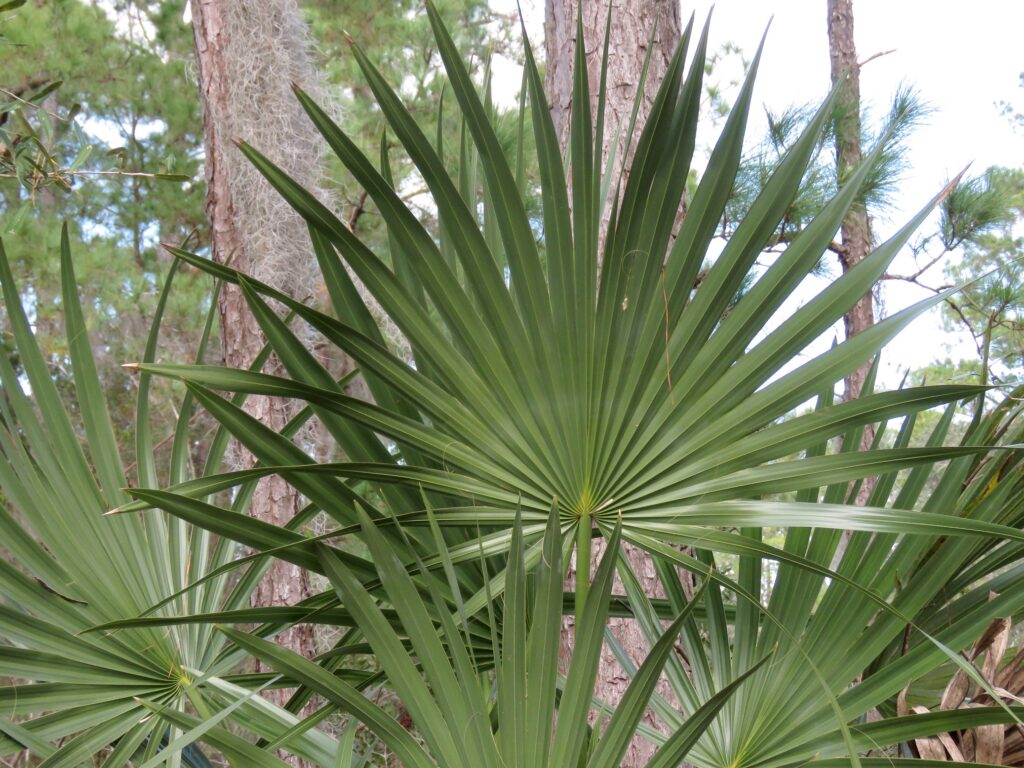
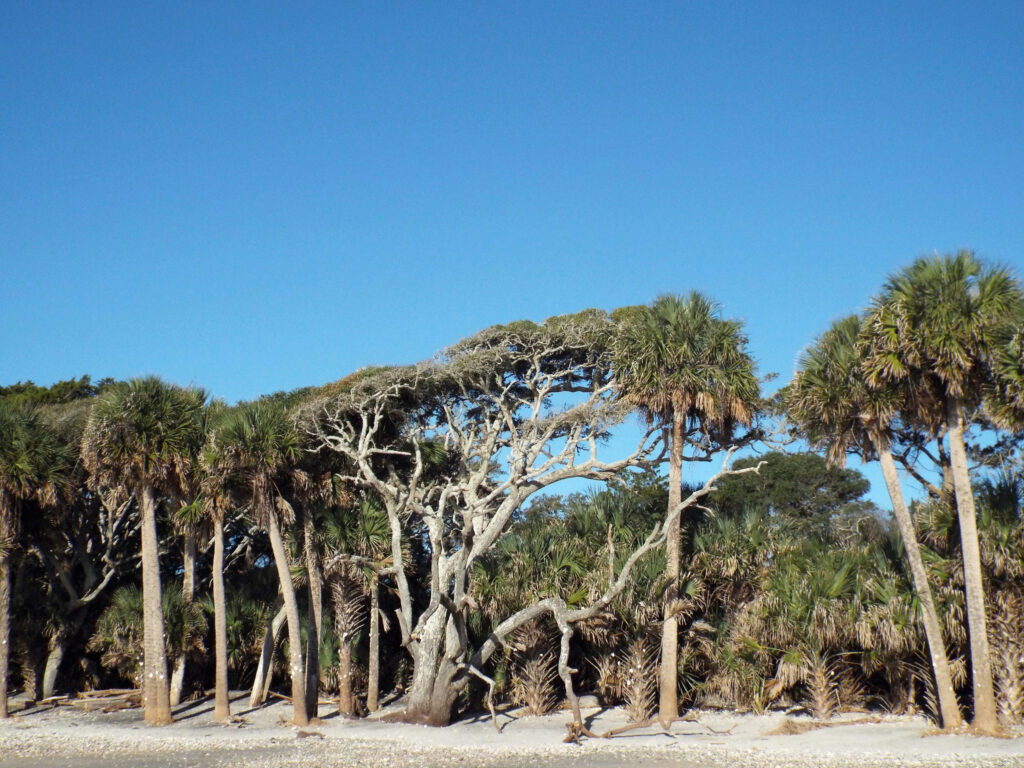
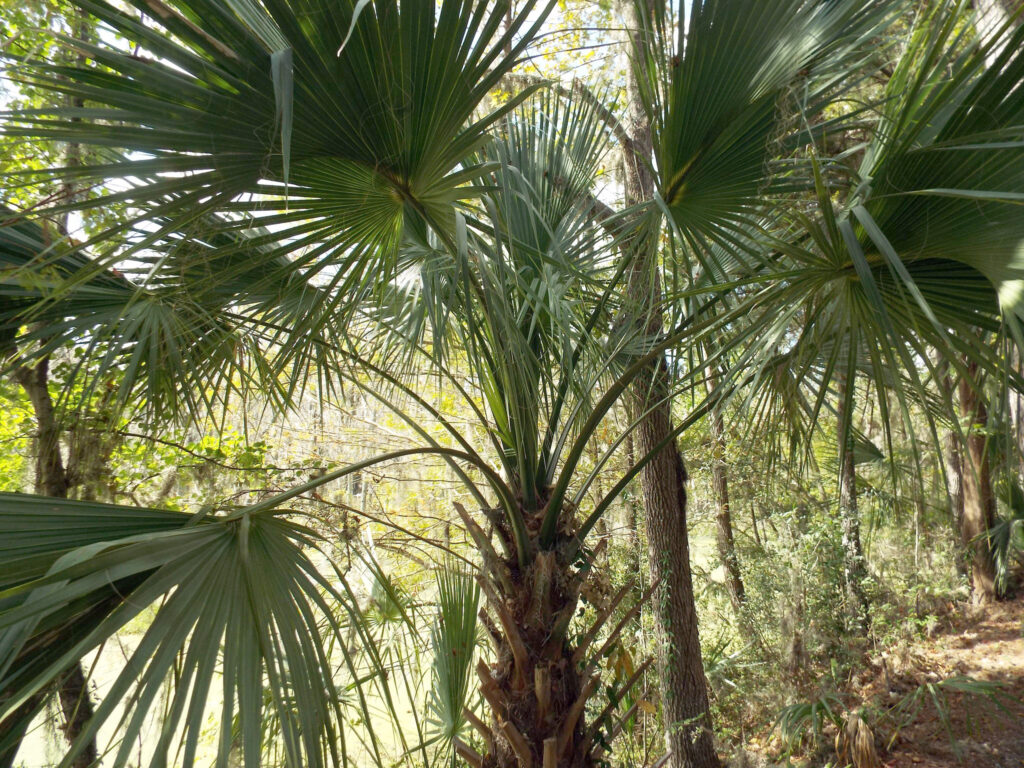
This week for Flora and Fauna Friday, we have our state tree to discuss. This week we’re talking about Palmettos, genus Sabal.
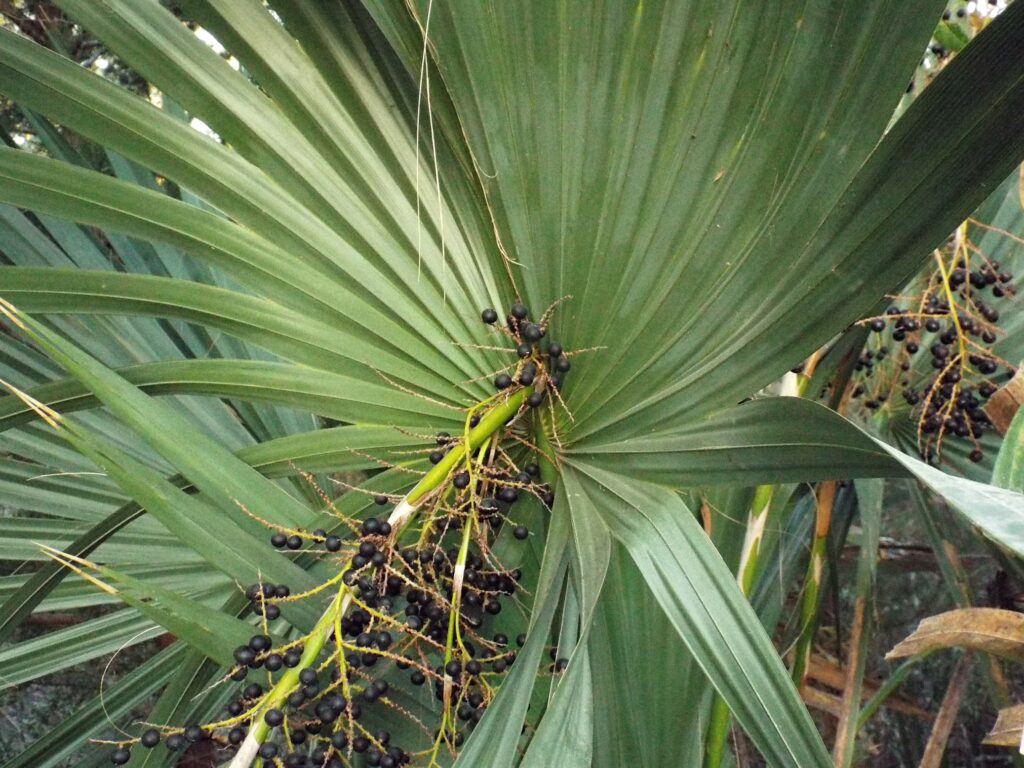
Here on Edisto Island we have two species of Palmetto, the Cabbage Palmetto (Sabal palmetto) and the Dwarf Palmetto (Sabal minor). The plant that’s on our state flag and found across our barrier islands, maritime forests, and parking lots is the more “tree-like” Cabbage Palmetto. A smaller species known as Dwarf Palmetto can also be found here in dense stands through the swamps and floodplain forests. This species rarely produces a visible stem. Young Cabbage Palmettos and full grown Dwarf Palmettos can often be hard to tell apart but there’s a simple trick to do so. The fresh fronds of Cabbage Palmettos produce strings between the segments of the leaf and Dwarf Palmettos do not. Additionally, Dwarf Palmettos are partial to forested wetlands and Cabbage Palmettos prefer barrier Islands and maritime forests. I’ll be talking about Cabbage Palmettos for the most part today.
Cabbage Palmetto is typically a small tree but can reach 30ft in height in ideal conditions. It has a straight fibrous trunk topped with a spherical crown of fronds. Each frond is a single leaf with a divided, circular, fan-like blade. The blade of the frond is connected to the trunk by a woody petiole that forks at the base. As the frond ages and is senesced, the blade breaks off. This leaves behind the forked base, called a “boot.” These boots can stay attached to the trunk for decades or may be shed after only a few years. Our Palmettos flower in late spring, producing a massive flower stalk covered in hundreds of small, cream-white flowers that are irresistible to bees and wasps. Come summer, their fruits, small black drupes, mature and are devoured by Mockingbirds and Raccoons.
Palmettos, like other Palms, are not true trees. They are monocots, just like Grasses, Orchids, Sedges, Lilies, and Onions. As such, Palmettos cannot grow laterally, only vertically. A true tree, like a Pine or Oak, will grow both taller and wider over time and produce a stem made of dense wood. Palms can only grow taller and their stem is a dense column of fibers instead of wood. They also produce a tangled ball of thin roots beneath their trunk rather than the elaborate branching root system of a woody plant. This is because a Palmetto tree only has one massive bud at the top of the plant, from which all leaves are produced. The trunk, which grows one layer at a time, can only be as wide as that one bud. This bud is an edible vegetable called “heart of palm” or “swamp cabbage” but removing this bud will kill the entire tree. So I can’t recommend foraging for it. This peculiar biology of Palm trunks allows the Palmetto to store months’ worth of water inside itself and makes it practically immune to hurricane force winds. The fibrous logs of the Palmetto earned it its place on our state flag. During the Revolutionary War, Fort Moultrie on Sullivan’s Island was critical to the defense of Charleston Harbor. The Fort was able to survive bombardment from the British Navy because it was constructed of Palmetto logs and loose sand. Traditional wooden and tabby fortifications would shatter and crumble under the force. The fibrous logs flexed and absorbed the impacts of the cannonballs, like a natural Kevlar vest.
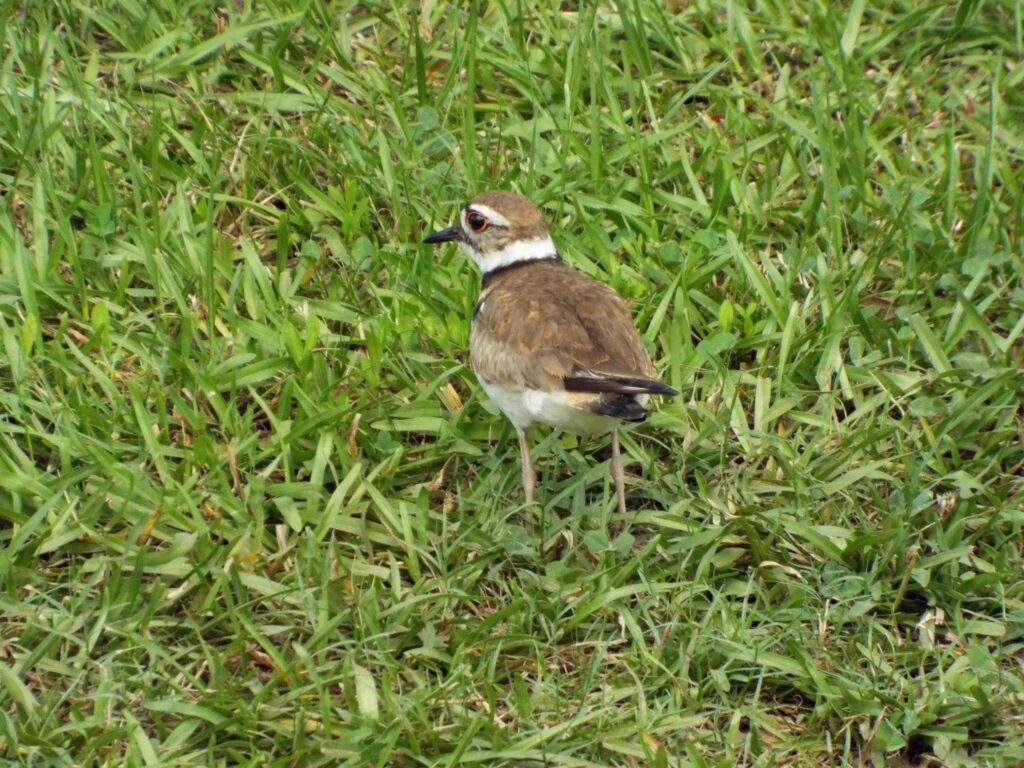


This week for Flora and Fauna Friday we have an onomatopoeia-ic shorebird who’s forsaken the shore in favor of green pastures, the Killdeer (Charadrius vociferus).
The Killdeer is a bird belonging to a group called the Shorebirds. This clade has experienced quite the taxonomic reorganization in recent years so I won’t get into confusing details. Just know that it includes our Sandpipers, Oystercatchers, Avocets, and Plovers. Members of this group are typically found on beaches and marshes. Killdeer are a species of Plover and our largest member of the “Banded” Plovers, genus Charadrius (but markedly smaller than the Grey Plovers, genus Pluvialis). They’re roughly the size of Mourning Doves and have long legs, a rusty-brown back, white belly, two heavy black bands across the chest, and big eyes ringed in red. They primarily eat invertebrates of all shapes and sizes. They get their curious common name from their call, a powerfully shrill, slurred “kill-deer.” A sound that should be as recognizable to the islander as the croaking “ca-ha” of the Fish Crow or the derisive guffaw of the Laughing Gull.
Like other Plovers, Killdeer can be found trotting along the beach, through the marsh, and over the mudflats. However, unlike our other Plovers, Killdeer are habitat generalists and aren’t restricted to the coast. They can be found in open habitat across the state and their staccato scooting can often be seen along lakeshores, farm fields, urban parks, and gravel parking lots. Killdeer are found year-round throughout all of South Carolina and breed across the entire United States. Killdeer nest on the ground in open areas, creating a small scrape to lay their eggs in. They’re partial to gravel lots and roofs but also nest on bare soil and short grass. Nesting out in the open has the advantage of giving the Killdeer total visibility of their surroundings, so they can detect all possible threats. When a predator is observed, Killdeer engage in a unique distraction display called the “broken wing act.” As the name suggests, the parent will move away from their nest and feign an injury, a broken wing to be precise. They will fan their orange tail feathers and frantically flail about on the ground. As the intruder approaches, the bird will string it along away from their chicks, pretending to be incapable of flight the entire time. Once they safely lead the threat away from their kids, they’ll burst off the ground and circle high in the air back around to far side of the clearing.
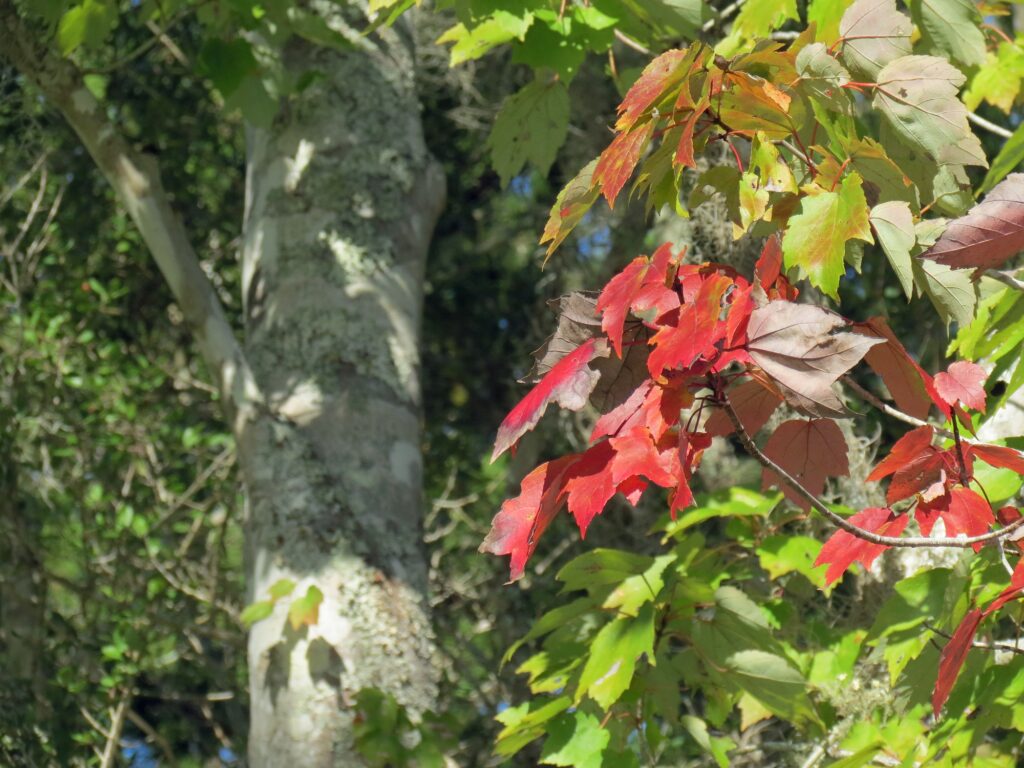
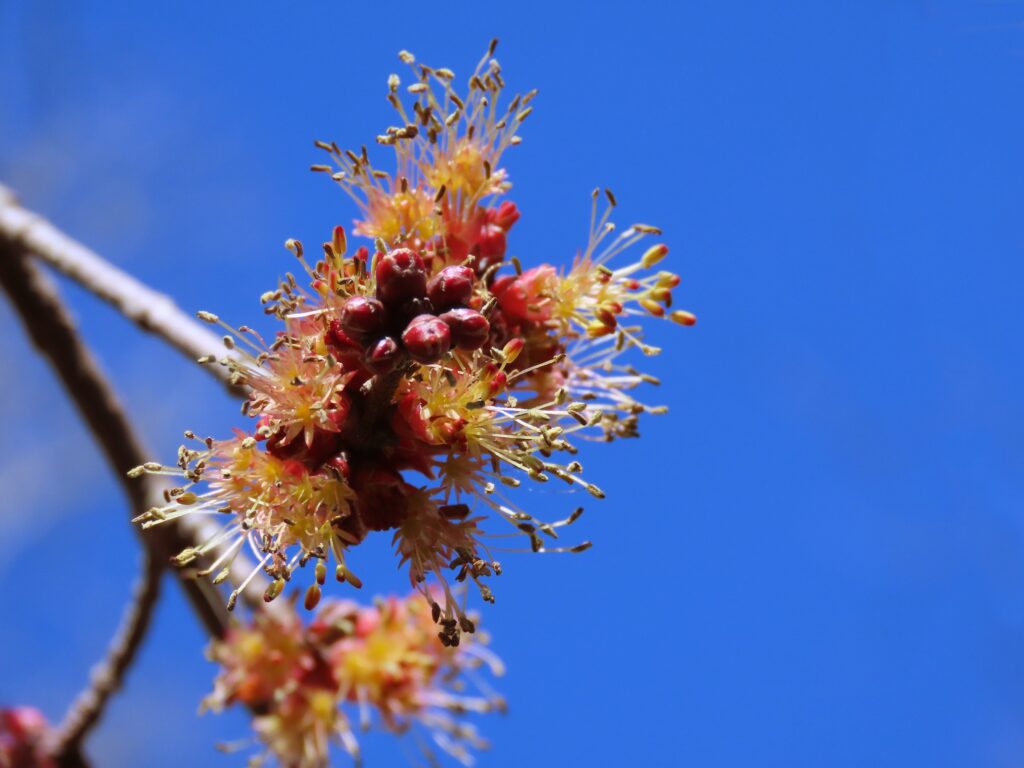
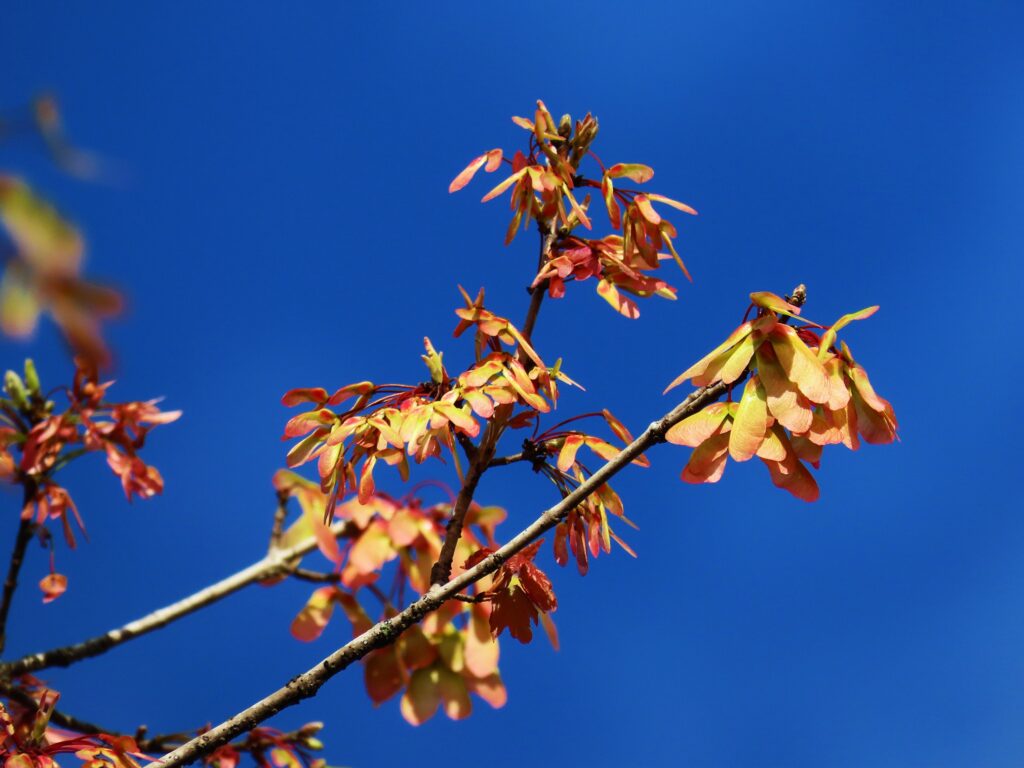
This week for Flora and Fauna Friday, we have a wetland tree that produces some of our first flowers of the new year. This week we’re taking a gander at Red Maple (Acer rubrum).
Red Maple is a common species of tree throughout the southeast. It’s a handsome plant with something for every season. In summer, its verdant green leaves, three or five-lobed and opposite each other, sway in the breeze. The smooth gray-white brindled trunk sucks water from the mucky soil of the wetland it anchors. Those leaves held limply on the limbs brew these murky waters into sugars. Red Maple is a close relative of the Northern Sugar Maple (Acer sacchraum) which is tapped in Canada for making maple syrup. With the onset of fall, the Red Maple produces its namesake display. The weather cools and the leaves redden. The once emerald foliage shifts to golden orange before settling on a scarlet that envelopes the entire crown. This presentation of pigment is only a byproduct of the plant’s built in sunscreen. This red is a mix of anthocyanins and carotenoids. These pigments protect the leaf from solar damage, absorbing the light wavelengths that chlorophyll doesn’t. Carotenoids are yellow and orange. Anthocyanins are red and purple. The leaves of Red Maples are high in both, producing a deep crimson color. During autumn, the tree breaks down chlorophyll and other cellular components in its leaves before dropping them. These pigments then become visible and more anthocyanins are pumped in to guard this botanical salvage operation. As the leaves age further, they dry and are shed. Through the first month of winter the marbled bark and bronzed twigs lay dormant. But in the depths of winter, their blooms break. A burst of soft red and pink erupts. A spray of color that captures the frosty dew. As these flowers fulfil their purpose, the fruits of their labors appear. A one-winged fruit born in pairs. A lime green head that bears a cresting rosy blade. These are samaras, specialized dry fruits built to spin as they fall. This graceful whirl allows the seeds to ride the wing as they float to the Earth. These seeds provide food for birds and rodents, both in the trees and on the ground.
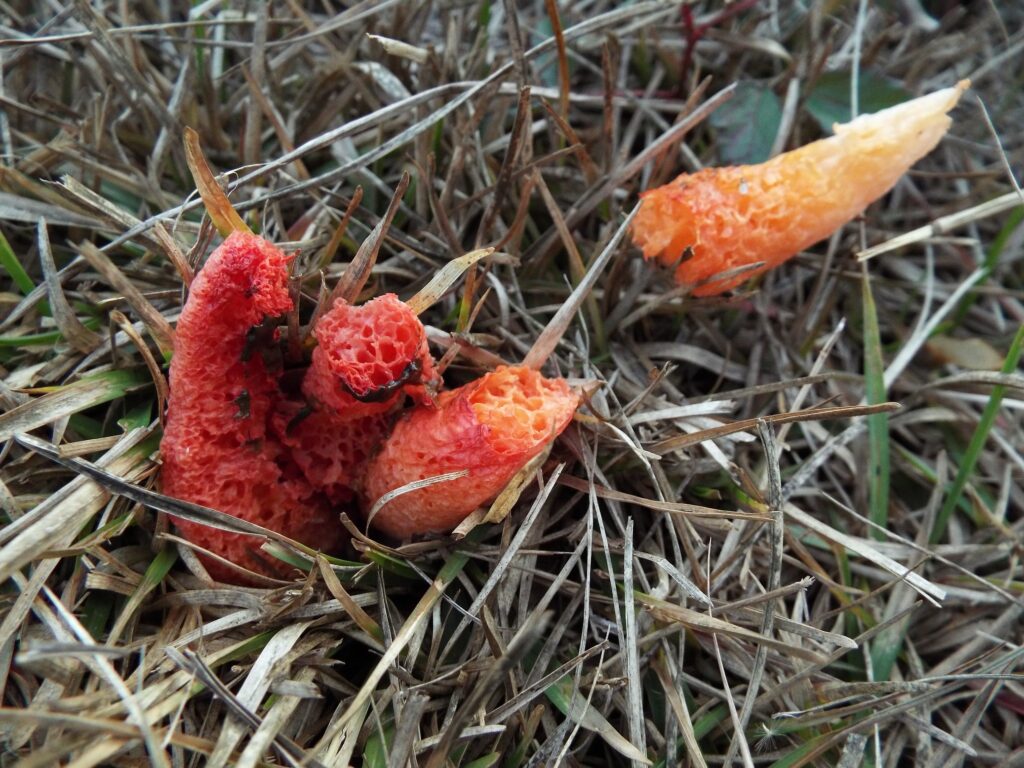
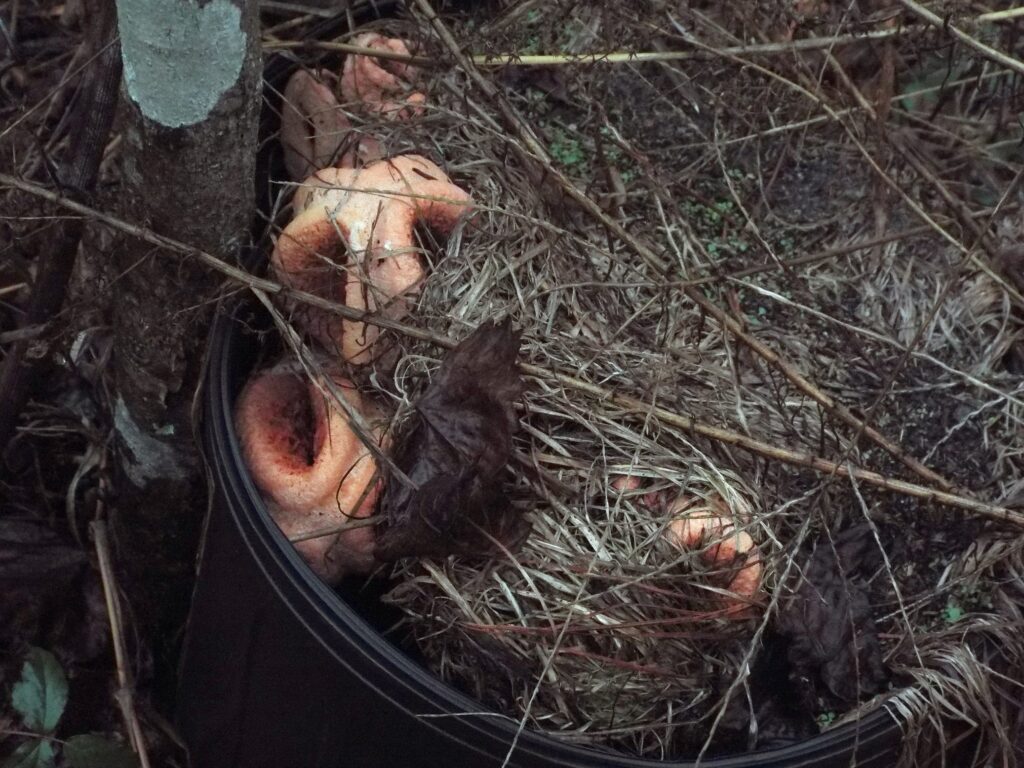
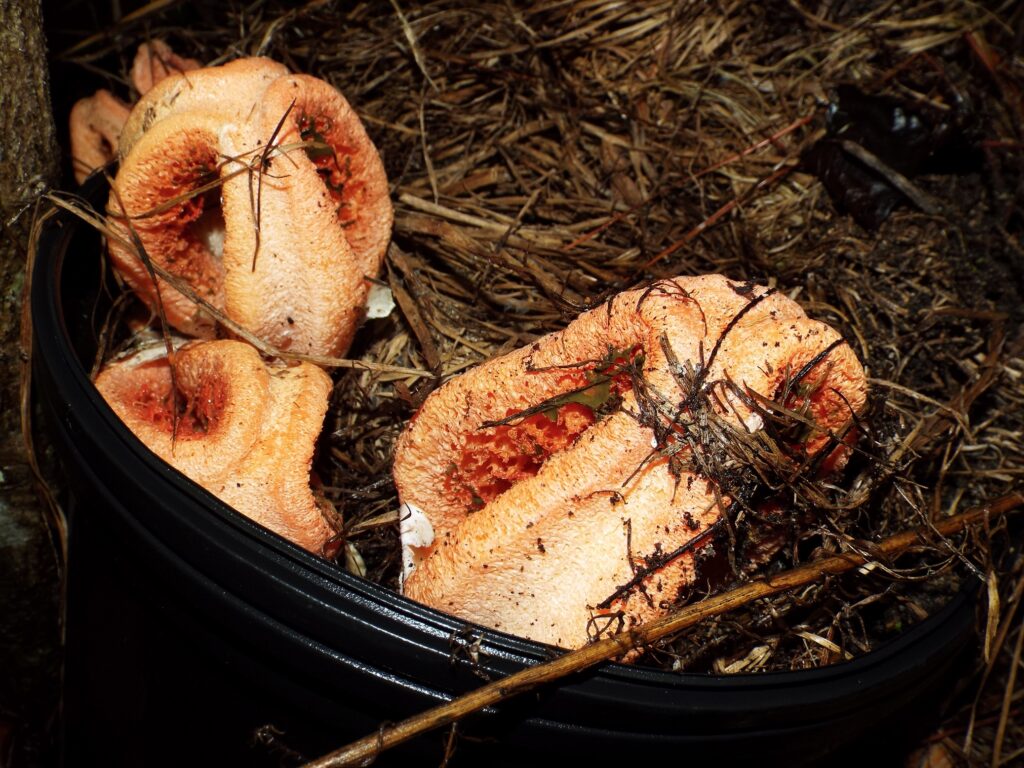

This week for Flora and Fauna Friday, we have a fragrant fungus found from fall to February, the Column Stinkhorn (Clathrus columnatus) also called Buzzard’s-Nose or what I refer to as “the stench of winter.”
Column Stinkhorn is a common fungus in gardens, yards, and fields. It’s a saprophytic species, meaning it feeds on dead organisms. Dead plants in the case of our stinkhorn. It is particularly fond of old mulch. The species is believed to be introduced to North America, as it tends to follow human developments as they spring up around the US. The part of the fungi you see is the fruiting bodies that we refer to as mushrooms. Mushrooms are a fungus’ version of a plant’s flowers. Except mushrooms yield spores instead of pollen or fruit. The main body of the fungus lies beneath the ground, spreading through the top soil. Like roots without a trunk.
Column Stinkhorn is a member of the Stinkhorn family, Phallaceae. Members of this family all share the traits of being saprophytic, smelling terrible, using insects to disperse spores, and producing a spongy mushroom. Members of this family produce mushrooms whose appearances range from unsettlingly demonic to geometrically elaborate to just plain vulgar.
The mushroom of the Column Stinkhorn is distinct, both in its appearance and its scent. Stinkhorns are one of many fungi that produce mushrooms shrouded in a structure called the universal veil. This is a thin white membrane that envelopes the mushroom as it develops. These immature mushrooms resemble clusters of eggs poking through the dirt at first. As the mushrooms mature, they split the veil and take their final shape. The remnants of the veil form a cup-like shape at the base called a volva. Column Stinkhorns produce three pink-orange columns joined at the top to create a three-legged arch. The flesh of this mushroom is spongy and porous. At the top, inside the arch, it exudes a green-brown slime that reeks of musky rotten flesh. This stink is not without a purpose though. Instead of driving all animals away, it draws the smallest ones in. This slime is sticky and filled with fungal spores. Spores are like a fungus’ microscopic seeds. The scent attracts flies and beetles looking for an animal carcass. As the insects clamber around our Stinkhorn, they become coated in this spore soaked slime. When they depart, they carry these spores with them. Potentially depositing them in the right habitats for our wee fungi.
This week for Flora and Fauna Friday, we have a genus of edible evergreen vines that’re every bit as stubborn as they are thorny. This week we’re talking about the Greenbriers, genus Smilax.
Greenbriers used to belong to the Lily family but have since been placed in their own, Smilacaceae. This is a group of plants that I’m sure all you gardeners and landscapers on the island are well acquainted with. There are eight common species in our area. All these common species share the traits of being woody vines with simple evergreen leaves. They climb with tendrils, grow starchy rhizomes, bear small clusters of pale-green flowers, and produce small dark berries. These berries are an important food source for birds in the winter months. Members of this genus were also an important food source for Native Americans. The new shoots in spring are edible raw and, I can tell you from firsthand experience, taste like a mix between asparagus and Japanese matcha tea. The young tubers are also edible when cooked and are full of starch.
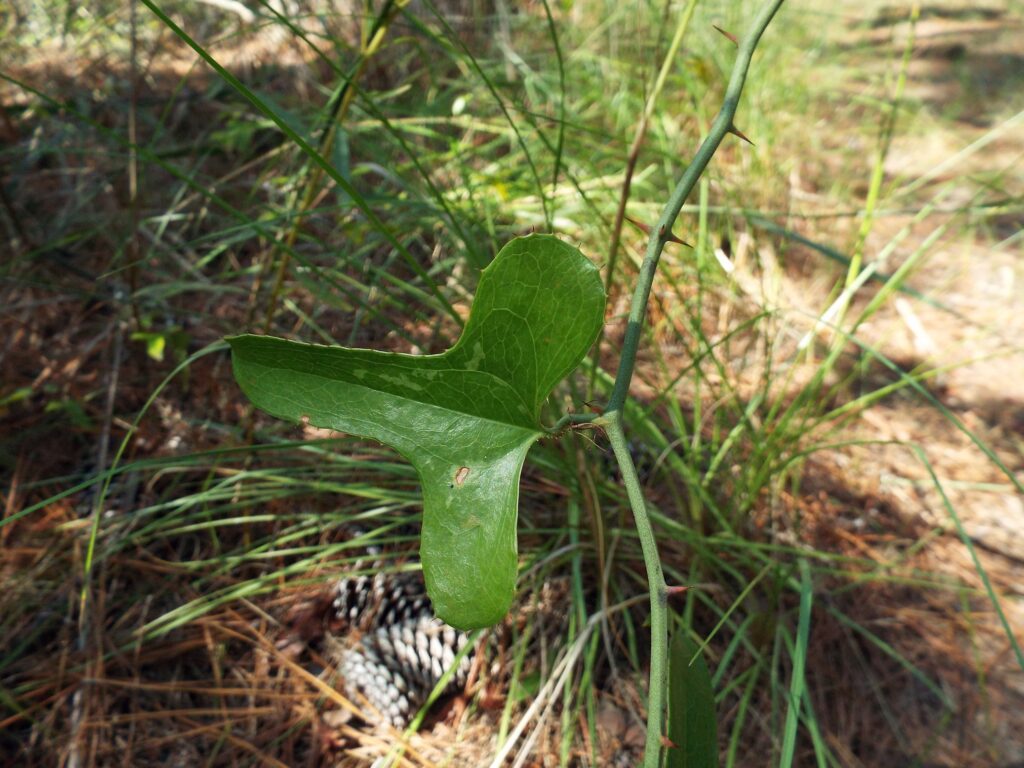
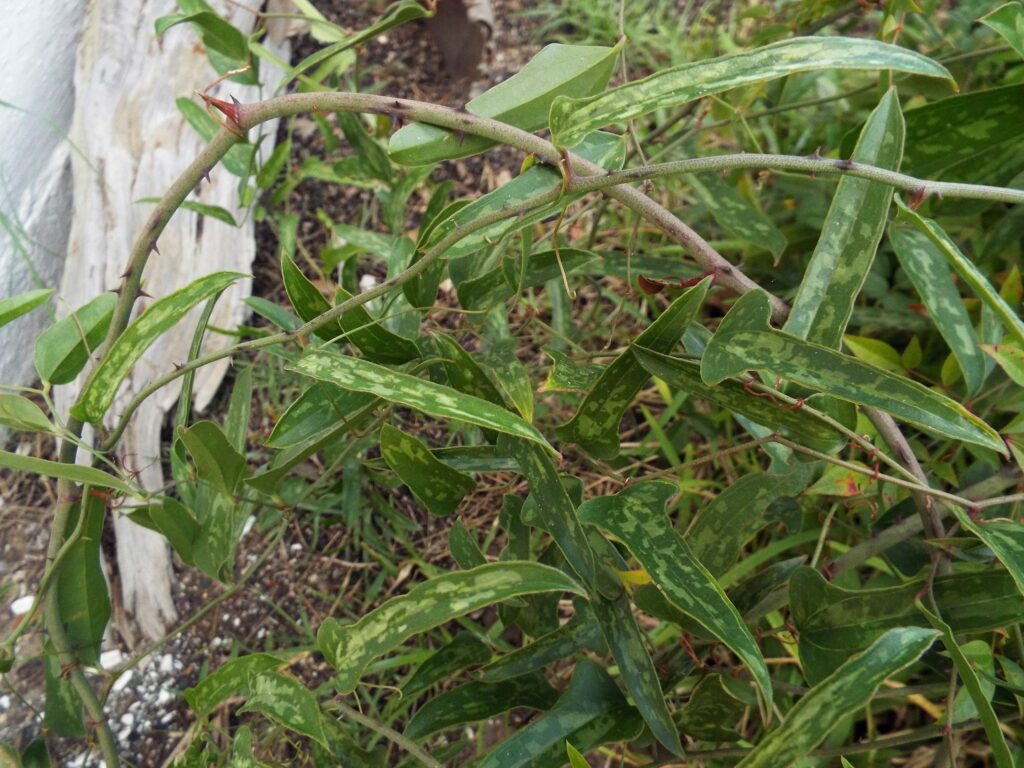
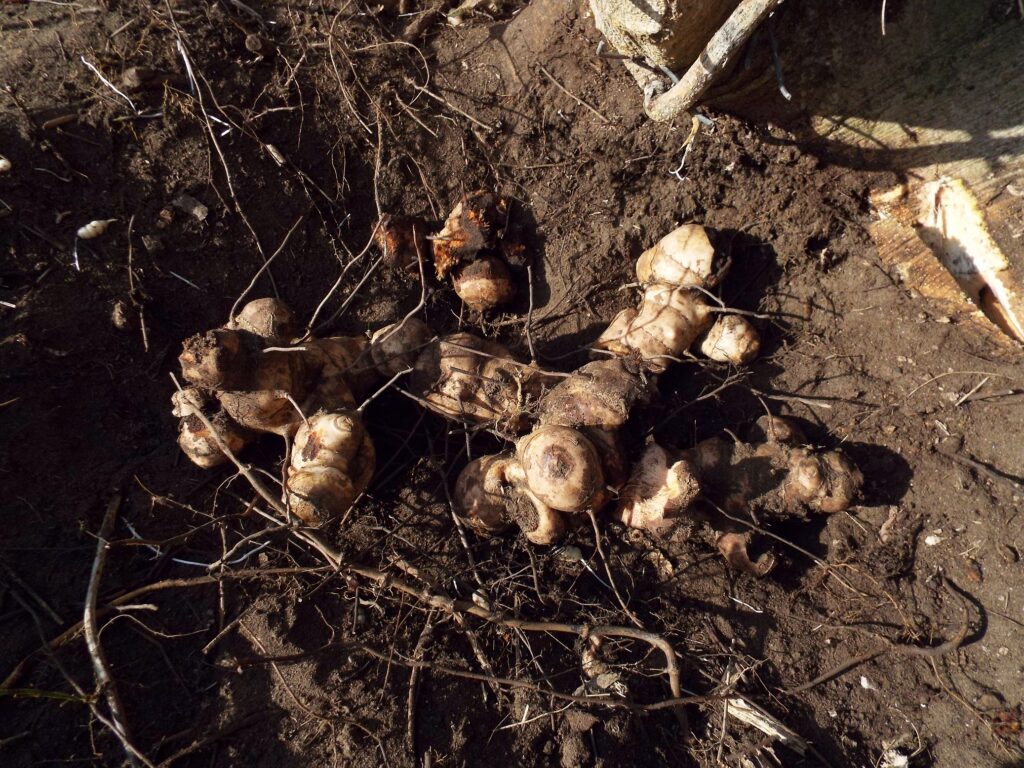
Sawtooth Greenbrier (Smilax bona-nox) is the most common species you’ll encounter inland. It’s also one of the easiest to identify. This species sports a signature margin of spines along the edge of its leaves. Its stem is encircled with stiff thorns up to half an inch long. These thorns protect the vine from girdling by deer and other herbivores. Sawtooth Greenbrier, and a few of the other species, produce a massive clump of branching rhizomes beneath the soil. These rhizome networks can reach several feet in diameter and weigh dozens of pounds. (The one pictured is a small section of a rhizome that filled a five-gallon bucket after I dug it up!) These rhizomes allow the plant to withstand drought conditions and, if need be, regenerate after it is cut or broken. I’ve seen shoots exceeding two inches in diameter at the base (imagine a thorny shovel handle) that came from rhizomes that might be over a hundred years old!
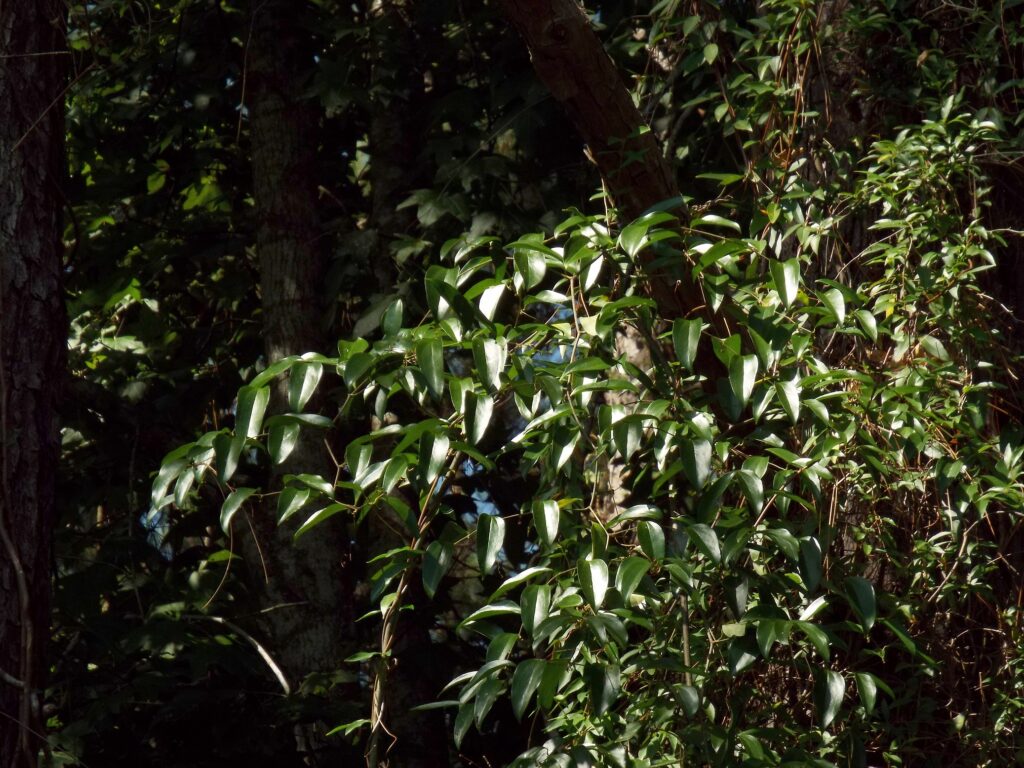
Another common inland species is Lanceleaf Greenbrier (Smilax smallii). Lanceleaf Greenbrier is the highest climbing species of Greenbrier in our area and can climb 40ft high into the tree canopy. It has shiny green, slightly triangular leaves and very few thorns on its stem. Laurel Greenbrier (Smilax laurifolia) is very similar to Lanceleaf Greenbriar in many respects but has thinner, more light-green leaves and prefers growing on top of bushes in sunny thickets or forest edges.
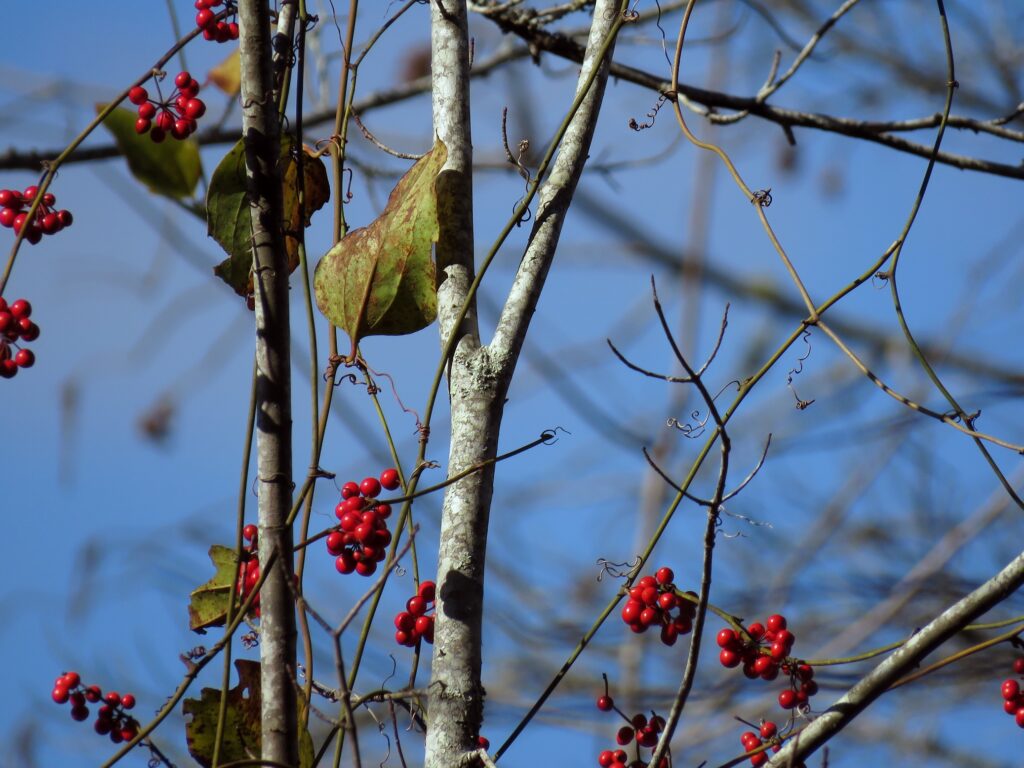
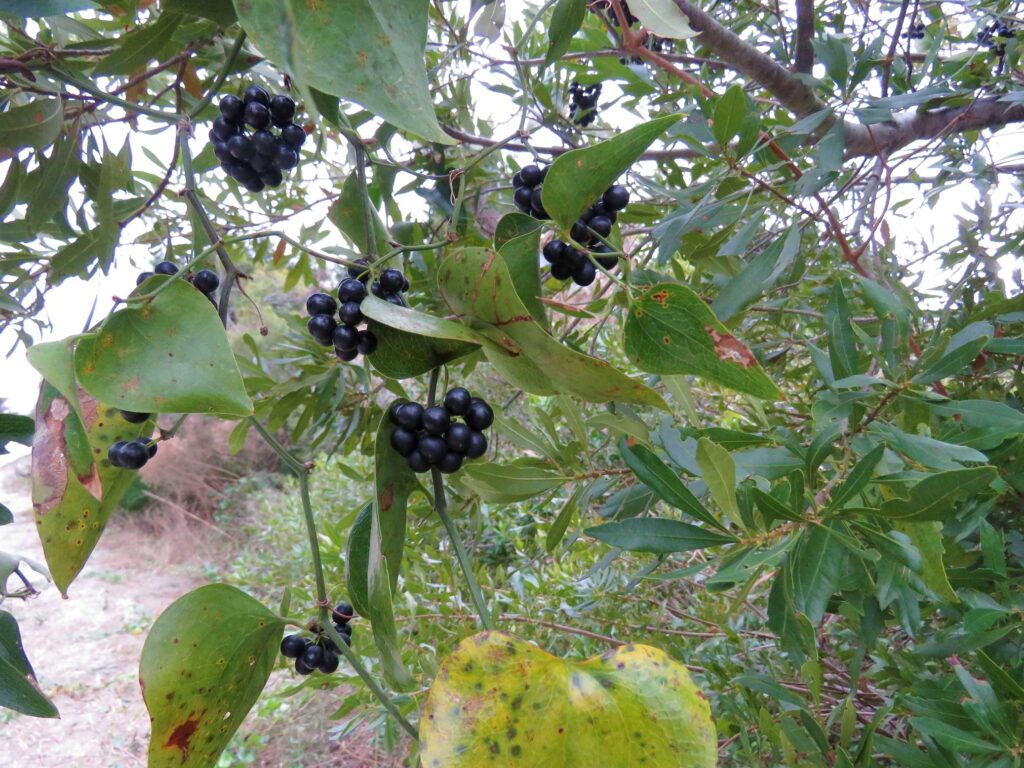
Coral Greenbrier (Smilax walteri), Roundleaf Greenbrier (Smilax rotundifolia), and Cat Greenbrier (Smilax glauca) are also common in wooded habitats. These species vary in their degree of thorniness and all possess large leaves but have berry colors distinct from one another. Coral Greenbrier is best identified by its preference for wetlands and brilliant red berries in winter. Roundleaf Greenbrier is characterized by its large, almost circular leaves when growing in shady habitats and dark, black-blue berries. Cat Greenbrier is similar to Roundleaf Greenbrier but layers a powdery blue-white veneer across its berries and the undersides of its leaves.
Earleaf Greenbrier (Smilax auriculata) is found most often in sandy soils near the coast or on sand dunes and hammock islands. Its leaves sport a pair of “ears” at the base that give them an arrowhead-like appearance. Earleaf Greenbrier, along with other dune species, help to protect the dunes from erosion by holding soil with its roots and trapping wind-blown sand. This species is just as savagely armed as Sawtooth Greenbrier and has a particularly tough stem.
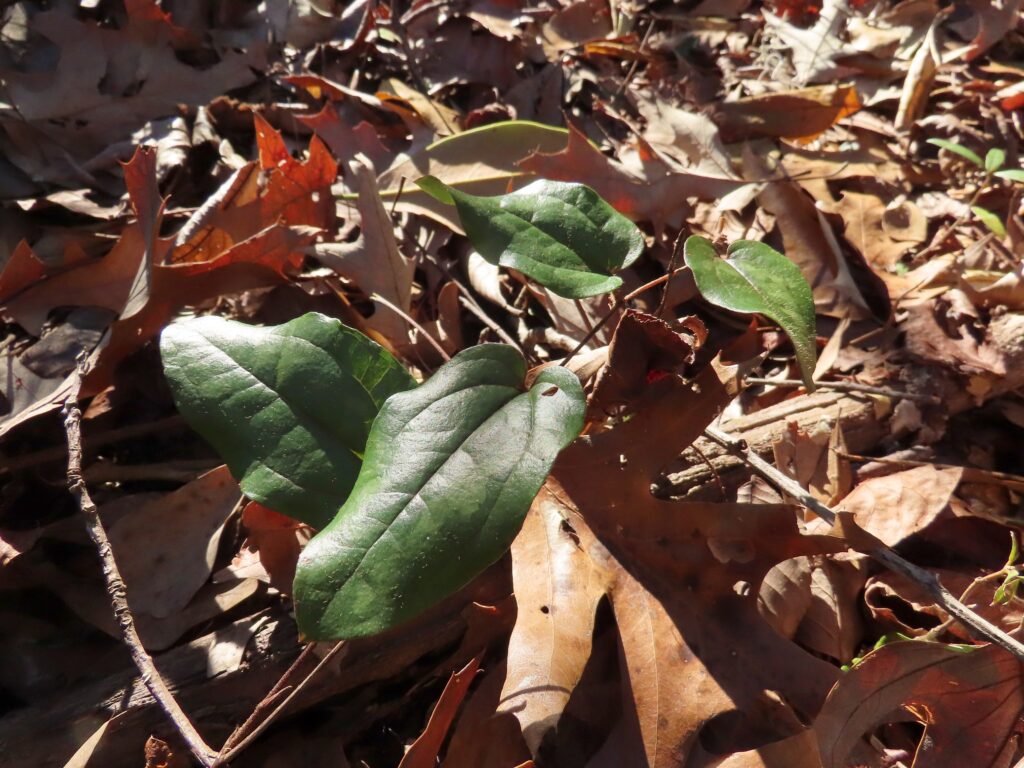
Sarsaparilla Vine (Smilax pumila) is unique from the other species I’ve talked about so far. It is small, thorn-less, grows low to the ground, and prefers to grow in shaded forest understories. This species, along with several others in the genus, are the plants that the root beer Sarsaparilla was traditionally made from. This species is best recognized by its wrinkly leaves with a rusty hue and a coat of fine hairs. Their spherical clusters of inconspicuous yellow flowers produce small, red, oblong berries.
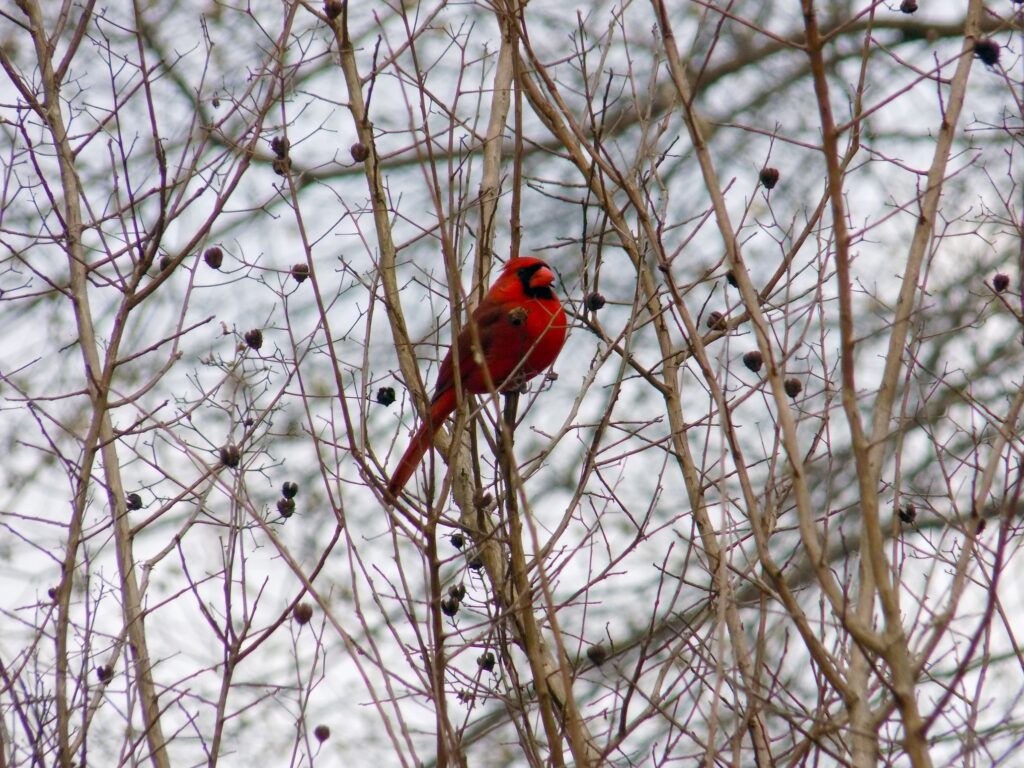


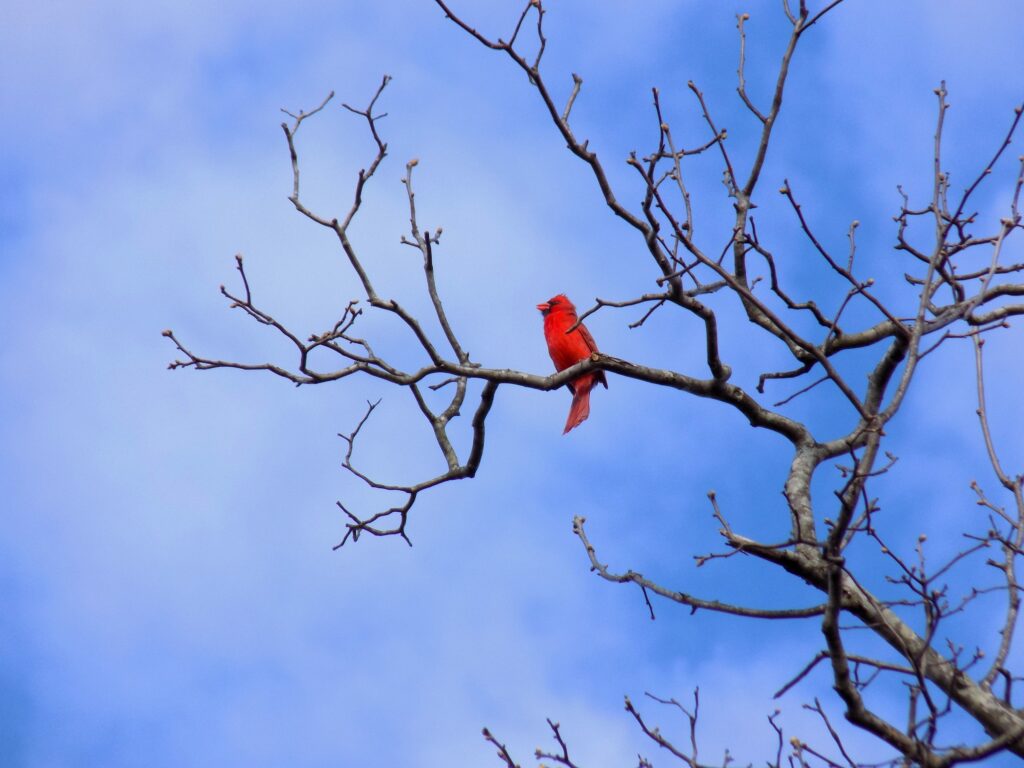
This week for Flora and Fauna Friday we have the unmistakable, unavoidable, scarlet songbird known throughout the eastern US. A bird that needs no introduction but will receive one anyway, the Northern Cardinal (Cardinalis cardinalis), or known more simply as the Cardinal or Red-bird.
Cardinals are an easily recognized, widespread species found in yards, brush, wood edges, and hedgerows from Maine to Minnesota to Guatemala. They don’t migrate and can be found throughout most of their range year-round, whether braving the winter or enjoying the summer. Male Cardinals are a deep, pure red and females a warm orange-brown with subdued garnet wings and tail. Both sexes sport a bold orange bill and black beard with a prominent crest to the head. They’re generalists, eating seeds, insects, worms, fruits, and nuts. Their stout bill allows them to take advantage of heavy seeds and the harder nuts to crack but it doesn’t limit their ability to eat softer, wrigglier foods. Cardinals are no strangers to bird feeders and regularly visit these seed dispensaries across this half of the continent. Like many feeder birds, they prefer sunflower seeds and enjoy suet. Males and females mate for life and are rarely far apart from each other. Males are territorial and can often be seen fussing at each other around feeders or singing 20 feet or more up in the trees each morning to stake their claim with the neighbors. Cardinals get their name from the male’s plumage. His scarlet feathers are the same shade as the robes and caps worn by the Catholic Cardinals.
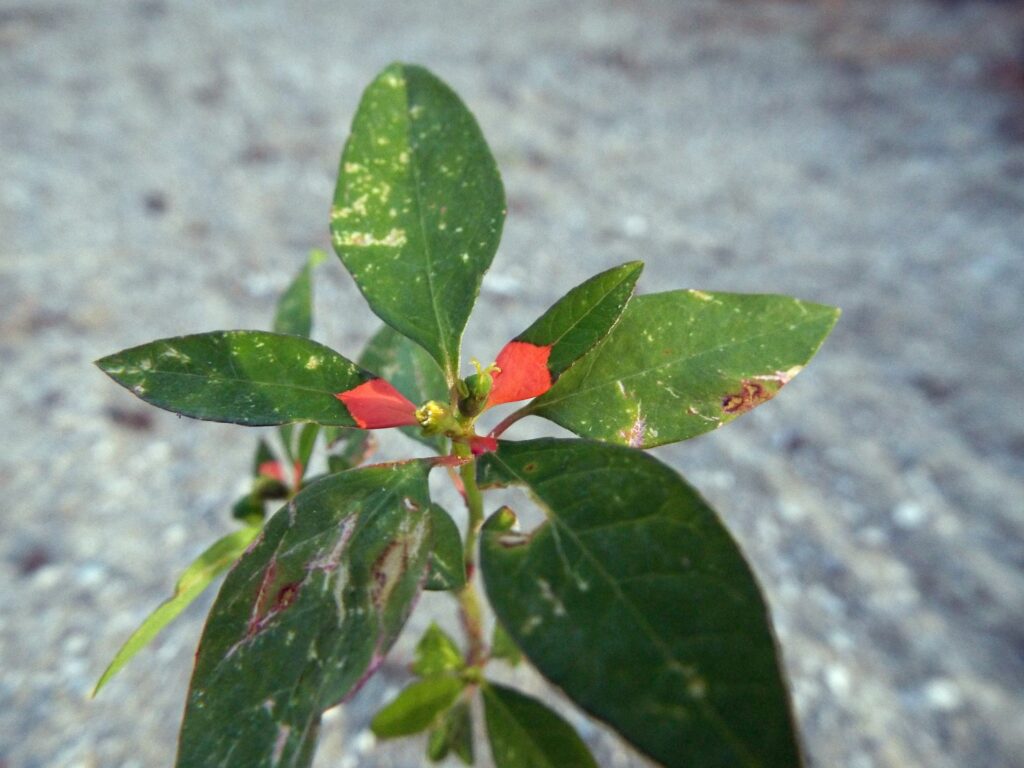
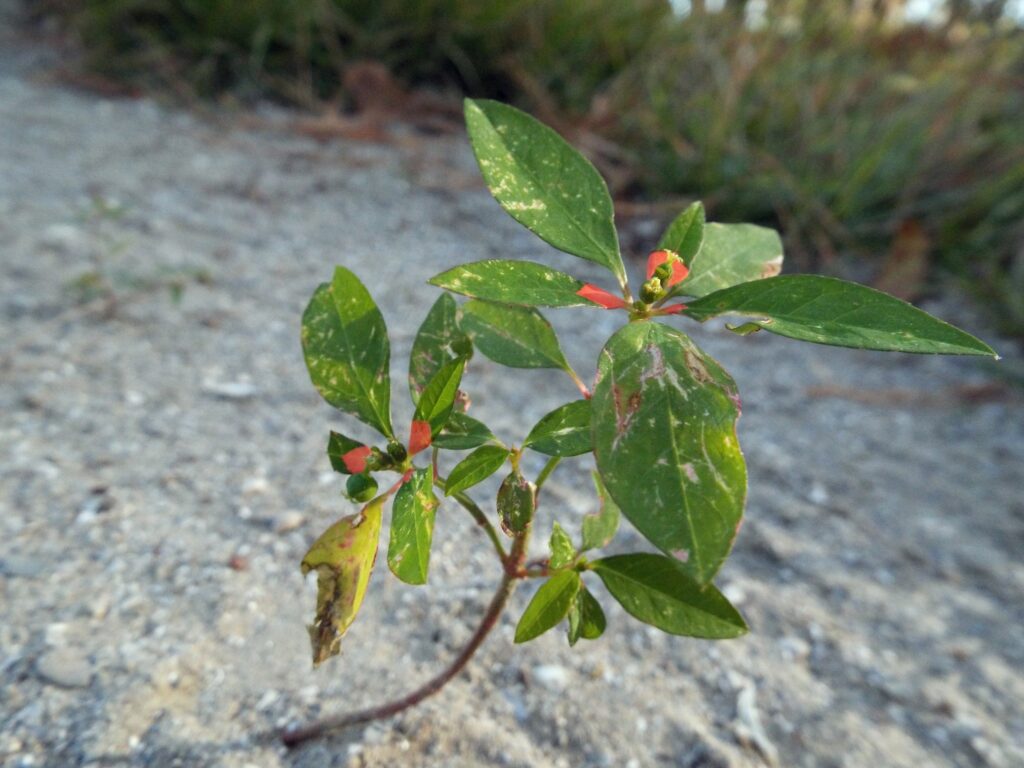
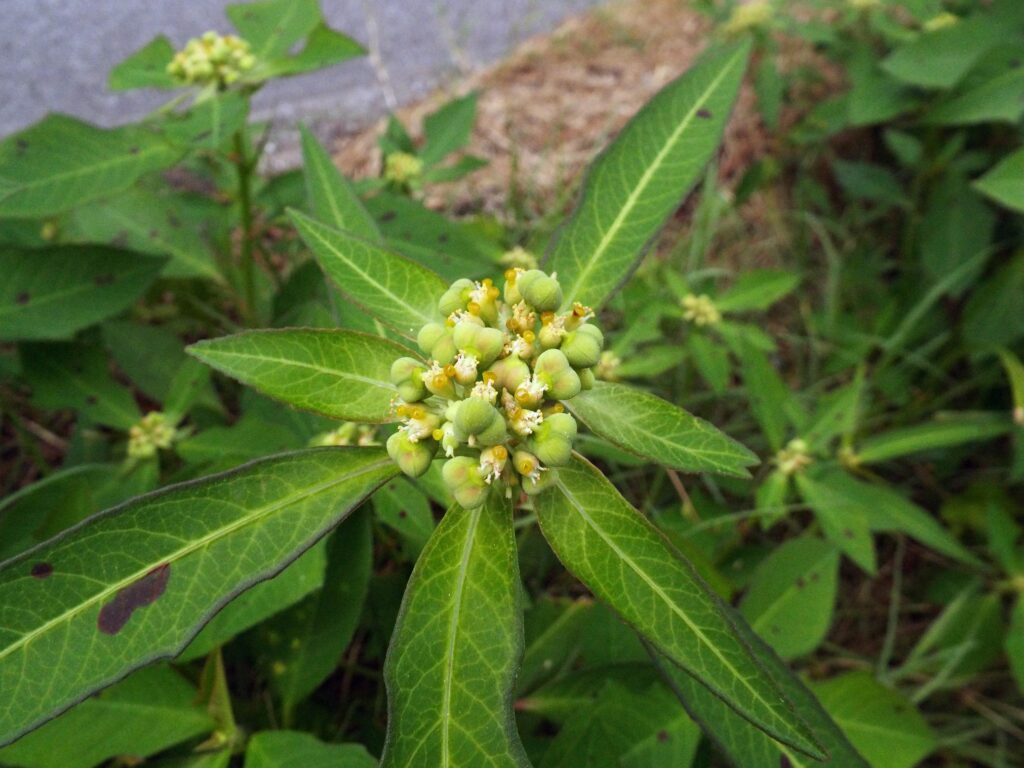
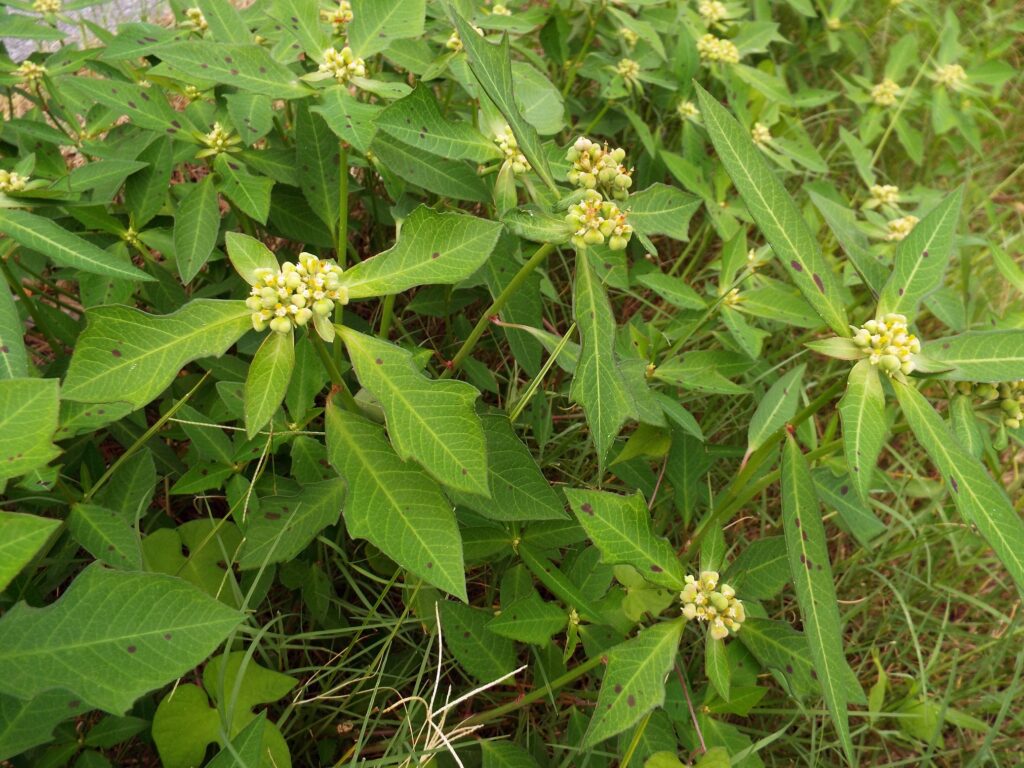
‘Tis the season for Flora and Fauna Friday because I have our native relatives of the crimson tropical trimming on display this holiday. This week we’re talking about Mexican Fireplant (Euphorbia heterophylla) and Fire-on-the-mountain (Euphorbia cyathophora), both who go by the name Wild Poinsettia.
Mexican Fireplant is a low-growing annual plant with large alternate leaves of variable shape. It’s in the same genus as the tropical ornamental Poinsettia (Euphorbia pulcherrima). It blooms in late summer producing a cluster of small, inconspicuous flowers above a ring of bracts, flecked with spots of red and a tinge of pink. Fire-on-the-mountain has more impressive crimson coloration to the bases of its bracts. It’s life history is much the same as Mexican Fireplant but with a greater tolerance for shade.
What’s interesting about the flowers of Poinsettias is that there are multiple layers of imitation going on. The red leaves of Poinsettias are bright, colorful, and draw in pollinators like petals but they’re not petals. They’re regular leaves modified to be colorful. So where are the petals? If you look closely at the central cluster, you’ll notice several pale yellow structures that look a lot like petaled flowers. However, the color you see is not the flowers themselves. Rather, they’re parts of a complex compound flower unique to the Euphorbiaceae family called a cyathium. The actual flowers are unisexual and lack both petals and nectar! The pale yellow structures that resemble petals are again modified leaves called bracteoles. Outside of these bracteoles you may notice a golden funnel shaped structure. That’s a nectar gland. Its sole function is to produce nectar for pollinators. The flowers themselves are located in two places. The tiny white stalks with two pink discs on the end are the male flowers. The three-sided lumpy ball hanging out of the middle of the male flowers is the maturing seed capsule and that small cone on the other side is the female flower. The cyathium is truly odd and unlike the flower of any other plant family. The next time you see a Poinsettia, appreciate the weirdness that makes it as beautiful as it is!

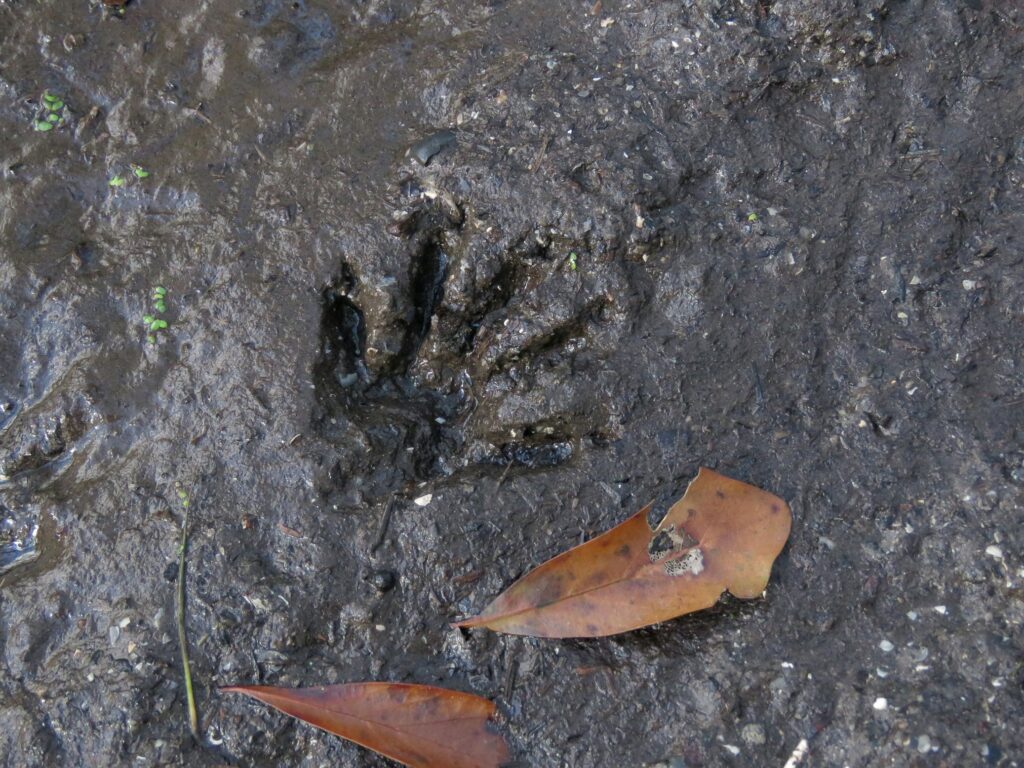
For Flora and Fauna Friday this week we have the banded bandit of the woods in our custody. No, that’s not Santa coming down the chimney it’s the Common Raccoon (Procyon lotor).
The Raccoon is an intelligent, dexterous, omnivorous, nocturnal, highly-adaptable, generalist mammal found throughout the US and Mexico. They are found in practically every habitat in the state, from barrier islands to mountain forests to bottomland swamps to the middle of the city. The average Raccoon here in the south is roughly the size of a house cat and weighs about 10 to 15 pounds. Their coat is a dark grayish-brown with a fluffy tail ringed by black bands. They have a black mask across their eyes and a pale gray snout, brow, and muttonchops. They have plantigrade feet, so their tracks look like little handprints. They belong to a small family, Procyonidae, that is most closely related to Bears and Weasels.
Raccoons have an interesting habit of dipping their food in water and rolling it around in their hands called “dousing”. The behavior looks like their washing their food but that’s not actually the case. In fact, biologists aren’t fully sure why they do this but believe it helps them soften their leathery paws and better feel the texture of what they caught. They primarily douse when hunting aquatic animals and won’t bother dousing if there’s no standing water around. Raccoons have long limbs, dexterous paws, and short stiff claws that make them excellent tree climbers. Climbing a tree is a Raccoon’s primary defense against predators. They also sleep through the day in a tree hollow or the crook of a tree limb. Raccoons are most active at night where they patrol their territory hunting frogs, fish, fiddler crabs, bird eggs, and crawfish and eating any berries, nuts, or seeds they may find. They will scavenge carrion too and raid farm fields for vegetables. In urban areas, they also pilfer bird feeders, steal pet food, and scavenge from trash cans. Raccoons are known for their intelligence and studies indicate that they’re as smart as some of the lesser primates. Their intelligence and dexterity, combined with their omnivorous diet, makes them highly adaptable. They’re one of a few native species that have taken to urban life with a shine. They can quickly learn how to undo latches, open closed containers, scale buildings, and remember who in your neighborhood feeds an outside cat, has a fig tree in their backyard, throws out half eaten pizza, or has a hole in their attic.
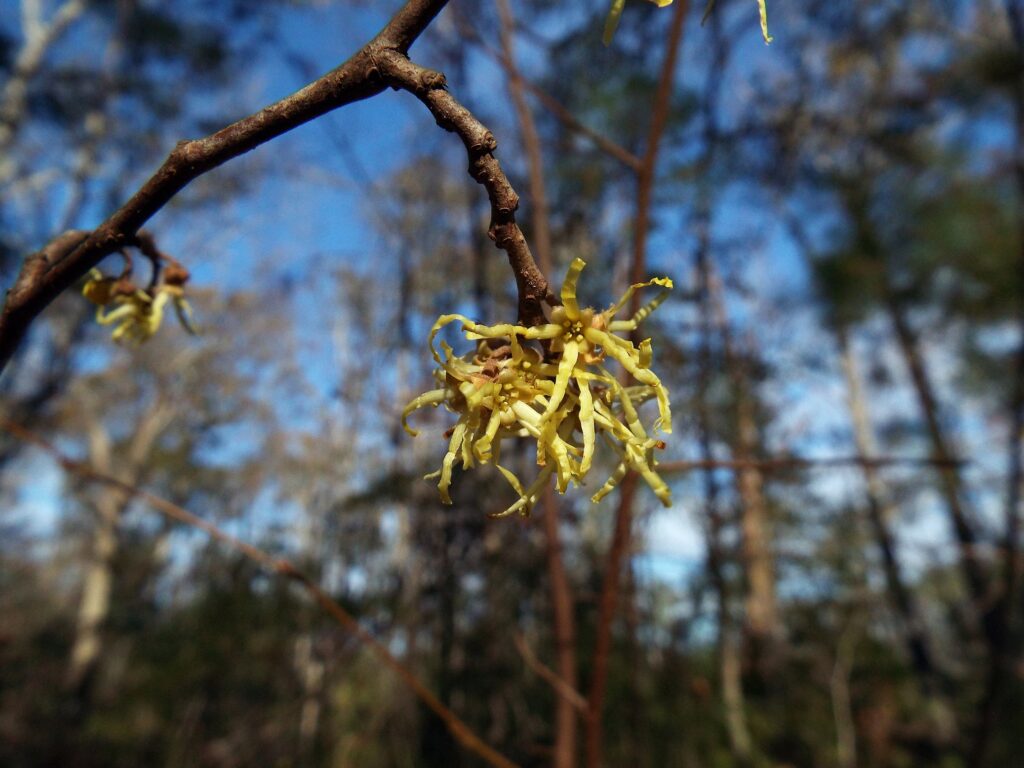
This week for Flora and Fauna Friday, we have an explosive and medicinal shrub that can be found flowering in the winter woods. This week we’re talking about American Witch-hazel (Hamamelis virginiana).
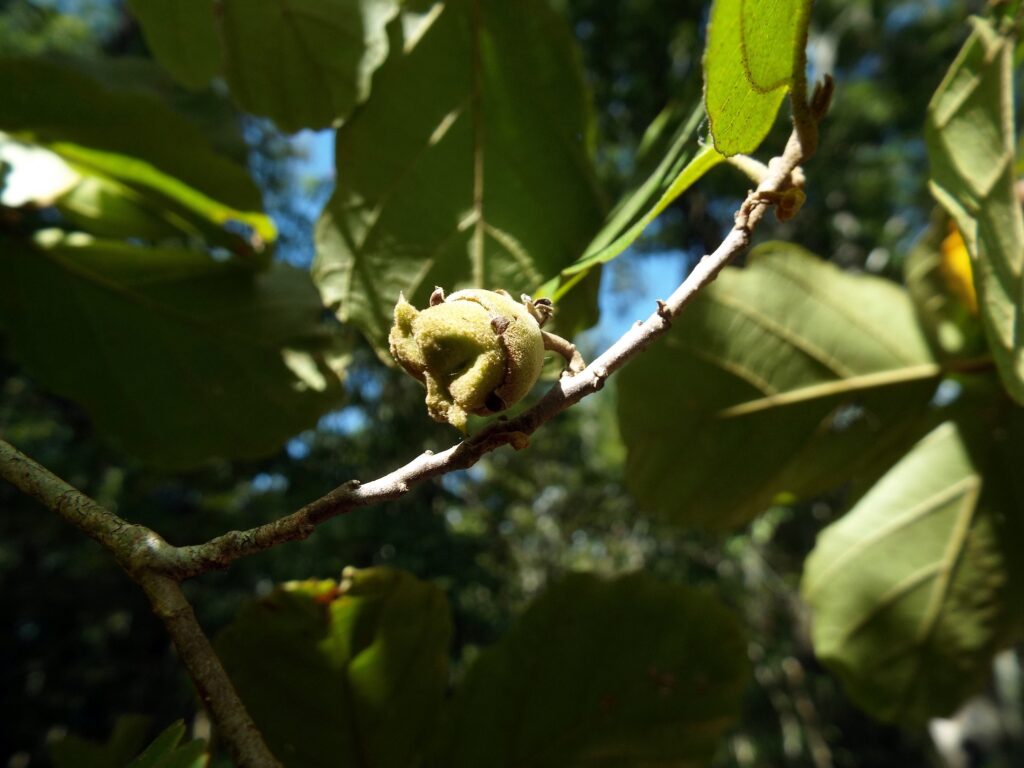
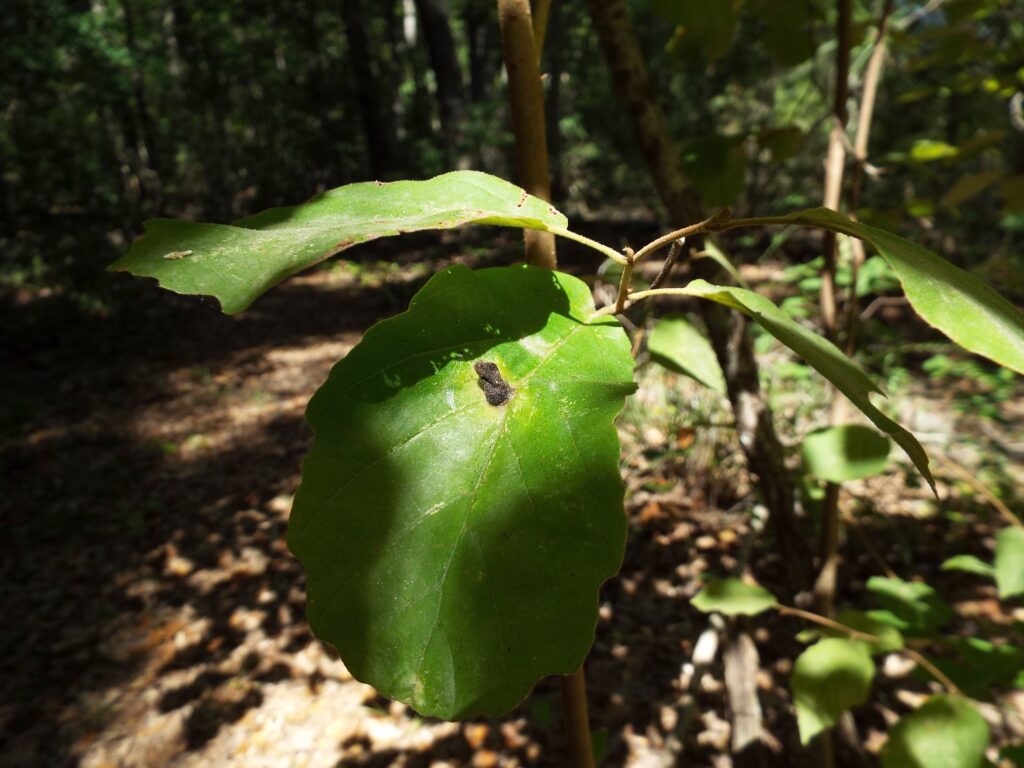
Witch-hazel is a large open shrub that grows in the understory of hardwood forests. It has fairly large, oval-shaped, deciduous leaves with a crenate (scalloped) margin. Its bark is thin with a light tan to gray color. Witch-hazel blooms in late Fall and here on the coast it’s one of the last plants to flower. The flower is fairly small with four pale-yellow and curly, ribbon-like petals. The fruit is a capsule with four bumps on top, like the scores in a loaf of bread, that cradle the two seeds within. Many of you likely know of Witch-hazel from its medicinal applications. Witch-hazel bark, stems, and leaves can be boiled to extract astringent compounds that can contract the skin and help relieve mild skin irritation. However, most modern concoctions are lacking in this traditional plant derived astringent.
Witch-hazel fruits remain on the shrub for a full year. Come autumn, they undergo an amazing process. The walls of the fruit grow asymmetrically at the cellular level. As it dries, this causes the wood of the fruit to bend outward. The water pressure from living cells is no longer there to retain the shape. These fruits are dehiscent too, meaning they have natural seams to allow the fruit to split as it dries. Neither of these two features are especially unique in the plant word and many species can do both. What is unique are the extremes to which Witch-hazel takes them both and the result it produces. The seams of this fruit are particularly strong and the asymmetry even stronger. As the fruit dries, the walls of the capsule put more and more pressure on the seams, creating a natural spring-loaded cannon. The spring pressure increases until a gust of wind, beam of sun, or some other disturbance causes a seam to fail and the whole fruit to split apart with an audible snap, kicking the seed out from the bottom in the process. This is called “explosive dehiscence” and it can throw the centimeter-long Witch-hazel seeds up to 30 feet!
It wouldn’t be Flora and Fauna Friday without me playing the explain the name game. So where does Witch-hazel get its interesting common name? It’s not that exciting. The plant looks similar to the true hazels, which produce hazelnuts, and “witch hazel” simply means “pliable hazel” in Middle English. However, a more interesting and completely false interpretation that I’m going to tell you anyway is that it comes from the galls that a certain species of aphid produces on its leaves. The Witch-hazel Cone Gall Aphid (Hormaphis hamamelidis) lays its eggs on the leaves of Witch-hazel. These eggs hatch into larvae that secrete chemicals into the tissue of the leaf. This tissue induces an abnormal growth on the leaf surrounding each larva. The larva feeds on the regenerating tissue inside of this growth while safe from the elements. This growth is called a gall and it’s a parasite’s way of fooling a plant into feeding its offspring. The galls of the Witch-hazel Cone Gall Aphid are conical in shape and poke out from the top of the leaf. This gives the leaf a shape similar to a witch’s hat, except with an over exaggerated brim width. That etymology isn’t true but I wanted an excuse to talk to about leaf galls.