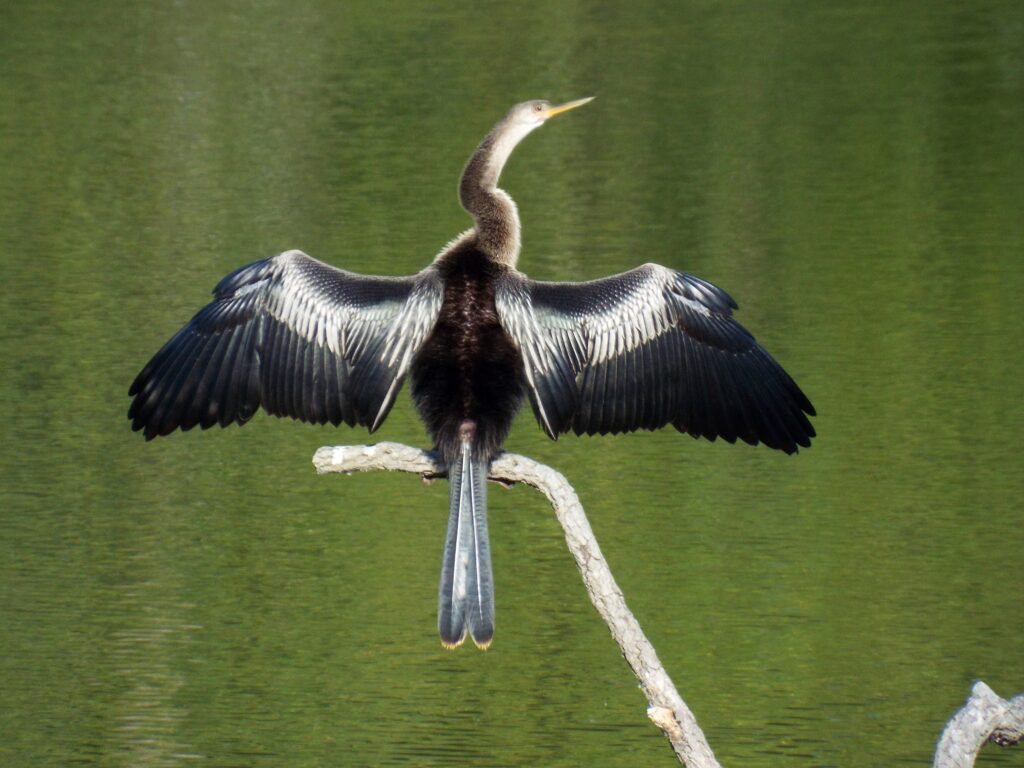
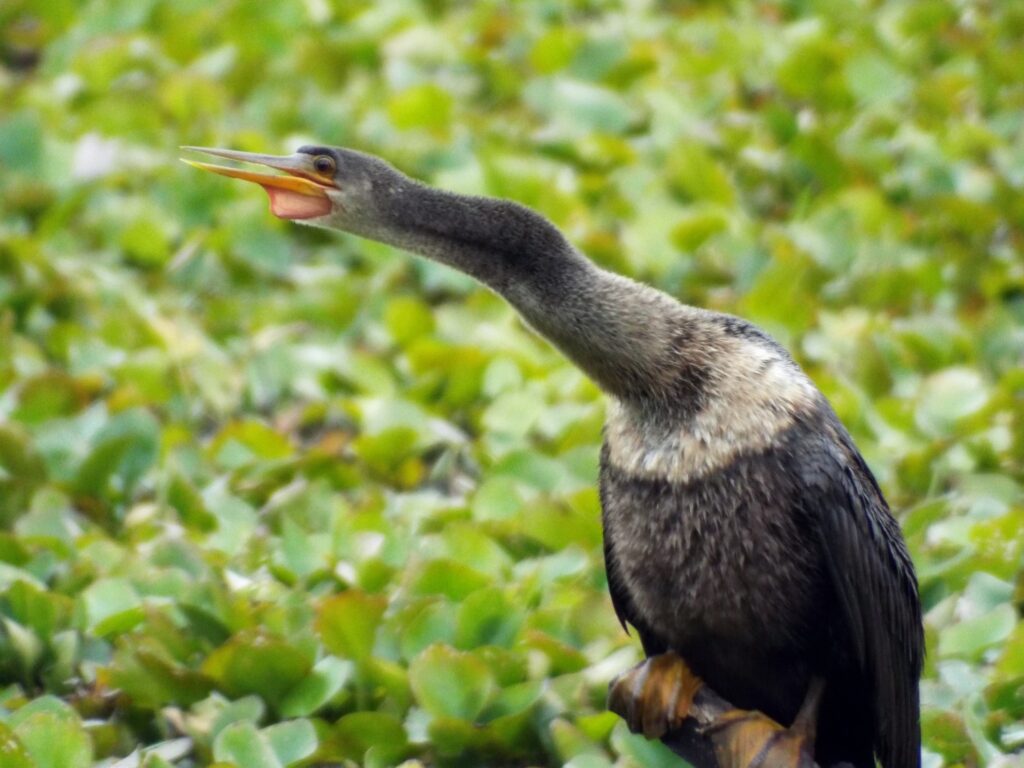
This week for Flora and Fauna Friday, we have a one of a kind, snake-necked, needle-nosed, neutrally buoyant bird. Today we’re gawking at the Anhinga (Anhinga anhinga) family Anhingidae. Also known as the American Darter, Snake-bird, or Water-Turkey. The word “Anhinga” comes from a native Brazilian dialect and means snake/devil bird.
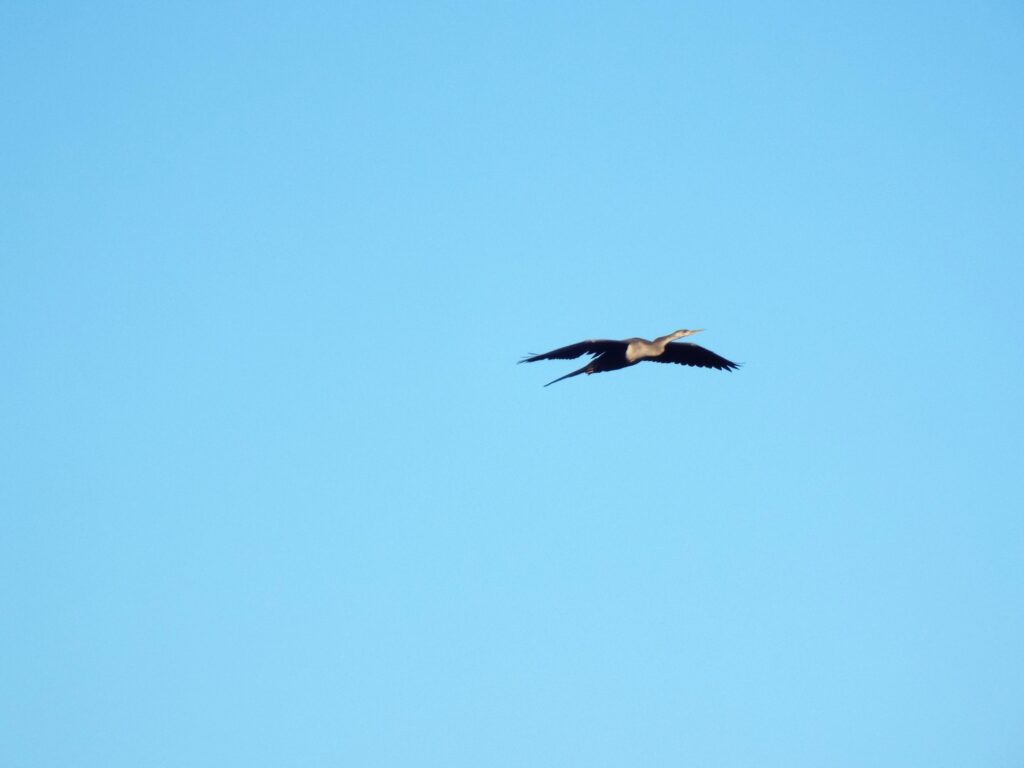
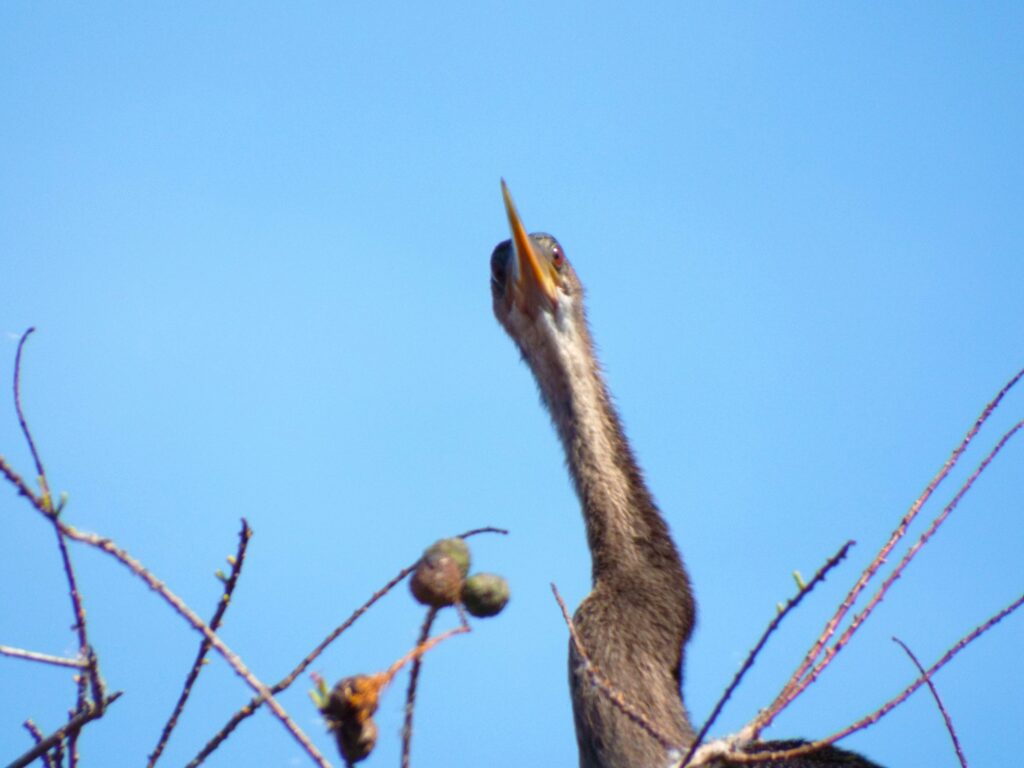
Anhingas are weird, but in a good way. The Anhinga is found throughout much of South America and the coastal plain of the southern US. They’re most closely related to Cormorants and Gannets. Anhingas have a long neck, fan-like tail, webbed feet, and large wings. Their feathers are a deep-brown or black on the body, silvery-gray and black through the wing, and a creamy-tan on the throat and chest. During breeding season, males turn jet black throughout with blonde highlights on their crown and a turquoise eyespot. When soaring through the sky, they can resemble Bald Eagles from a distance. Anhingas are piscivorous. They hunt and eat only fish. Their bodies are very well adapted for this lifestyle and it’s also what makes them as weird as they are.
Anhingas are the spear-fishermen of the bird world and everything about them is suited to that task. Their eyes face forward, giving them great binocular vision. Their bill is needle-like, perfect for poking clear through a Bass. Their neck is long and S-curved, allowing them to speedily spear fish. They have a stretchy, membranous throat that aids in swallowing fish. Their feet are wide and webbed, providing rapid propulsion and course correction. Their tail is long and broad, working like a stabilizing fin to adjust pitch and prevent roll. Most interestingly of all, their feathers don’t repel water. Water does not run off this odd duck’s back. Most aquatic birds have a hydrophobic coating to their feathers that traps an insulating layer of air beneath them. This makes a bird buoyant and keeps it warm and dry in cold water. Fighting against buoyancy is exhausting work and it makes a bird less stealthy and impairs agility. In contrast, the Anhinga forgoes this approach entirely. Their feathers wick up water and don’t hold any air. This can make their feathers look more like fur than feathers. It’s also how they get the name snake bird. Since their bodies sink below the surface of the water, all you can see of a swimming Anhinga is its long serpentine neck craning out of the water. When Anhingas depart the drink to rest and digest, you’ll see them perched, neck outstretched, wings held wide to the sun. They pose this way to allow water to run out of their feathers so their plumage can air dry. Their lack of aquatic insulation means Anhingas are mainly a tropical species. However, they summer here in the southern US and some stay year-round in areas where the water temperatures stay warmer.

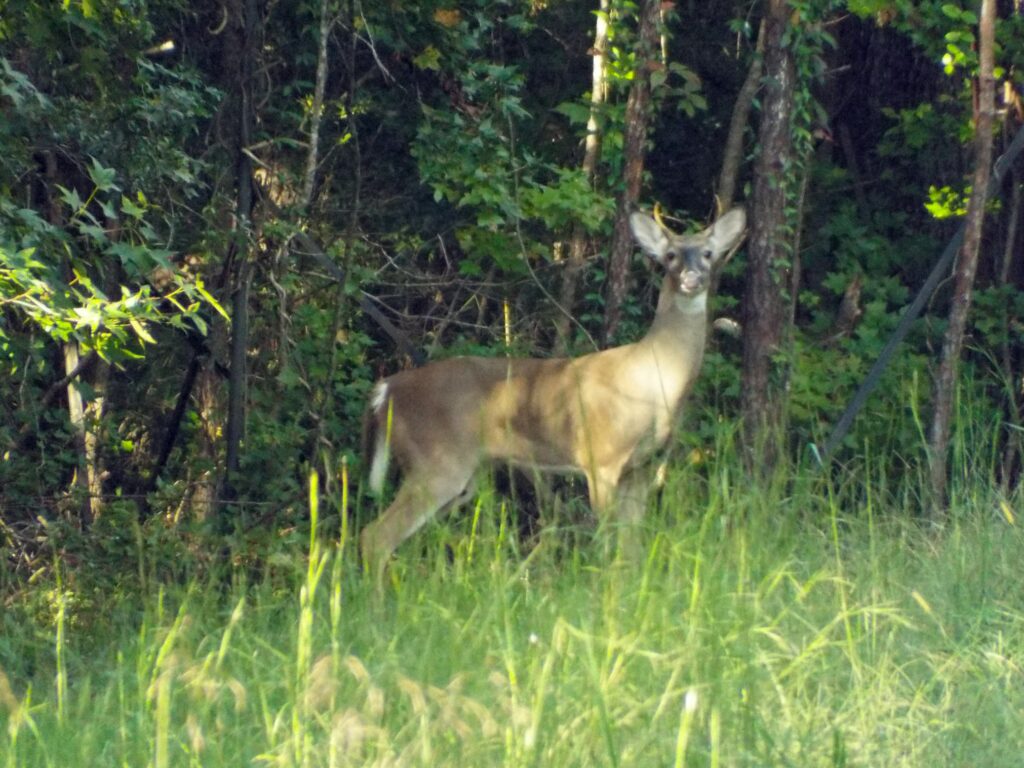
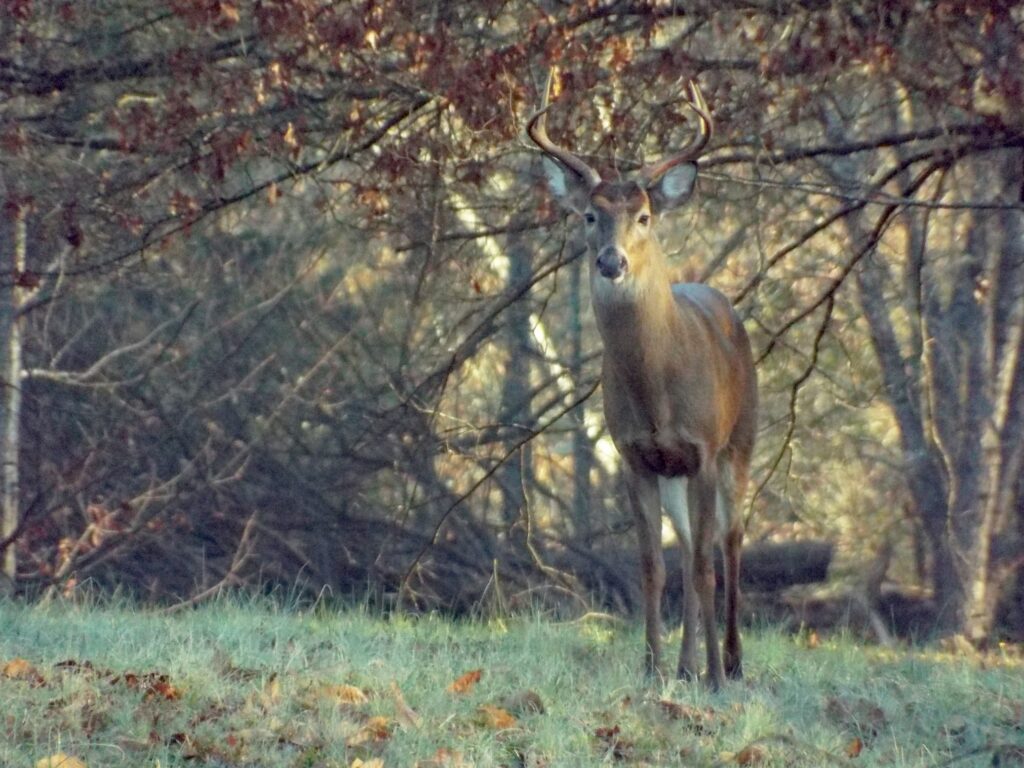
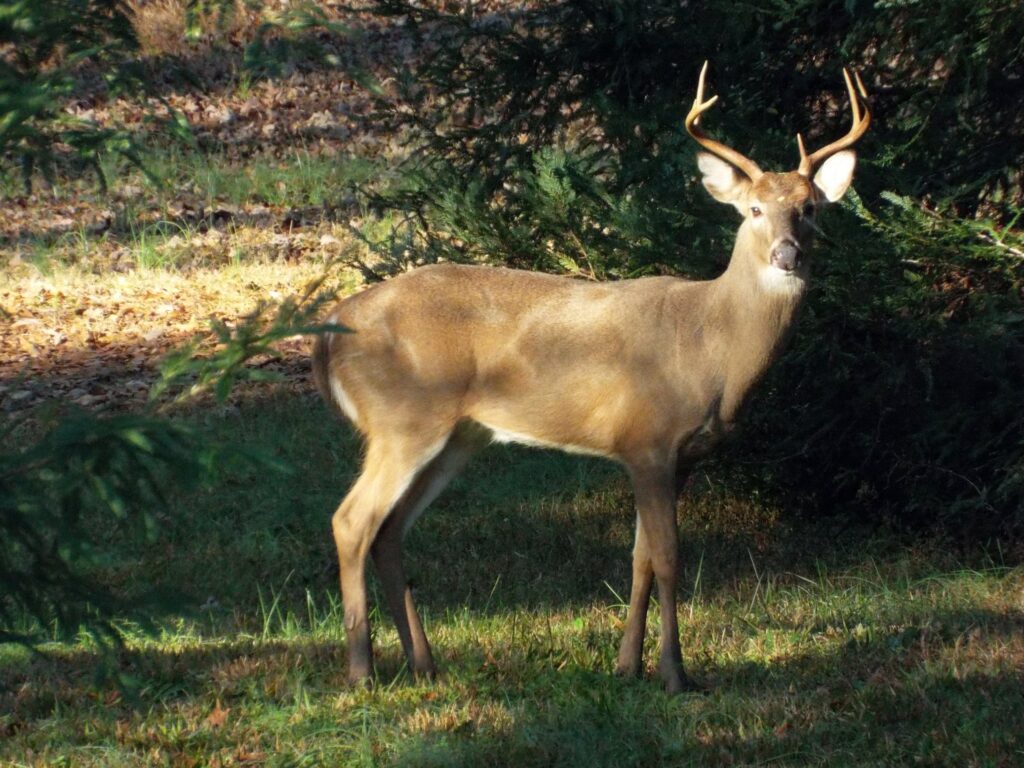
This week for Flora and Fauna Friday, we have a ubiquitous ungulate from across the US. This week we’re taking a gander at the White-tailed Deer (Odocoileus virginianus).
Found everywhere in the United States and Mexico, except the arid southwest, the White-tailed Deer is North America’s most common native ungulate and the only species of ungulate native to Edisto. They are a highly adaptable species found in every terrestrial ecosystem in SC. The subspecies we have inland and here on Edisto is the Southeastern White-tailed Deer (Odocoileus virginianus virginianus). Ungulates are a group of mammals who walk on hooves and whose legs are shaped differently because of it. There are three main classifications of mammal legs, unguligrade, digitigrade, and plantigrade. I’ll explain each of them by how many joints they have in their foot. Humans, bears, opossums, rats, and raccoons are plantigrade. We walk on the heels, balls, and toes of our feet. Dogs, cats, and birds are digitigrade. They walk on just the balls and toes of their feet. Deer, cows, horses, antelopes, and pigs are unguligrade. They walk only on the tips of their toes. A hoof is really just a big toenail!
While we’re on the topic of pedantic biological terminology, members of the Deer family, Cervidae, have antlers. Antlers are a unique feature of the family. They are made of solid bone and attached to the skull by a structure called the pedicle. Except for Caribou, only male deer have antlers and they are shed in late winter each year. In contrast, the horns of cattle and antelope have a hollow bony core coated in a thick layer of keratin, the same substance that makes up their hooves and hair, and horns are not shed but grow continuously. Male deer, called bucks, use their antlers to settle territorial disputes during the rut. The rut is the species’ mating season and bucks become increasingly aggressive and single-minded, forgoing eating and sleeping to fight and mate. They go antler to antler with other bucks over territory and mating rights. Only the strongest and most well fed will prevail. A buck will also use his antlers to defend against predators and to mark his territory by rubbing them and the scent glands on his forehead against small trees. Shed deer antlers are an important source of calcium and phosphorous for some species of wildlife. Rats, mice, rabbits, snails, and Squirrels will rapidly gnaw away at shed antlers as soon as they hit the forest floor. If you’ve ever wondered why you don’t find years’ worth of antlers littering the woods, that’s why!
The White-tailed Deer has been a culturally significant animal in the Southeast as long as humans have lived here. Native Americans on the coast hunted them not just for their meat but for their hide, sinew, and bone. Materials critical for making clothes, bow strings, and tools. White-tailed Deer were an important food source for colonists in early America and for both freedmen and white southerners alike in the financially destitute South after the Civil War. Today, that hunting tradition is still alive and well. Although it’s no longer a dietary necessity for most hunters, the hunting of White-tailed Deer is just as important for wildlife conservation today as it was for the survival for early Americans. White-tailed Deer have lost almost all of their natural predators in the southeast. Cougars and Red Wolves have been extirpated from South Carolina and our Black Bear populations are sparse and isolated. Although a bull Alligator is more than capable of taking a mature Buck, Alligators rarely attack deer. ‘Gators simply have easier prey to hunt. Bobcats and Foxes will hunt fawns. Coyotes fill some of this niche by hunting weak deer and fawns but aren’t large enough to hunt healthy adult deer alone. In rare instances, Coyotes will hunt in packs and are capable of taking mature deer but this is not a common occurrence. Left uncontrolled, deer populations quickly grow to the carrying capacity of the land and induce ecosystem-wide alterations in plant communities by overgrazing their preferred food plants. This continuous and selective plant grazing alters the plant community and, in turn, changes the habitat composition of the area. The habitat composition determines what species of wildlife can live there. These disturbances in the plant community also open up chances for invasive species to establish and further degrade the habitat. White-tailed Deer are generalists and are mostly unfazed by this habitat change. More specialist species, typically rarer and of great concern to conservationists, are pushed out of the habitat and, in extreme cases, may never be able to return. This process is called a “trophic cascade”, an ecological positive-feedback loop that can be devastating to an ecosystem. Luckily, deer hunting prevents this and SCDNR manages White-tailed Deer across the state in excruciating detail to prevent this on public lands. Additionally, the sale of hunting licenses, deer tags, sporting arms, and ammunition provides the lion’s share of funding for all conservation work that happens in this state. That’s funding for all conservation work for all species, not just game species.
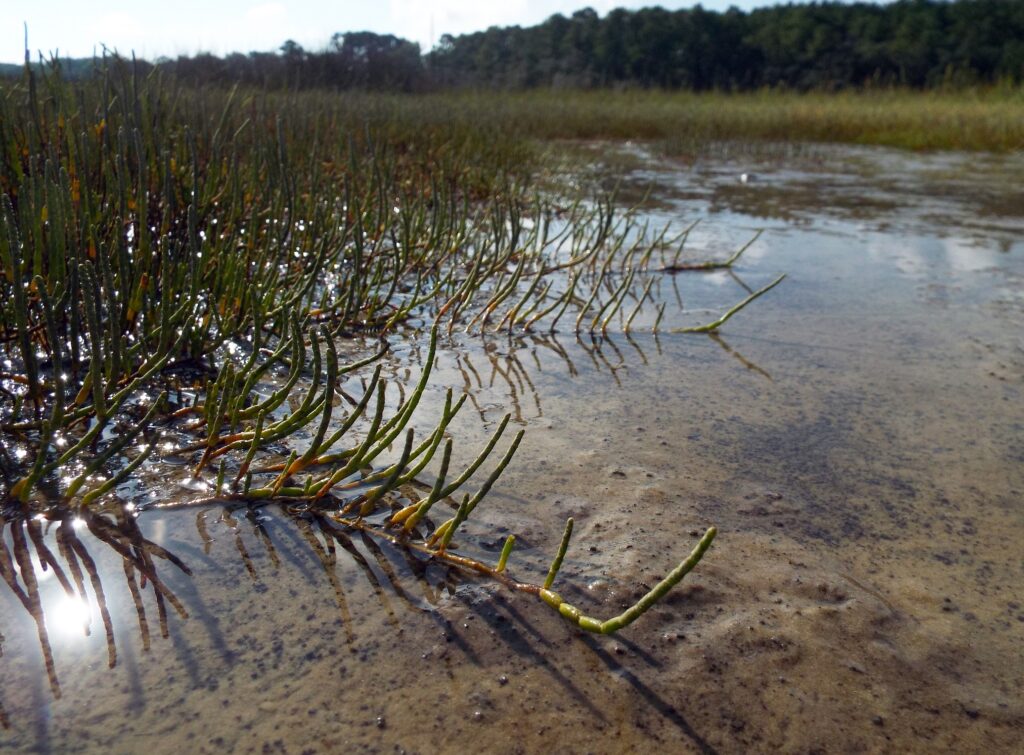
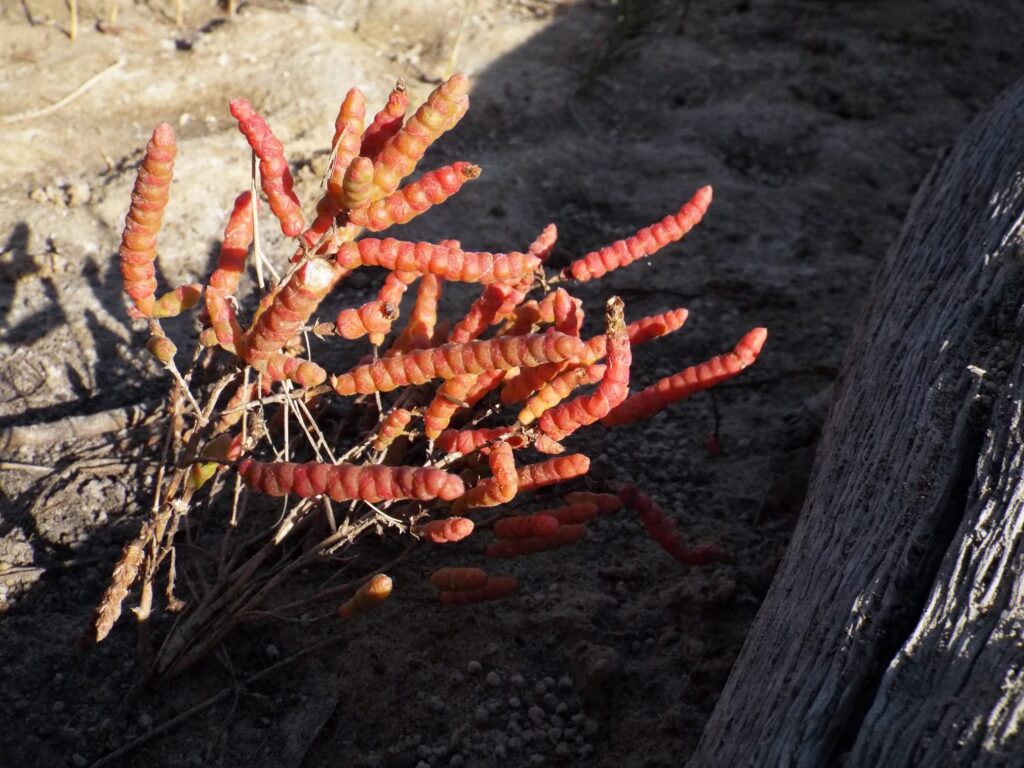
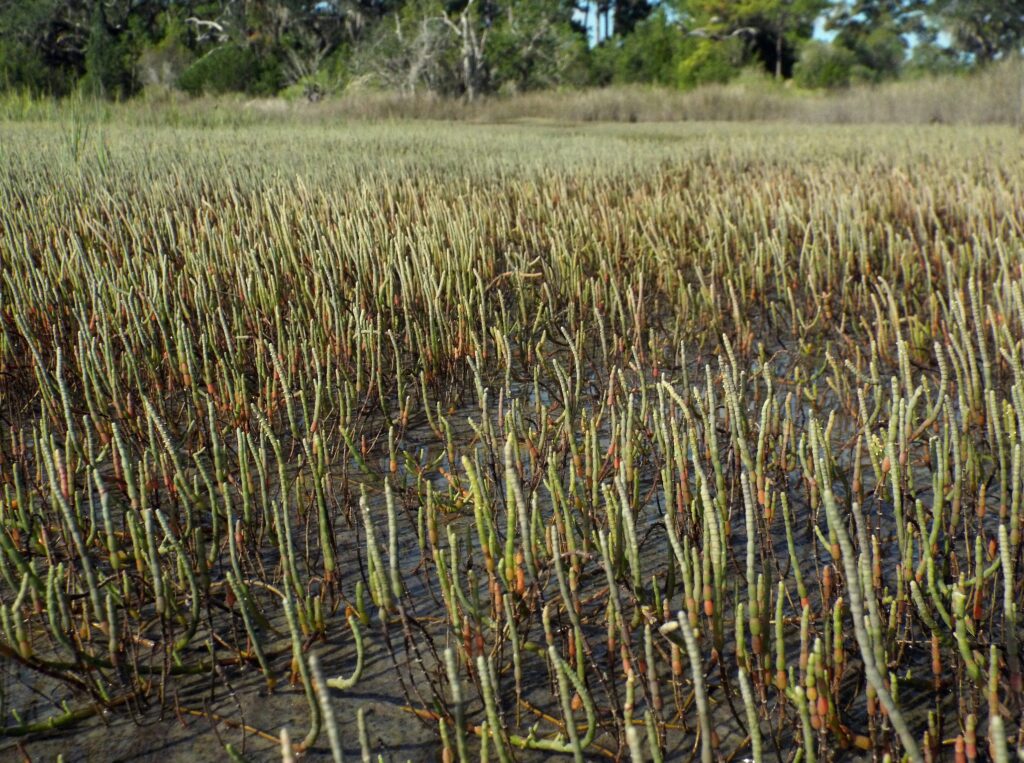
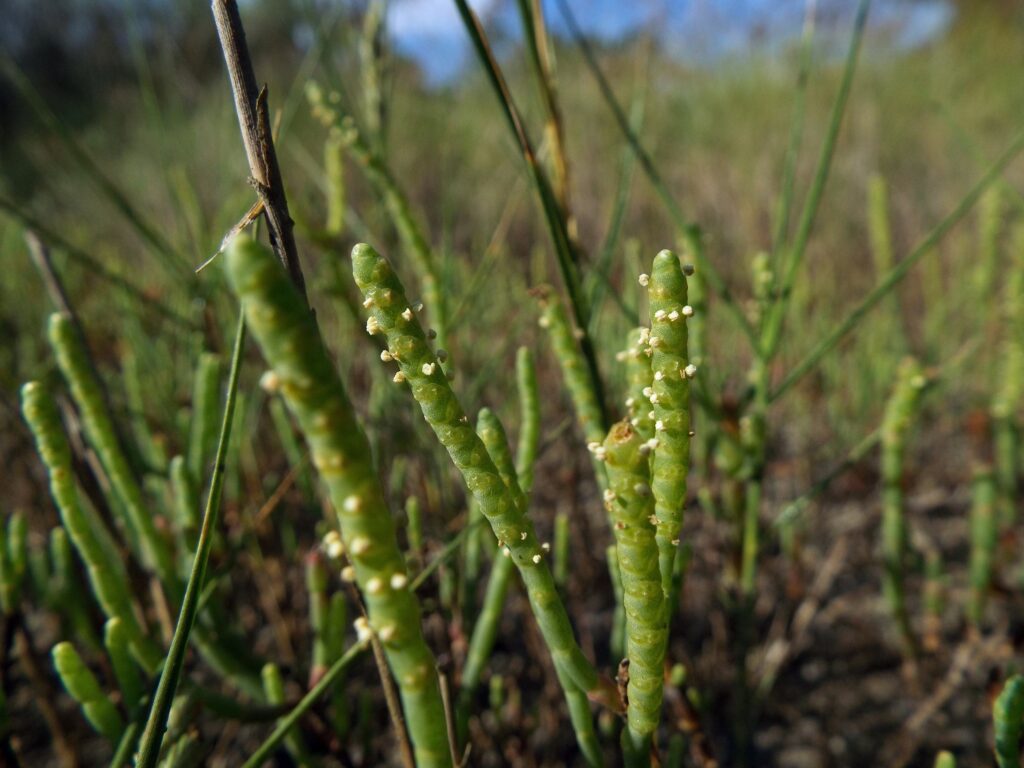
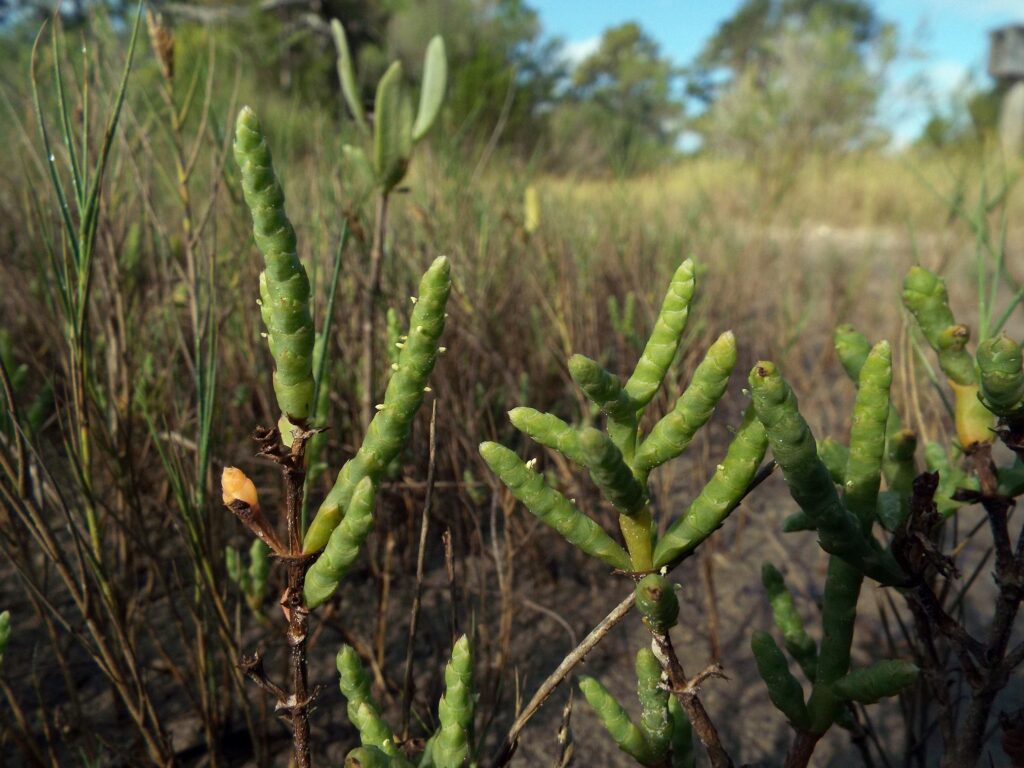
This week for Flora and Fauna Friday, we have an edible, pre-seasoned, halophytic plant on the menu. This week we’re talking about the Glassworts, Genus Salicornia.
Glassworts are a clade of salt-loving succulent flowering plants that grow best in the sandy soils of salty wetlands in the subfamily Salicornioideae. Here on Edisto, you’ll find them on the sand flats of the high saltmarsh. Their succulent leaves are oppositely arranged but wrap entirely around the stem of the plant, giving Glassworts a jointed, somewhat cactus-like appearance. These leaves are packed with salts the plants accumulate from the saline tides that bathe them twice a day. The Glassworts get their name from this salt-sequestering ability. In England during the renaissance era, it was discovered that these plants could be harvested and burned to produce soda-ash, an important ingredient in glass making. Glassworts are also edible and can be eaten raw or cooked. They are predictably quite salty, which has granted them the common name Pickleweed. The plants can be grown on land where little else grows and irrigated with saltwater and agricultural runoff. Glassworts are rich in fats and protein and can be harvested as animal feed or converted into biofuels. Species in the genus Salicornia also serve as hosts to our smallest species of butterfly, The Eastern Pygmy Blue (Brephidium pseudofea).
Here on Edisto I believe we have two species of Glasswort, Dwarf Glasswort (Salicornia bigelovii) and Perennial Glasswort (Salicornia pacifica). I’m not sure how many species we have because this group of plants is in taxonomic turmoil at the moment. I can’t find a scientific consensus on the phylogenetics and I’m not entirely sure there is one at this point. So we’ll just go with my best guess. Dwarf Glasswort is an erect annual species with a bare stem towards the base and highly swollen leaves. It turns a bright orange red in fall before dying off in the winter. Virginia Glasswort is a prostrate, spreading perennial species. This is the more common species you’ll see in the saltmarsh and the one that will form stands that blanket the sand.
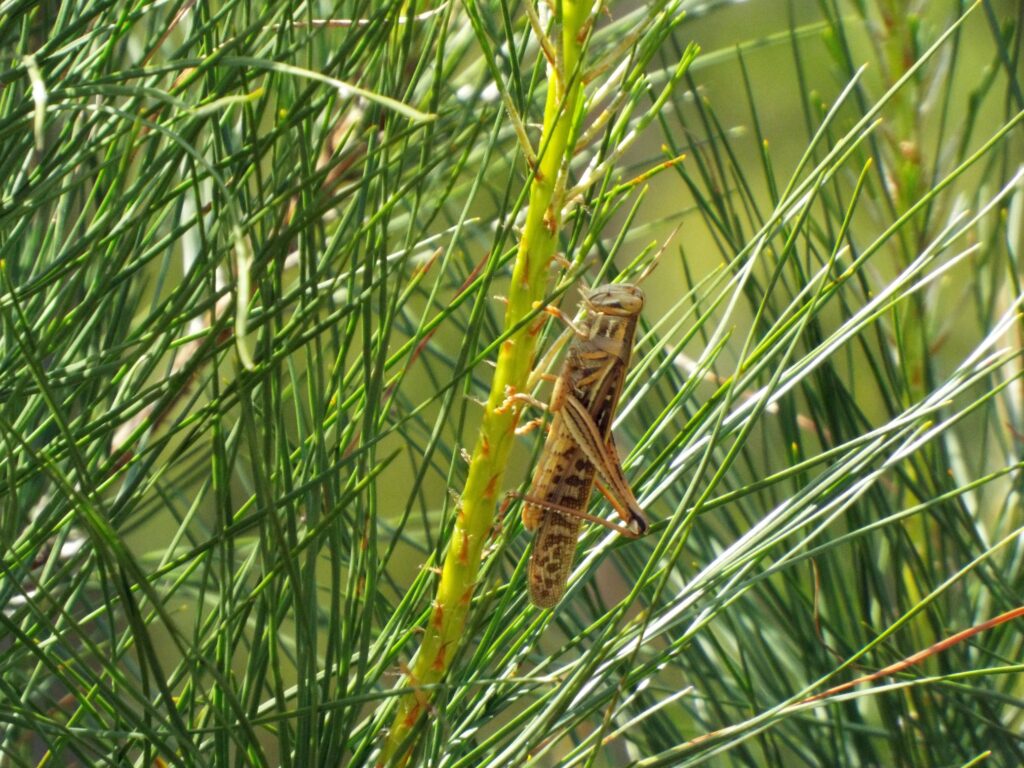
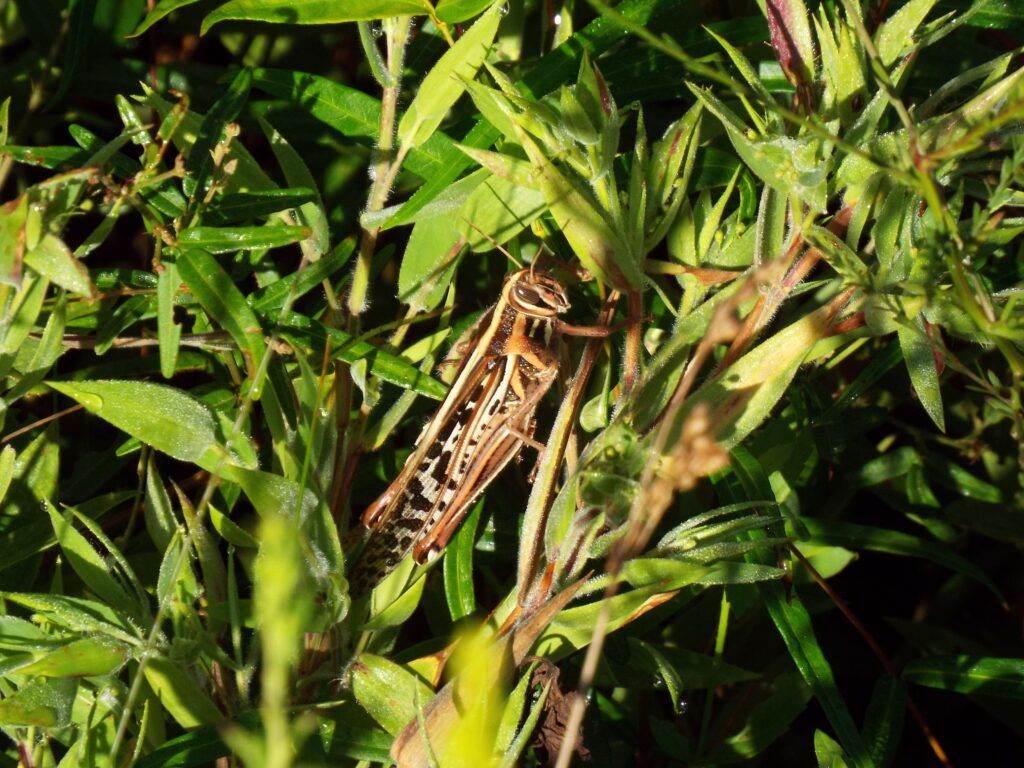
This week for Flora and Fauna Friday, we have an acrobatic arthropod of avian proportions. This week we’re talking about the American Bird Grasshopper (Schistocerca americana).
The American Bird Grasshopper is a very large grasshopper, with females reaching nearly 4 inches in length. Their color is primarily a golden tan, mottled with brown and black, and topped with a tan stripe down the center of the back. They can be found in fields, meadows, and prairies feeding on grasses, forbs, and the leaves of broadleaf trees. American Bird Grasshoppers get their name not only from their substantial size but because of their unique behavior when fleeing as well. When disturbed, they will leap from their perch and take flight. Instead of quickly throwing themselves back into the safety of the grass, like other grasshoppers, the American Bird Grasshopper will soar up into the air before either landing atop grass some yards away or lazily flying up into the branches of a tree to hide. Much like a flushed bird would do. Their substantial size and lackadaisical flight behavior makes them a target for predators. They’re a favorite food for the Loggerhead Shrike and American Kestrel, who’ll snatch the insects out of the air.
Our species is in the same genus as the swarming Desert Locust (Schistocera gregaria), infamous from the biblical plague. Although the American Bird Grasshopper can be considered a pest to some agricultural crops, it doesn’t swarm like its Old World cousin. Swarming is an adaptation to life in the desert, where food is scarce and scattered over vast distances. That’s not the case here in the southeastern United States. The American Bird Grasshopper is content with dining alone in the bounty of our climate. Adults overwinter and can often be seen rousing in fallow fields and meadows on warm winter days. Come Spring and Summer, the new year’s generation emerges to carry the species’ mantle.

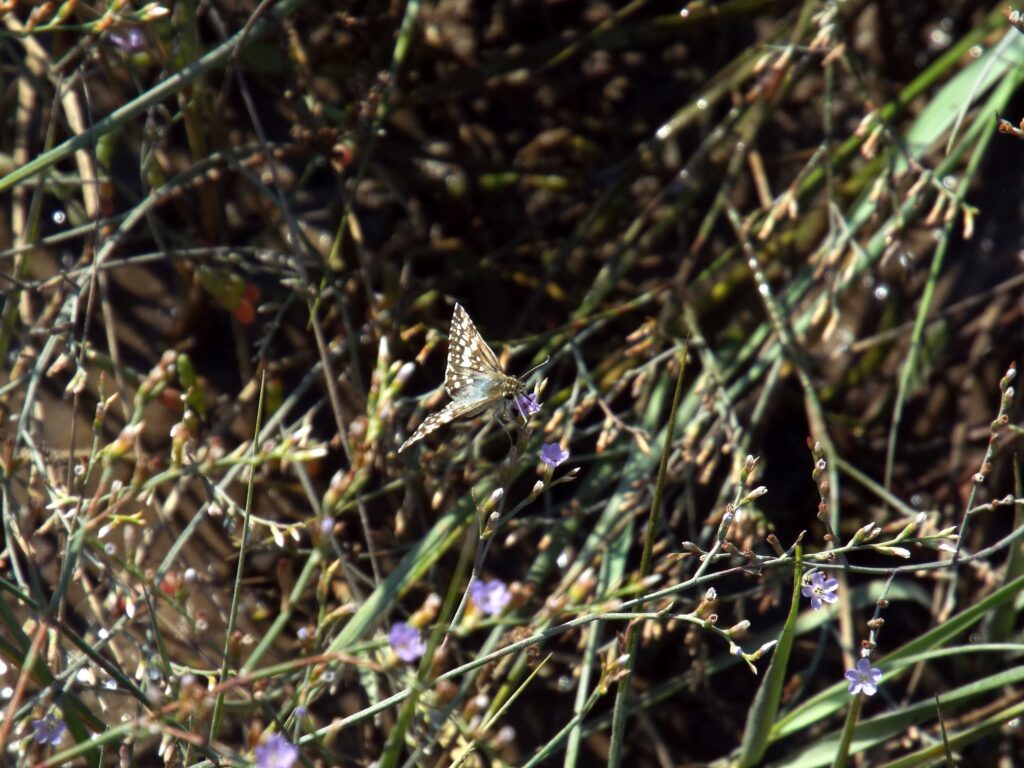
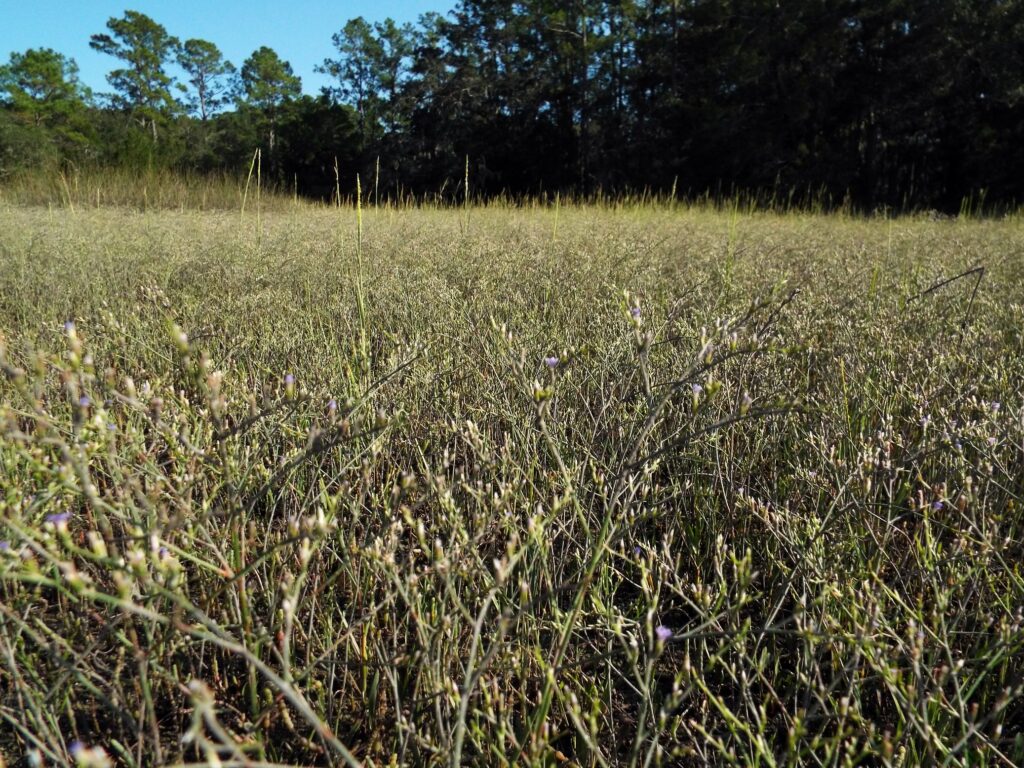

This week for Flora and Fauna Friday, we have a wildflower of the high saltmarsh. This week we’re looking at Carolina Sealavender (Limonium carolinianum).
Carolina Sealavender is a perennial wildflower that can reach two feet in height. It’s found exclusively in the saltmarsh, growing in the high marsh along the edges of sand flats. Just outside the meadows of Fimbry and Rush. It’s one of a select few plants that tolerate the harsh life in the saltmarsh and one of the fewer still that sport flowers. A breath of beauty in an oft barren plain. For most of the year it exists as a rosette of simple leaves above the bare sand of the marsh. In summer and fall, Sealavender blooms producing a web of stems punctuated by lavender flowers. Each flower has 5 petals and is less than a quarter of an inch across. What these flowers lack in size they can make up for in the intensity of their color, as well as their volume. Their inflorescence forks in a fractal manner and each arm ends in a line of bright purple flowers. After the flowers dry and the seeds mature and disperse, the flower stalks remain. They can be seen along the marsh edges for months afterwards. Like miniature dormant trees in a fallow winter’s field of salted sand.
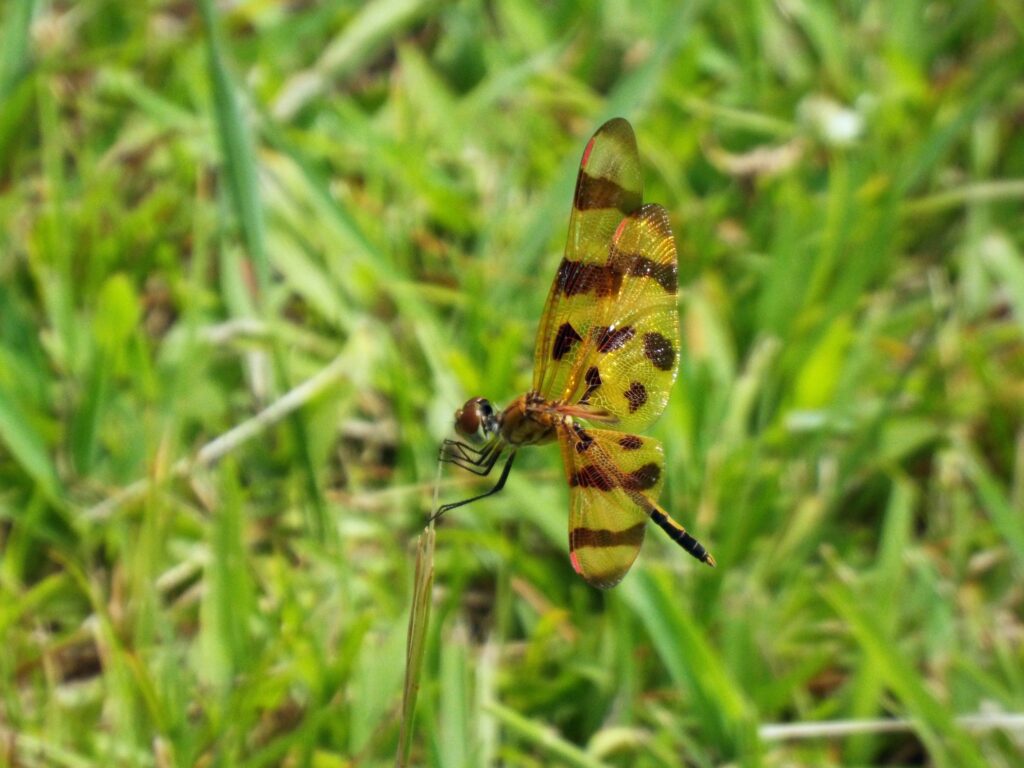
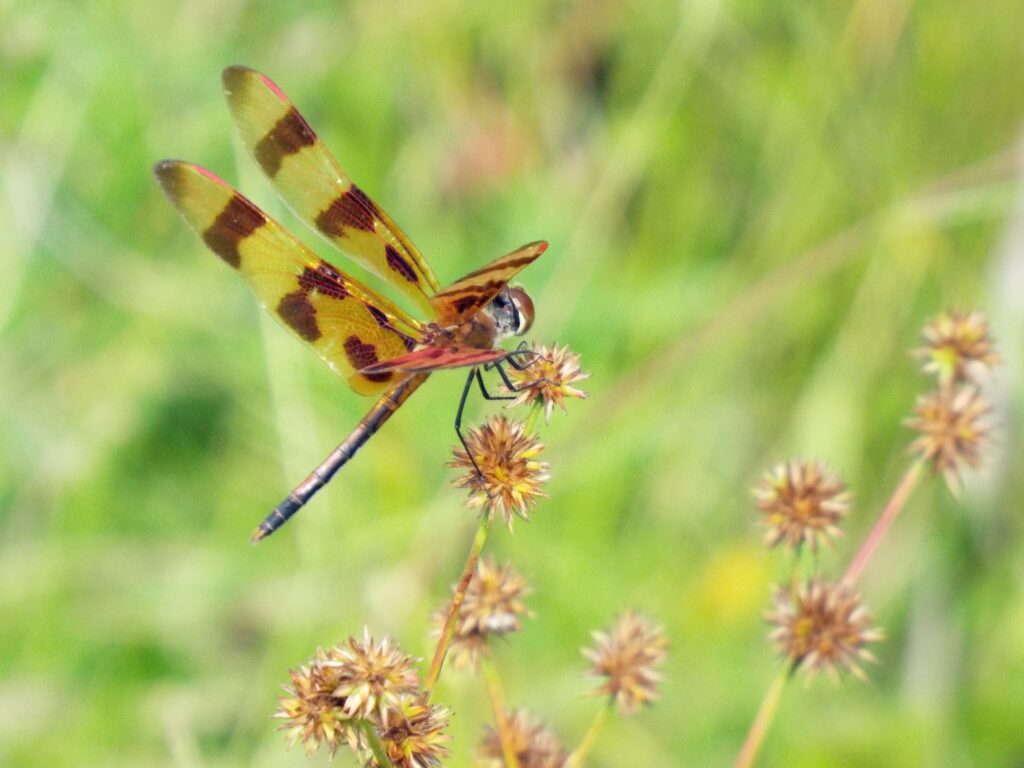
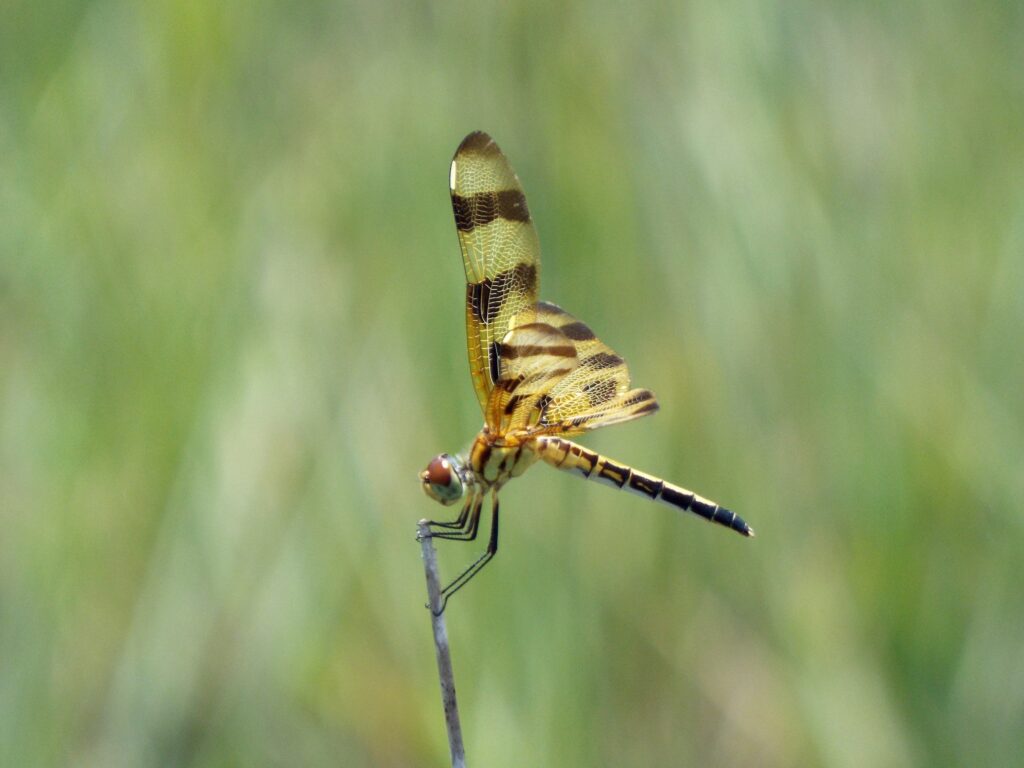
For this week’s Halloween special edition of Flora and Fauna Friday, our subject is neither ghoulish nor haunting but aptly named. The cold moon’s light of Hallow’s Eve shines upon the Halloween Pennant (Celithemis eponina).
The Halloween Pennant is a medium-sized dragonfly in the Skimmer family, Libellulidae. Although named for the fall holiday, the Halloween Pennant is most easily observed in summer. It breeds in marshy ponds and wetlands. It typically hunts in fields and high saltmarsh where it can often be seen perched on the tip of a grass blade, watching for prey. Male Halloween Pennants aren’t territorial like other dragonfly species and won’t be seen chasing each other through the air. Conversely, they are rather protective of their perch and will brush off harassment from larger, more territorial dragonfly species in favor of keeping their seat. Halloween Pennants have abnormally long wings for their body size compared to most dragonflies. This lends them a floaty flight pattern more like a butterfly than other Skimmers and Pennants. They get their autumn-themed moniker from the color of the male’s elongated wings. His wings are a transparent burnt orange striped with thick bands of ebony brown and coral red veins that bring to mind the orange and blacks of Halloween décor. Females are just as colorful with bright yellow wings banded with black. The wings of the male are studded at the tips with hot pink stigmata. The female’s stigmata are cream white. Stigmata, or more accurately pterostigmata, are distinct cells on the leading edge of the wing near the tip. These cells are thickened areas of chitin that are opaque and colored in many species of dragonfly, making them stand out from the rest of the wing. The dense pterostigma improves the aerodynamics of a dragonfly wing by reducing vibrations and allowing dragonflies to glide at faster top speeds.
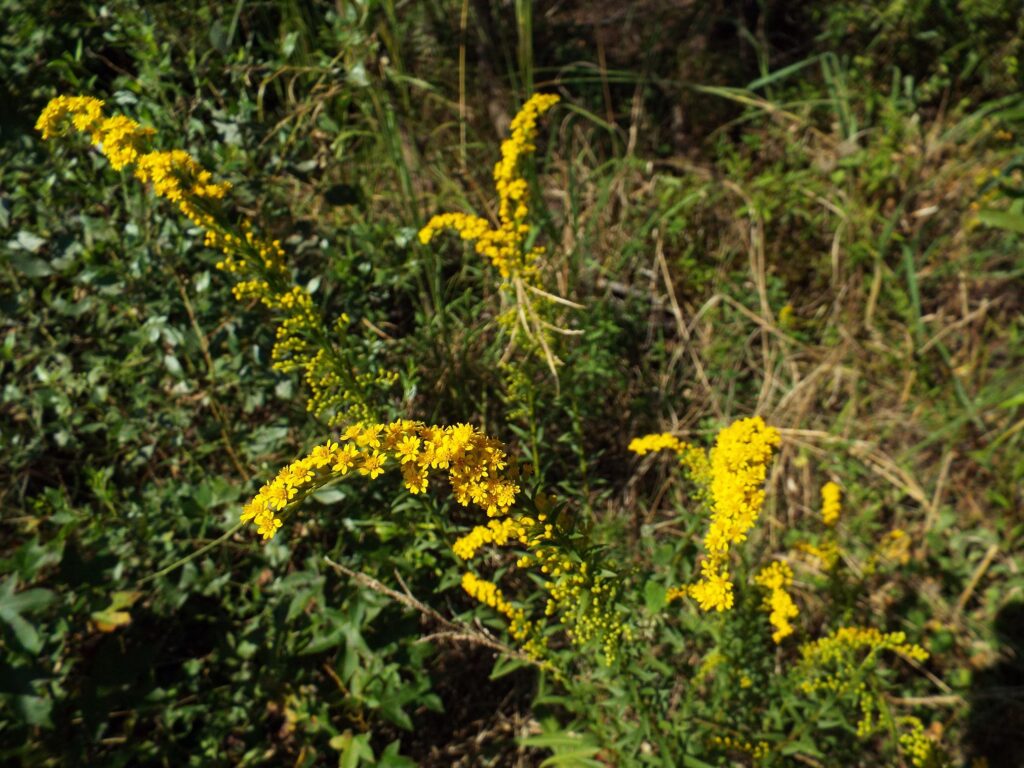
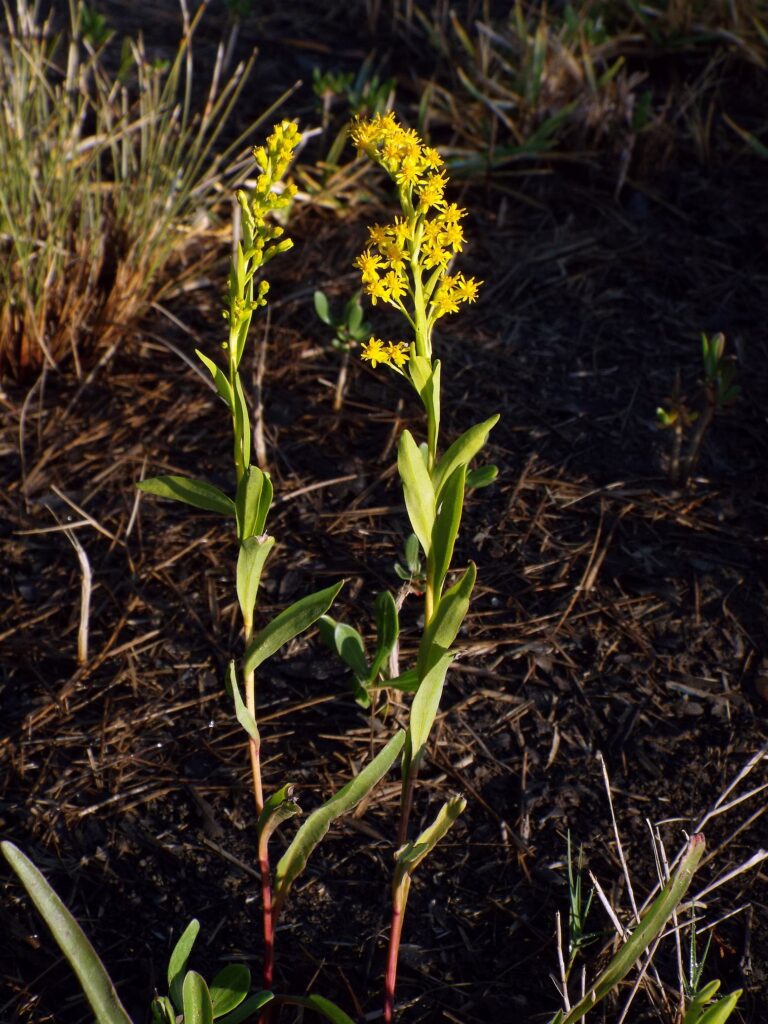
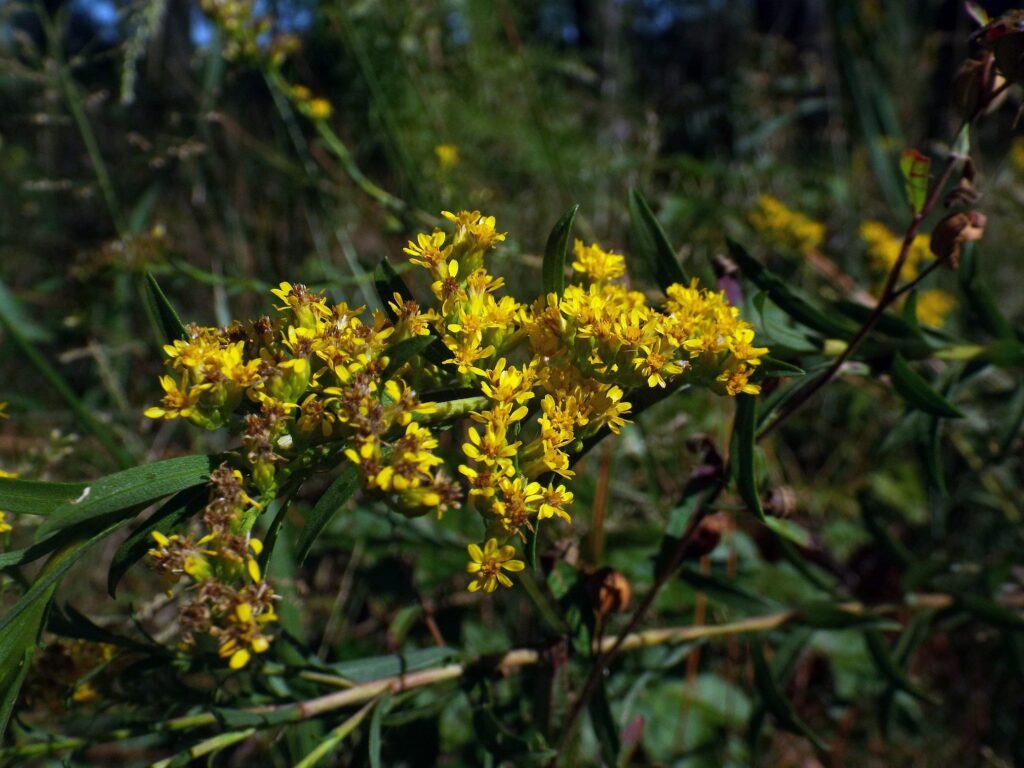
This week for Flora and Fauna Friday, we have another wildflower important to pollinators. This week we’re talking about Seaside Goldenrod (Solidago sempervirens).
Seaside Goldenrod is a member of the Goldenrod genus, Solidago. Goldenrods, just like Asters, are a highly diverse group with members who all look very similar. There are over a dozen species found in our area. Goldenrods as a whole are tall, narrow plants with numerous rich, golden flowers. Hence the common name of “Golden Rods”. Seaside Goldenrod is no exception. Every Fall it produces long, single-stemmed flower stalks, capped with a cluster of small yellow flowers, that can reach 7 feet in height. It’s stems and leaves can turn red when the plant is in strong sunlight. It gets its specific epithet of “sempervirens”, which means “forever green”, from the almost succulent, evergreen leaves of its basal rosette. Unlike many Goldenrods, these leaves persist even after the flowers stalks die back in the winter. Seaside Goldenrod grows on the banks of brackish waters, edges of saltmarshes, and in dune ecosystems. It doesn’t grow in the marsh, like Sealavender or Saltmarsh Asters, but instead grows on high ground just above the high-water line. It can be found on the edges of hammocks, ditches, and impoundments where it grows alongside Baccharis, Fimbry, and Sea-Oxeye. Goldenrods as a group are a critical nectar source for bees, wasps, flies, and beetles at the end of the year’s growing season. Seaside Goldenrod is especially important as a nectar source for Monarchs and other migratory butterflies. As Monarchs migrate South for the winter, Seaside Goldenrod creates a golden river of nectar down the Eastern Seaboard.


This week for Flora and Fauna Friday, we’re taking a look at a group of lizards found throughout South Carolina. This week we’re talking about the Skinks, family Scincidae.
Here in South Carolina, we have four species of Skink that are found all across the state. They are the Little Brown Skink (Scincella lateralis), Broadhead Skink (Eumeces laticeps), Southeastern Five-lined Skink (Eumeces inexpectatus), and the Common Five-lined Skink (Eumeces fasciatus). All four of these species have smooth scales, short legs, and a streamlined body with lengthwise stripes. Like many lizards, all our Skinks can shed their still-wriggling tails to distract predators. Juvenile skinks of the three larger species look very similar to each other and sport brilliantly blue tails that aid in this distracting defense.
Broadhead Skinks are our largest species of Skink. Adult males can be identified by their sausage-like physique, stripe-less gray brown body, and orange-red, heavy-jowled head. Female Broadhead Skinks are more dainty by comparison and retain some striping on their sides but look a good deal like males of the two Five-lined Skink species. The easiest way to tell Broadhead and Five-Lined Skinks apart is by counting the number of scales on the lip, between the nostril and the front of the eye. Broadhead Skinks have five lip scales where as both Five-lined Skinks have four. Broadhead Skinks are more arboreal than Five-lined Skinks and spend a lot of their time in the trees. They’re also partial to living in hardwood tree hollows and, when startled, will either dart into the nearest hollow tree or up a trunk. This proclivity for cavities often leads them to hang around at human dwellings, where they laze about on porches and scuttle under doors to hide in the garage.
The Little Brown Skink is our most common Skink as well as our smallest lizard. They’re also the easiest to identify. They have a long thin body only a few inches in length with a brown back, gray belly, and a dark gray stripe down their side. They live in the leaf litter of forests where they crawl between the fallen leaves, hunting small insects and spiders.
The Southeastern Five-lined Skink is our next most numerous Skink. They’re more common than their sister species here on the coast as well as in drier habitats and pine forests. The Common Five-lined Skink is more numerous in the upstate but is still relatively abundant on the coast. This species is most common in bottomland hardwood forests in our area but can be found in most damp forests. Both species spend most of their time on the ground but flee up tree trunks when startled. The two species of Five-lined Skink are practically identical in appearance and must be identified by looking at the scales on the underside of the tail. Southeasterns have scales on the underside of the tail that are all about the same size and somewhat disorganized. Commons have a central row of scales that are wider than the others. Males of both species have a red-orange head and typically have a back that is more brown in color, lacking the central stripe. Females are ebony brown in color with 5 pale stripes down the back and sides. Juveniles are black with 5 yellow stripes and a blue tail.
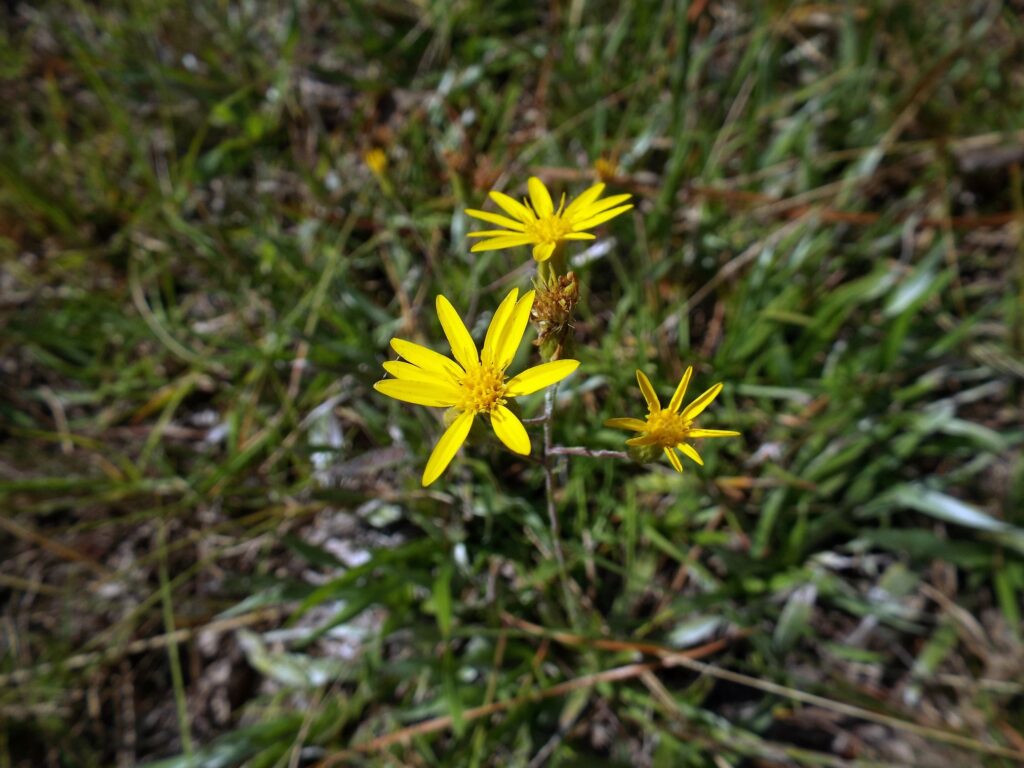
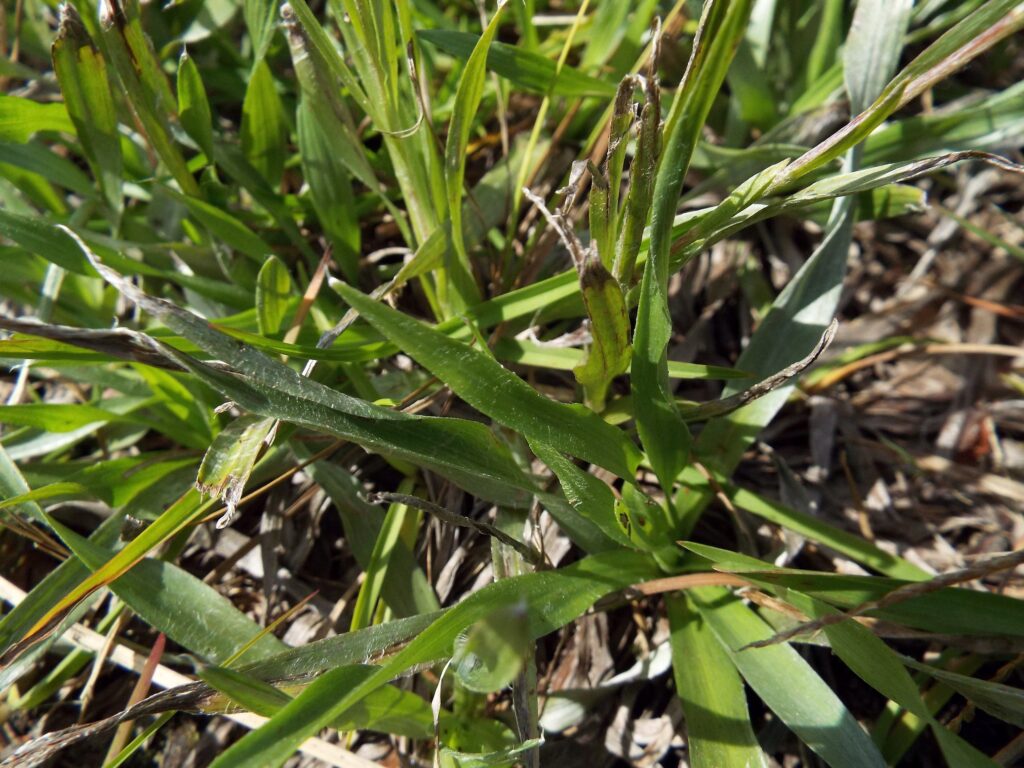
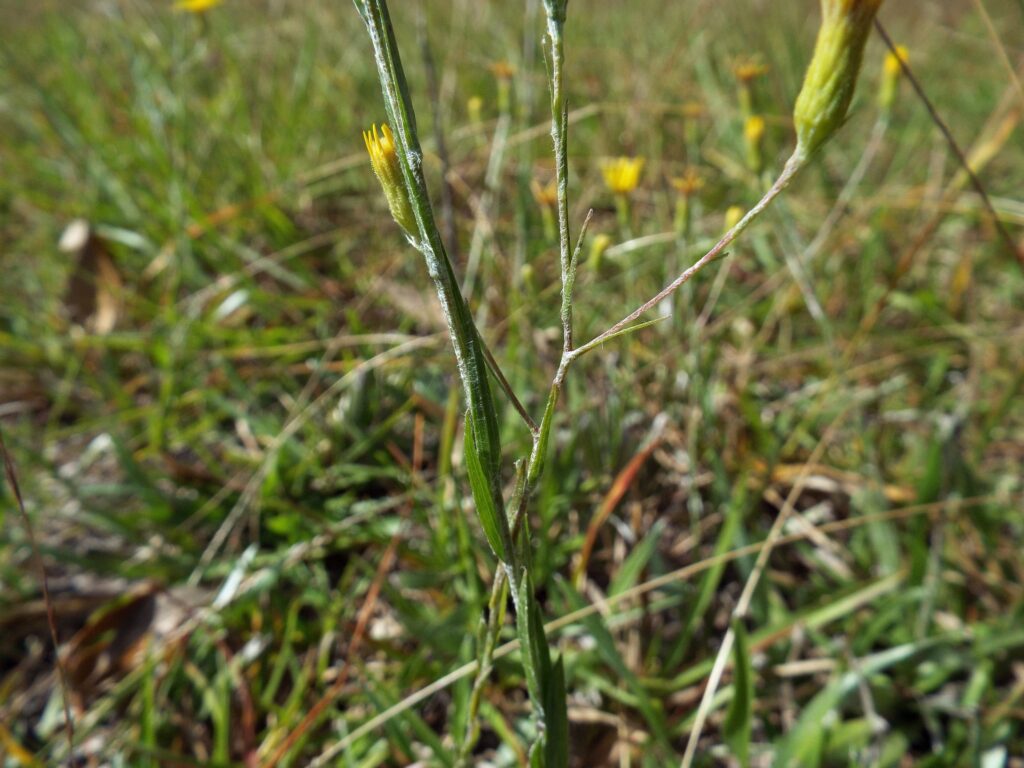
This week for Flora and Fauna Friday, I’ve got a stealthy autumn wildflower for you. This week we’re taking a look at Narrowleaf Silkgrass (Pityopsis graminifolia).
Narrowleaf Silkgrass is a low growing perennial wildflower. It’s typically found in drier sunny habitats but tolerates some shade. It has thin ribbon-like leaves that are covered in a silver coat of fine hairs. These leaves form a dense basal rosette for most of the year. In late summer and early fall, Silkgrass is in full bloom. It produces a wiry flower stalk that can reach 3 feet in height and is crowned with pale yellow flowers. Veins of silver and malachite ore, running from radiant crystals of Sulphur, suspended in the ether of ecology.
What’s interesting about Narrowleaf Silkgrass is that, for most of the year, it looks quite convincingly like a species of grass. It grows in open areas as a dense clump with thin, grass-like leaves. It looks quite similar to Bluestems (Andropogon spp.) and other perennial clumping grasses found in the same habitat. (One of my photos below shows a patch of Silkgrass mixed with Bluestem.) But, it may come a surprise to some that, Silkgrass is a member of the Aster family. It produces the characteristic compound flowers like any other member of the family. If you feel the leaves you’ll also notice that they’re more smooth and pliable than your typical grasses. This façade is only betrayed by its flower buds that begin to emerge each summer and bloom each fall. Come winter, Silkgrass senesces its flowers and returns to its covert grassy cover.
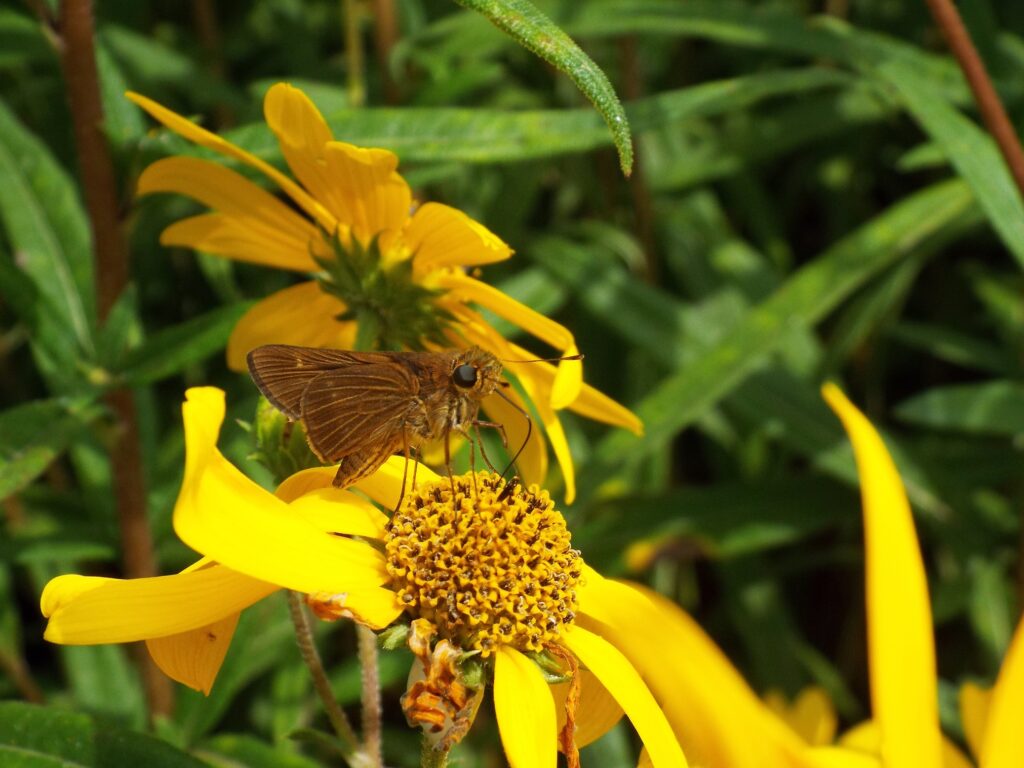
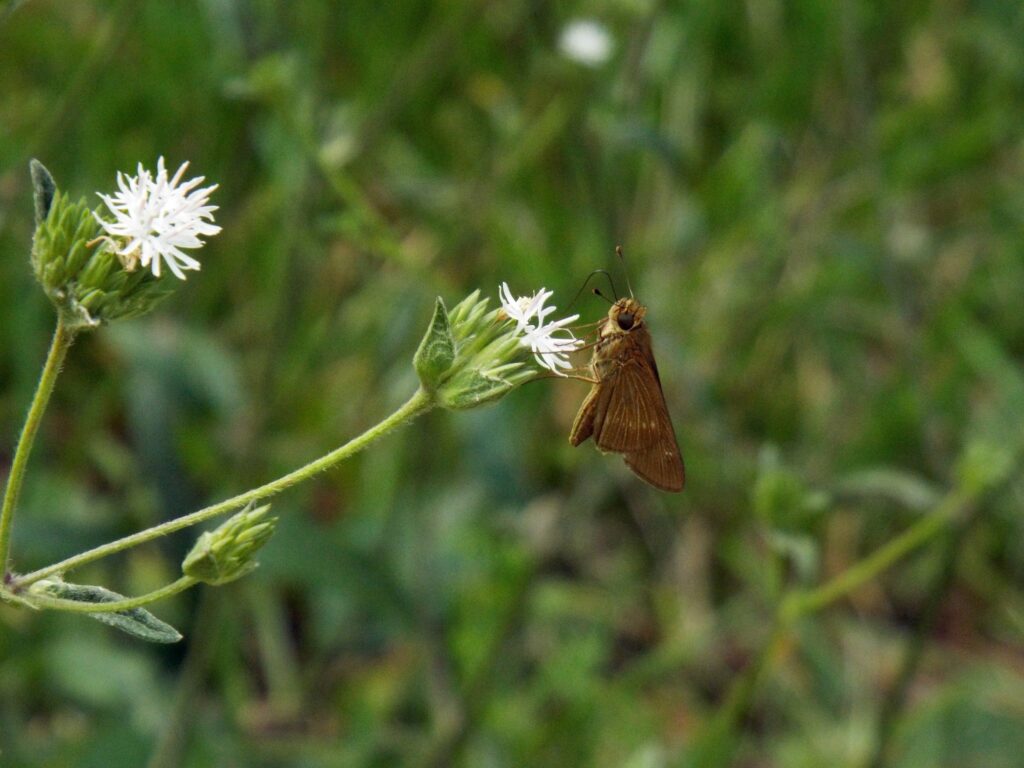
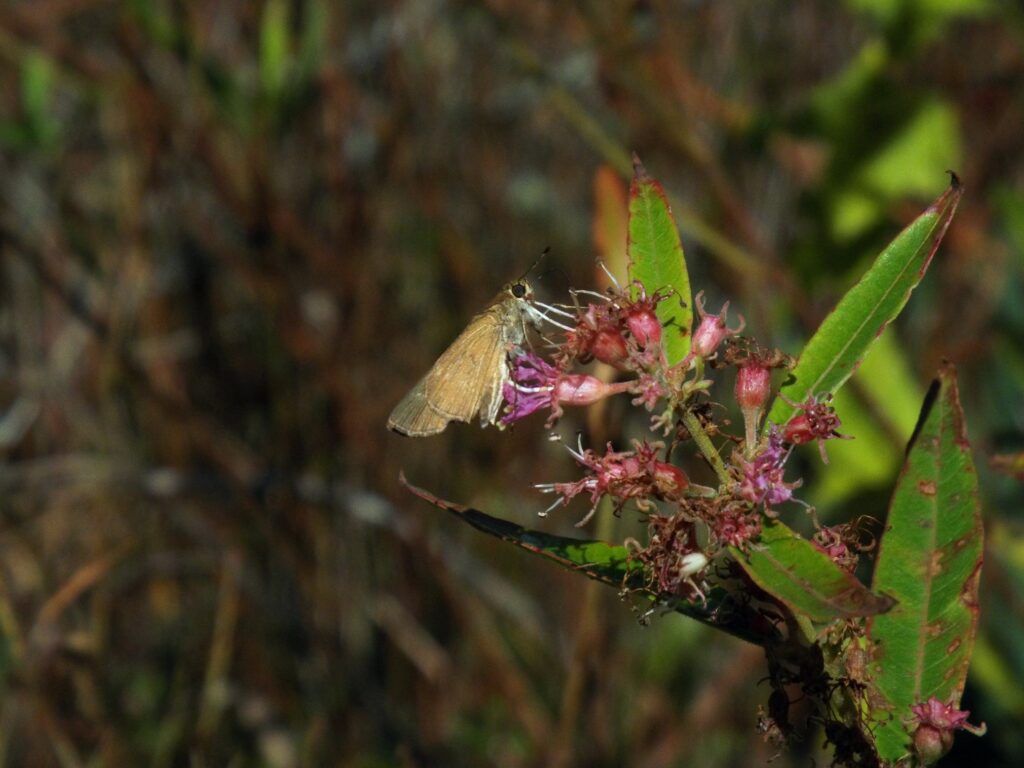
This week for Flora and Fauna Friday, we have a migratory insect to discuss. This week we’re talking about the Ocola Skipper (Panoquina ocola).
The Ocola Skipper is a small, grayish-brown butterfly with long wings and an occasional band of spots on the hindwing. They’re a member in the Skipper family. Skippers are a type of butterfly that are built for agility with narrow triangular wings and a compact, streamlined body. Unlike the floaty flights of Monarchs and Swallowtails or the labored lofts of Hairstreaks and Satyrs, Skippers move with purpose. Pumping their triangular wings rapidly to launch their torpedo shaped torso into the air. Ocola Skippers are built more for speed than other skippers. This is evidenced by their characteristic extra-long forewings and an overall elongated appearance. Ocola Skippers flap their wings with such speed that you can even hear them buzz past your head.
Ocola Skippers need this speed because they are a migratory species. They have to be able to fight crosswinds and fly efficiently over long distances. However, unlike the Monarch that migrates south each fall, Ocola Skippers migrate North each summer. Ocola Skippers are a wetland species. Their caterpillars host on the leaves of Rice and Sugarcane. As summer is winding down, adults begin to migrate north from Florida in search of new habitat for their offspring. Ocola Skippers flood the Lowcountry by the hundreds of thousands every September on their way North. They saturate every ecosystem and swarm nectar plants. They are partial to feeding on Asters, Lantanas, and patches of Elephant’s Foot. Their migration usually peaks in the first week of October. I’ve even had day counts for this species tip into the thousands at pollinator hotspots like Roxbury Park. Yesterday’s butterfly walk, led by Dr. Forsythe and myself at Roxbury Park, was no exception!