This week for Flora and Fauna Friday, I’m presenting an introduction to animal tracks.
The winter can be boring for a naturalist, especially if stalking ducks or chasing shorebirds isn’t your cup of tea. As trees lose their leaves, annuals dry up, perennials die back to their roots, reptiles and amphibians hibernate, and the birds quiet down, it becomes much harder for naturalists to find wildlife in the winter months. However, winter is an opportune time to look for animal tracks. As plants stop growing for the winter and take in much less water from the soil, leaving the ground soft and soggy. Annuals die off for the year, exposing bare soil. Mammals have to search more to find food, so they travel further than normal and farther from the beaten path. Most mammals are nocturnal, so the longer nights give them more time to forage. If it snows, that just means an animal will leave tracks everywhere it goes. All these factors improve both the quality and quantity of animal tracks found in the winter and create a perfect environment for a naturalist to see just how many and what types of mammals surround them throughout the year.
Below I have a sample of most of the common species you’ll find tracks for on Edisto. Try and see how many you can identify! I have the species and track characteristics for each photo in the descriptions.
What exactly is an animal “Track”?
Tracks are the physical impressions an animal makes in the substrate, the material the ground is made of, as it moves through its environment. Tracks are predominantly footprints but, for example, also include things like tails drags for Alligators. Tracks are not to be confused with “Signs”, which are any other environmental indication of an animal’s presence. Signs include things like: trails, scat, slides, burrows, holes, rubs, scrapes, chew marks, etc. Signs are equally useful in identification but, with the exception of droppings, signs are typically found under unique circumstances and in specific locations. Since most signs are subtle in nature and unique for certain types of animals, I’ll just be talking about tracks today.
Now, where can one find tracks?
In my experience dirt roads, marsh flats, nature trails, point bars, and the banks of ocean inlets are the best places to find tracks. However, any place with lots of bare earth and soft soil is a good bet. If you follow Deer and Raccoon trails, which many other species use, sooner or later you’ll find a depression or patch of dirt where tracks are present.
What species can you expect to find tracks for?
That all depends on the type of substrate you’re dealing with and the habitat you’re in. If you’re dealing with dew dampened sand on an island driveway, it’ll hold tracks for everything between a Horse and a Dung Beetle. However, dry, hard-packed clay on a causeway may not even take deer tracks unless there was a torrential rain the day beforehand. For the most part, you’ll only see tracks for animals the size of a Squirrel or larger. As far as habitats go, typically you see more tracks where animals tend to gather. The edges of wetlands, marshes, and fields act as natural borders that mammals follow. Open areas on causeways and dikes act as bridges for Mink, Raccoons, Otters, Alligators, and Turtles to pass between wetlands. Carnivores like to hunt on the edges of heavy brush where Deer, Rabbits, and Turkeys retreat during the day. Birdfeeders attract Squirrels, Rats, Raccoons, and Deer looking for an easy meal. After them may come predators like Bobcats, Coyotes, Foxes, or Mink. Armadillos and Opossums may show up as well to eat invertebrates in the feeder spill or by following an established trail. Mammals are by far the most common and easiest to identify tracks. Turkeys and Alligators are also quite common and easy to distinguish. You can expect to find Raccoon, Deer, and Armadillo tracks anywhere you look.
How do you identify tracks?
Identifying tracks successfully requires having a good understanding of the body shape, behavior, and lifestyle of the animals that make them. Some species, like the Nine-banded Armadillo and Virginia Opossum, leave tracks so distinct they can’t be mistaken for anything else. Others, like Bobcats and Feral Cats or Coyotes and Hound Dogs, require a good deal of investigation to tell apart. The important features to look at in tracks are size, depth, gait, and the shape and arrangement of the individual parts of the foot that left impressions. The size of the track tells you exactly how big the foot of the animal that made it was. This is very important in telling Canids apart. Depth gives you an estimate of how heavy the animal was and the force with which the animal landed. Gait tells you the length of the animal’s stride and whether it was walking, trotting, or sprinting. The shape and arrangement of the track itself is the most important feature in identification. The shape and location of the heel, toes, and nails is unique for almost every mammal species in our area. I get into the specifics for each species in the descriptions of the photos below.
Now get out there are see who’s been hanging out in your backyard when you weren’t looking!
PHOTO DESCRIPTIONS

1. American Mink
The tracks of the American Mink are consistently circular in appearance with five toe pads and claw marks. They are almost always found near wetlands.
The Mink is one of our more confusing track makers. All the tracks in this photo are from a Mink. The Mink is a highly agile animal that has quite chaotic movements. This necessitates that they vary the shape of their feet to provide the best traction possible for their current gait and the surface they’re moving on. This results in highly variable tracks, with a hard to decipher gait, that crisscrosses over top of itself. The Mink’s tracks are most easily confused with those of the Common Raccoon, as well as the Bobcat and North American River Otter. Otter Tracks are very similar in shape but are far larger, about the size of your palm. The walking tracks of the Mink look a lot like a Bobcats but Mink have a fifth toe, consistent claw marks, and a larger foot. Raccoons are the most similar in size but their hand-like feet leave prints with elongated toes that are strongly connected to the heel and claw marks that blend into the tip of the toes. Raccoon Tracks are typically more triangular in shape than circular.
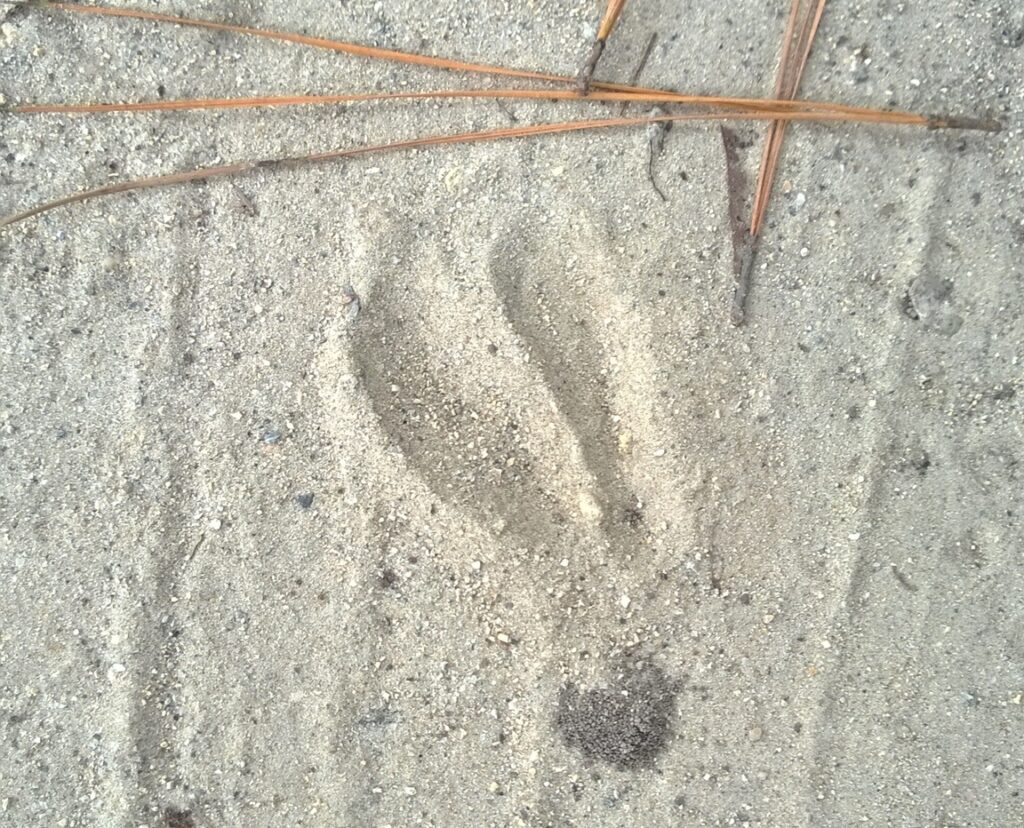
2. White-tailed Deer
The Tracks of the White-tailed Deer, along with the Common Raccoon, are the most common tracks you’ll encounter in the Lowcountry. Deer tracks consist of two tapered, mirrored hoof prints and occasionally an additional set of tiny rear hoof marks, especially from mature bucks. Deer heavily utilize trails and are fond of walking along dirt roads. So if you follow one long enough, you’re bound to find some tracks.
Excluding livestock, there’s only one other species that has tracks resembling the White-tailed Deer, the Feral Hog. The hooves of Feral Hogs are not tapered like those of Deer, so they leave a set of mirrored semi-circles. This gives the prints of a Deer a heart or crab-claw shape and the Feral Hog that of a rounded rectangle. The rear hoof prints of a Hog are also typically larger and farther to the outside.
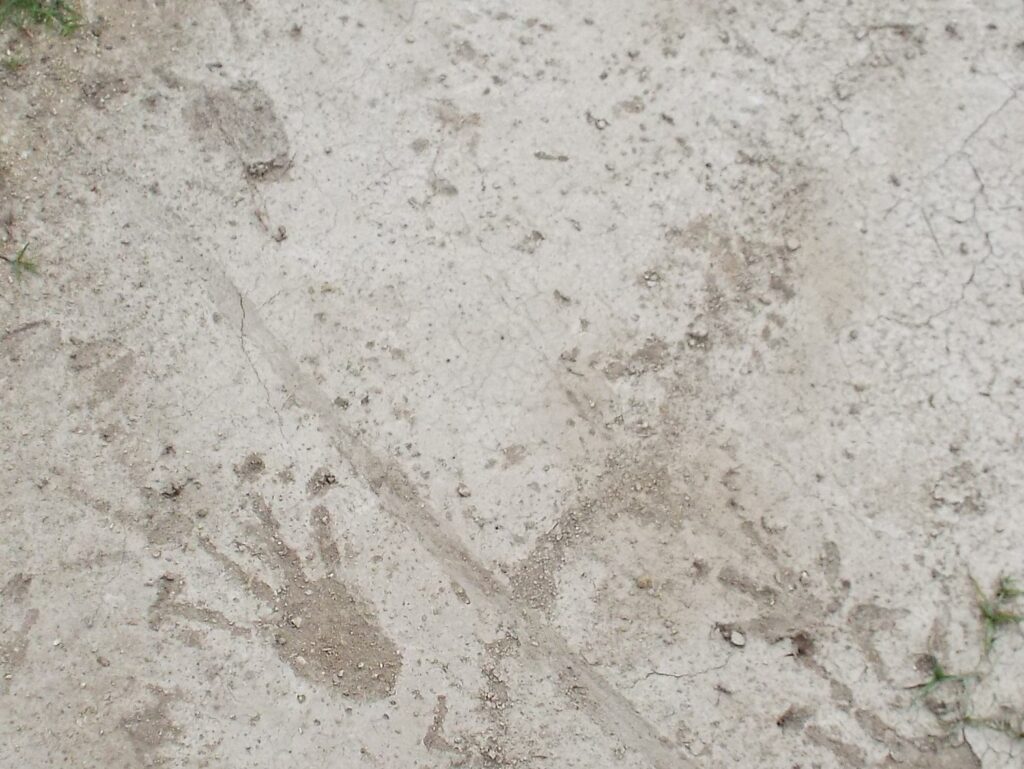
3. American Alligator
The tracks of the American Alligator are hard to mistake. Alligators produce the largest tracks of any of our wildlife. Look for handprint shaped tracks that can exceed a foot in length with long toes, claw marks, and usually accompanied by a tail drag.
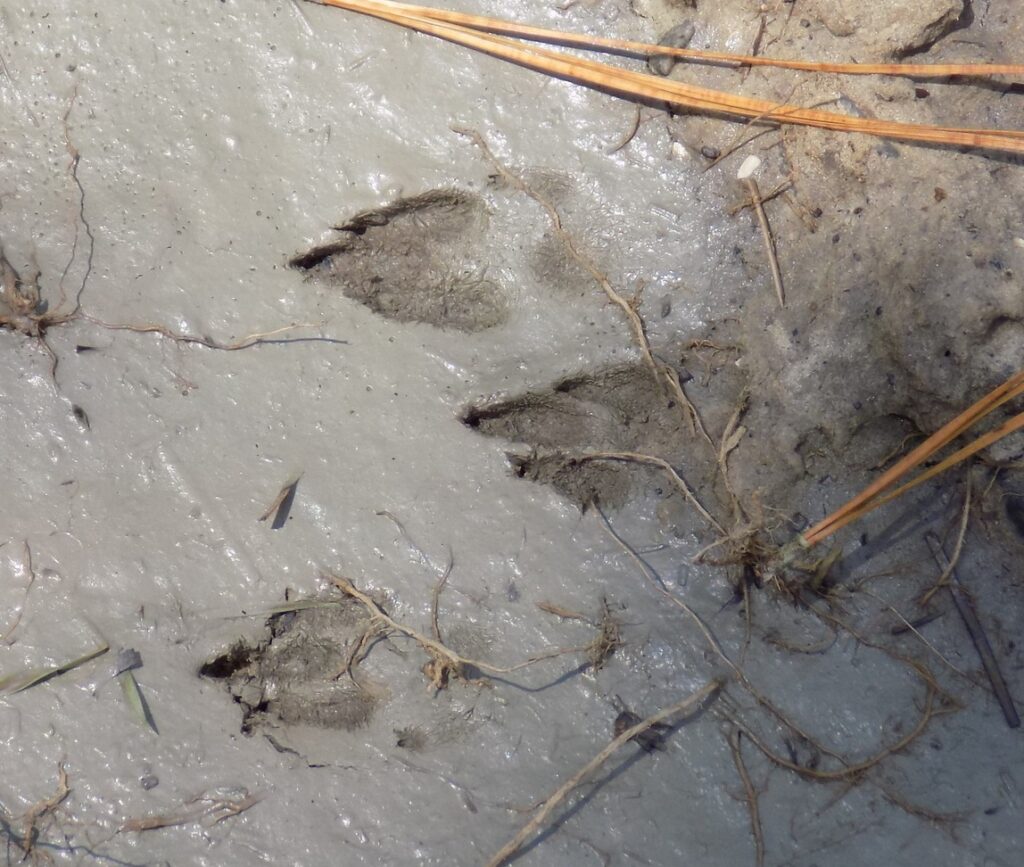
4. Marsh Rabbit
The tracks of Marsh Rabbits are basically identical to those of the Eastern Cottontail, but the latter rarely ever ventures onto marsh flats. I’ll just be talking about Rabbit tracks in general here. Rabbits have pointed, asymmetrical, 4-toed tracks. The gait of Rabbits is distinct. Their bounding movements leave all of their tracks bunched together with the front feet landing one in front of the other and their rear feet landing directly across from each other, outside of the front prints. The further forward the rear prints are in relation to the front prints, the faster the Rabbit was moving.
The most similar tracks to those of Rabbits are Squirrels but only in gait. Squirrels also travel in a bounding motion but they have 5 rear toes, symmetrical front feet, and thinner, more hand shaped prints. Squirrels never venture into the salt marsh, where Marsh Rabbits live.
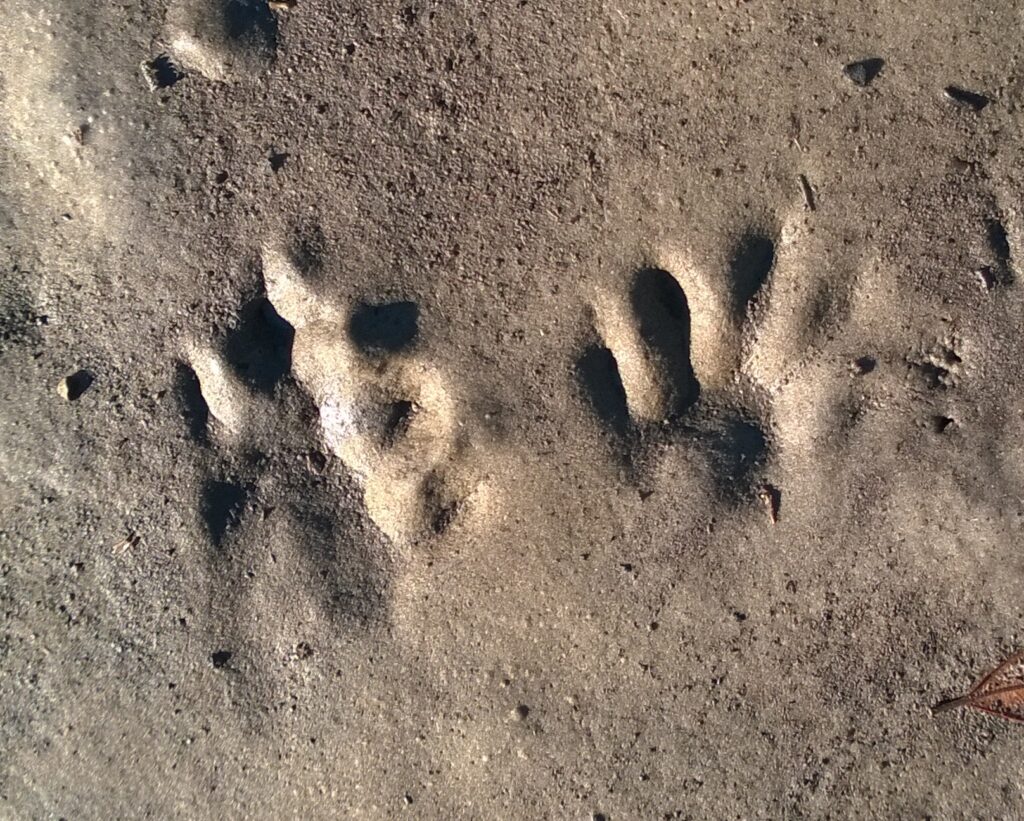
5. Common Raccoon
Raccoon tracks are incredibly common. They have 5 toes on both feet, with the rear heel being markedly larger than the front. The tracks are hand shaped with the toes having a weak claw and strong connection to the heel. Raccoons like washing their food, so look for their tracks anywhere there’s standing water, especially in pluff mud.
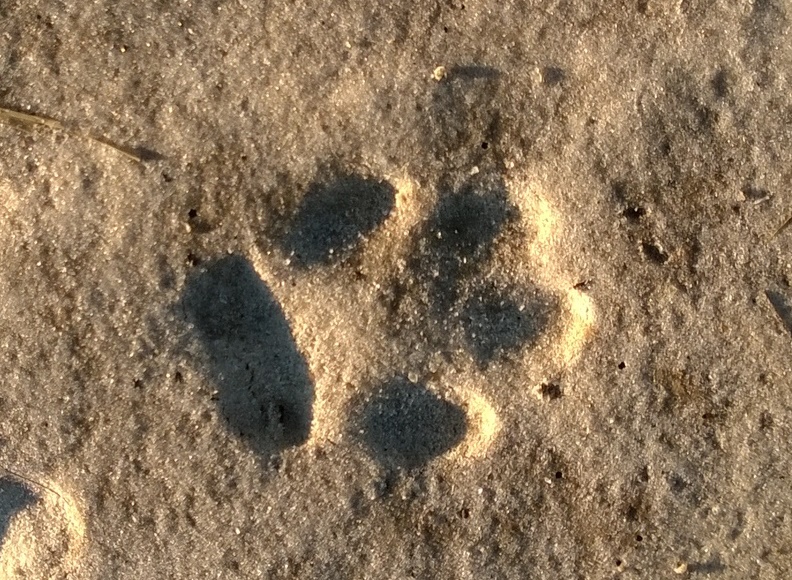
6. Coyote
Coyote tracks are symmetrical with 4 toes and distinct claw marks. They’re typically 3 to 4 inches long. Coyote tracks are very similar to those of the Domestic Dog but there are some distinctions that can help tell the two apart. Dogs, especially retrievers, have larger, wider feet. Dogs are also typically much heavier than Coyotes, who rarely exceed 40lbs. For their weight, Coyotes have large feet. This makes their tracks rather shallow, and narrow, with little claw showing. Coyote tracks are compact and oval in shape. Dogs are much bulkier, so their feet splay out and they use more claw for traction. This gives Dog tracks a circular shape and their toes spread further apart and have prominent claw marks. Foxes have similar tracks to Coyotes but the tracks are smaller in size and have a slight gap between the front and rear toes.
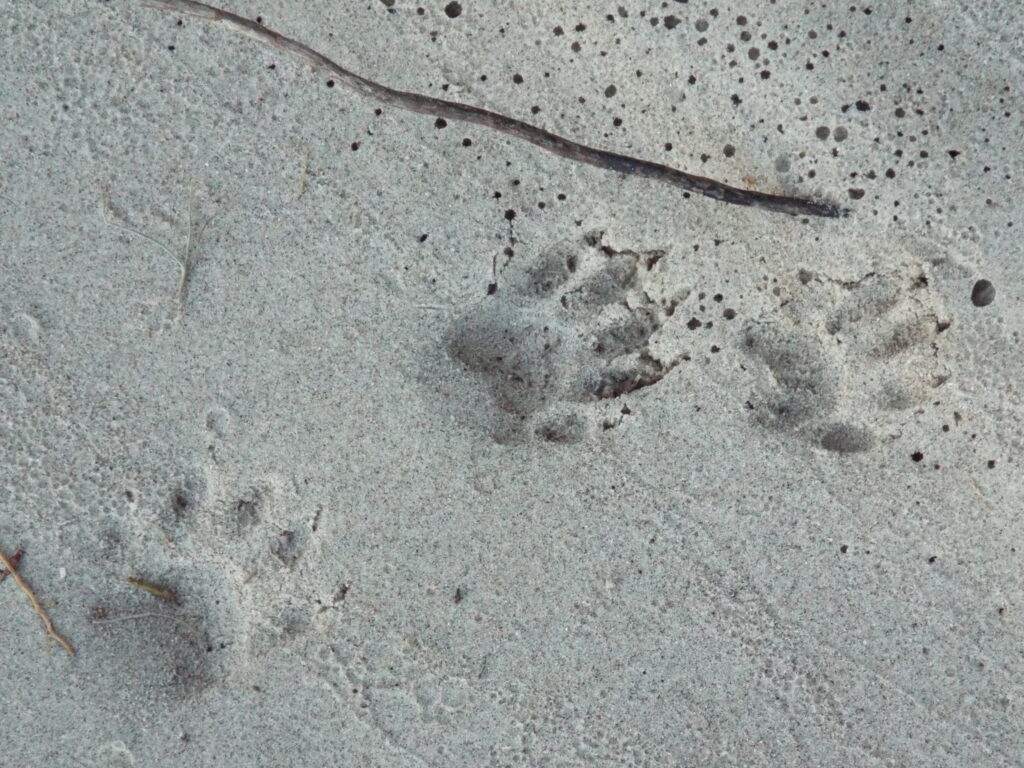
7. North American River Otter
River Otter tracks are large, have five toes, obvious claw marks, a long rear heel, and occasionally a tail drag. Otter tracks are always near water. Look for their tracks on causeways and dikes around water control structures. They resemble Mink tracks but are much larger, with front tracks up to 4 inches in length. Their chaotic, weaselly gait and playful social nature means their tracks are often a mess of several individuals bouncing and rolling around in an area.
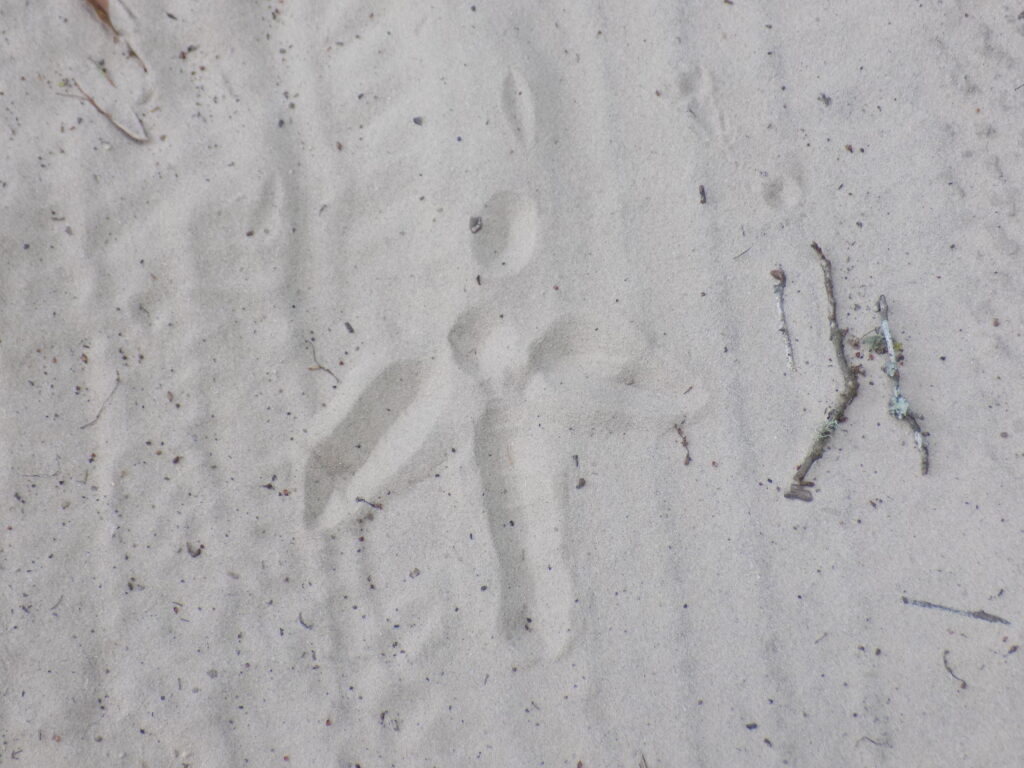
8. Wild Turkey
Turkey tracks are the one bird track you can reliably identify. They have large 3- toed tracks, a prominent heel dot, and a relatively small rear toe and claw mark. Their tracks are usually about 6 inches in length. The only other bird that commonly leaves tracks this large is the Great Blue Heron. The Turkey is significantly heavier than any Heron; this means Turkey toes are much wider. Herons have longer tracks with a prominent rear toe.
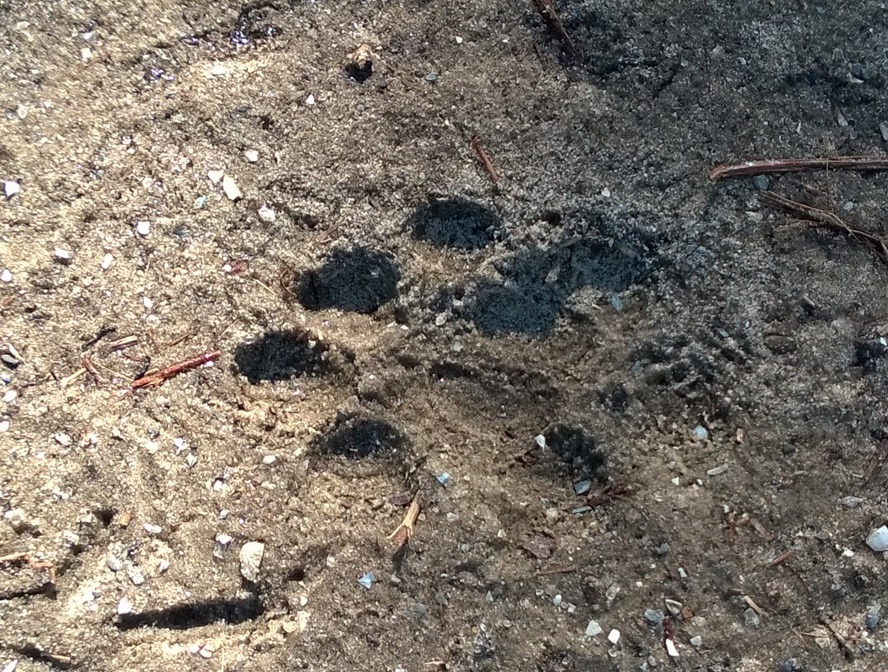
9. Bobcat
Bobcat tracks are asymmetrical with four toes and no claw marks. In the Southeast, their tracks are practically identical to those of Domestic and Feral Cats. There’s no easy way to tell the two apart but their gait can be telling. Bobcats are taller and longer than Feral Cats, so their stride is longer. Bobcats also travel longer distances in search of prey than do Feral Cats. So, if you have a good enough trail, you can make a good guess about the size of that cat and how far it went. The track above is two prints on top of each other. They came from a Bobcat who I tracked after this recent snowfall. I followed her trotting tracks for over a mile through the snow.
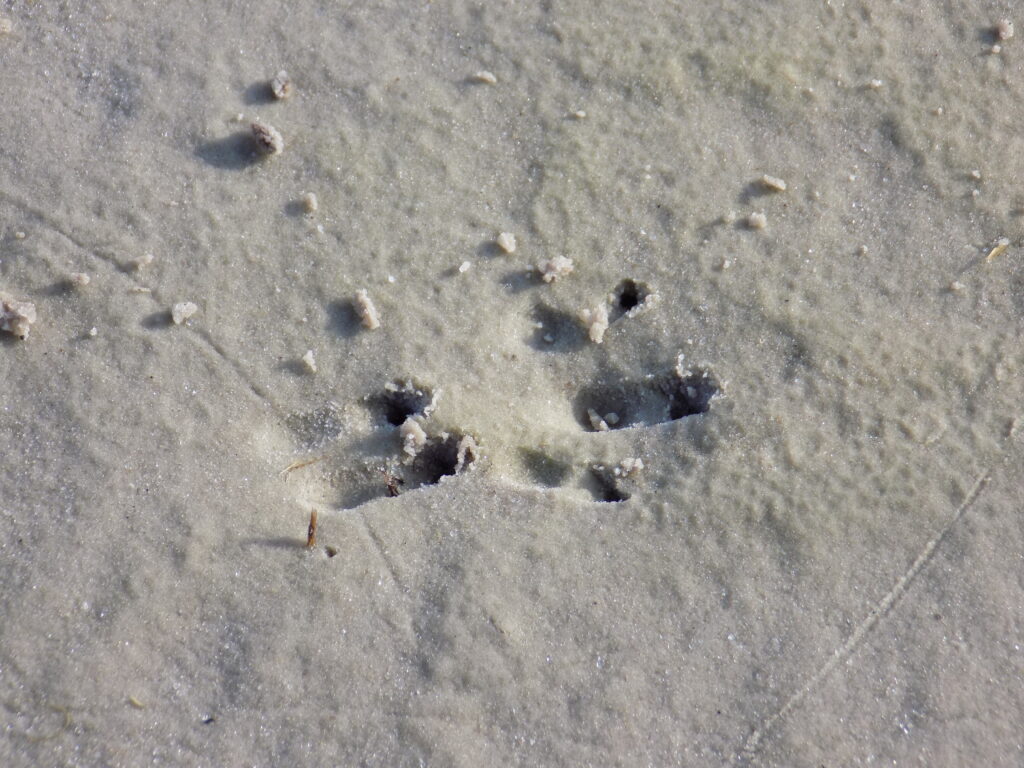
10. Nine-banded Armadillo
The Nine-banded Armadillo has a track like no other in our area. Typically, their front track is two toe/claw marks and their rear three but occasionally they have 4 and 5 respectively. Like a lot of four-legged mammals, when walking Armadillos move both legs on one side of the body at once, placing the rear foot in front of where the front foot just was. This creates a strange looking “5-toed” track, like in the picture above, with 3 toes in front and 2 in back but in reality it’s two tracks, one ahead of the other.
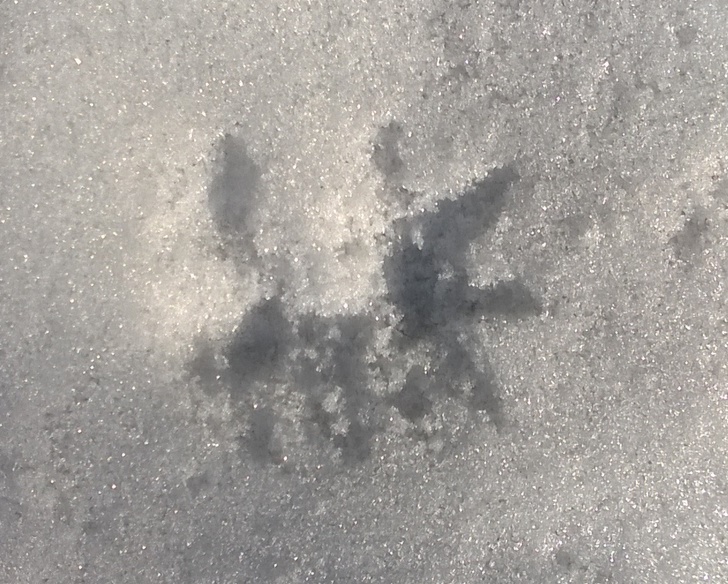
11. Virginia Opossum
The Virginia Opossum is another mammal with an unmistakable set of tracks. I rarely see their tracks but there’s no question about who made them when I do. Opossum tracks have five toes on both feet and the front and back feet are very differently shaped. The front track is shaped like a stubby, wide open handprint and the rear track like a closed hand with a thumb that points in almost the opposite direction from the fingers. The photos above are in snow, so it’s a bit difficult to make out the fingers. These wonky feet are built for climbing trees. Their wide grip allows them to easily scale trees and walk along branches.

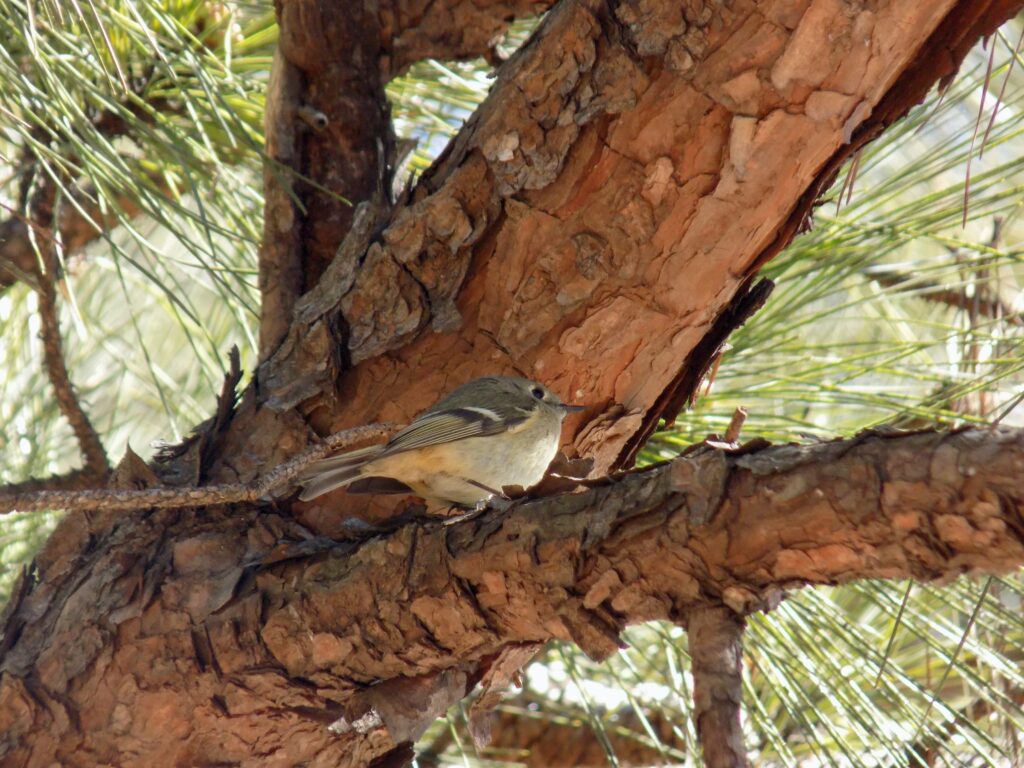
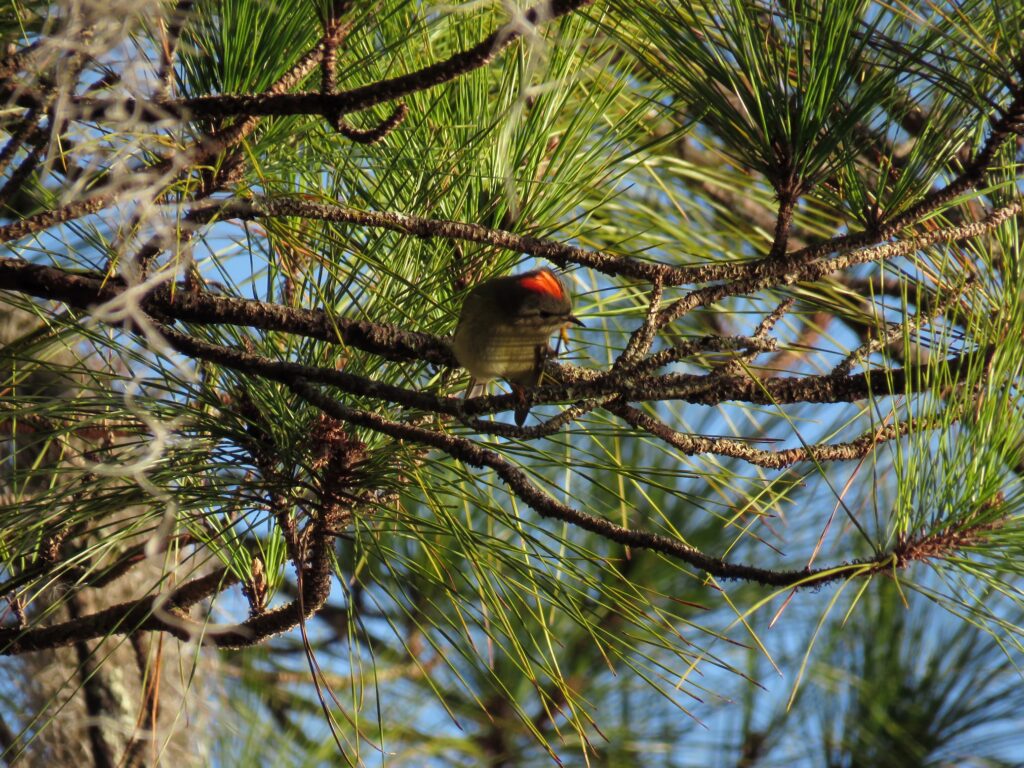
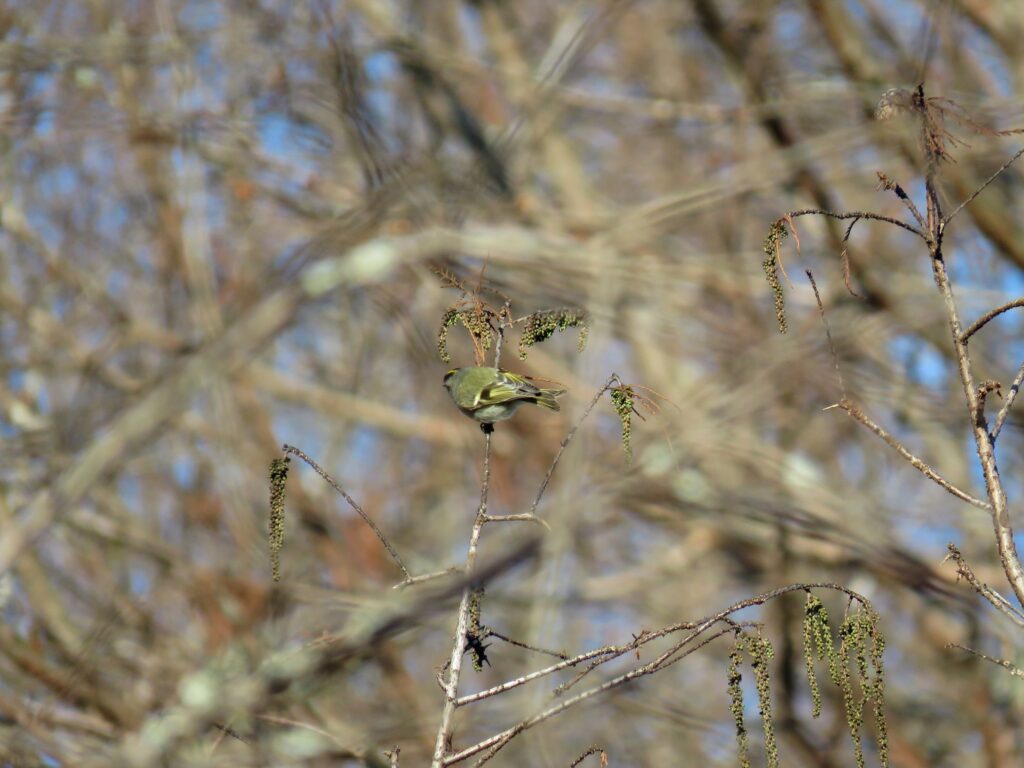
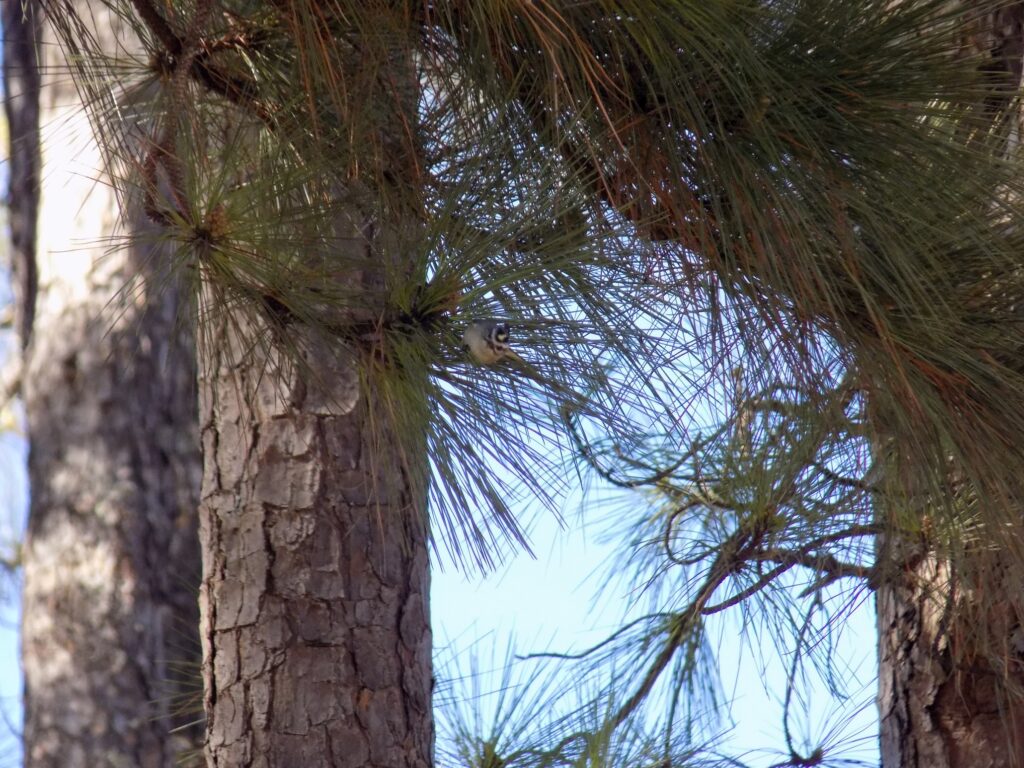
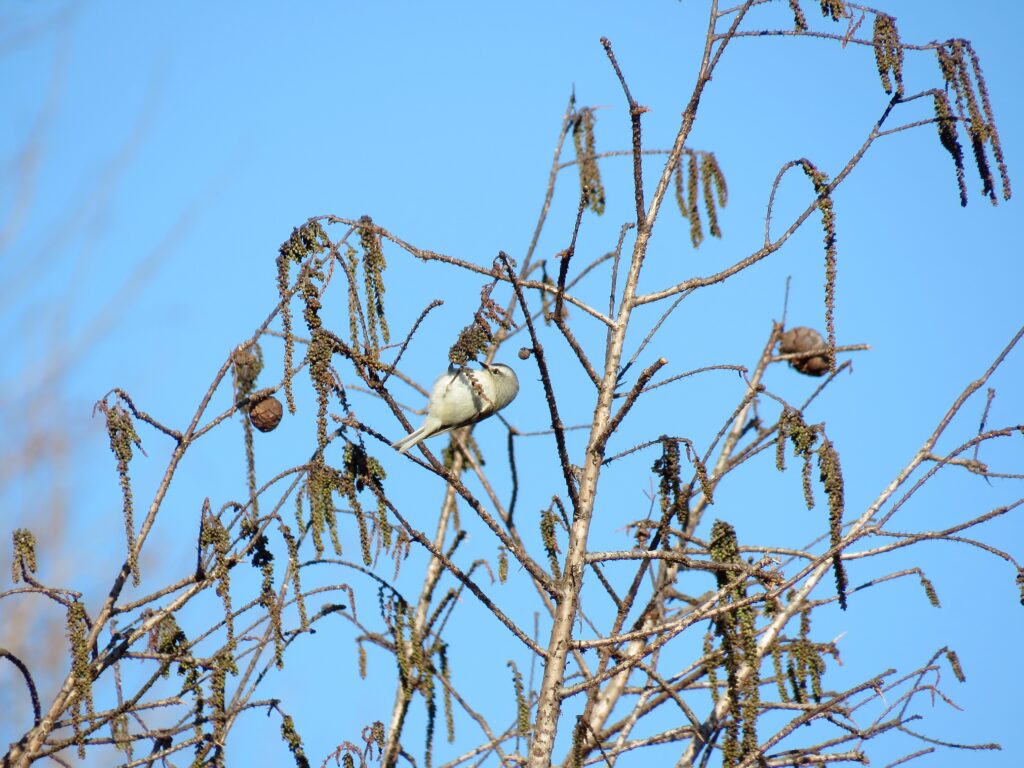
This week for Flora and Fauna Friday, we’re looking at a pair of birds that we welcome to our state every winter, the Kinglets.
There are two species of Kinglet that migrate to our state: the Ruby-crowned Kinglet (Regulus calendula) and the Golden-crowned Kinglet (Regulus satrapa). Kinglets are tiny birds. The only SC bird smaller than a Kinglet is the Ruby-throated Hummingbird. Despite their size, Kinglets have a lot of energy and personality. Kinglets spend their days rapidly bouncing through the brush or treetops eating tiny caterpillars, moths, spiders, beetles, and other insects that are overlooked by larger leaf gleaners. Count yourself lucky if you get to watch one sitting still for longer than 3 seconds. Their small size and preference for cold weather means they need to eat constantly to keep their metabolism up and avoid hypothermia. Kinglets, especially the Ruby-crowned, are gregarious and boisterous. Ruby-crowned Kinglets often make a chattering call, much like a Wren, as they dart through brush or along forest edges. They sing a chaotic song, featuring a rapid build-up into a series of sporadic whistles, squeaks and chirps that is, once again, very Wren-like. Golden-crowned Kinglets are more reserved, issuing high pitched calls and songs from the treetops, reminiscent of a Chickadee.
The Kinglets get their name from their diminutive size and a vibrantly colored crest. Males of both species flaunt this normally subdued crest in courtship and territorial displays. As their common names imply, the Ruby-crowned Kinglet has a striking ruby-red crown and the Golden-crowned Kinglet has a fiery golden-orange crest. Apart from their hairstyles, the two species are easy to tell apart. Ruby-crowned Kinglets prefer habitat low to the ground and are most commonly seen flitting through shrubs along forest edges or in forest understories. They are olive-drab in color with an unmarked face, save for a prominent white eye-ring. Golden-crowned Kinglets are partial to the canopies of Pines, particularly in mixed forests. Their bodies are similar in plumage to Ruby-crowned Kinglets but with a pale-gray underside and a more petite build. Their face, however, is much different. They sport a sooty moustache and eye-stripe as well as a halo of coal beneath their burning crown. Kinglets are birds that are easy to find but hard to see, and even harder to photograph (evidenced by my lackluster photos). Kinglets are common visitors to backyards, so long as you have the vegetation for them to hunt in, but their tiny size and hyperactive nature let them hide in plain sight. Next time you find yourself on the forest’s edge in the cool morning air. Take a minute to listen for chatters and whistles while watching for tiny green blurs. You may just stumble upon a Kinglet, collecting its breakfast.
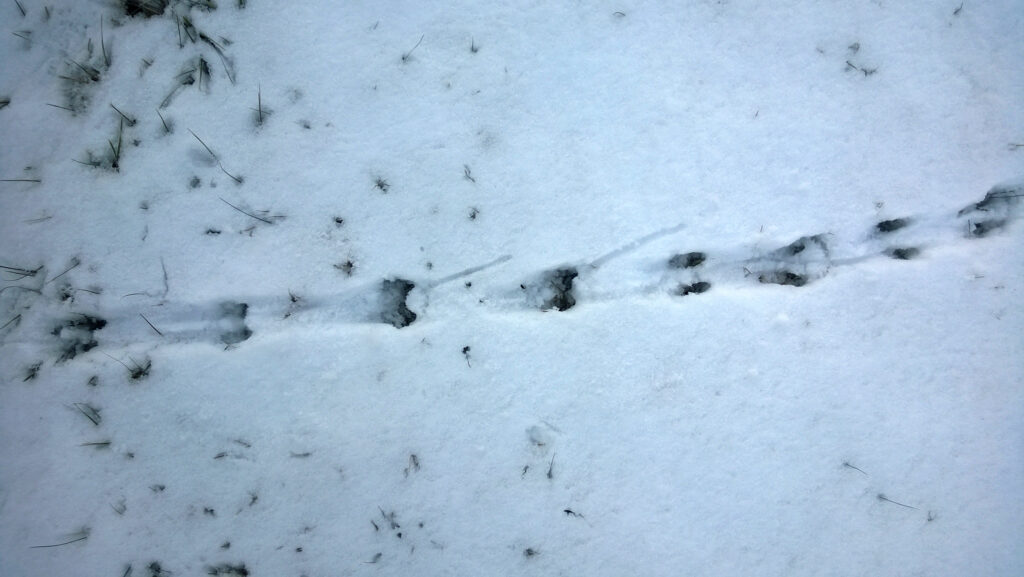
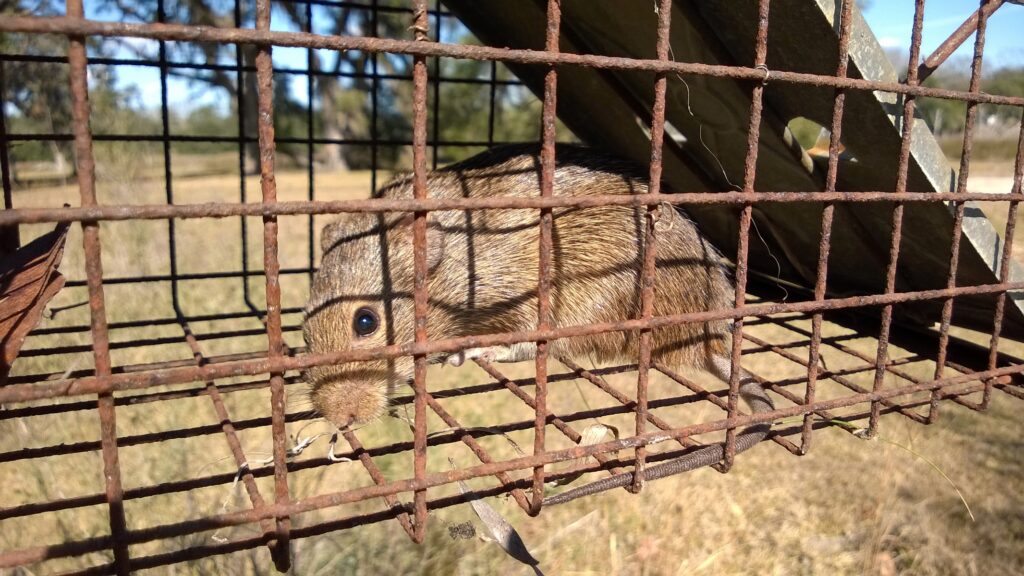
This week we’re looking at a misunderstood but ecologically important species. This week we’re talking about the Hispid Cotton Rat (Sigmodon hispidus).
The Hispid Cotton Rat is one of our three native species of Rat here in the Lowcountry. The other two are the Marsh Rice Rat (Oryzomys palustris) and Eastern Woodrat (Neotoma floridana). We also have two exotic species of Rat: the Roof/Black Rat (Rattus rattus) and the Norway/Brown Rat (Rattus norvegicus). Cotton Rats are a common mammal found throughout the state. However, they are nocturnal and live in heavy vegetation. So they’re not often seen. They inhabit grasslands, particularly: savannas, fallow fields, hayfields, salt marsh edges, and meadows.
Let’s take a look at its names to see what we can learn about them. Hispid is a term that means “covered in bristles”, which is appropriate for this rodent that’s covered in coarse fur. They get the name “Cotton Rat” from their historic abundance in cotton fields and for using balls of cotton in their nests. For the scientific name, we see the term hispid again for the specific epithet. The genus Sigmodon translates directly to “Sigma-shaped tooth” or “S-shaped tooth”. This describes the shape of their molars, which have a chewing surface that is serpentine in shape. So “Stiff-haired S-Tooth” would be an accurate translation.
These S-shaped molars are important to their diet. Hispid Cotton Rats are primarily herbivorous, eating mostly the vegetation of grasses and forbs as well as seeds and occasionally insects. Plants, particularly grasses, are difficult to digest and must be chewed more thoroughly in order to be properly digested. This requires these large, flat grinding teeth to do. The stiff fur of the Cotton Rat is also important to its lifestyle. Their stiff fur pushes out against the heavy vegetation they live within and protects their skin from sharp-edged grasses and blackberry vines.
Cotton Rats are a crucial link in the food webs of grassland ecosystems. They are a primary food source of nocturnal and crepuscular predators like Owls, Bobcats, Foxes, Coyotes, Rattlesnakes, and Mink as well as diurnal predators like Harriers, Hawks, and Rat Snakes. They also help to influence the plant community by eating the seeds and shoots of grasses, allowing for openings in the understory where less dominant plant species can establish. This in turn can improve forage for other mammals and birds as well as increase insect and pollinator diversity. Cotton Rats are not a species that inhabits human dwellings. In fact, none of our native Rats do. They may visit your bird feeder or barn at night but they’re gone by morning. They all have their own preferred habitats and nesting sites. Cotton Rats live in fields and make nests under dense grass. Rice Rats live in marshes and build nests in brush on the wetland’s edge. Woodrats live in forests and build their nest from sticks at the base of a tree or shrub. Our native Rats are important parts of the ecosystems around us and should be treated with respect and courtesy, like any other wildlife species. However, the exotic Roof and Norway Rats do not deserve such courtesies. These are the Rats that invade homes, spread disease, destroy farm equipment, contaminate livestock feed, attack pets, kill threatened and endangered wildlife, and destroy native plant communities. They have earned the spite of man and deserve no quarter on this continent. This is why I never recommend relocating Rats caught in live traps. Native Rats typically don’t need relocating and it is grossly irresponsible to release exotic Rats into new habitats. Learn to identify exotic Rats and help save our wildlife.
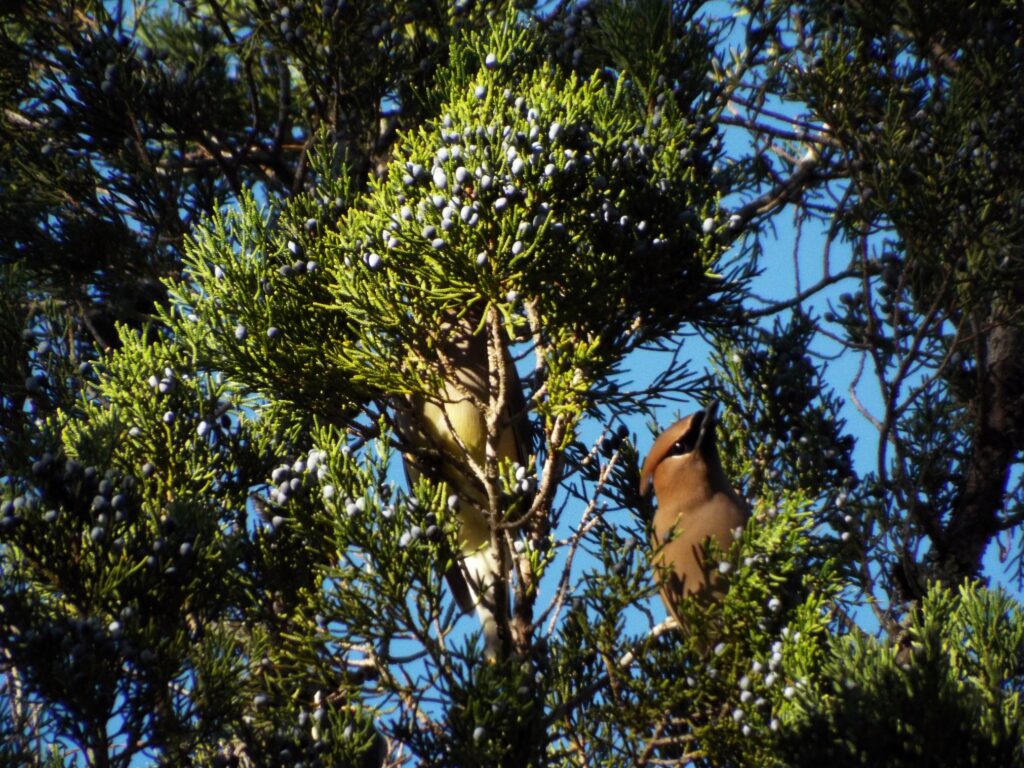
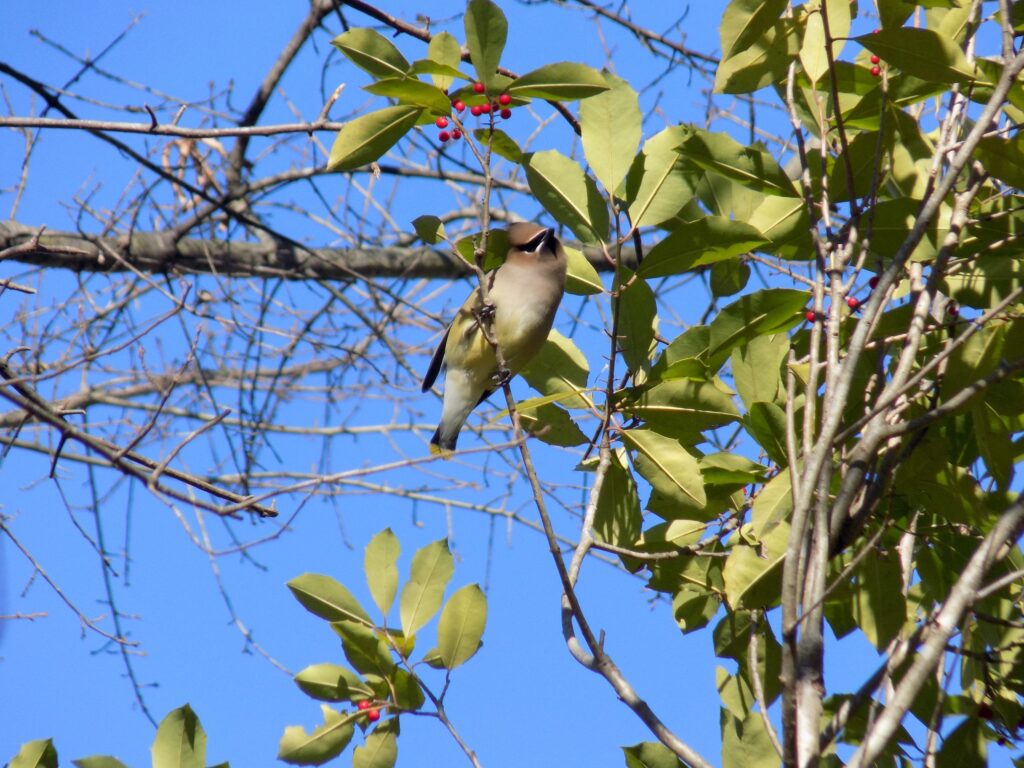

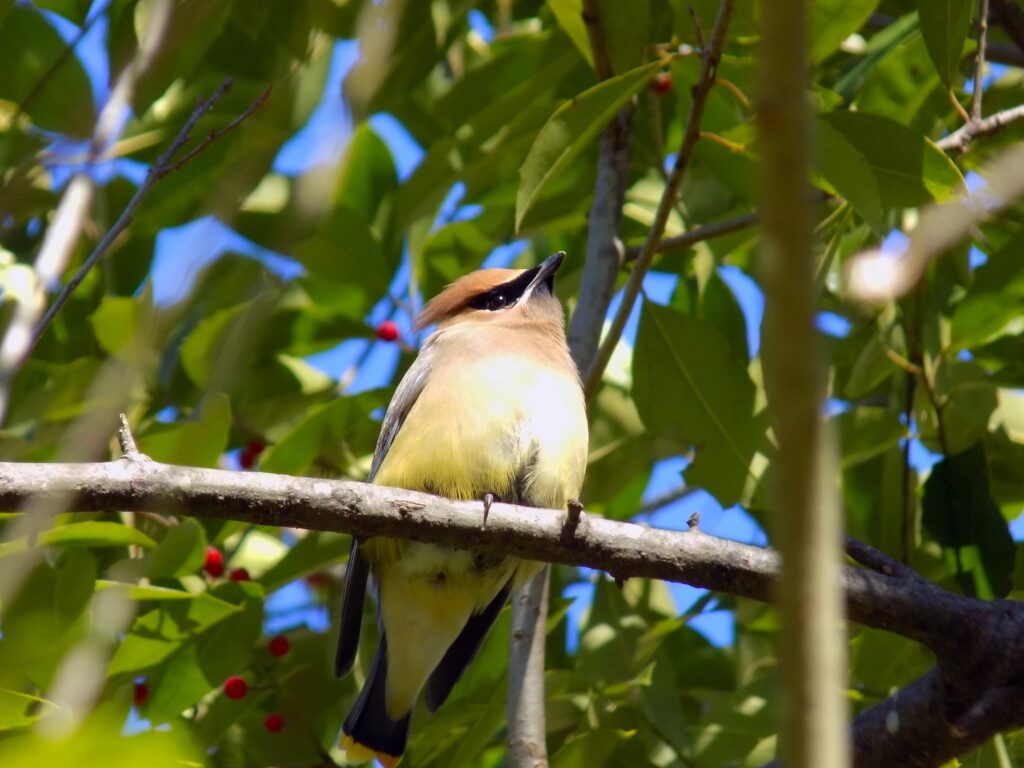
This week for Flora and Fauna Friday, we’re looking at a migratory bird that flocks to our area every winter. A golden-amber squeaky socialite; a crested berry bandit with Crayola crowned feathers. This week we’re taking a quick look at the Cedar Waxwing (Bombycilla cedrorum).
Cedar Waxwings are a medium sized songbird. They are a striking and unmistakable species. Their plumage is a blend of amber brown, golden yellow, shale gray, and snow white. The birds sport a black mask, prominent crest, bright yellow tipped tail feathers, and red waxy tips to their secondary wing feathers. Their call is a short high pitched whistle and buzz. Their whistle is very reminiscent of a distant, squeaky brake pad. (So much so that I’ve often wondered how many brake pads have been officially recorded as Cedar Waxwings during ornithological surveys.)
Like many bird species, Cedar Waxwings visit our state in the winter in search of food and warmth. They typically travel in flocks of a half dozen to several dozen birds, but rarely alone. They can usually be found perched at the tops of hardwood trees or feeding in fruit bearing trees and shrubs. Cedar Waxwings are one of the few birds in our area that feed almost exclusively on fruit. Around here you can typically find them gorging themselves on the berries of Holly, Privet, Dogwood, Cherry, Honeysuckle, Crabapple, Mistletoe, Pyracantha, and, of course, Redcedar. As their straightforward common name implies, the fruits of the Eastern Redcedar make up a large part of their diet. They also eat insects when available. Their active life style, migratory nature, and fruit based diet puts Waxwings in an interesting ecological role. They are an important distributor of plant seeds. They eat fruits whole at one location and pass the undigested seeds off at another location. The species of trees and shrubs they feed on recognize this and have brightly colored, sugar-filled fruits to entice birds into eating them. It’s a symbiotic relationship. Birds get to eat, plants get to spread their offspring far and wide, and the newly established offspring become new stop over sites for the birds during migration. A win-win. This dispersal is also important to how ecosystems recover from disturbances or changes in environmental conditions by returning old plants or introducing new ones to a degraded habitat. However, this also means that Waxwings are the primary disperser of some aggressively invasive exotic species. Species like Privets, Honeysuckles, and Eleaegnus are primarily spread to new habitats by birds like Waxwings, Robins, and Catbirds. There the seeds lie dormant in the soil until a disturbance creates a gap in the canopy and the invasives can establish. Adaptations like this can become a double-edged sword. What was originally a behavior that promoted biodiversity can quickly result in the opposite once an exotic species is able to exploit the system.
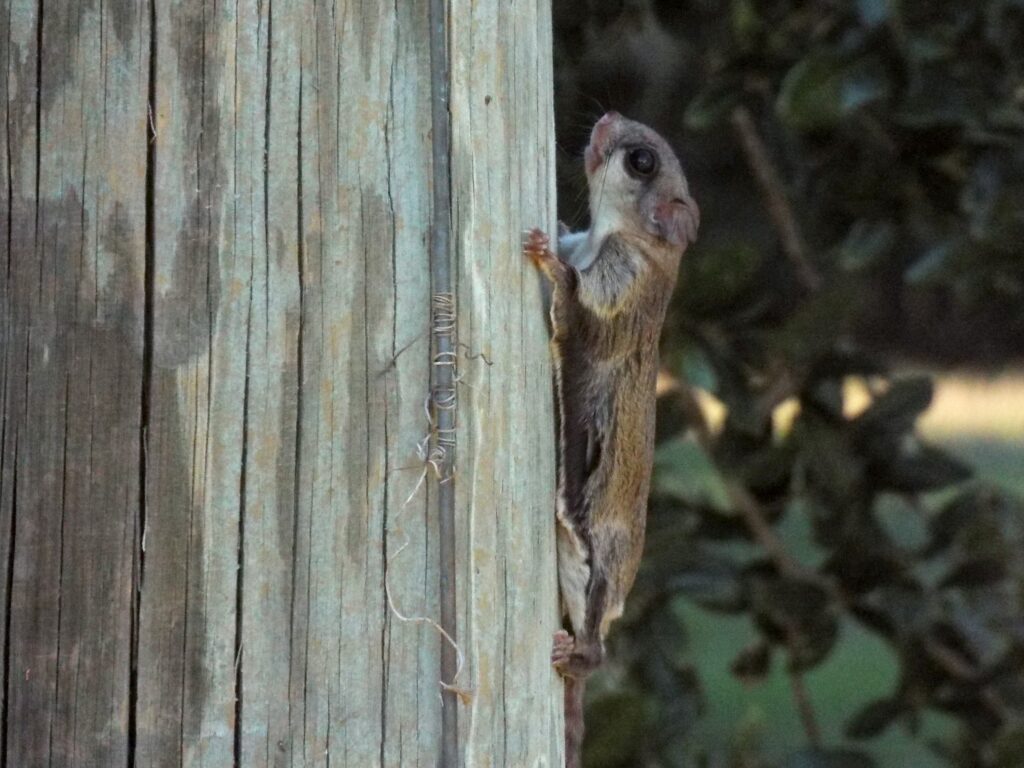
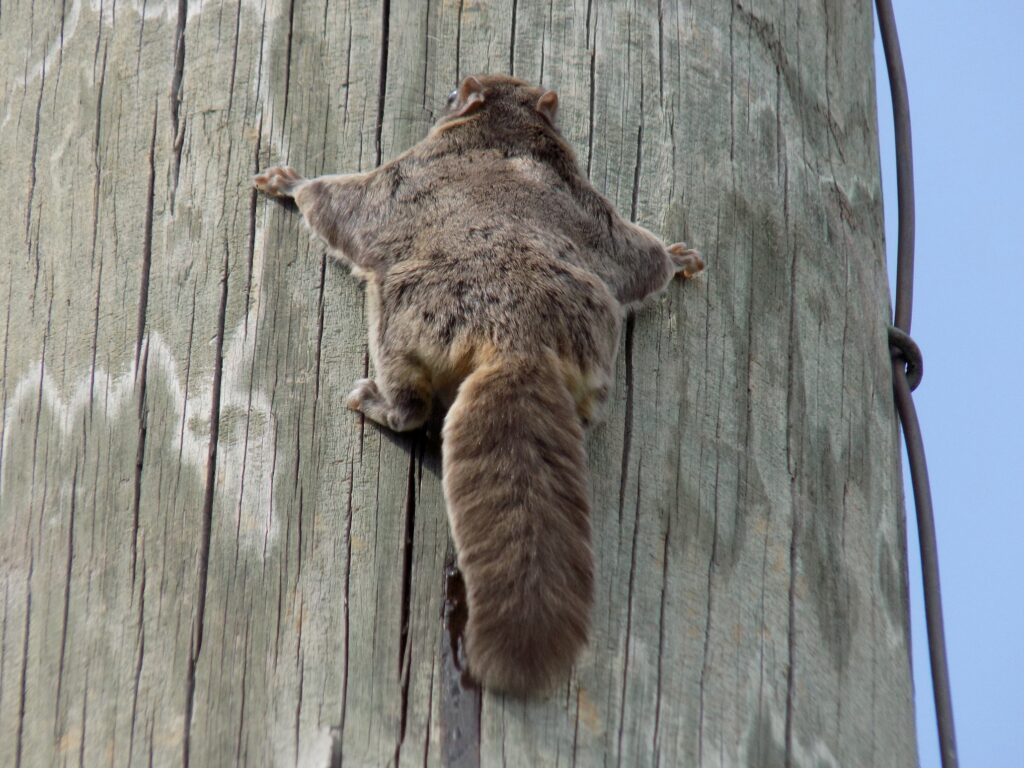
This week for Flora and Fauna Friday, we’re discussing a unique little nocturnal rodent native to the eastern US. We’re talking about the Southern Flying Squirrel (Glaucomys volans).
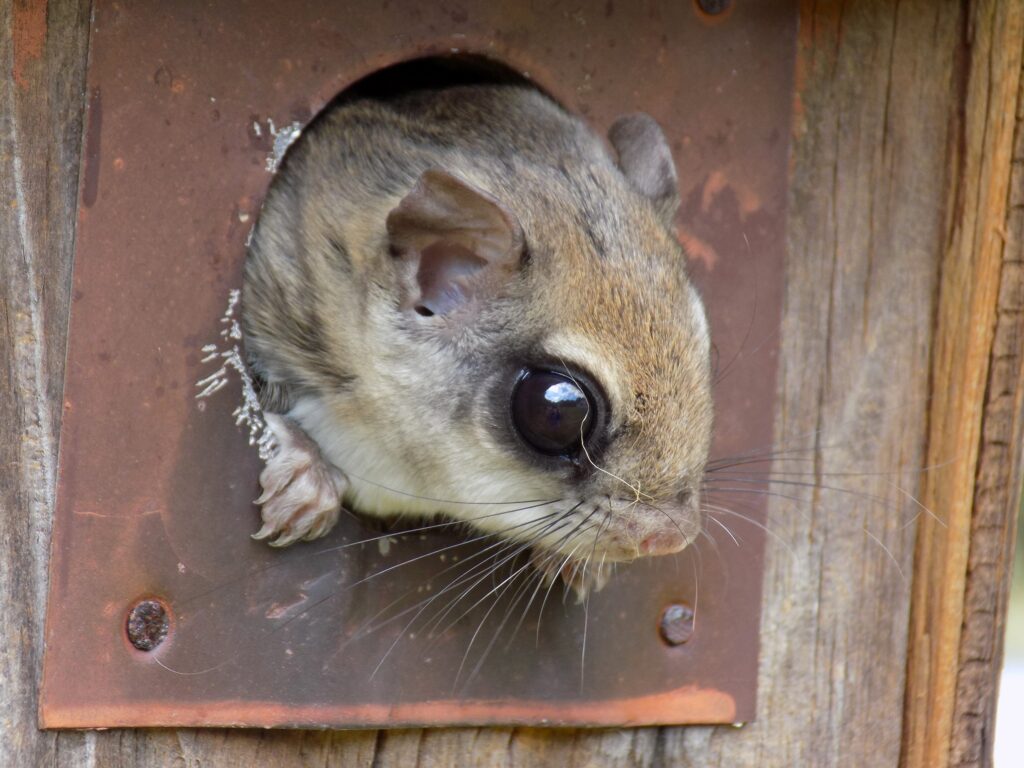
Southern Flying Squirrels are fairly small, reaching about 9 inches in length. Making them about the same size as a Cotton Rat. They have large bug eyes, a flat fluffy tail, and, of course, those flaps of skin between its legs that let it glide. Flying Squirrels can’t fly, like how a bat does, but they can glide rather well. They use their body as a parachute and their tail as a rudder. Flying Squirrels live in similar habitats to the regular old Gray Squirrel and have similar diets and life histories. Flying Squirrels inhabit hardwood or mixed forests. Being smaller, they are more omnivorous than Gray Squirrels. Their size limits their ability to access the more difficult nuts to crack. They eat nuts, berries, acorns, insects, and will even raid bird nests. They are cavity nesters and use old Woodpecker cavities for their nests. The one in the photos below has taken to nesting in one of my Bluebird boxes.
Flying Squirrels are nocturnal and their big eyes allow them to navigate the treetops at night. Flying Squirrels, like most mammals, have a structure called the tapetum lucidum. This is a specialized reflective structure in the eye that allows for improved night vision. This is the same thing that gives your cat or dog glowing green eyes at night. Flying squirrels have reddish-orange eyeshine. Humans lack this structure, so our eyes don’t reflect light at night. This structure is basically a mirror behind the retina within the eye. The retina is not perfectly efficient at sensing light and some will pass through undetected, only to be absorbed by the back of the eye. What the tapetum lucidum does is reflect this lost light back through the retina. This gives the animal’s retina a second opportunity to sense that light. Any light that is not “seen” this second time comes back out through the cornea. This reflected light is what we see as eyeshine.
The scientific name, Glaucomys volans, like other species we’ve discussed, tells us a little bit about the species. The specific epithet “volans” is Latin for flying. Pretty straight forward. The genus “Glaucomys” is a compound word with glauco meaning blue-gray or silvery and mys meaning mouse. Also straight forward. So, this species is simply named “flying gray mouse”. Flying Squirrels are very common in the hardwood forests of our area. However, due to those big eyes, they are entirely nocturnal. This makes them hard to and many people have never seen one. Luckily, this time of year is the best time to find one. Flying squirrels are rather vocal in the winter as they are gearing up for their winter breeding season. I hear them in the woods every week. They emerge once the sun has fully set and will begin call to each other, especially if they think you’re trespassing under their trees. They make a repetitive series of very high-pitched squeaks and when these squeaks come from 20ft up a tree, there’s no mistaking who’s making them.
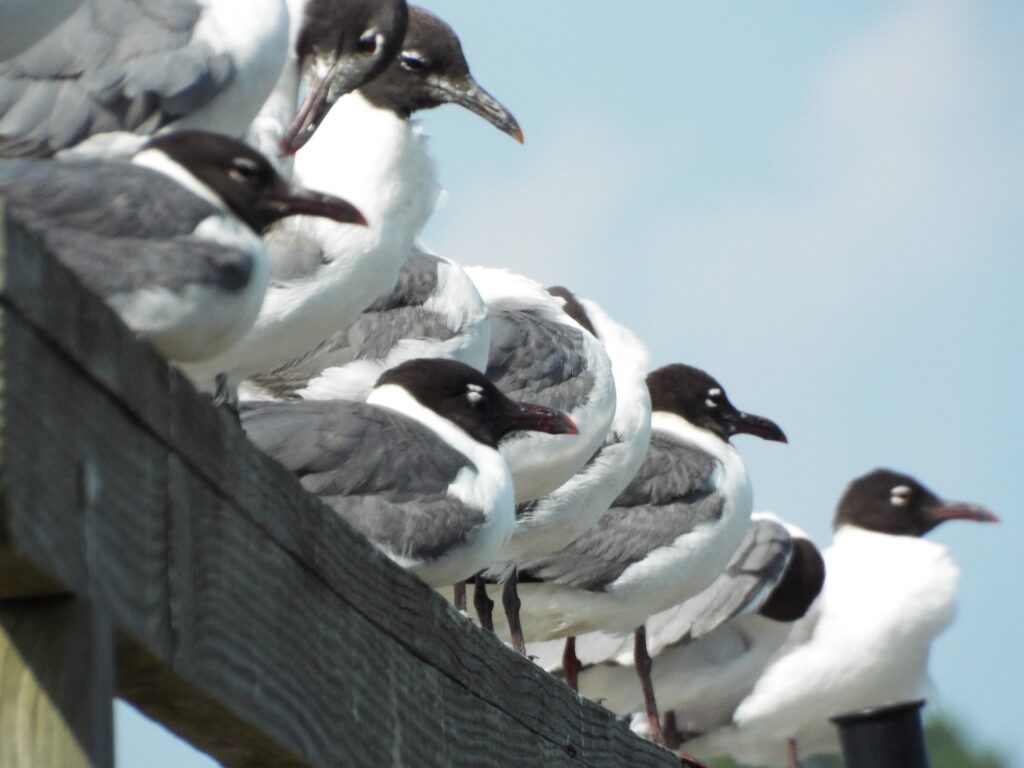
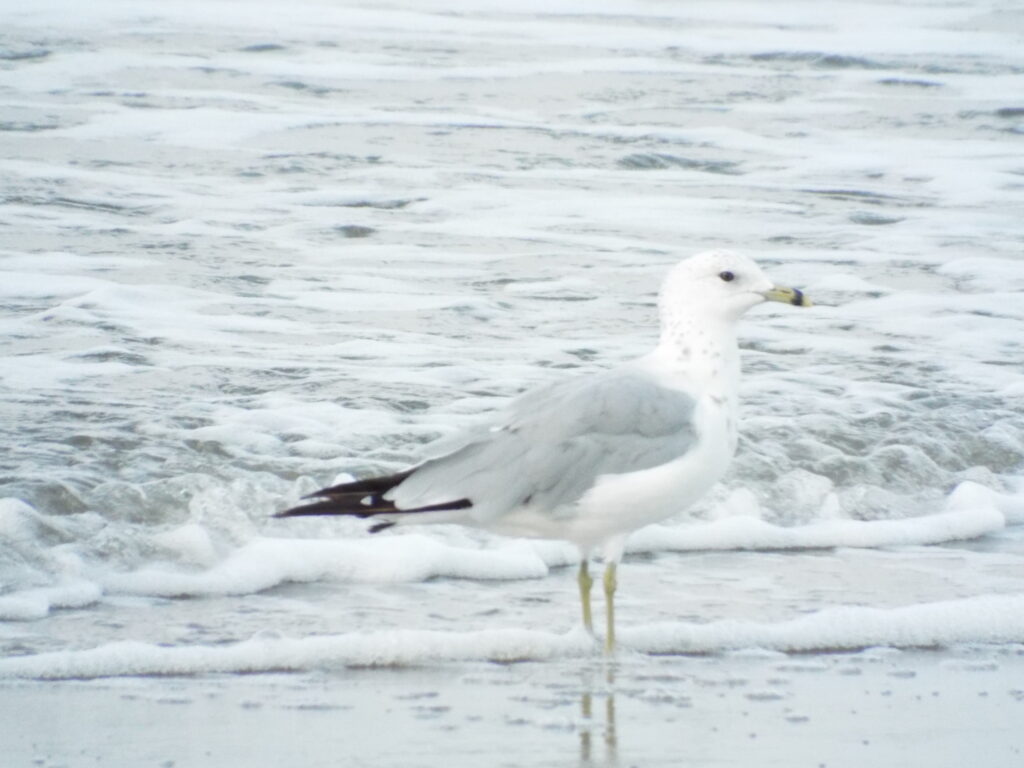
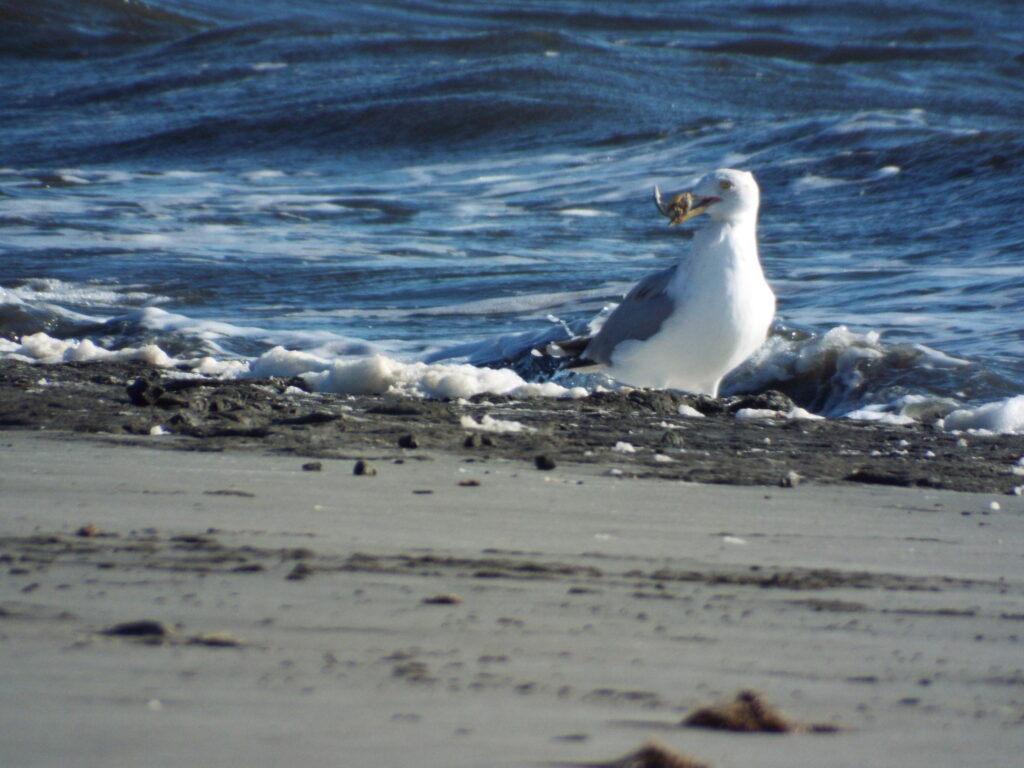



This week for Flora and Fauna Friday were taking a look at a clade of seabirds that are best represented on Edisto in the Winter. We’re talking about the Gulls.
First things first, the term seagull is not linked to any taxonomic designation. The proper term is just Gull. It’s semantics but that’s why I use the term Gull instead. Gulls are members of the family Laridae. This family includes Terns, Skimmers, Noddies, and Gulls. I’ll just be talking about Gulls, and only the 6 most common species in our area. Those species are the: Laughing Gull, Ring-billed Gull, Herring Gull, Bonaparte’s Gull, Lesser Black-backed Gull, and Great Black-backed Gull. I’ll spare you the Latin, this time.
Gulls are equally at home in the air, on the water, and on the ground They typically stay close to tidal systems, hence why people call them seagulls. Gulls can be quite challenging to identify because they take several years to reach sexual maturity and many have distinct winter and summer molt patterns. At each molt on their way to maturity, their feathers take on a new pattern that incrementally comes closer to that of the adult. These immature molt patterns can look remarkably similar across species, and without a size reference, can make ID difficult, even for seasoned birders. Gulls are opportunistic omnivorous seabirds that will eat anything that suits their fancy. They are primarily carnivorous and will hunt fish, crabs, shrimp, shellfish, rodents, insects, and even shorebirds. They are also scavengers and will eat any carrion that washes up on the shore. Most are also kleptoparasitic, meaning they steal food or other resources from other animals. Gulls are also well renowned for their ability to adapt to human environments and structures, such as marinas, Wal-Mart parking lots, and garbage dumps. That’s thanks mostly to their bold nature and opportunistic diet. This makes them equally at home feeding above a school of fish on the open sea, stealing a Tern or fisherman’s catch, swallowing wayward hotdogs whole at a ballpark, or picking at kitchen scraps at the municipal dump. This is an important ecological niche that Gulls, along with Crows, fill and their adaptability helps fill ecological voids that might otherwise be exploited by more harmful invasive species, such as Black Rats and Feral Pigeons.
In our area two species of Gull dominate the inland and coastal habitats. Those are the Laughing Gull and Ring-billed Gull. Let’s talk about the Laughing Gull first. The Laughing Gull is our most common Gull and dominates the island in the warmer months. In the winter, some head further south but they are always present in number year round. They are named for their distinct call, which sounds a lot like laughter. The laughing gull is our second smallest gull and is easily identified by its size, dark legs and bill, slate gray back, and dark head in summer.
The Ring-billed Gull is our most common gull in winter, especially inland from the barrier islands. It and the next 4 gulls are all primarily winter residents of the island. The Ring-billed Gull is a medium sized gull that’s noticeably larger than a Laughing Gull. They are paler in appearance, lacking any markings on the head. They are identified by their yellow legs, pale gray back, and yellow bill with a conspicuous black ring.
The Bonaparte’s Gull is our smallest Gull. It’s seen on the open water along the coast. They tend to flock and hunt sea life more than other Gulls which typically scavenge alone. They are easily recognized by their diminutive size, slender frame, small thin bill, pink-orange legs, pale wings, and a small black spot behind their eye in the winter.
The Herring Gull is one of our larger Gulls. It’s most abundant in the winter but immature birds can be seen fairly regularly along the coast in the summer. They look quite similar to the Ring-billed Gull but the Herring Gull is substantially larger, has pink legs, and a heavier bill with a red spot on the bottom tip of the bill.
The Lesser Black-backed Gull is also a large Gull and is much less abundant than the other Gulls mentioned. It is restricted to the immediate coast in our area. They are primarily winter residents but immatures occasionally stick around over the summer. It looks very similar to the Herring Gull and is only slightly smaller. The Lesser Black-backed Gull is best distinguished by its yellow legs and slate gray back.
The Great Black-backed Gull is our largest Gull. It is substantially larger than even the Herring Gull. In flight they always give me the impression of a compact Bald Eagle, especially from above. They are also fairly uncommon and restricted to the beachfront. They look quite similar to the Lesser Black-backed Gull but the Great Black-backed Gull is distinctly larger with pink legs and a back ranging from slate gray to charcoal black.
I’ve included photos of adults each species (some much better than others) and for fun I also included a distant photo of multiple species to give an idea of what makes this group difficult to ID.
Whether we may want to or not, we share our island, our beach, and the handrails of our docks and boats with Gulls. No matter how tough things get, they’re a group of species that’s here to stay. I hope you learned something about these birds beyond their proficiency at whitewashing decking lumber or swallowing half-eaten hamburgers. We should have an appreciation for the group’s species richness and their place in our coastal ecosystems.
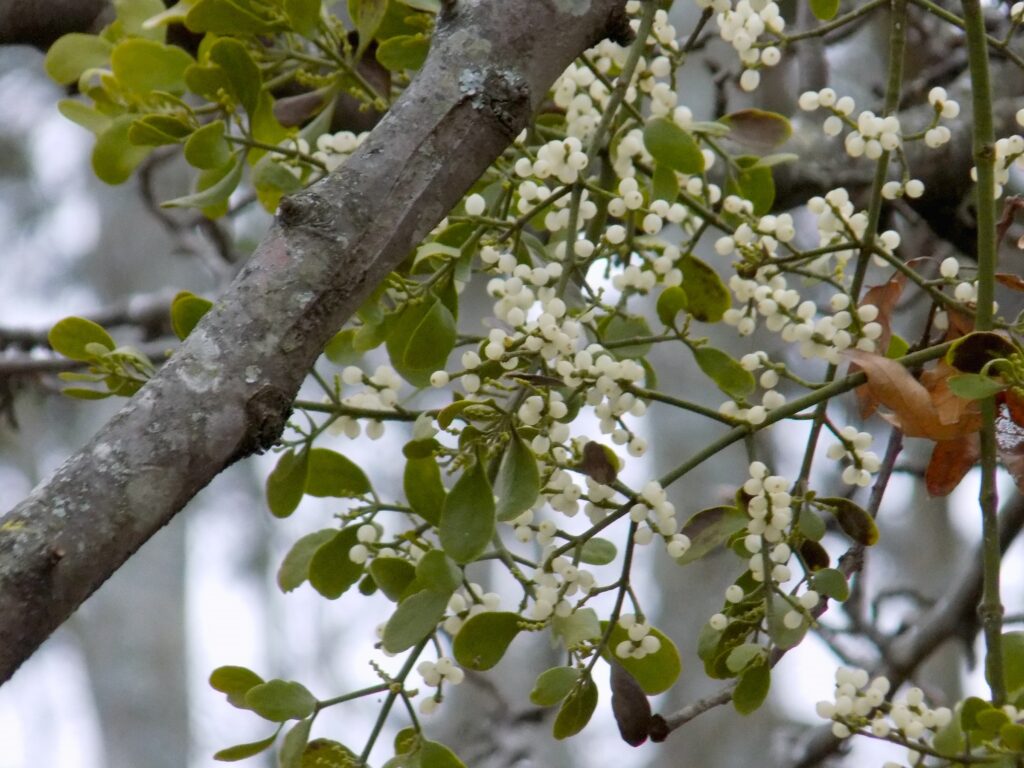
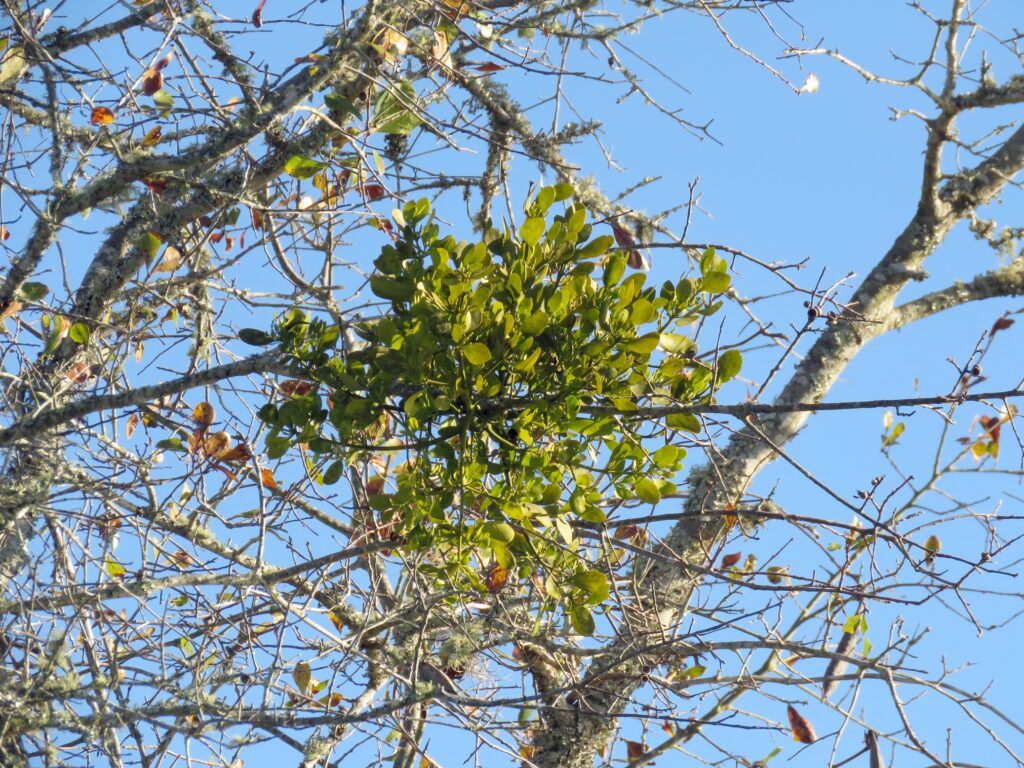
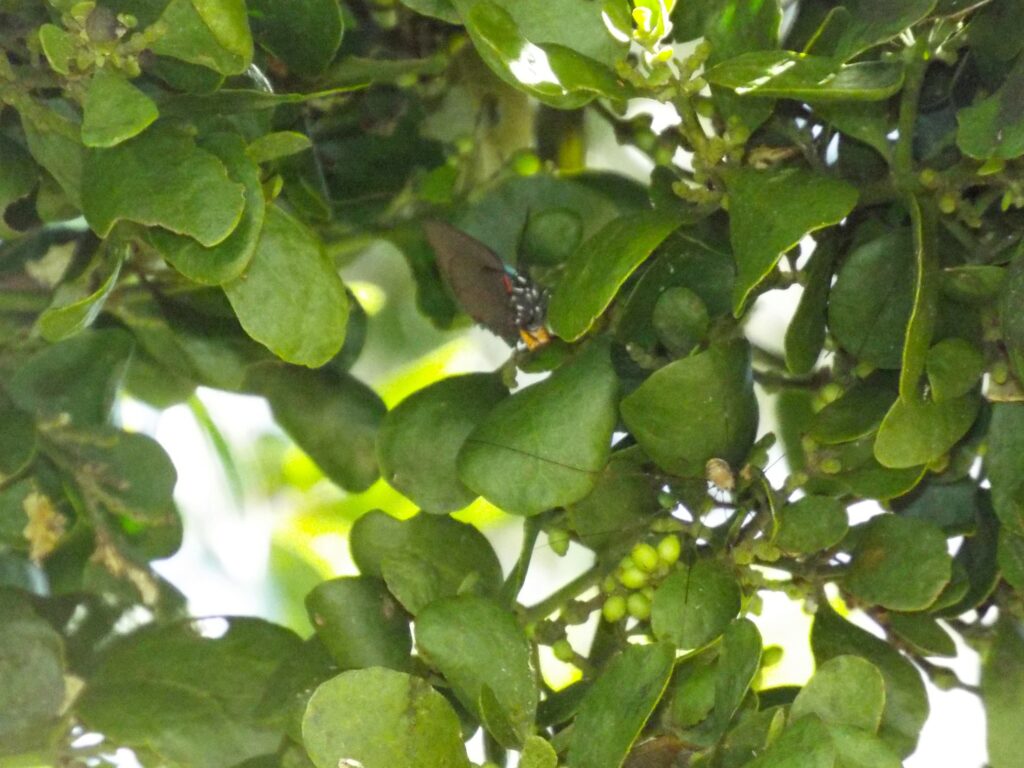
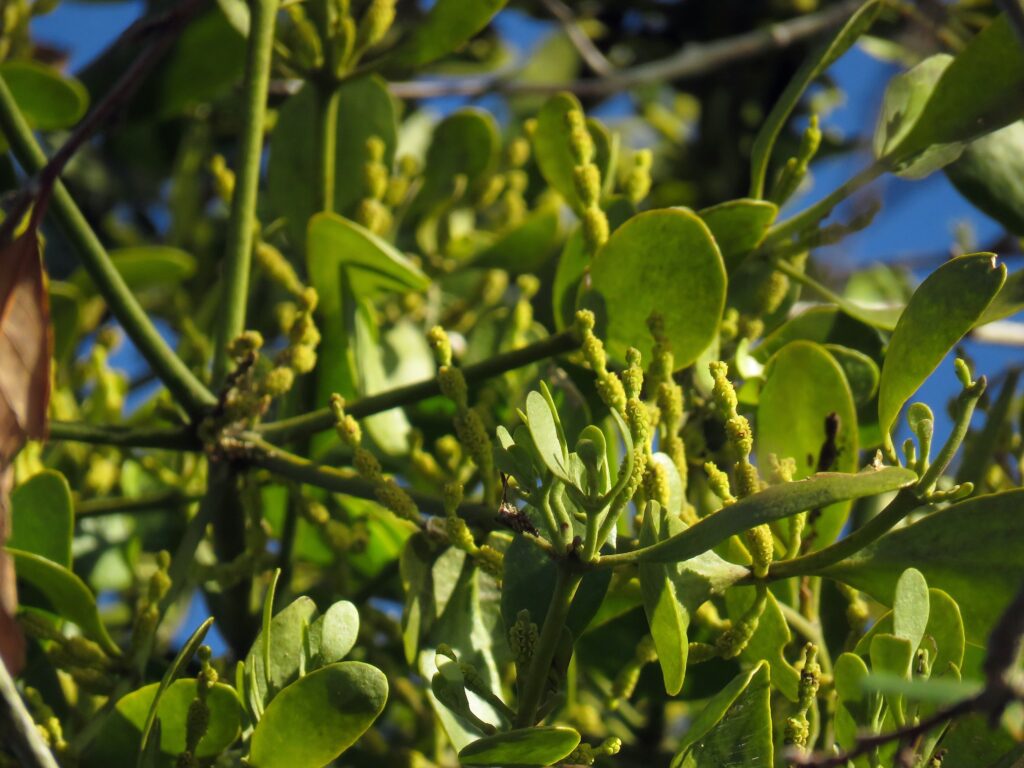
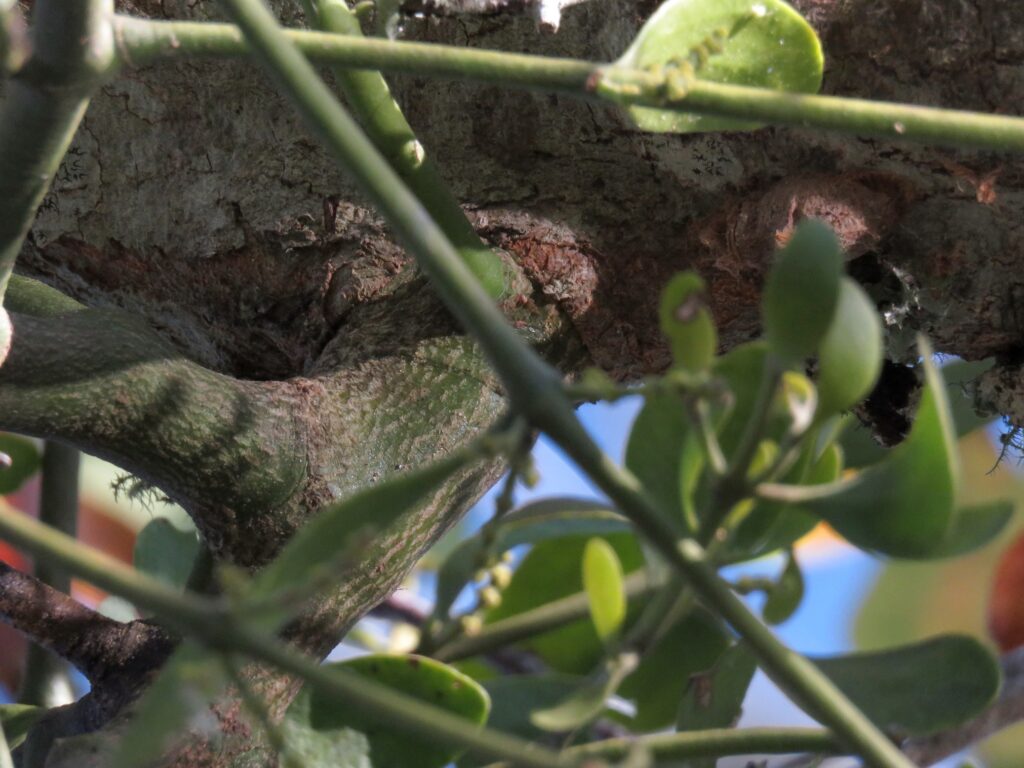
This week for Flora and Fauna Friday, were looking at our third and final festive plant. This partial parasite is a common site dangling from deciduous trees and doorways alike: Oak Mistletoe, Phoradendron leucarpum.
Oak Mistletoe is one of many species of Mistletoe found throughout the US but the only species found here in the Southeastern US. It is a small shrub with thick, leathery, evergreen leaves and pearl-white berries. However, unlike most shrubs it grows not on the ground but high in the air. Oak Mistletoe is parasitic in nature. It grows on and inside the branches of deciduous hardwood trees. I’ll go in depth on this later.
Oak Mistletoe is one of those species whose names say quite a lot about it. First, let’s dig into its scientific name, Phoradendron leucarpum. The specific epithet, leucarpum, translates directly as “White-Fruit” and this species indeed has prominent white fruits. The genus name, Phoradendron, can be interpreted one of two ways. The direct translation is along the lines of “Beared/Carried by Trees” but it can also be interpreted as “Thief of Trees”. Both of these translations are correct in regards to the biology of Mistletoes. Mistletoes are both supported physically and nutritionally by their host trees and they also steal nutrients and water from their host. So an appropriate translation of the scientific name could be “The white-fruited plant that steals from and is supported by trees.” The common name, Oak Mistletoe, sheds some light on the plant’s life history. It makes it rather obvious that Oaks are a common host for the species. Additionally, the term “Mistletoe” is derived from middle English word “Misteltan”, which is a compound word for “excrement” and “twig”. The plant is, in fact, dispersed by bird droppings that land on twigs.
Oak Mistletoe starts life as a seed, on a twig, in a pile of bird droppings. From there it germinates and quickly adheres itself to the bark of the host. Then the plant produces roots that penetrate the bark of its host and enter its vascular tissue. From here on out, Mistletoe grows like any other evergreen shrub. However, instead of spreading its roots through the soil in search of water and nutrients, it roots into the flesh of a tree and absorbs water and nutrients straight from its host. Oak Mistletoe is only a hemi-parasite. It photosynthesizes nearly all of its own food but it relies on a host for water and nutrients. As the branch of the host plant grows, so does the Mistletoe. It can reach about the size of a yoga ball. In our area, I most commonly find Oak Mistletoe growing on the branches of Water Oaks and Laurel Oaks but it can be found on many species of deciduous hardwood including Maples and most Oaks. Mistletoe photosynthesizes throughout the winter, so it prefers deciduous trees. Evergreen trees, like Live Oak, typically don’t allow enough light through their canopy for Mistletoe to survive. The fruit of Mistletoe matures in winter and is an important food source for many bird species, especially Bluebirds, Cedar Waxwings, and Northern Mockingbirds. Oak Mistletoe is also the host plant for the Great Purple Hairstreak, the largest species of Hairstreak butterfly in North America. Oak Mistletoe can be harmful to trees as it causes extra water stress in summer and the added weight can break branches. However, it is typically not an issue for healthy trees or if it is only present in small quantities.
The tradition of kissing under the Mistletoe dates back to Norse mythology and the legend of Baldur. I won’t re-tell the tale but it ends with Mistletoe becoming a conduit for a goddess’s “kiss” or blessing to all who pass beneath the plant. From this legend our modern tradition eventually evolved. Oak Misteltoe provides a blessing to wildlife who visit it too. It is an important food source for wildlife and acts as a conduit that harvests resources from its host tree and distributes it to wildlife during the hardest months of the year. Throughout the year it supports one of our most striking species of butterfly.
Oak Mistletoe may be a parasitic mooch and a re-gifter at that but even it is well versed in the spirit of giving. Have a Merry Christmas and Happy Holidays!
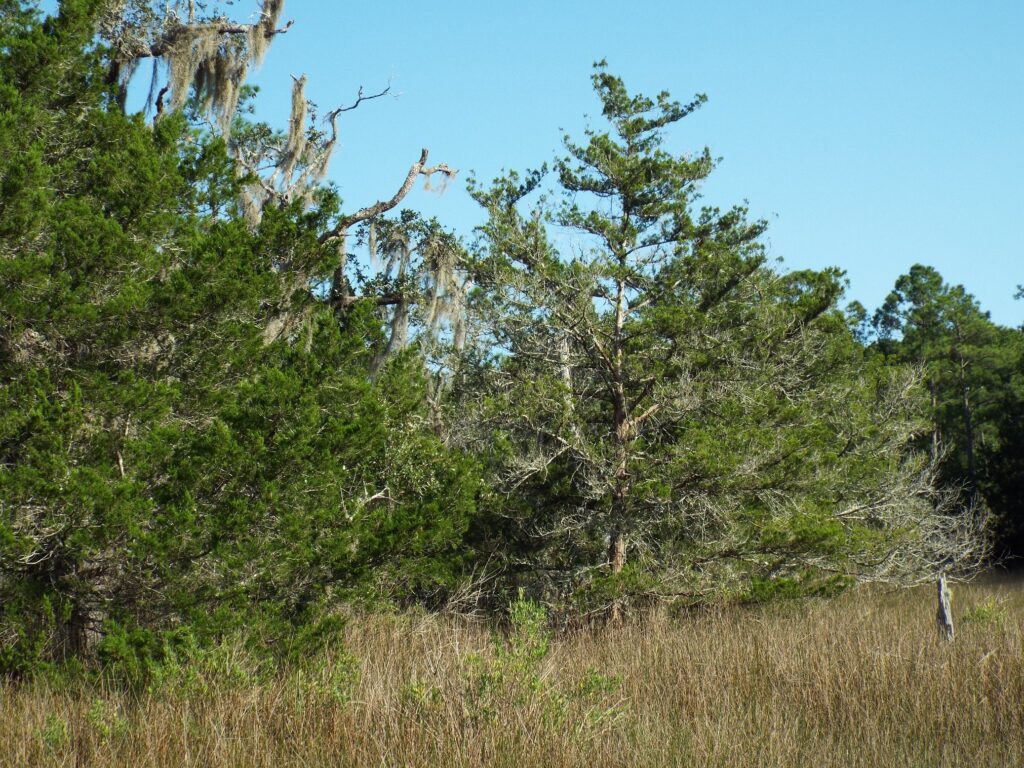
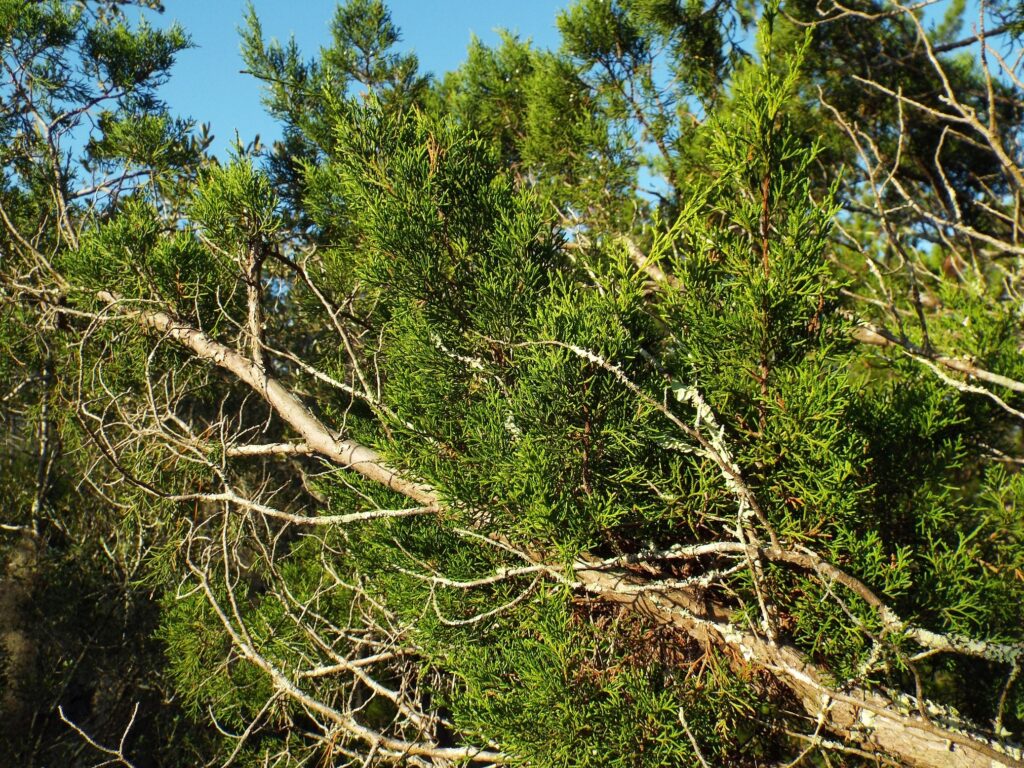
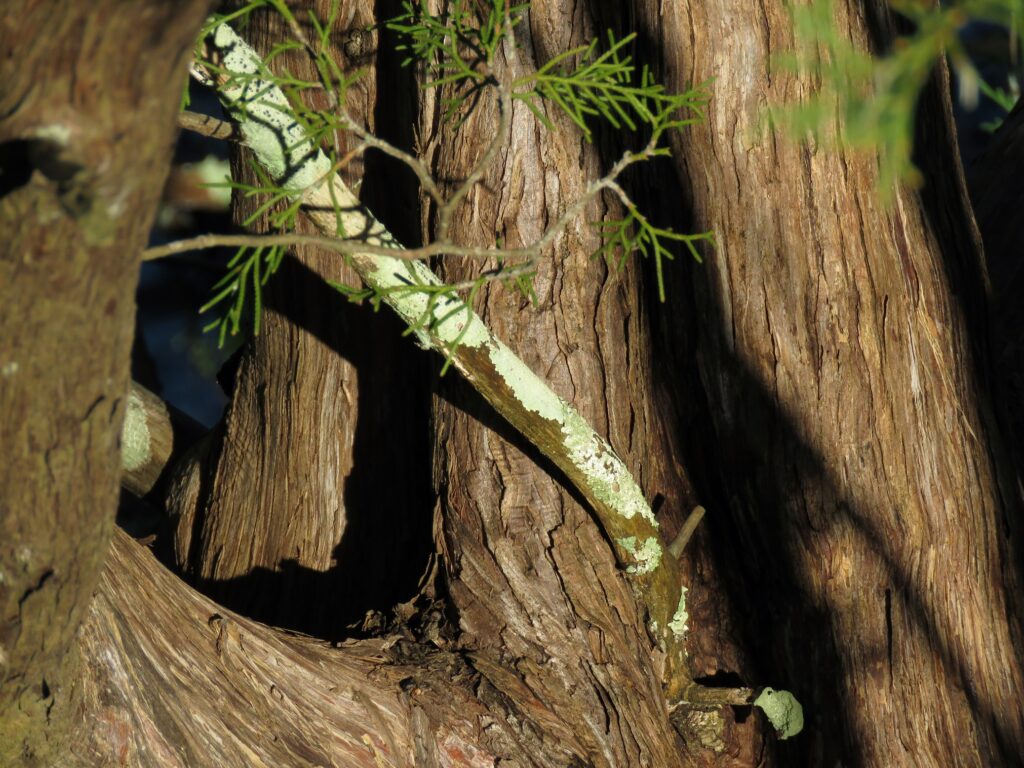
This week for Flora and Fauna Friday we’re looking at the second holiday plant in our 3 part series. This plant is one of dozens of species that have earned the title of “Christmas Tree” but this one is a native here on Edisto: the Eastern Redcedar, Juniperus virginiana.
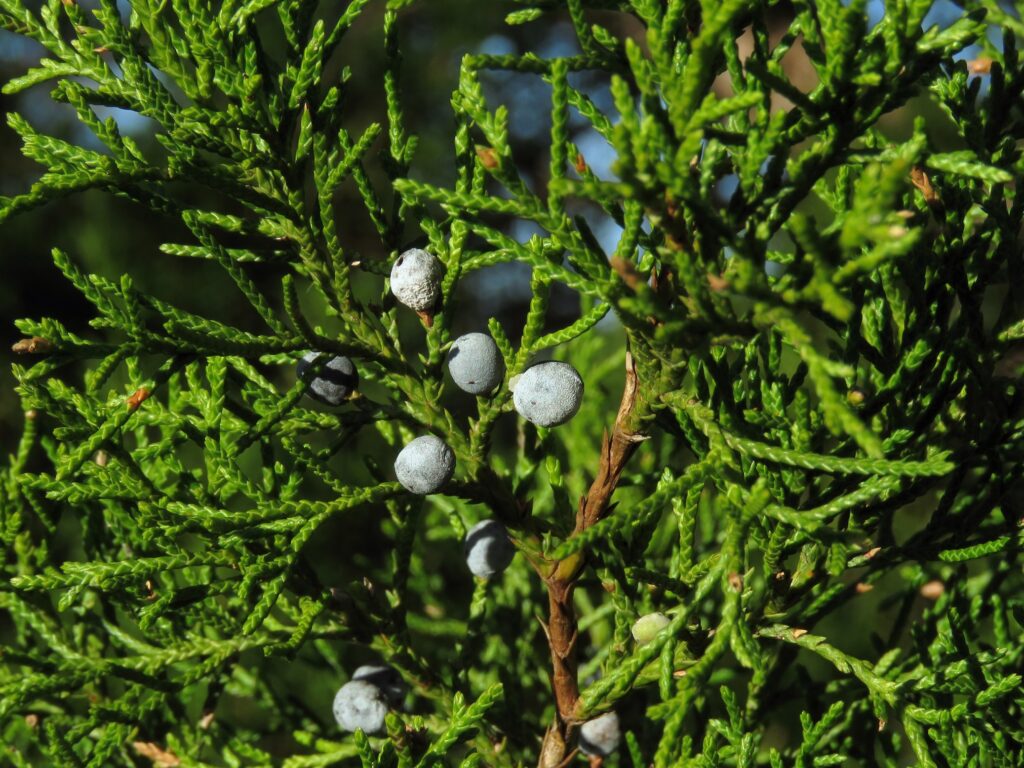
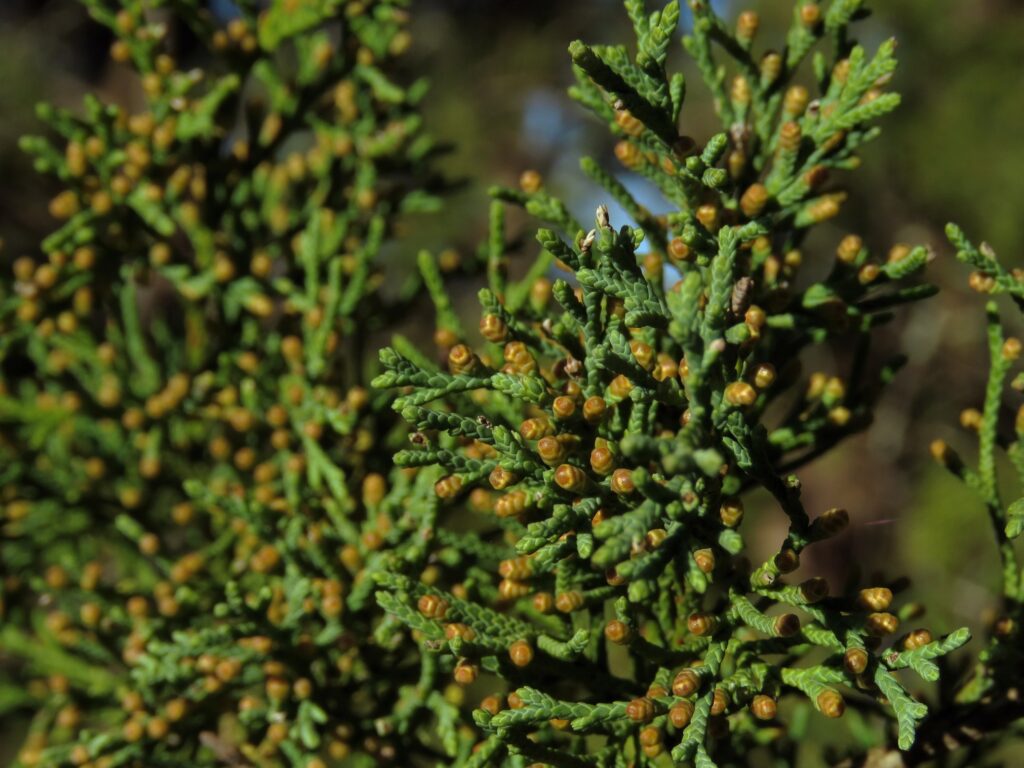
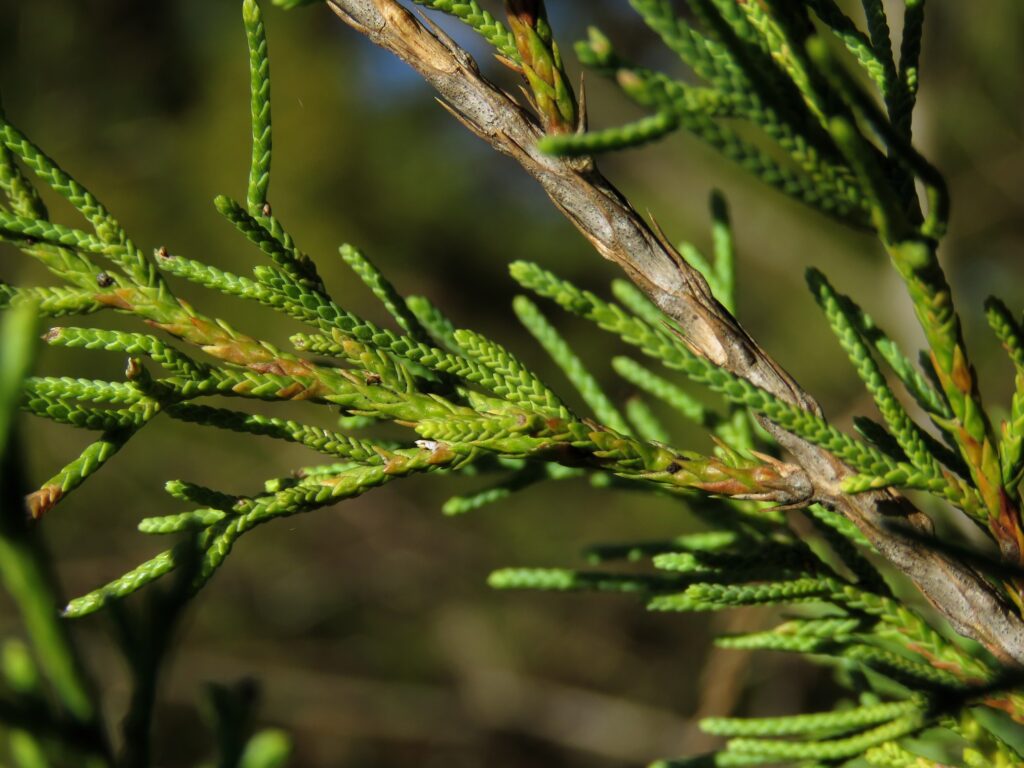
The Eastern Redcedar is not a true Cedar, which are natives to Asia and members of the Pine family. It’s actually a Juniper, as the genus name suggests, and a member of the Cypress family. It’s a common woody plant throughout the entire Eastern US. It can grow as a hedge, bush, shrub, or a tree ranging in height from 15ft to 50ft tall. It has small evergreen scales and peeling reddish bark. In the lowcountry, most of what we see is the Southern Redcedar, Juniperus virginiana var. silicicola, which prefers maritime forests and is usually shrubbier in appearance. The Redcedar is a ridiculously hardy species that can be found in a myriad of habitats. From wetland edges, to sandhills, to saltmarsh hammocks, to oak forest understories, to fallow fields, to sandspits, Redcedars inhabit them all. They can live for centuries and frequently survive traumatic damage, including sheered off canopies, split trunks, toppling, and partial girdling. The Eastern Redcedar is dioecious, meaning there are both male and female trees. The foliage of males trees takes on an amber hue in winter as they develop pollen cones. When the pollen cones open, males trees can appear to be enflamed during a stiff breeze, emitting a smoky yellow cloud of pollen into the air. Female trees turn a blue green as their berry-like cones mature. These fleshy cones are an important food source for many birds, particularly the Cedar Waxwing which is named after its fondness for the fruit.
The Eastern Redcedar has several interesting uses beyond its use as a local Christmas tree and floral arrangements. (On a side note, your typical Christmas Tree is a Fraser Fir, Abies fraseri.) Its wood is rot resistance and is commonly used for fence posts. The heartwood is great for making both pencils and longbows. Also, the heartwood is a vibrant violet color when fresh. A remarkable sight to the unsuspecting woodsman. The aromatic compounds in the heartwood also repel moths, particularly the ones that dine on wool clothing. Lastly, but certainly not least, Juniper “berries” are an important flavoring in the spirit Gin.
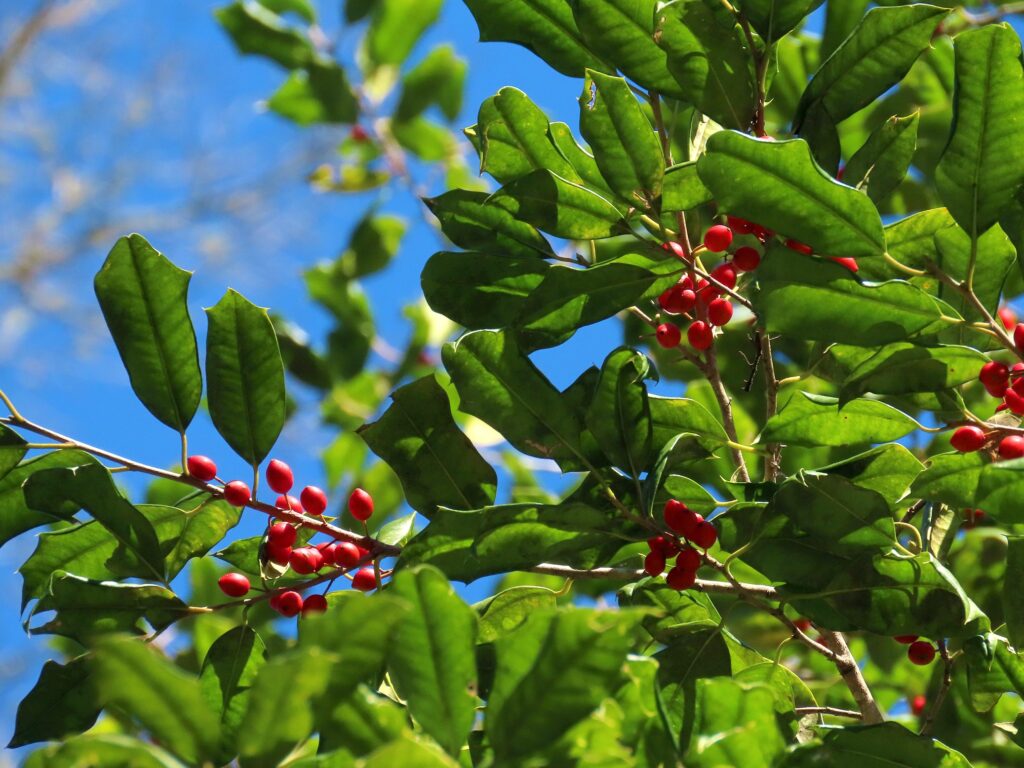
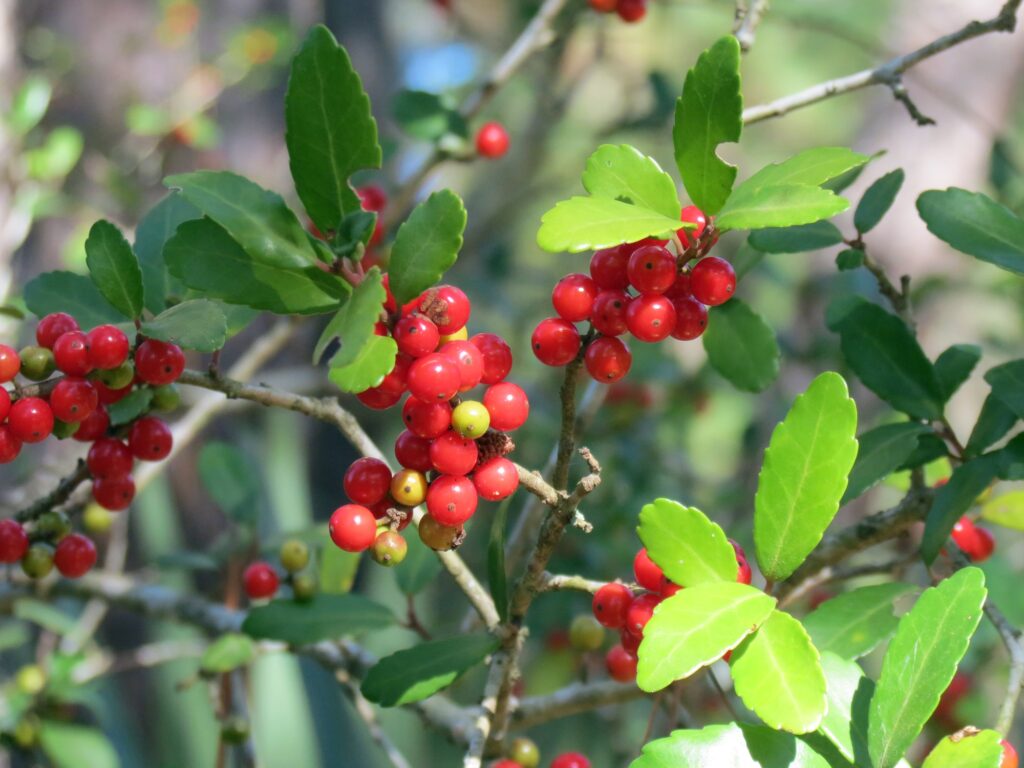
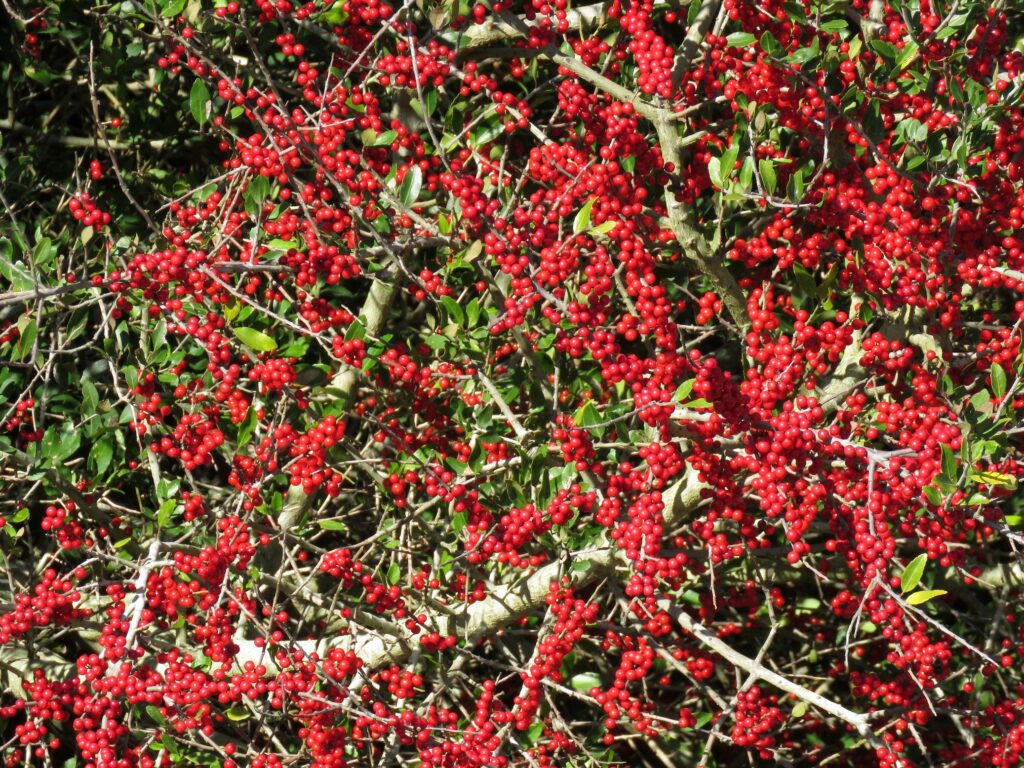
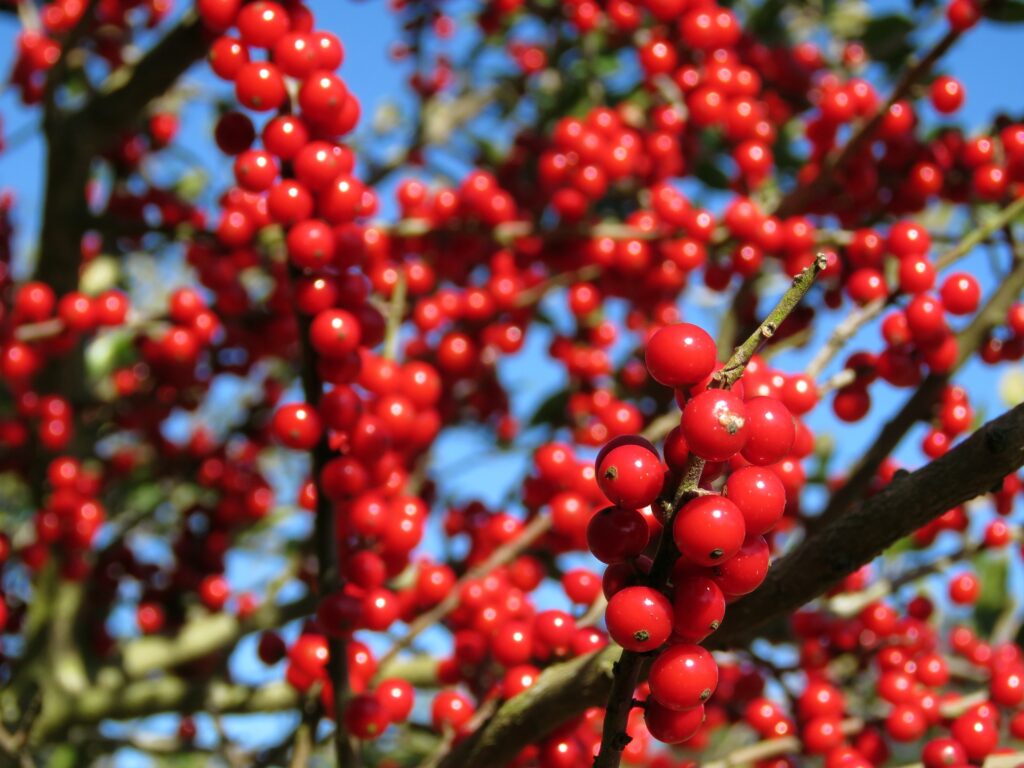
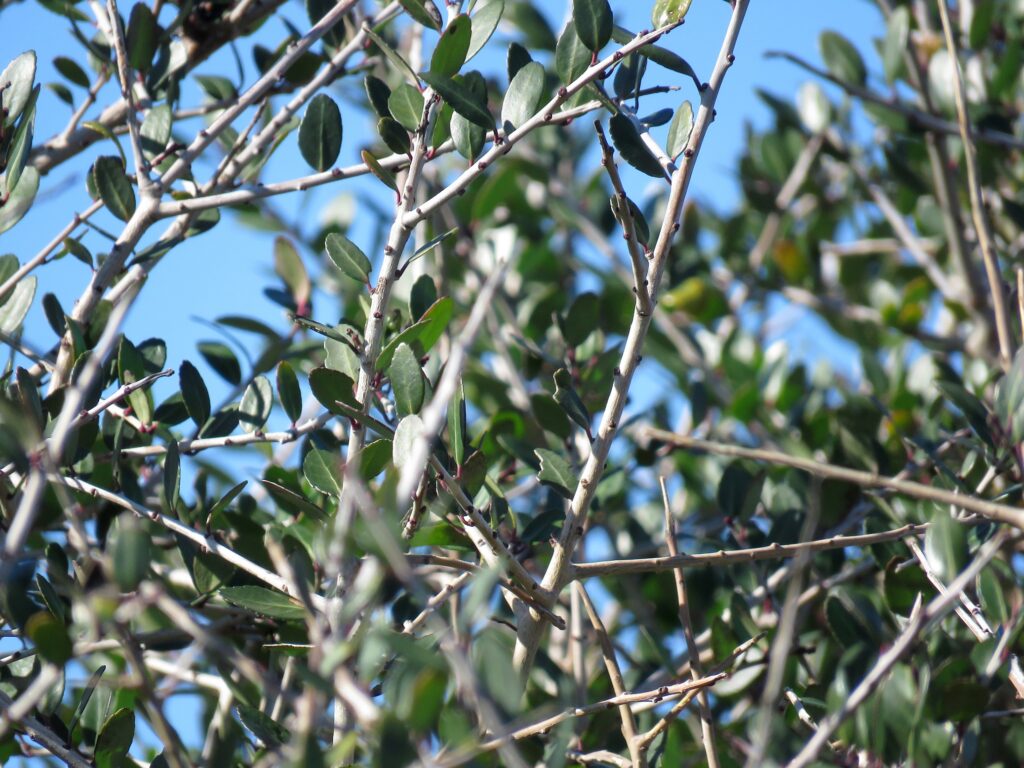
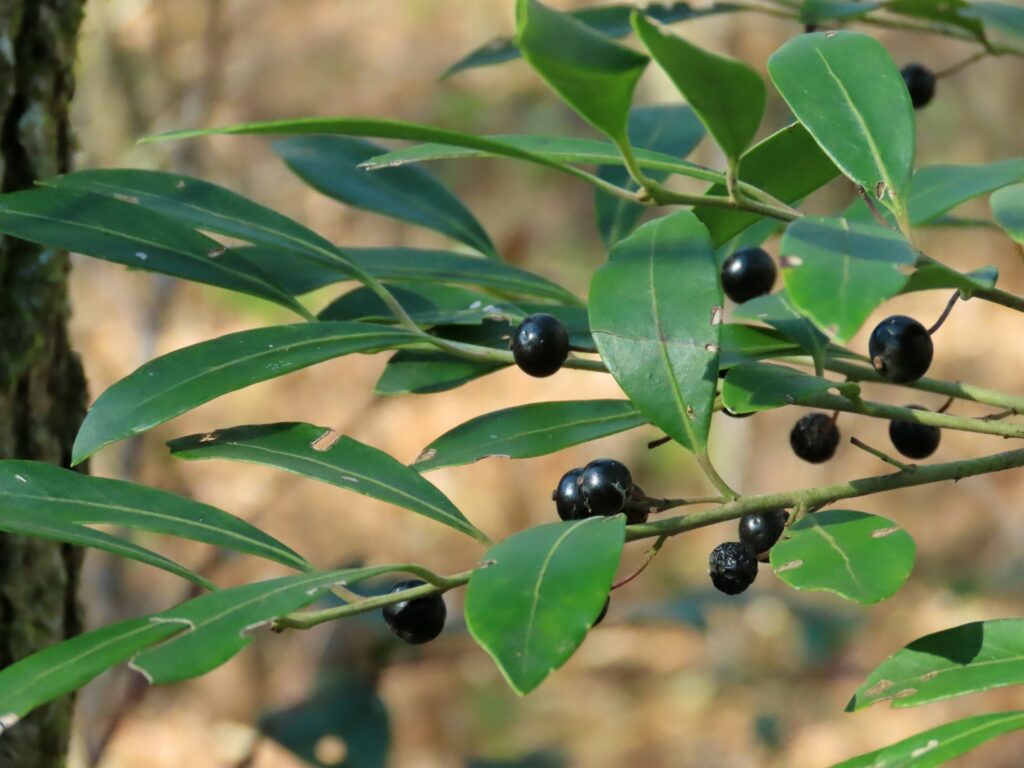
This week for Flora and Fauna Friday, we’re beginning a short 3 part series spotlighting some of our important Holiday plants! Today we’re starting with a genus of trees and shrubs that are a staple of holiday decorations: the Hollies, genus Ilex.
The Hollies are known for their evergreen leaves and showy berries. In our area, we have three common species: American Holly (Ilex opaca), Yaupon (Ilex vomitoria), and Inkberry (Ilex glabra). All have smooth light gray bark, leathery evergreen leaves, and produce a berry that is attracts wildlife, especially birds. They are partial to life in the understories of hardwood forests and don’t do well in ecosystems with frequent fires, due to their thin bark.
American Holly is the quintessential Holly. It has spiny leaves and bright red berries. It is a common addition to festive floral arrangements due to the aforementioned aesthetics of its fruits and foliage. It can grow as an upright bush or into a fairly large tree. Its small red berries provide a much needed fall and winter food source for wildlife, especially birds like the Cedar Waxwing.
Yaupon, or sometimes called Cassina, is our most common Holly on the Island. Unlike the American Holly, they grow primarily as a shrub but can still reach 20ft in height. They are a common sight along woodland edges and hedgerows where they form dense thickets with their ashen trunks. Their leaves are much smaller than those of the American Holly and lack any spines. Their fruit is a minute, glossy, crimson berry that grows along the stem. Their scientific name, Ilex vomitoria, is a misnomer and comes from the use of the plant’s leaves by Native Americans in a purifying ritual that included the use of an emetic tea to induce vomiting. However, Yaupon does not actually contain any emetic compounds and can safely be brewed into a tea for human consumption. (Its leaves even contain caffeine!)
The Inkberry is a smaller plant than the other two Hollies I’ve mentioned. It’s typically only about head height and grows in sandy woods or wetland edges. It also has black berries as opposed to the red berries of the Yaupon and American Holly. The berries contain a pink juice that can be used as an ink or dye, hence the common name. Its leaves are also spineless, like Yaupon, but are more yellowish in color.
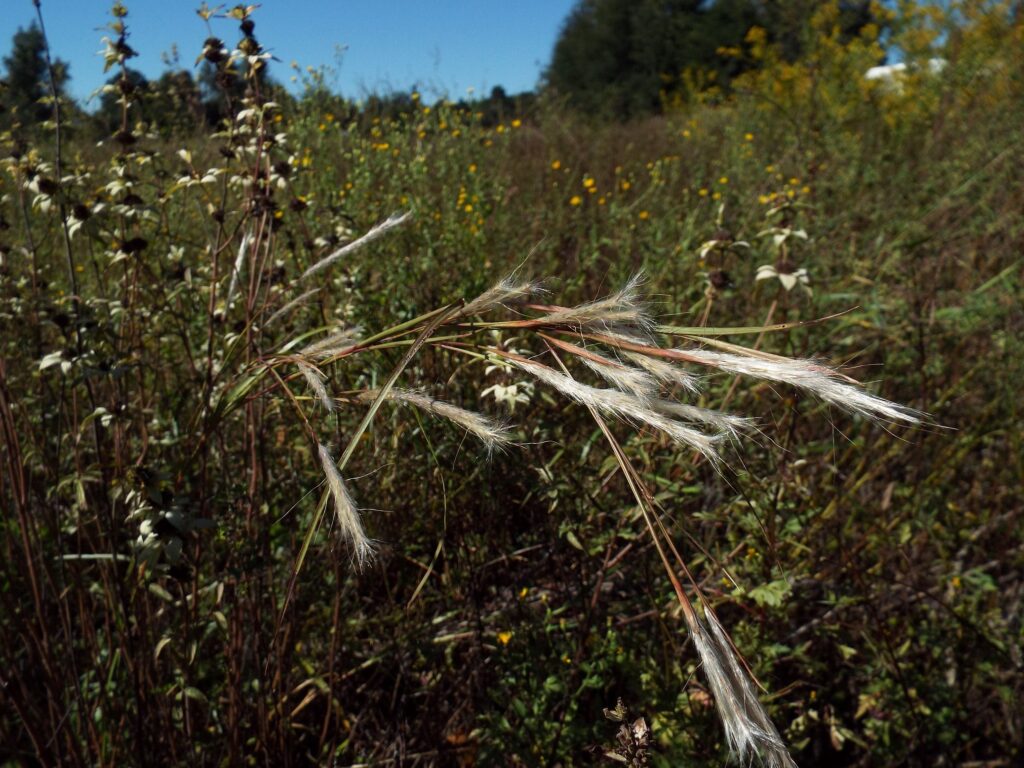
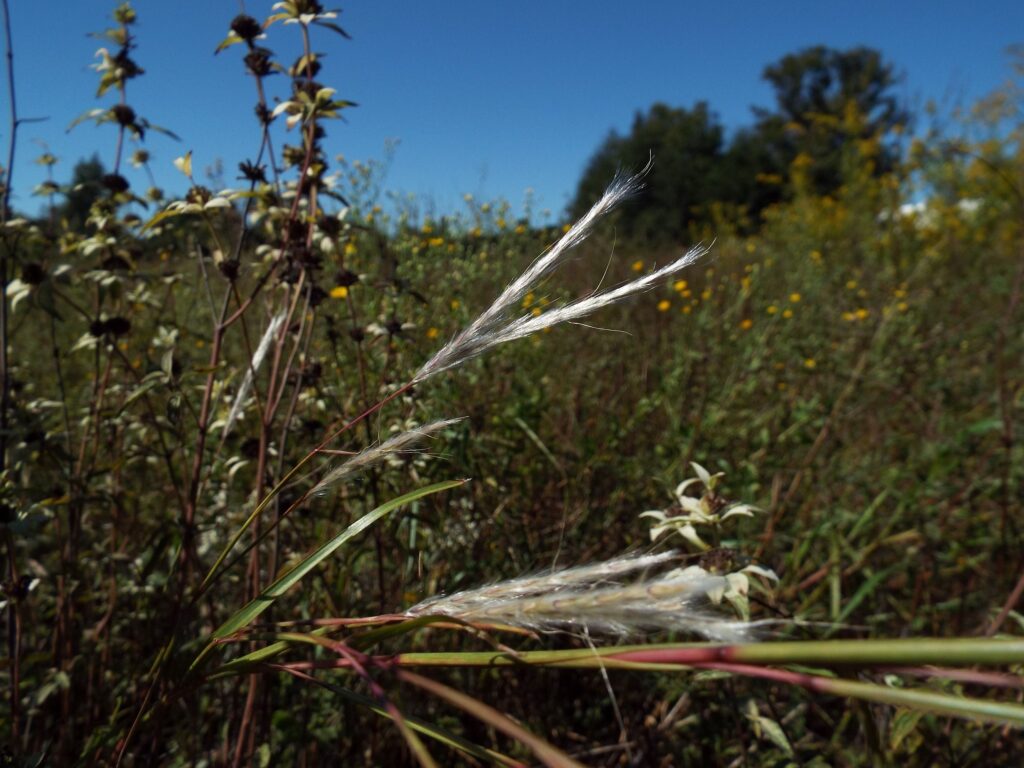
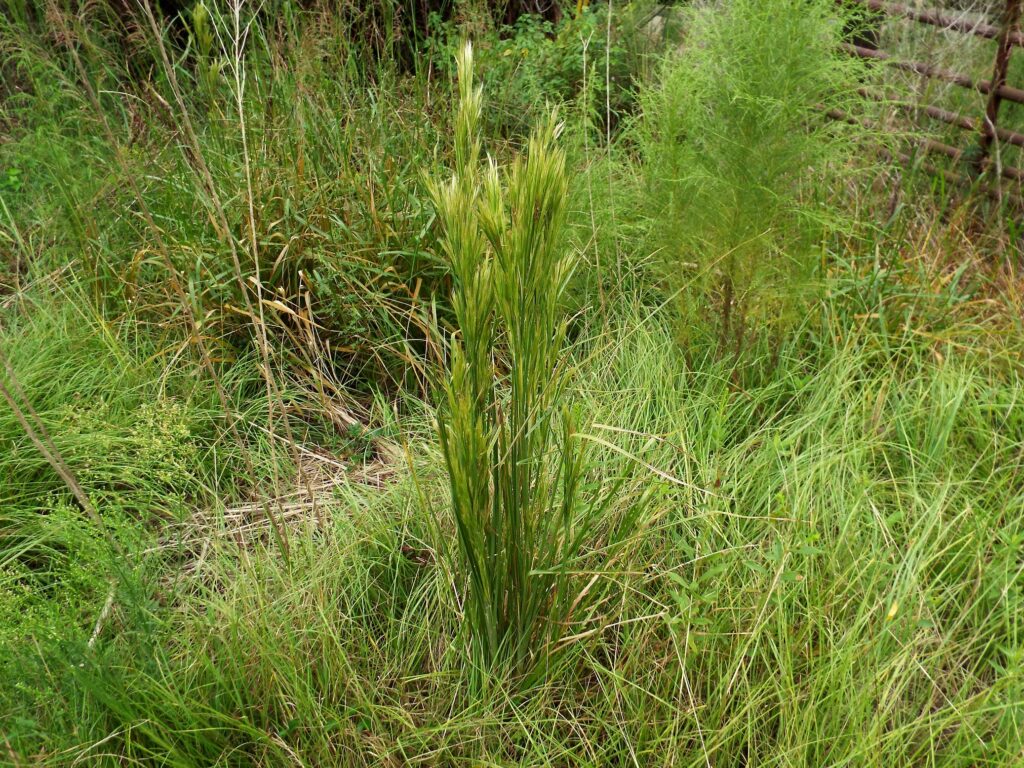
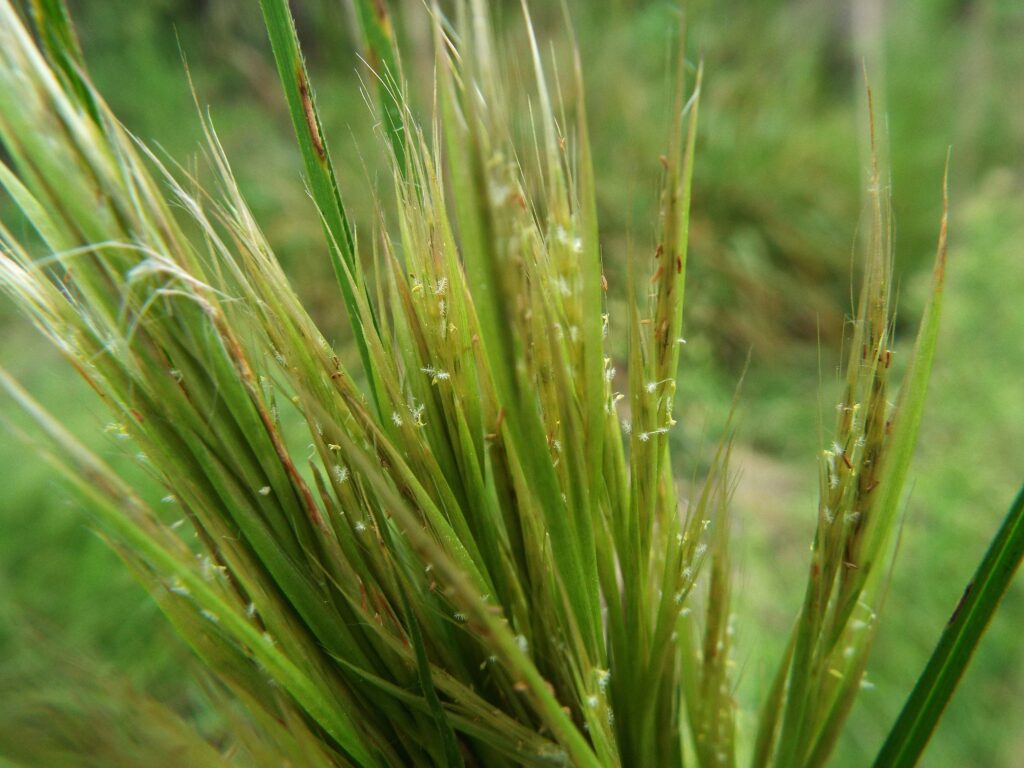
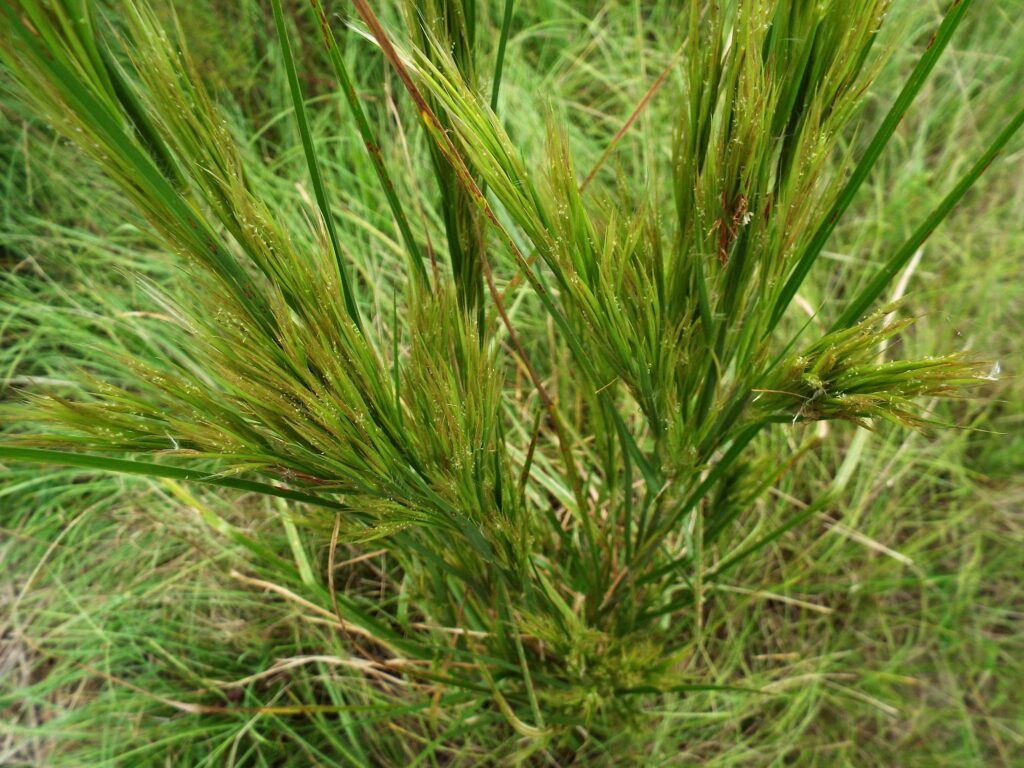

Today for Flora and Fauna Friday we’re examining another one of those ubiquitous Lowcountry plants. It’s a grass known commonly as Broomsedge, Bluestem, or Beard Grass and scientifically as Andropogon.
Each one of these common names describes a different characteristic of the plant. Bluestem describes the color of the foliage: a blue-green grass throughout the growing season. Beard Grass describes the appearance of the plant when it seeds in the fall: a pointed beard of straw covered with white fluff. Broomsedge describes its shape and winter color: an upside down, light brown broom-head. The scientific name of “Andropogon” means “Man’s Beard”, echoing the common name of Beard Grass.
Broomsedge, as I prefer to call it, is not a sedge but a grass. It is a rather diverse genus of grasses that all look rather similar. Its fresh leaves are often glaucous (the scientific way of saying bluish-green) and the more common species in our area can reach up to 5 feet in height. It is a pioneer species, meaning it is one of the first plants to grow in a freshly disturbed habitat. Think of clear cuts, fallow fields, or piles of fill dirt; those are the sorts of habitats that Broomsedge loves to pioneer. Broomsedges also do well in prairie or savanna habitats where regular disturbance by grazing and fire limit the growth of trees. They’re also a very common sight in hayfields and make up a fair portion of the hay the fields produce. In the fall the plants flower and go to seed, releasing hundreds of fluffy white seeds that rely on the wind to carry them to bare earth. Come winter, the grass dies back to its roots but the dried flower stalks from the previous year can persist for months afterwards. Broomsedges provide habitat and food for many species including: Field Sparrows, Rabbits, Sedge Wrens, Katydids, Cotton Rats, Mice, and Deer.
In our area we have quite a few native species but I’m only able to identify the two most common: Broomsedge Bluestem (Andropogon virginicus) and Bushy Bluestem (Andropogon glomeratus), which I have photographed below. The redundantly named Broomsedge Bluestem is our most common species and its appearance is typical of the genus. Bushy Bluestem is also quite common and more distinct in appearance, having large, bushy clumps of flowers rather than having them evenly dispersed across the stem. All our native species are quite similar in appearance and ecology but have slightly different habitat preferences. All provide a valuable ecosystem service in erosion control and soil restoration. Their deep, perennial roots stabilize the soil and bring nutrients up to the top soil from deep in the ground. When they die back each winter they replenish micronutrients and organic matter to tired topsoil and improve growing conditions for other plants. Over time, if grasses are allowed to perpetuate without being harvested for hay, they can restore a once barren field into a meadow, prairie, or savanna. Breathing new life into weathered earth.