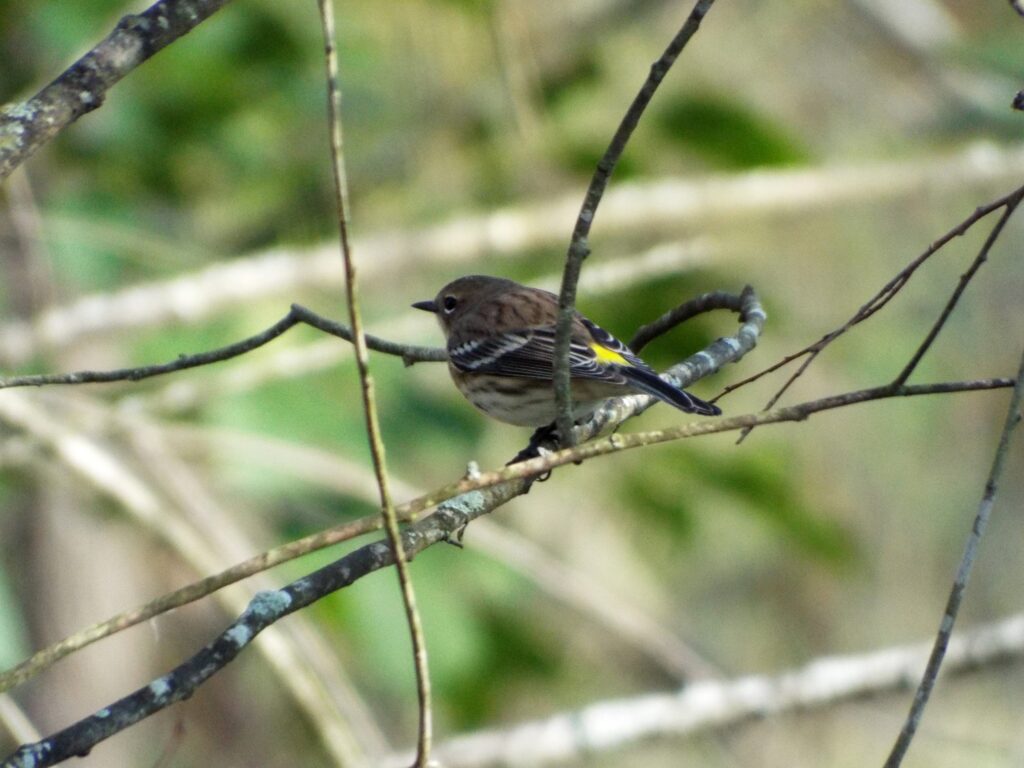
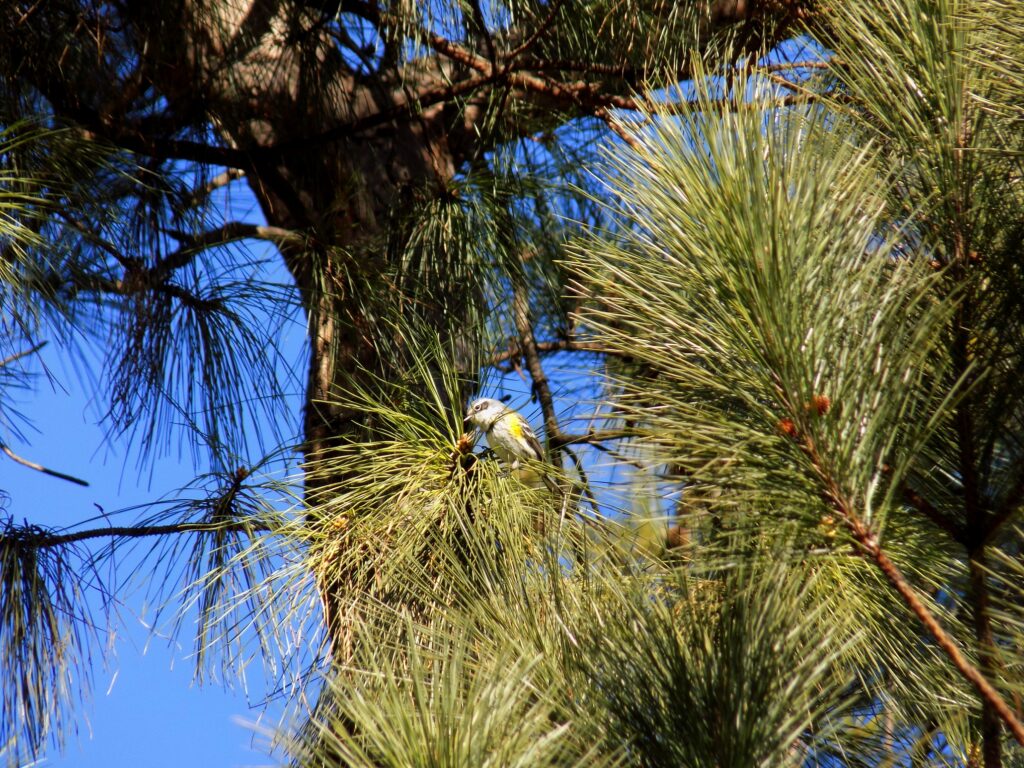
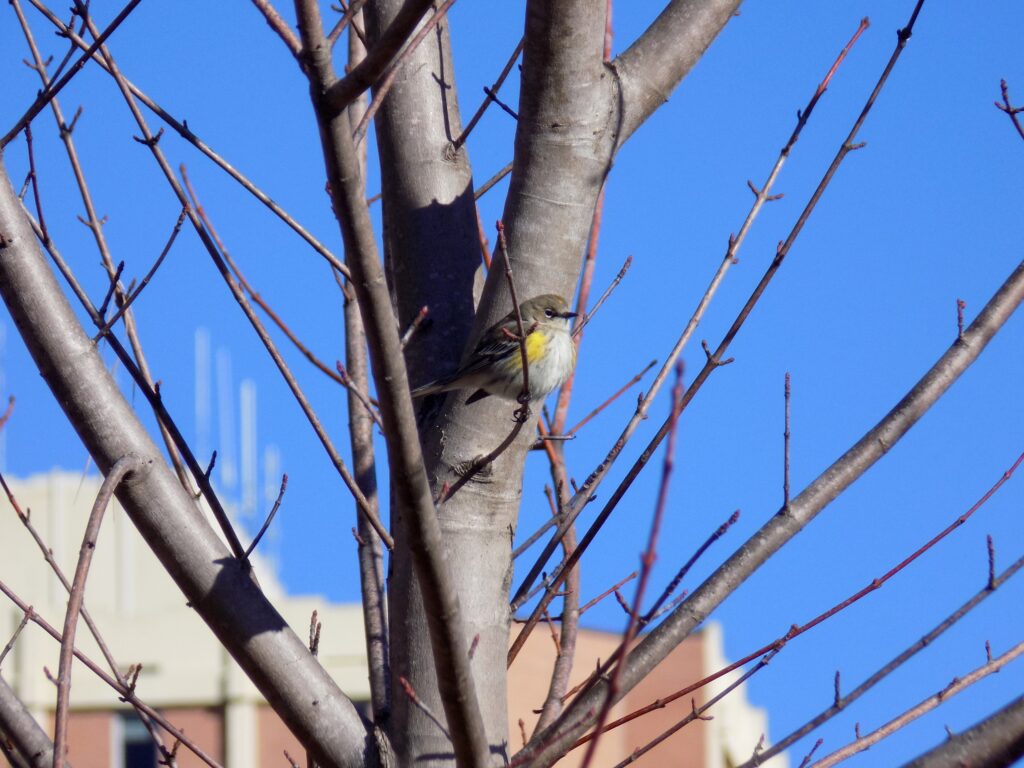
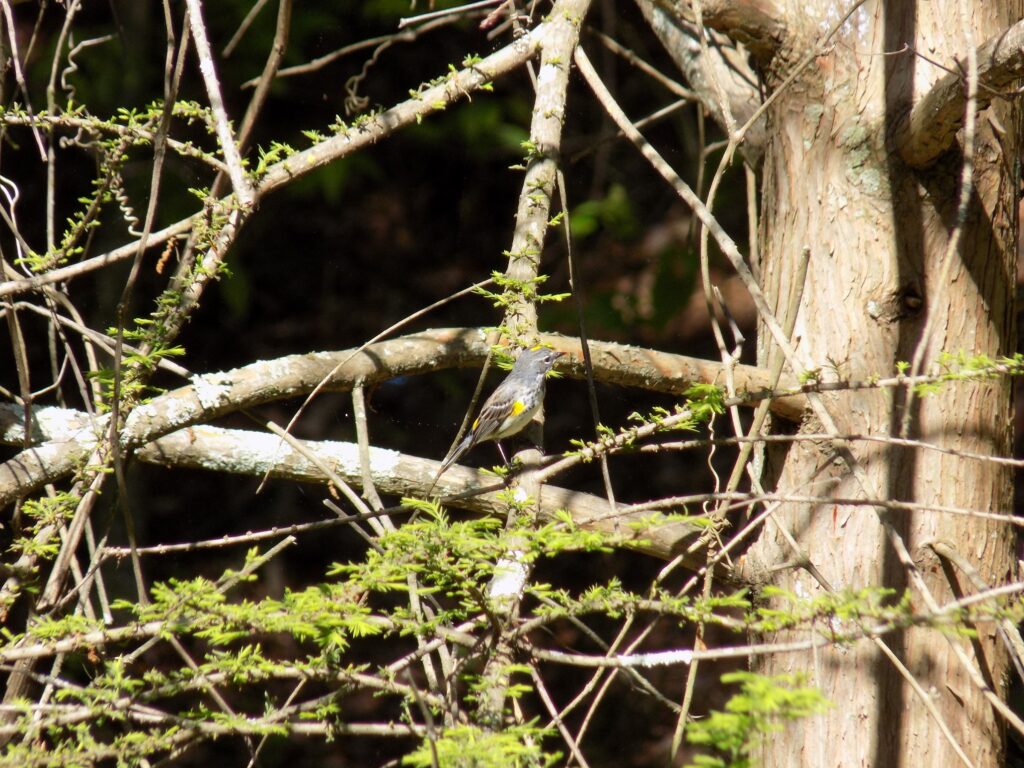
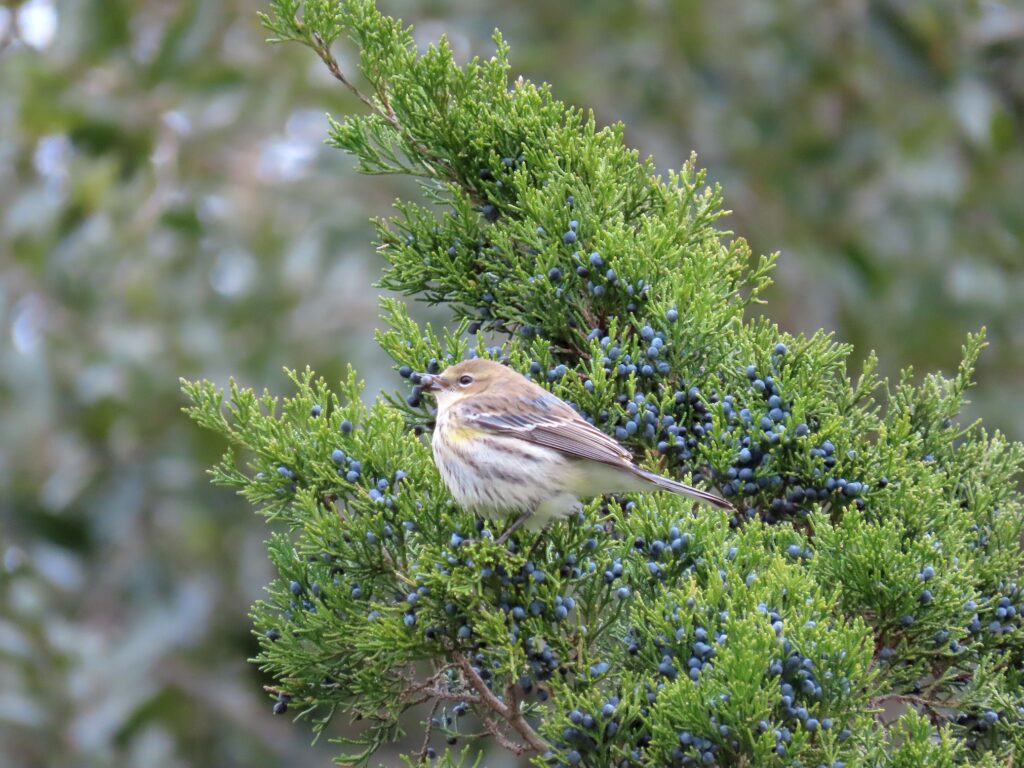
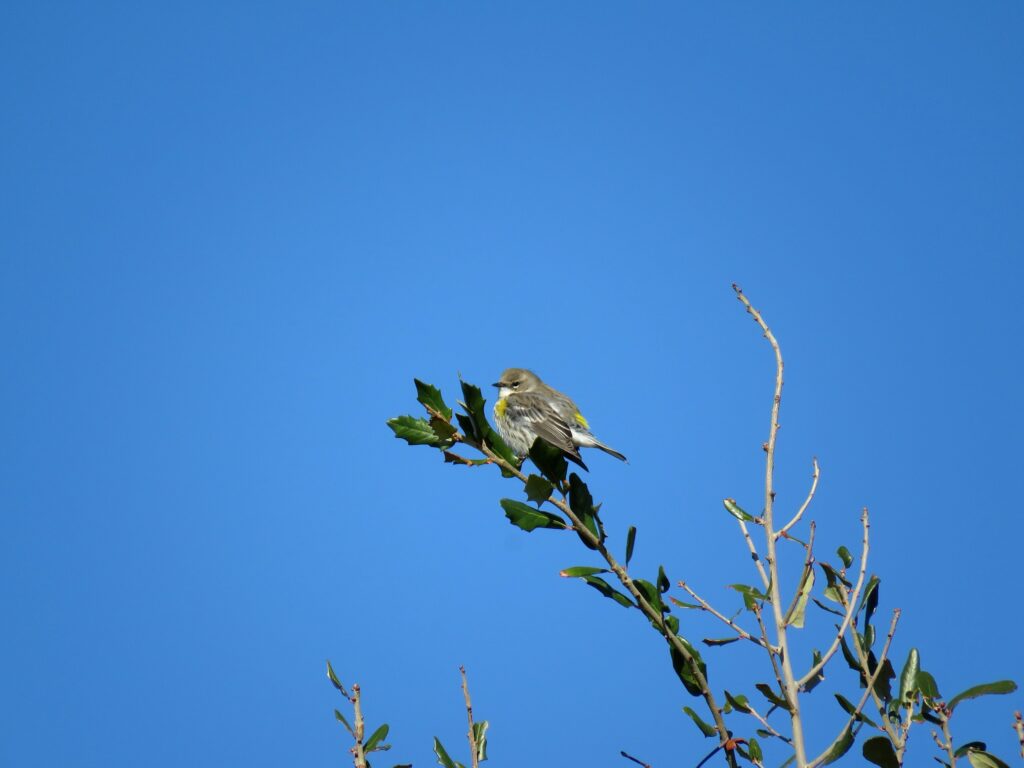
This week for Flora and Fauna Friday we’re examining our most widespread winter warbler: they Myrtle Warbler (Setophaga coronata coronata). A bird affectionately referred to as the “Butter-butt” by bird watchers.
The Myrtle Warbler is the subspecies of the Yellow-rumped Warbler found here in the eastern US. They were originally classified as a separate species from the more western Audobon’s Warbler, then both were lumped together as the Yellow-rumped Warbler, and now there’s evidence to suggest they may be split again in the future. But that’s a different story for a different time from a different person. Myrtle Warblers are a member of the Wood Warbler family, Parulidae. Wood Warblers are a diverse group of small, insect-eating birds native to the New Word. They are notoriously difficult for beginning bird watchers to identify in the field due to their similar songs and plumages, highly variable appearance, and their tendency to move quickly through brush and treetops without giving you the chance for a clear viewing.
Myrtle Warblers are probably the easiest to identify warbler in our area. They are easily recognized by their distinctly butter-yellow rump, as well as their yellow flanks and crowns, white throat, and streaked breast with a white part down the center. Females (pictured below) and immature males are usually brown above with a dusky streaking to the breast. Adult males are more boldly patterned with steel-blue, white, and black with a split black breast and a black mask. They are also easily identified by their voice. Their call is a rather mundane, sharp “chek” that, once you’ve heard it a few thousand times (which can be fulfilled by these prolific birds in just a few winter outings), is hard to misplace.
Myrtle Warblers are migratory. They leave our state in spring for Canada, where they breed over the summer. In fall they migrate back to our state en masse, quickly becoming our most numerous woodland bird throughout the winter. You can sometimes see hundreds on a morning walk if you’re in the right place. They are unique among our warblers in that not only does the winter migration for many end in the southeastern US but their winter diet consists primarily of fruit. They get their common name from their wintery food source: the Southern Wax-myrtle (Morella cerifera). Wax-myrtles, as their common name suggests, produce wax. They produce this wax on the outside of their leaves and fruits to help conserve water. Myrtle Warblers eat these fruits to digest the wax. Wax is a type of fat, which is high in calories but typically hard to digest. Myrtle Warblers are able to exploit this rich food source with unique biological adaptations. The Wax-myrtle benefits from this relationship by having its seeds spread far and wide by this active little warbler. Myrtle Warblers can also be seen scraping wax off of the seeds of other plants, such as Poison Ivy and the invasive Chinese Tallow Tree, or visiting suet feeders for a fatty treat.

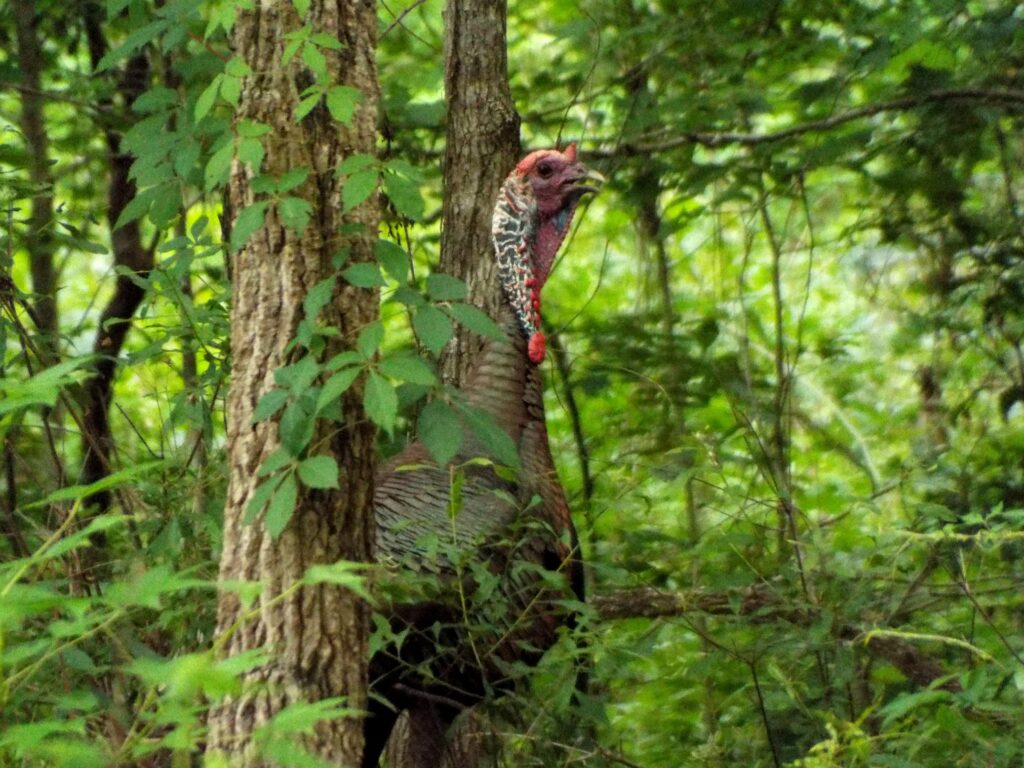
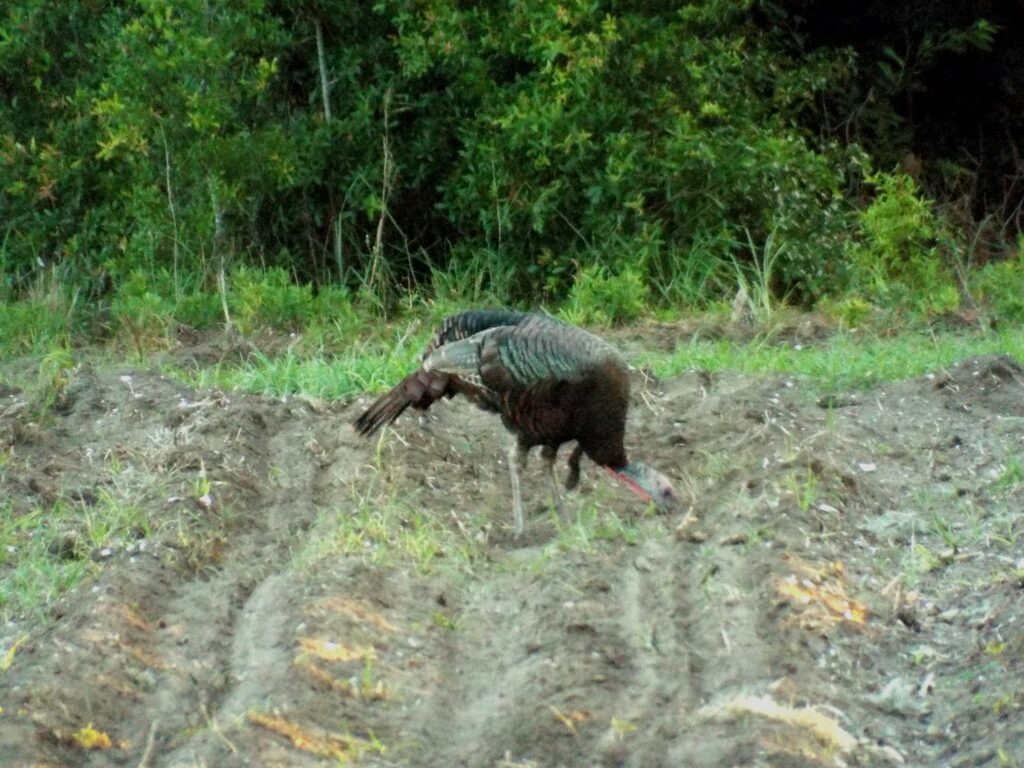
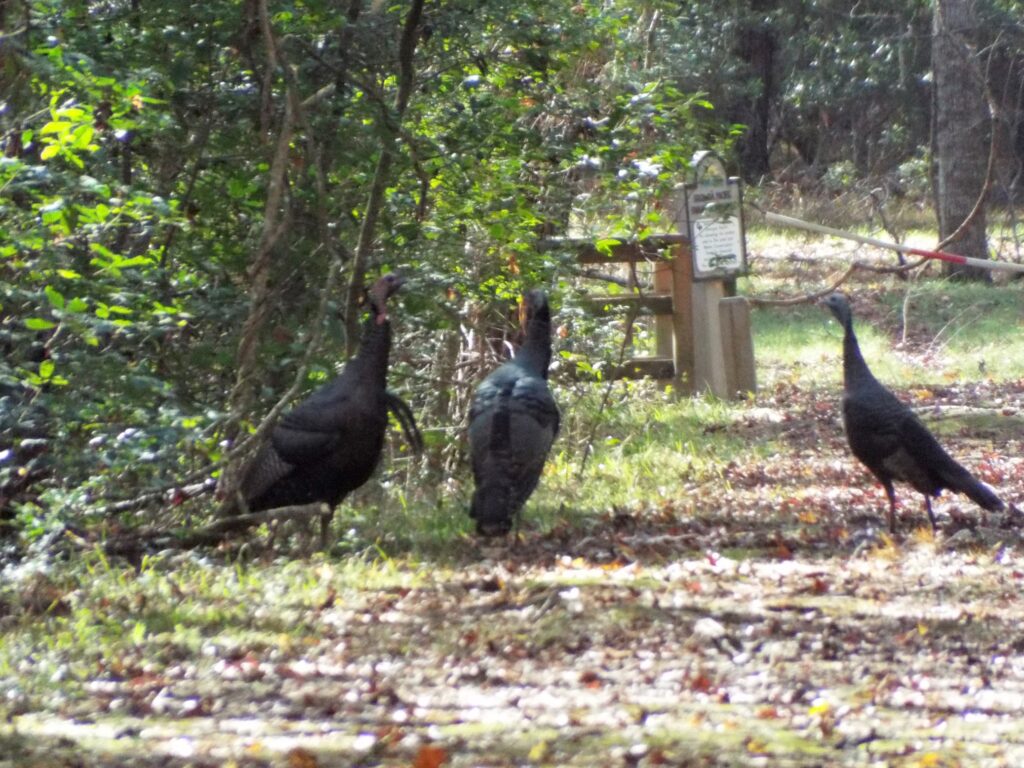
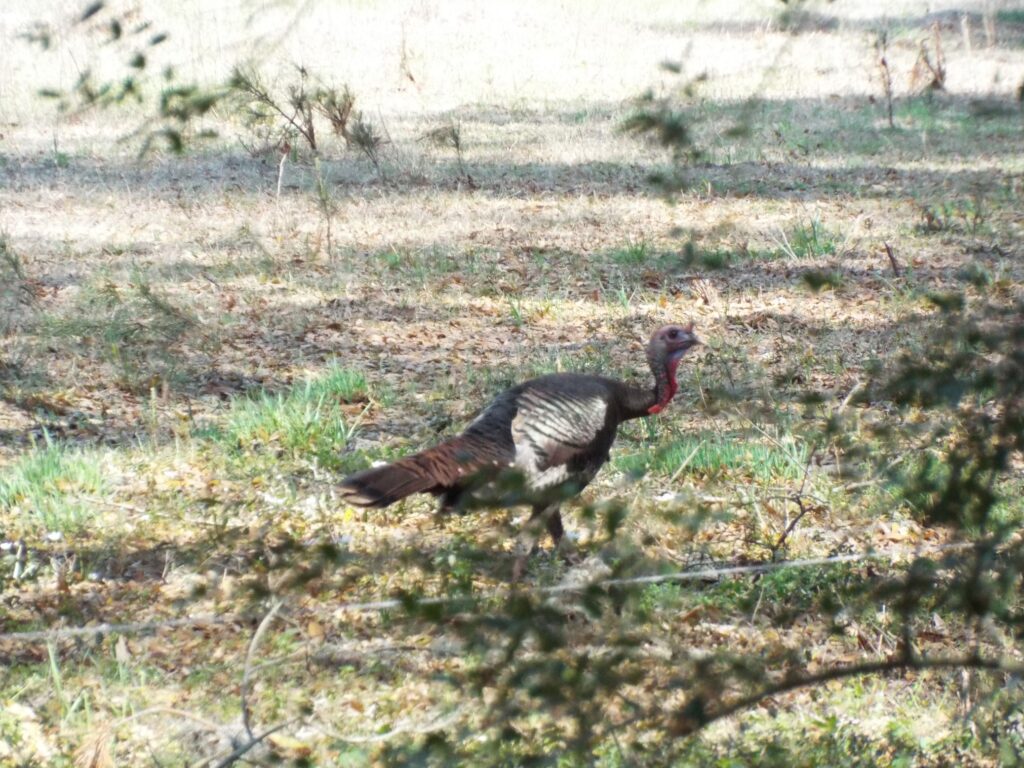
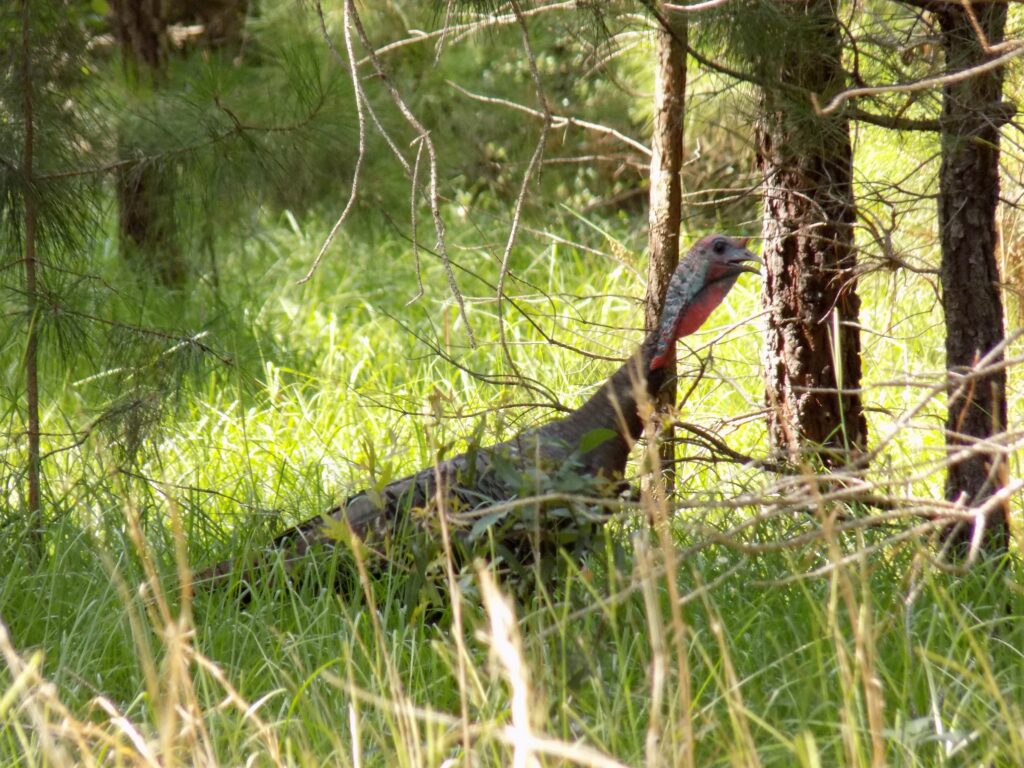
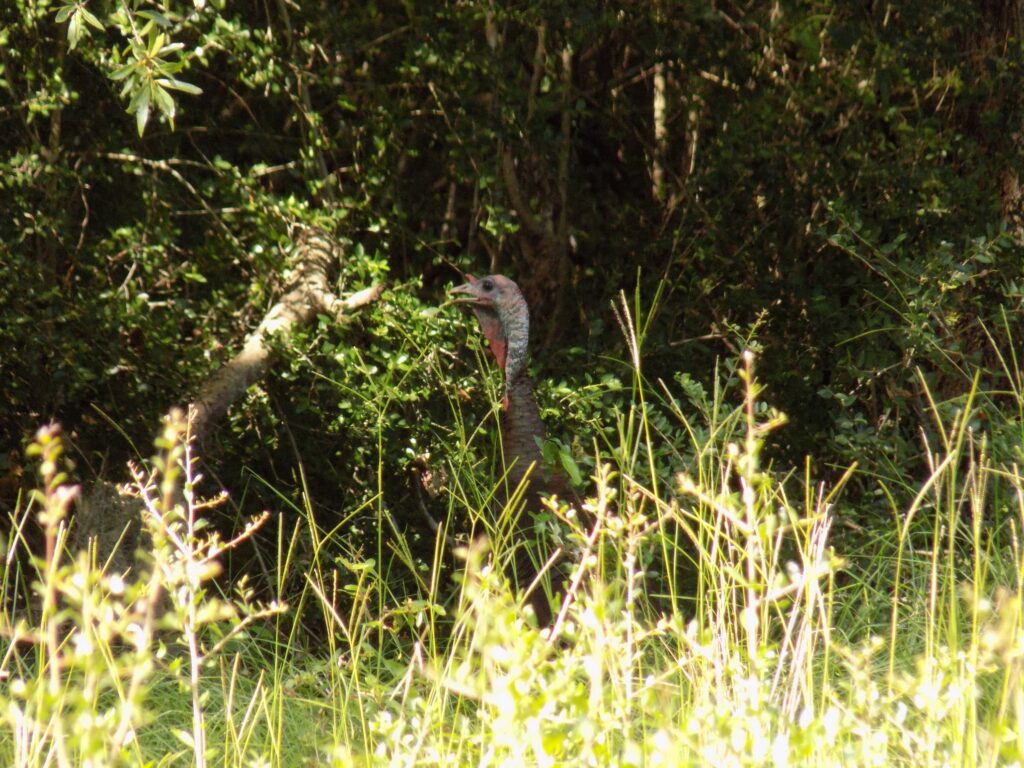
This week for Flora and Fauna Friday we’re taking a look at a bird that’s a familiar sight this time of year, although usually not in its natural setting. This week we’re taking a look at the Wild Turkey (Meleagris gallopavo). The Wild Turkey is the same species as the Domestic Turkey, which is the entrée of choice for Thanksgiving and Christmas dinners around the country. Wild Turkeys were domesticated in Mexico by the Native Americans approximately 2000 years ago. Here is SC, the Turkey season is in Spring, so Domesticated Turkey is what we’re eating.
The Wild Turkey is native to the eastern and central US but has been introduced to all of the lower 48 and Hawaii. Weighing up to 37.5lbs, The Wild Turkey is the heaviest bird in SC. (Domestic breeds can weigh more than twice this.) It comes in at a close second for the heaviest bird in the country behind the Trumpeter Swan, which has been recorded to reach 38lbs. Turkeys belong to the order Galliformes, which includes all of our gamefowl such as Grouse, Quail, Pheasants, and Chickens. Like most Galliforms, the Wild Turkey is heavy bodied and primarily qround-dwelling. Although they prefer to stay grounded, Turkeys are capable of flight and when cornered will escape to the air. They live in forests and roost in trees at night. Their diet consists of seeds, fruits, insects, and other plant material. They primarily eat large nuts like acorns, Beech nuts, chestnuts, pecans, and even Hickory nuts. They don’t crack the nuts or even chew them before swallowing. This is because Turkeys possess a particularly well developed gizzard. The gizzard is a powerfully muscular stomach that is filled with sand and small rocks, called grit, that the birds have consumed. With this organ, Turkeys are able to crush nuts like acorns, chestnuts, and pecans with relative ease and can even grind a Mockernut down until it shatters.
The Wild Turkey is sexual dimorphic. Males are called Toms and females Hens. Toms are larger with a darker, bolder plumage. Toms also have a several distinct physical features. The snood is the fleshy protuberance above the beak of a tom. The wattle is flap of skin below the chin of a tom. Caruncles are the many fleshy bumps on the back and sides of a tom’s neck. The beard is a patch of long, stiff, hair-like, black feathers found on the breast of a tom. Hens are typically smaller, more drab in appearance, and lack many of the growths found on the head and neck of a tom. A Gobbler is simply a Tom that is in it’s breeding plumage and/or performing a courtship display. During courtship a gobbler will retract its neck, fluff up its feathers, and both raise and fan its tail feathers to create an impressive display. Nesting occurs on the ground and juvenile Turkeys are called Poults.
The Wild Turkey is actually a conservation success story. It may not seem like it but their wild populations were almost extirpated from Georgia and SC by the mid-20th century due to unregulated hunting and habitat destruction. In the early 1950s, a biologist and conservationist by the name of “Duff” Holbrook pioneered the use of rocket-netting to capture Wild Turkeys in the Francis Marion National Forest and reintroduce them across the two states. His efforts were extremely successful and now the species can be found in every county of SC and most of Georgia.
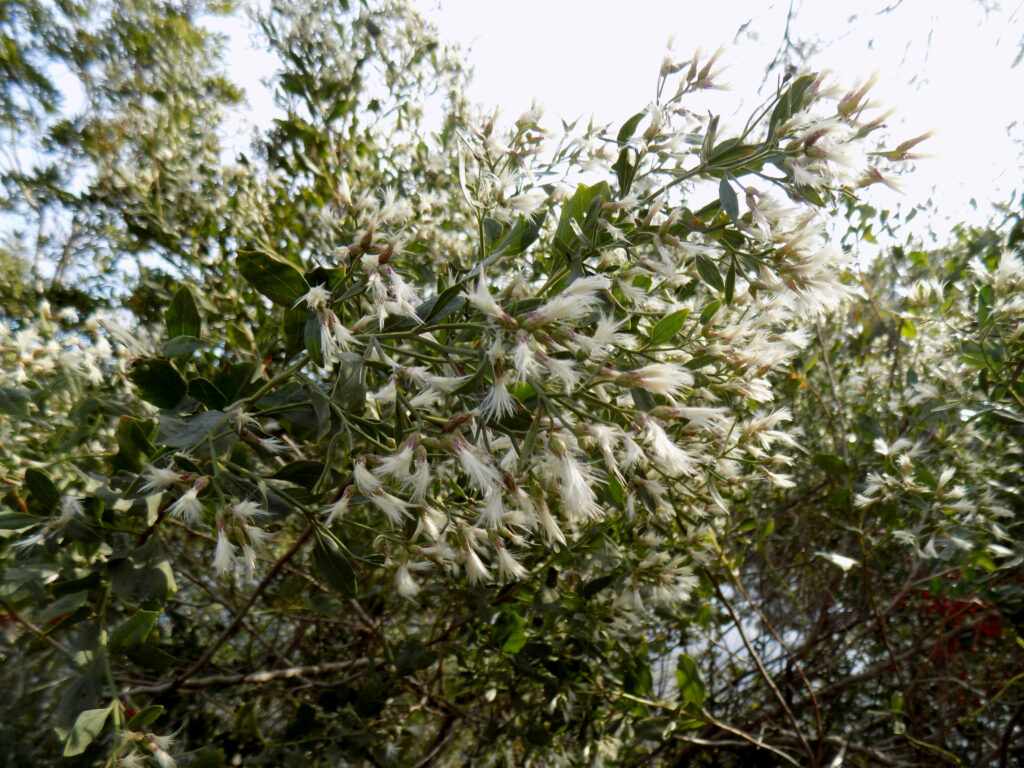
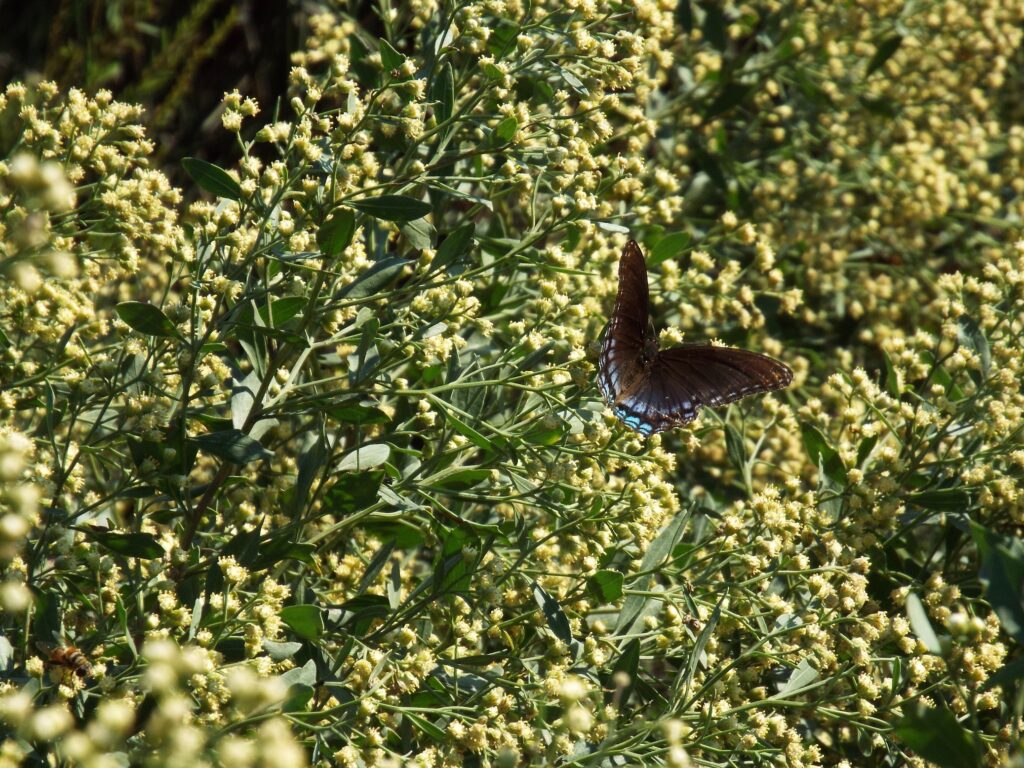
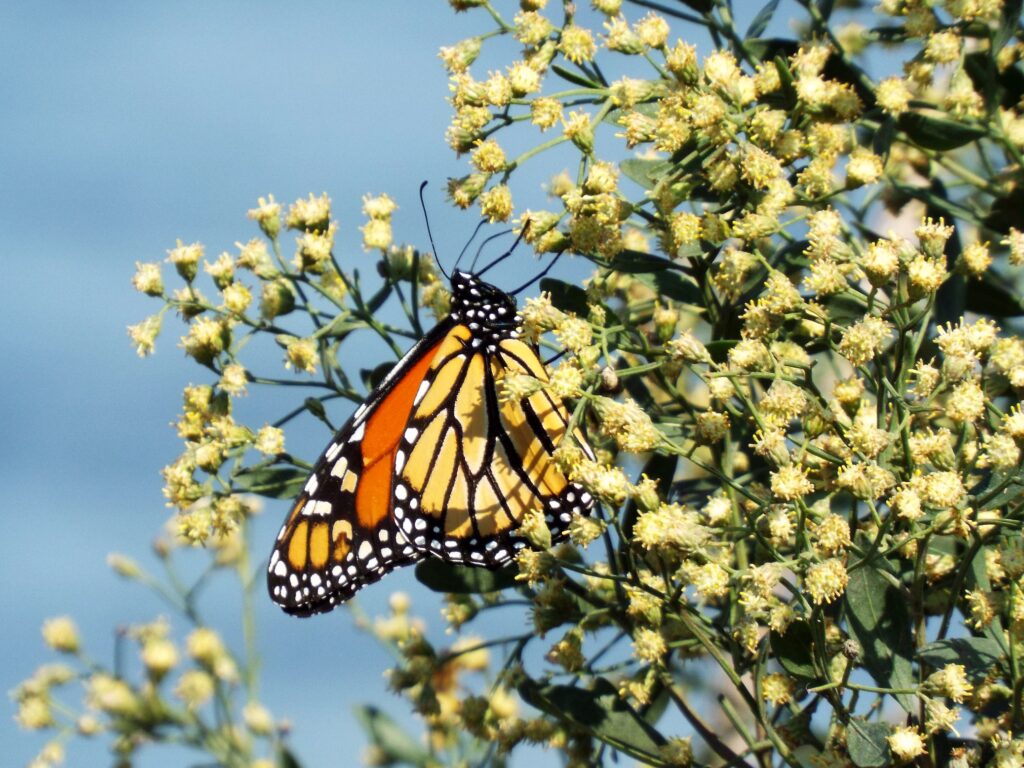
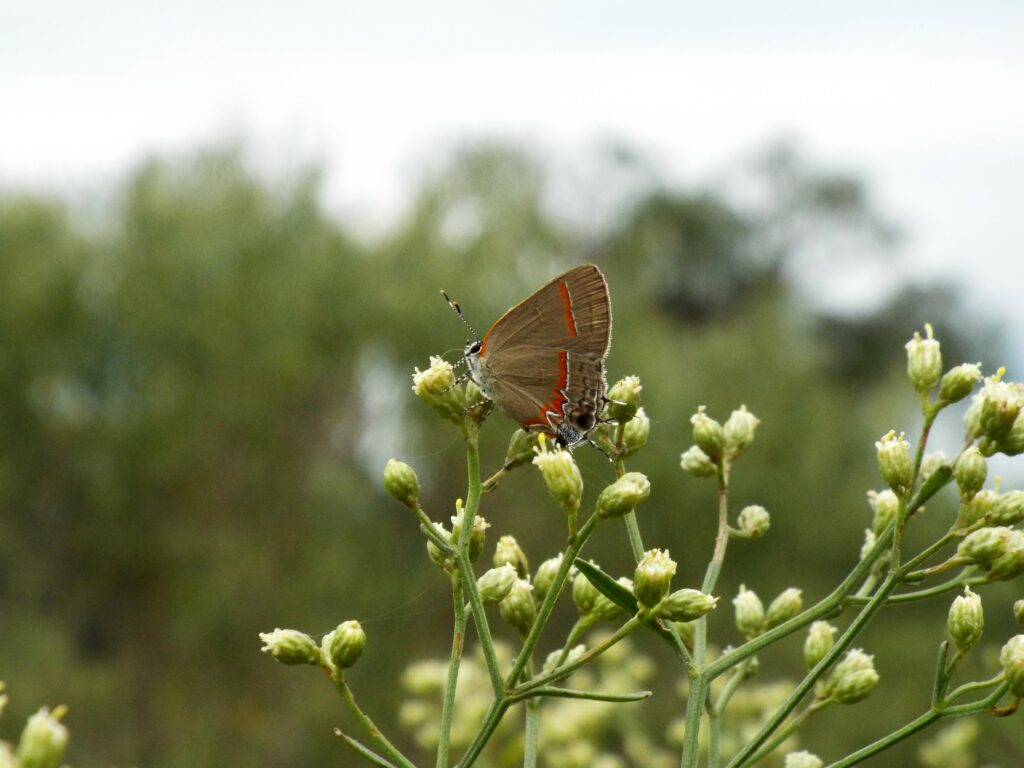
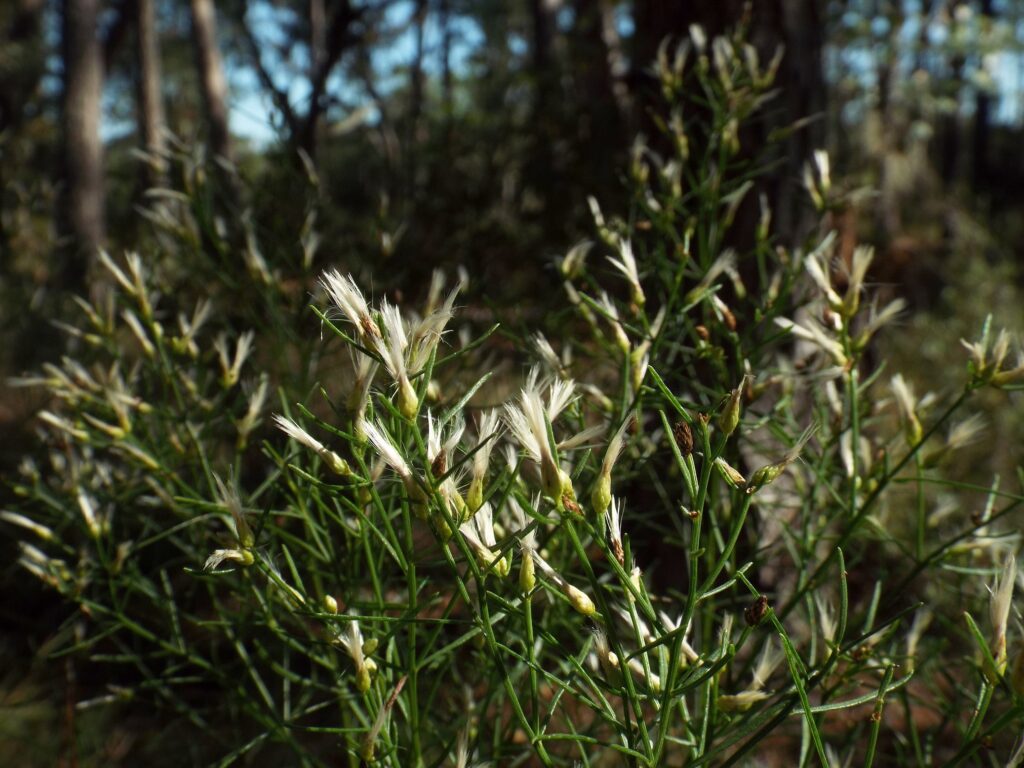
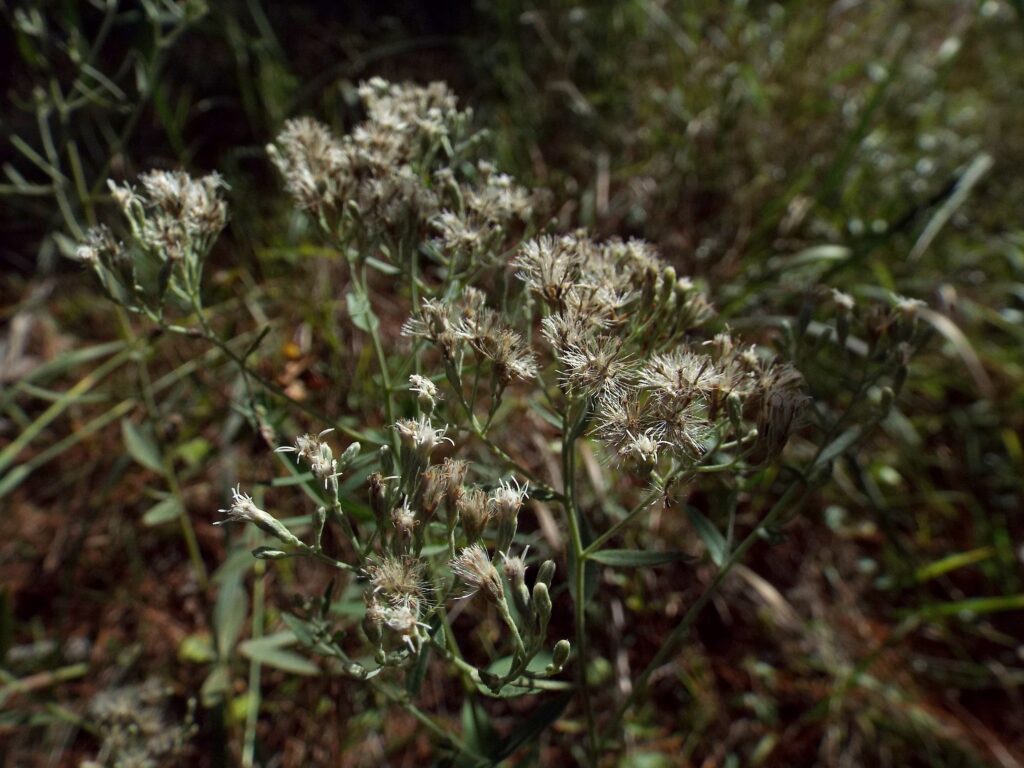
This week for Flora and Fauna Friday, we’re looking at a genus of flowering bushes known as Baccharis.
Baccharis and the species within it are known by many names: Groundsel, False-willow, Silverling, Coyote-bush, Broom, or usually just Baccharis. There are three species found in our area: Silverling (Baccharis glomerulifolia), Saltwater False-Willow (Baccharis angustifolia), and Groundsel-tree (Baccharis halimifolia). These species are rather similar in appearance and habits but differ distinctly in the shape of their leaves and flowers. So I’ll touch on how they differ first.
Of the three, Silverling is probably the hardest to locate species in our state. It’s found exclusively along wetlands in the coastal plain. It has densely packed, compact, pale yellow flowers and silver succulent leaves (Not pictured). Saltwater False-willow is found exclusively on the edges of maritime forests and hammocks in saltwater tidal zones. It has small white flowers and narrow, succulent leaves. Groundsel-tree is by far the most common and is found on wetland edges and otherwise wet soil throughout the state. It has pale yellow flowers and leaves of highly variable shape that are usually light green to silver in color.
All of these species are salt tolerant, large shrubs with dense evergreen foliage and a scrubby appearance. They prefer full sun and grow on the edges of wetlands. They bloom in mid to late fall each year and resemble a snow laden bush when their silky white seeds begin to mature. Interestingly, Baccharis is a member of the Head Flower family, Asteraceae. This is a massive family of predominantly smaller, herbaceous plants. It includes plants like Sunflowers, Coreopsis, Bonesets, Goldenrods, Dandelions, Thistles, Asters, pretty much anything that resembles one of those, and many more. (I’ll talk about what defines a Head Flower on a later date.) However, it contains only a very few woody plants like Baccharis.
Baccharis is considered a weed by many. Its prolific flowers produce thousands of windblown seeds per bush. These seeds can float on the wind for miles and find their way into almost every patch of bare Earth, where they’re ready to germinate come spring. This means they often show up on pond edges, the edges of structures, neglected gardens, fallow fields, and fence rows with regularity. Their scraggly appearance, relatively short lifespan, and brittle wood don’t win them any points with landscapers either. However, there’s always a silver lining. Baccharis prefers to grow in sunny areas on wetlands edges, which means it is often found on the edges of dikes, causeways, and ponds where it provides excellent erosion control. It’s quick growing roots rapidly stabilize the soil and its soft, brittle wood means it’s likely to lose branches during a wind storm instead of uprooting and damaging a water control structure. Baccharis species are also fantastic nectar sources for pollinators. They provide a huge quantity of nectar to insects like bees, flies, wasps, and butterflies at the end of the growing season once most sources are beginning to dwindle with the coming of fall.
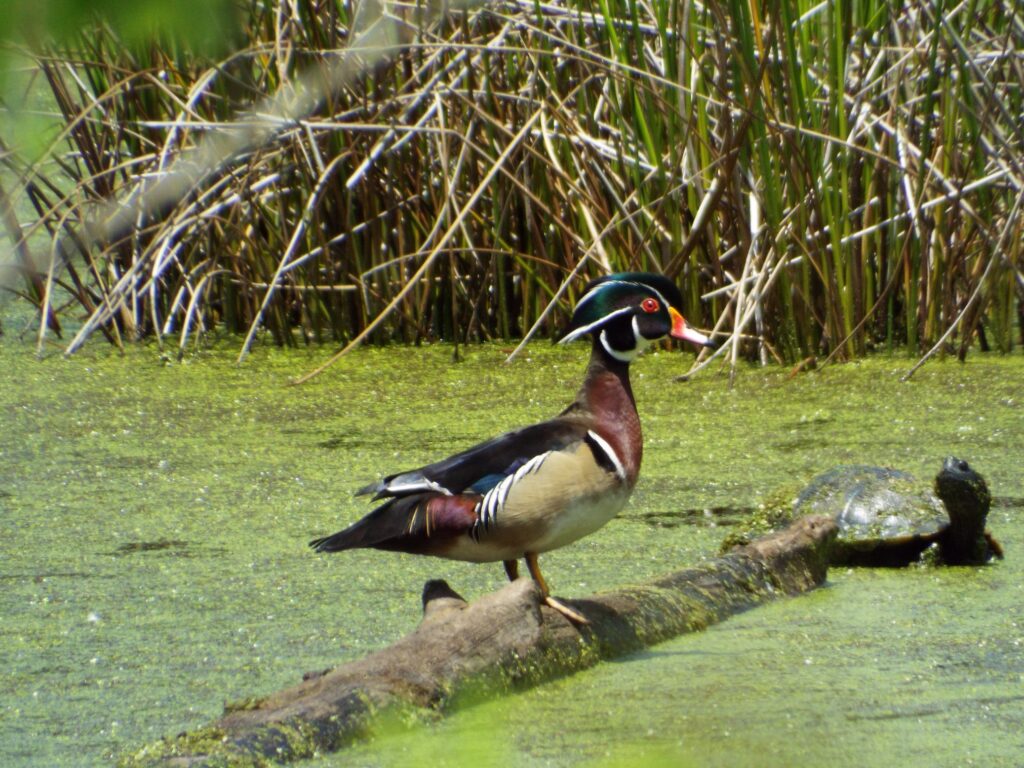
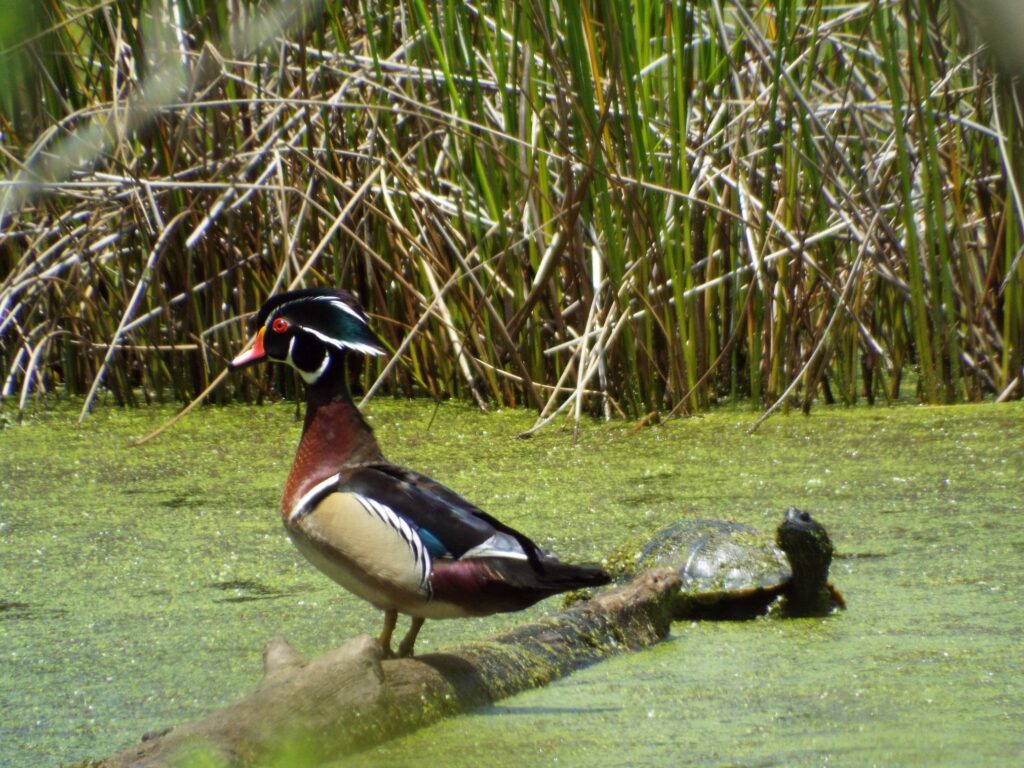
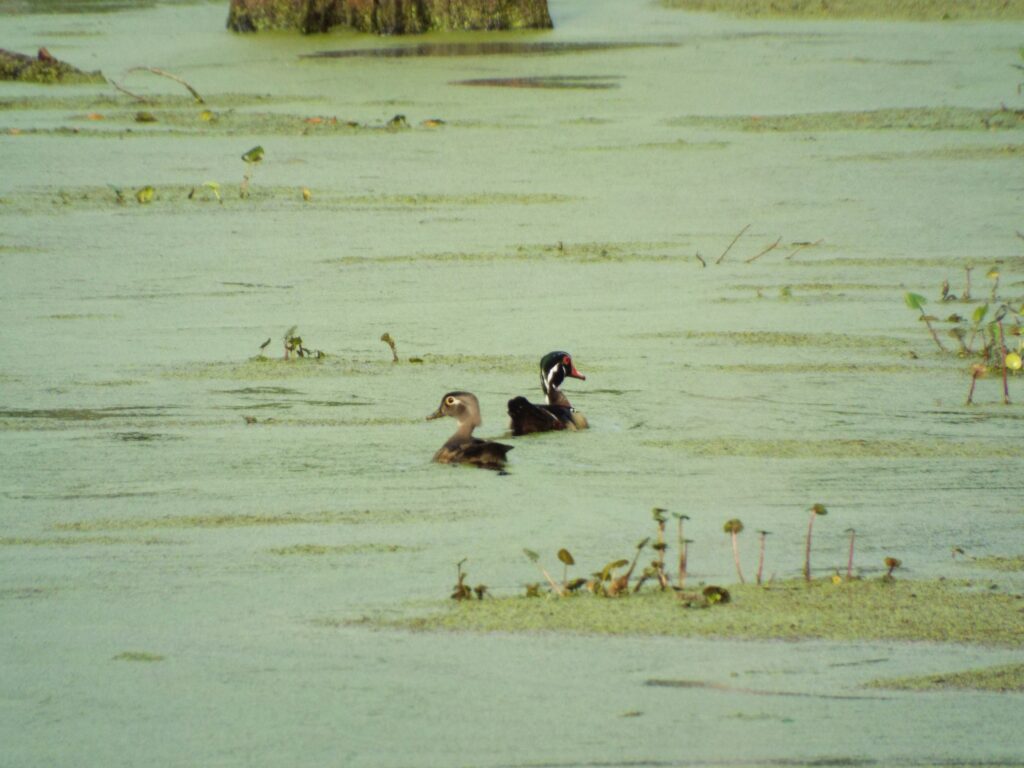
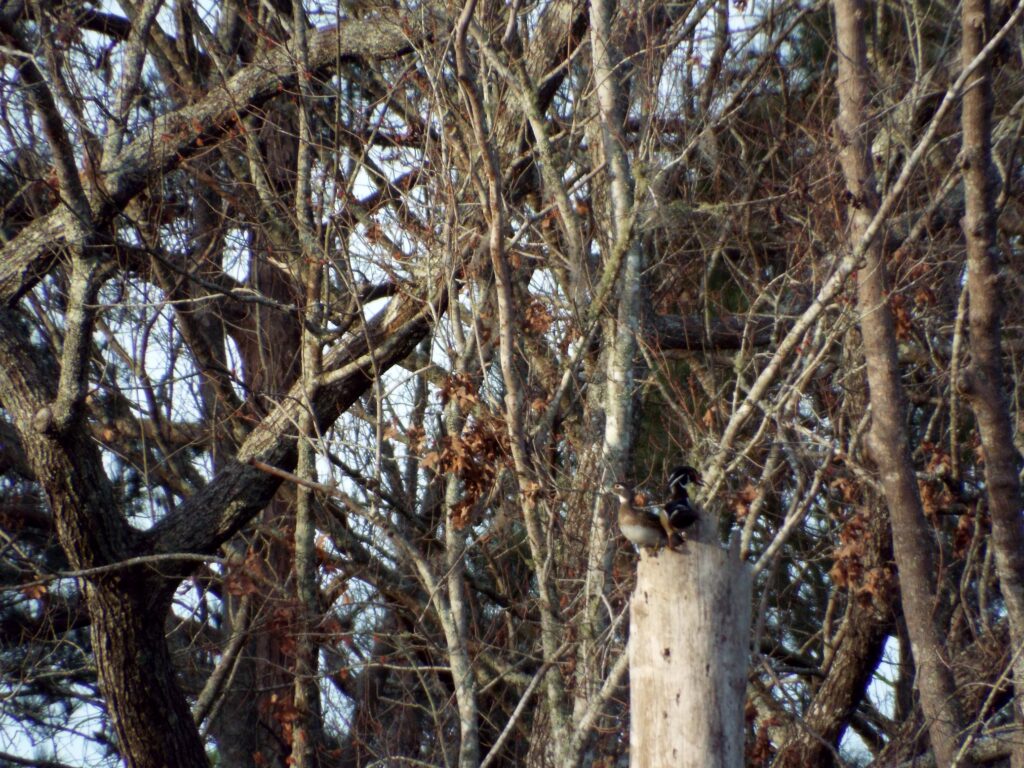
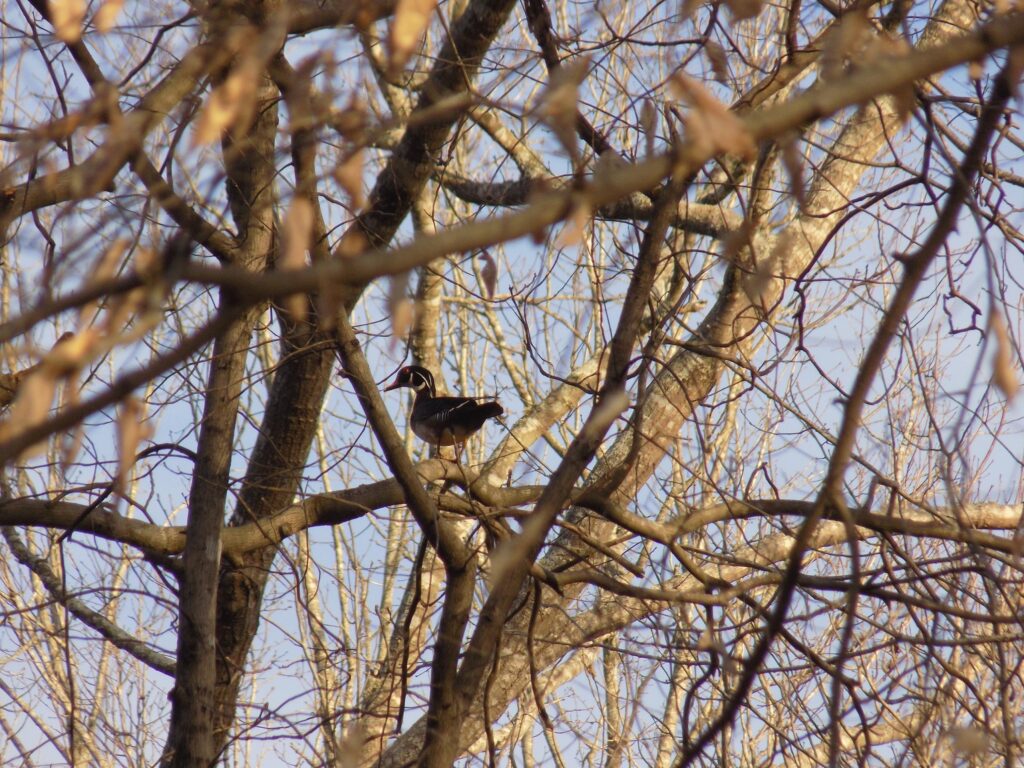
This week for Flora and Fauna Friday we’re focusing on one of our resident waterfowl, the Wood Duck (Aix sponsa).
The Wood Duck is a medium-sized species of Duck native to the Eastern US. In South Carolina they are a common species and permanent residents. Many individuals are non-migratory but they may be joined by northern birds in the winter months. The species is strongly sexually dimorphic, meaning males and females have distinct and obvious differences. Males are beautifully patterned with bright red eyes, pink bills, and a complex plumage of brown shades accented by greens, blues, and white. Females have a very drab and camouflaged appearance, sporting only a distinct white eye patch over a plumage of light brown and white. Both males and females have a crest of feathers on their head but it is more pronounced in males. Wood Ducks feed primarily on vegetation, especially Duckweeds, seeds, and nuts.
Wood Ducks, as the name implies, live in the woods. More specifically, they inhabit swamps, floodplain forests, and vegetated ponds surrounded by woodlands. The reason for this preference is three fold. First, flying through the woods is dangerous. This means Wood Ducks have little competition for food from other duck species since those other species would rather avoid the hazard. Second, it’s hard to see through trees. This means Wood Ducks are better protected from aerial predators like Falcons and Eagles that other Ducks must avoid. Third, Wood Ducks nest in tree cavities. It’s hard to nest in trees without any trees around. Cavity nesting helps protect a nest and its mother from predators like Raccoons, Rats, Snakes, Bobcats, and Alligators.
Wood Ducks are one of only two species in the genus Aix. The other is the equally handsome Mandarin Duck, native to East Asia. This means they’re fairly weird compared to most of our species of Ducks. To name a few: they have that crest, they have claws, they roost in trees, they prefer to feed on the water’s edge rather than open water, they nest in cavities, they don’t migrate, and they don’t quack, instead they whistle and scream.
Wood Ducks are a conservation success story. Their numbers were in rapid decline at the turn of the 20th century due to habitat destruction and unregulated hunting. Thanks to federal intervention and a shift in American hunting culture, their numbers today are completely recovered. Being fairly large, cavity nesting birds means Wood Ducks are very susceptible to habitat degradation from logging. They require large standing dead trees over standing water that Pileated Woodpeckers have already nested in. Much like Eastern Bluebirds, their recovery has nest boxes to thank. It takes decades to grow trees large enough for Wood Ducks to nest in but it only takes an afternoon for a conservation minded citizen to build and install a Wood Duck box on the edge of a swampy farm pond or fishing hole. Sometimes that little bit of effort from enough people is all it takes to make a real impact.
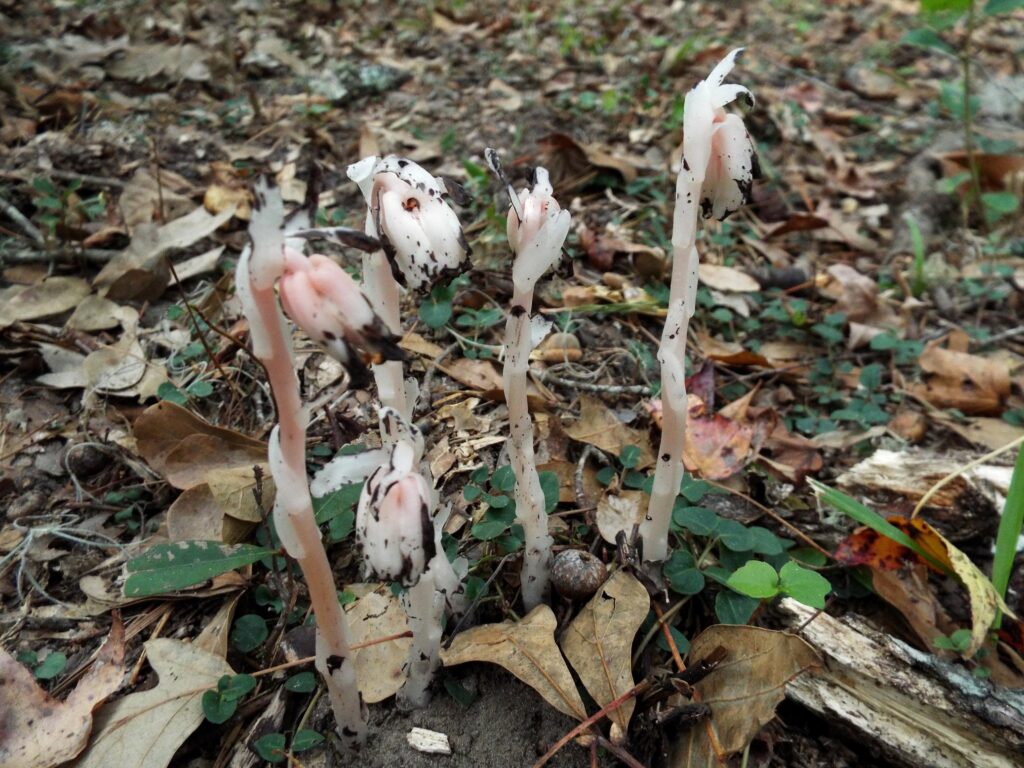
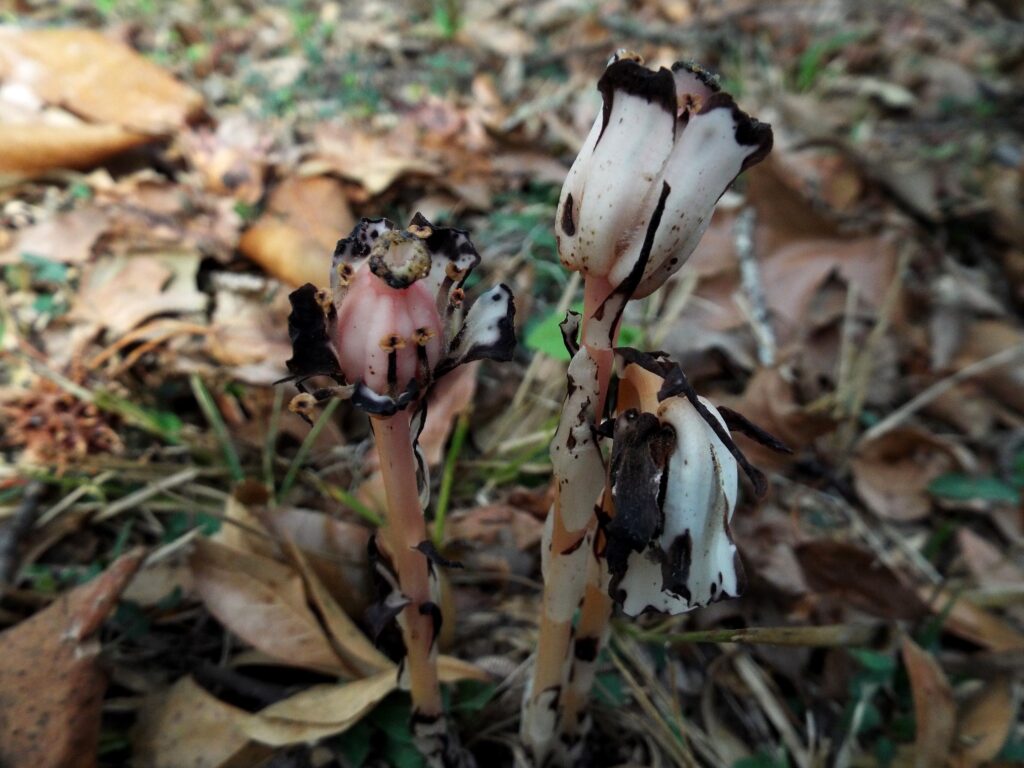
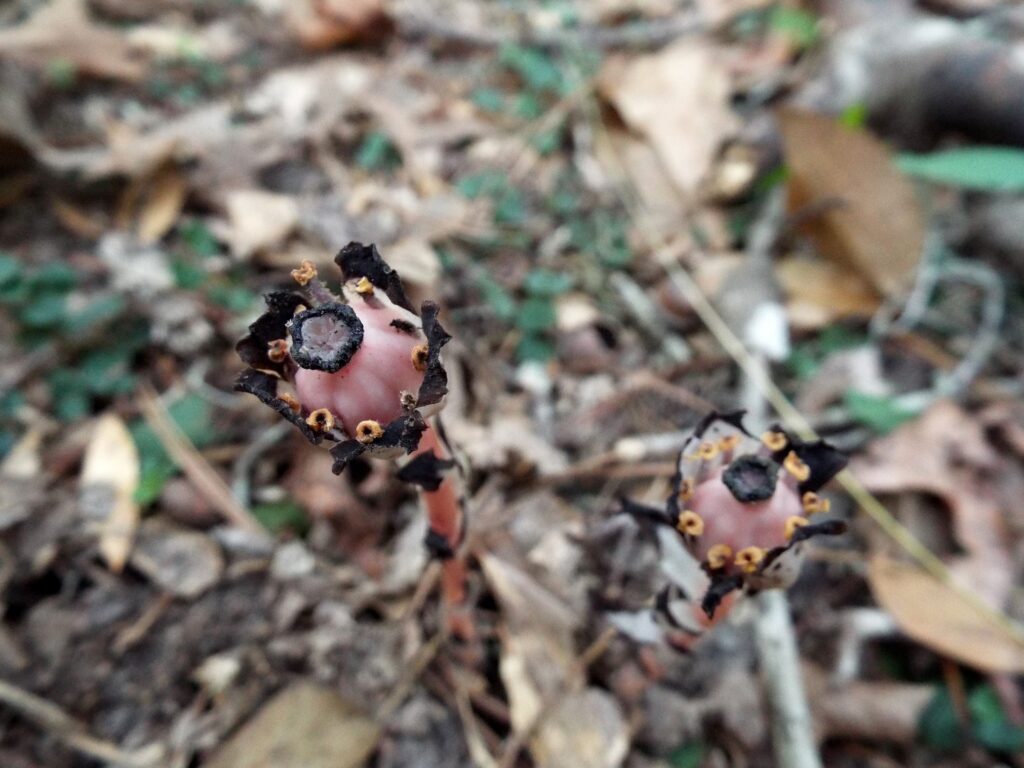
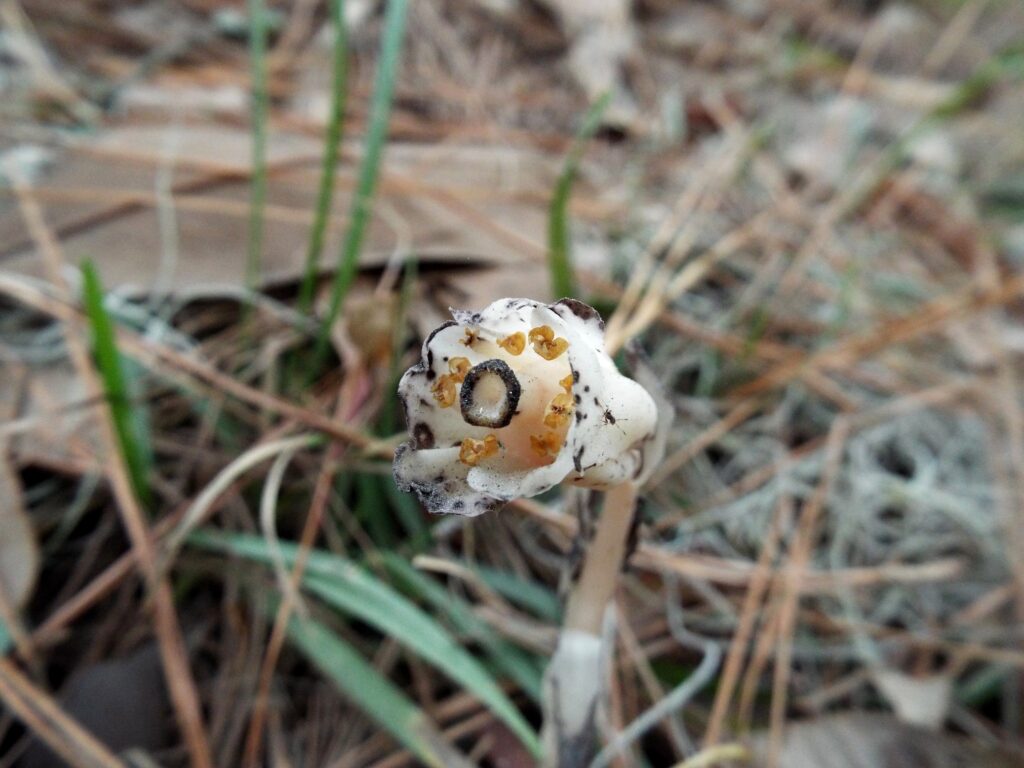
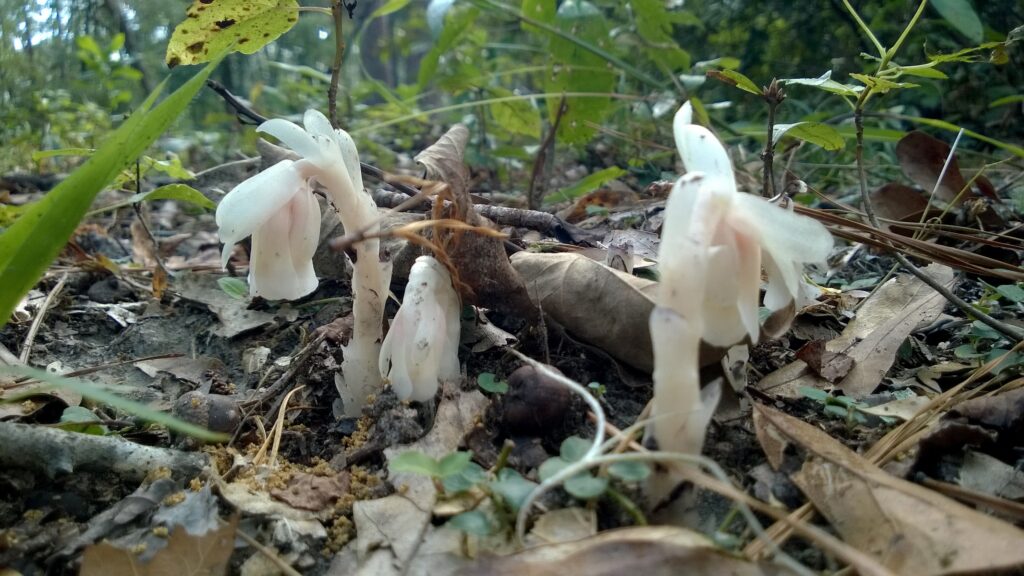
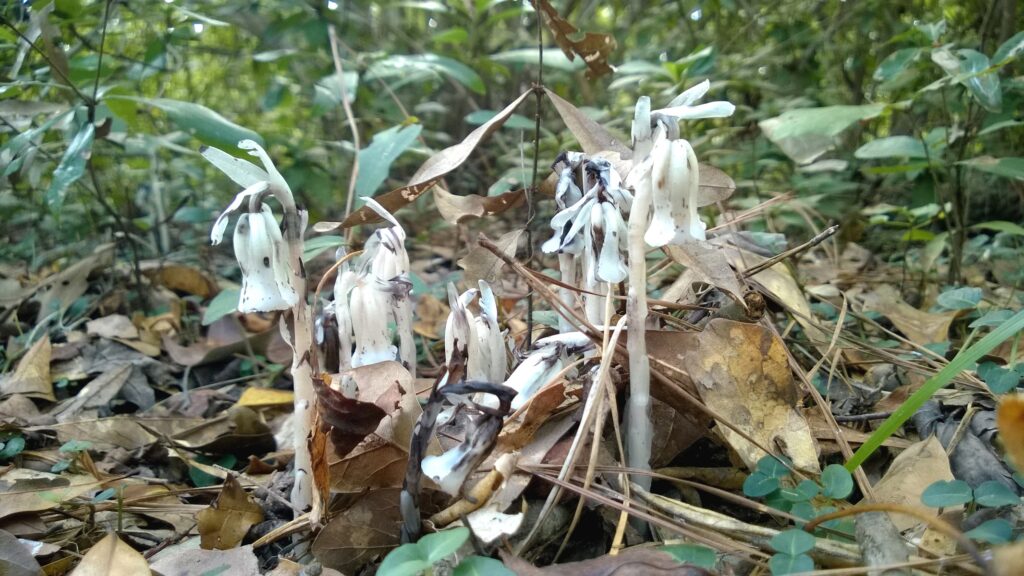
This week for Flora and Fauna Friday, in celebration of Halloween, we’ll be talking about a ghostly vampire of the forest understory. An ephemeral hand of an unlikely parasite that pushes its way into our realm of view every Halloween season. Today we’re looking at the Indian Pipe (Monotropa uniflora).
The Indian Pipe is a member of the Heath family, Ericaceae. This is the family that Azaleas, Rhododendrons, Blueberries, and Mountain-laurels belong to. This family is known for its evergreen shrubs with pinkish, bell-shaped flowers. Indian Pipes possess the latter but the former is nowhere to be seen. That’s because Indian Pipes are a subterranean, nonphotosynthetic, achlorophytic, parasitic, myco-heterotrophic angiosperm. In other words, they’re a flowering plant that lives completely underground and feeds by stealing nutrients and sugars from soil fungi, instead of photosynthesizing. They bloom in mid fall, right around the end of October. This is the only time they’re visible to us.
Now, let’s go in depth on how Indian Pipes go about parasitizing their host. First we need to talk about mutualistic mycorrhizal associations. A mycorrhizal association is a partnership between a plant and a soil fungus where both organisms benefit. So what does each stand to gain? The plant gains increased access to mineral nutrients. The fungus is rewarded with sugars. Why form a partnership? Soil fungi are excellent at breaking down organic matter and mineral deposits in the soil, in order to have access to the mineral nutrients within them. This requires some complicated biochemistry, microscopic body structures, and a lot of calories. Thus, fungi need to seek out and breakdown organic material that’s high in calories in order to keep themselves fed. Plants are excellent at turning water, air, and sunlight into raw sugars. However, their rigid cell walls and vascular structures restrict how efficiently they can pull available mineral nutrients out of the soil. On top of that, they’re not able to access most of the nutrients that are locked away in soil organic matter. So, plants and fungi have allied and the two prosper because of it. The plant has access to more mineral nutrients and the fungus has a steady and dependable supply of calories. This sort of alliance is most fruitful in trees and shrubs due to their high demand for nutrients and high photosynthetic output. The fungi will form a sheath around the roots of a plant or sometimes embed itself within the skin of the plant’s roots.
Indian Pipes cheat this alliance by parasitizing the fungus in a mycorrhizal association. The fungus provides the Indian Pipe with mineral nutrients but instead of rewarding the fungus with sugars, the Indian Pipe steals the sugars the fungus was given by its partner. The fungus, as a result takes more sugars from the tree to make up the deficit. So really, the Indian Pipe is parasitizing both a fungus and, indirectly, the plant. This theft is so efficient that the Indian Pipe has completely lost the ability to produce chlorophyll, the pigment that allows photosynthesis. This leaves their flesh a ghastly white and their flowers with only a faint wash of red.
This Indian Pipe was parasitizing on the roots of an exotic Azalea. They seem to prefer hardwoods in our area. Indian Pipes are not alone in this lifestyle. They have a sister species known as Pinesap (Monotropa hyopitys) that specialize in hosting on Pines. Many species of Orchid will do the same. If you’re wandering the autumn forests or traversing the haunted woods this Halloween, you may stumble onto these pallid vampyric fingers rising from beneath the Earth to pierce the shadow soaked forest floor.
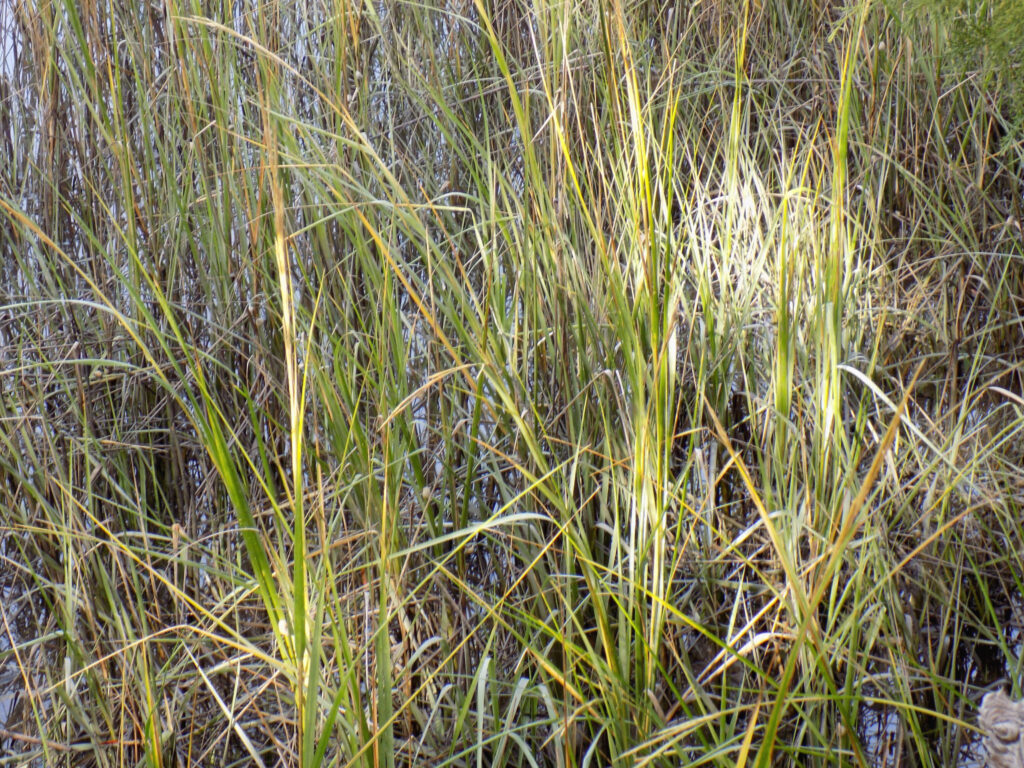
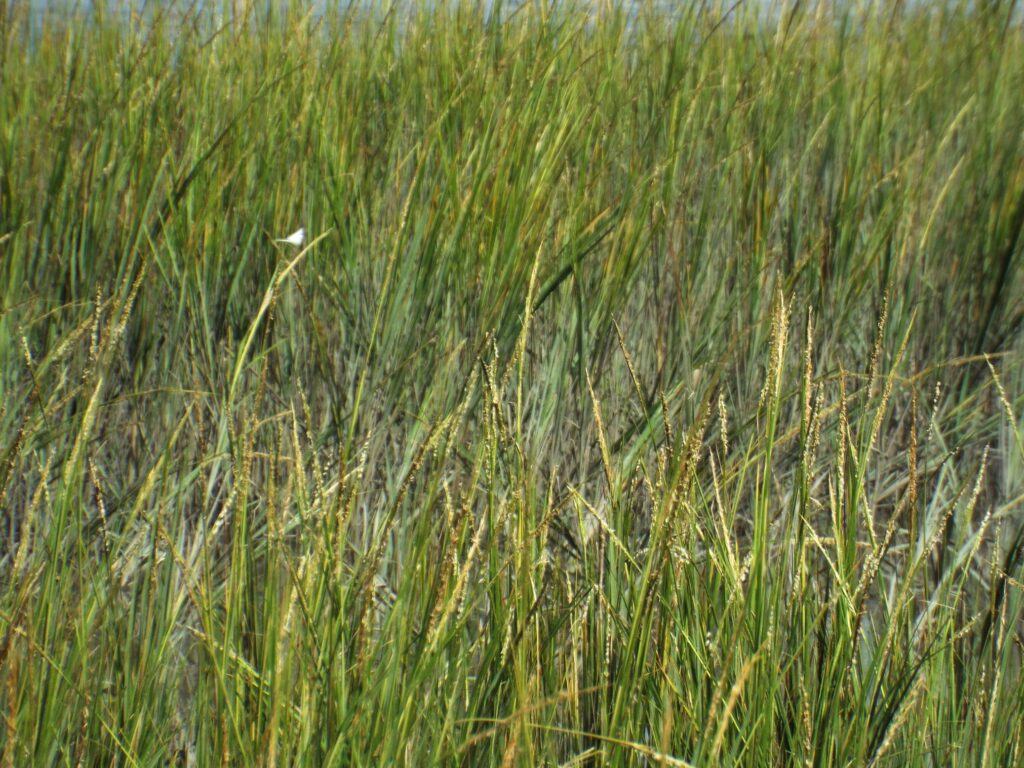
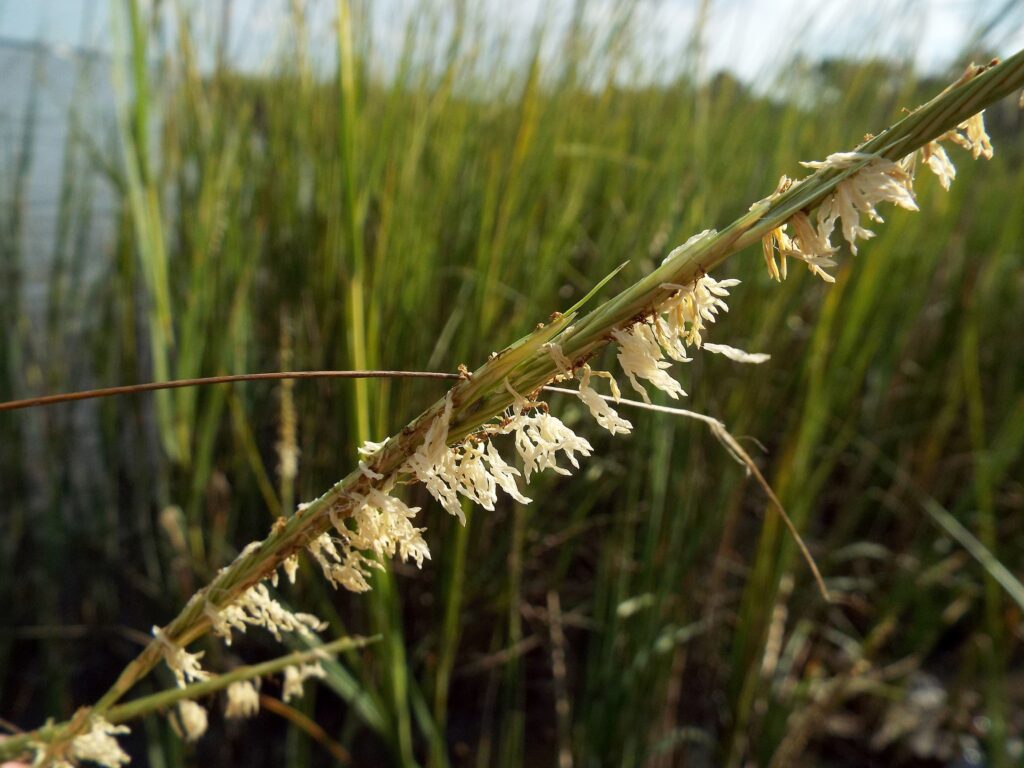
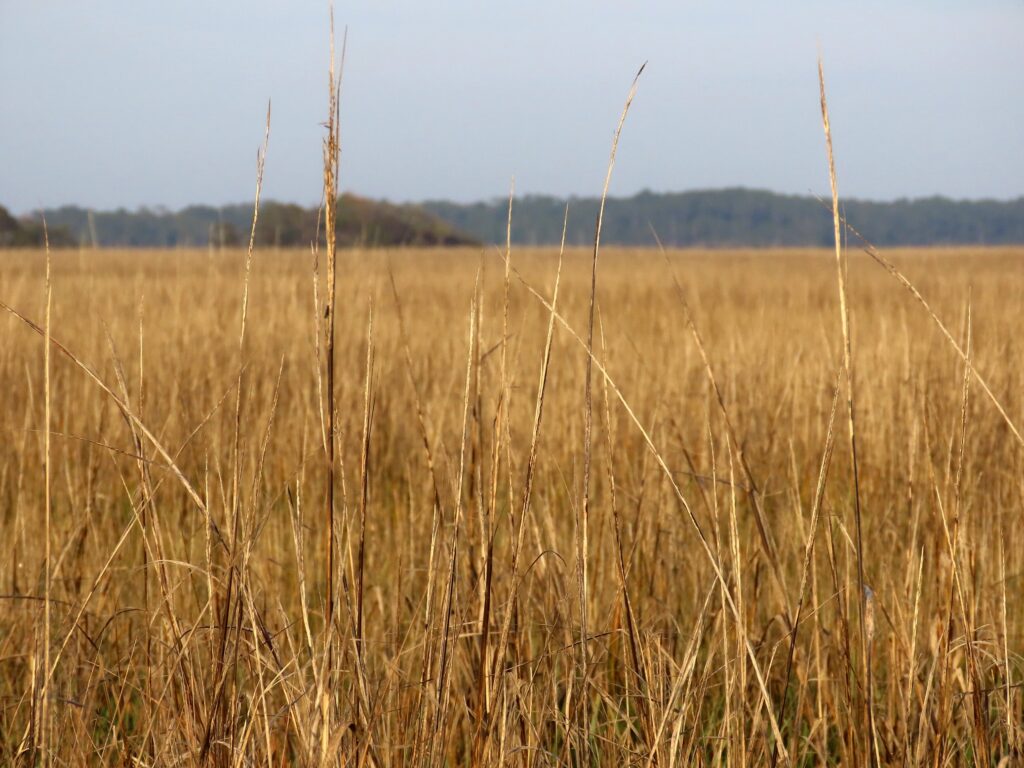
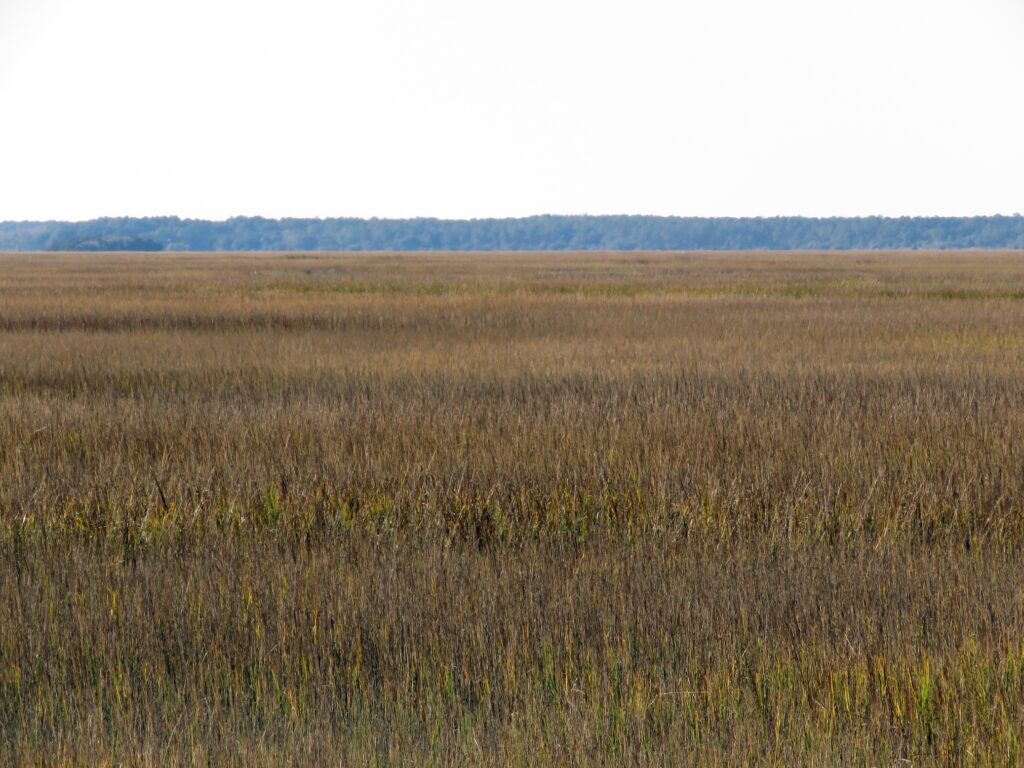
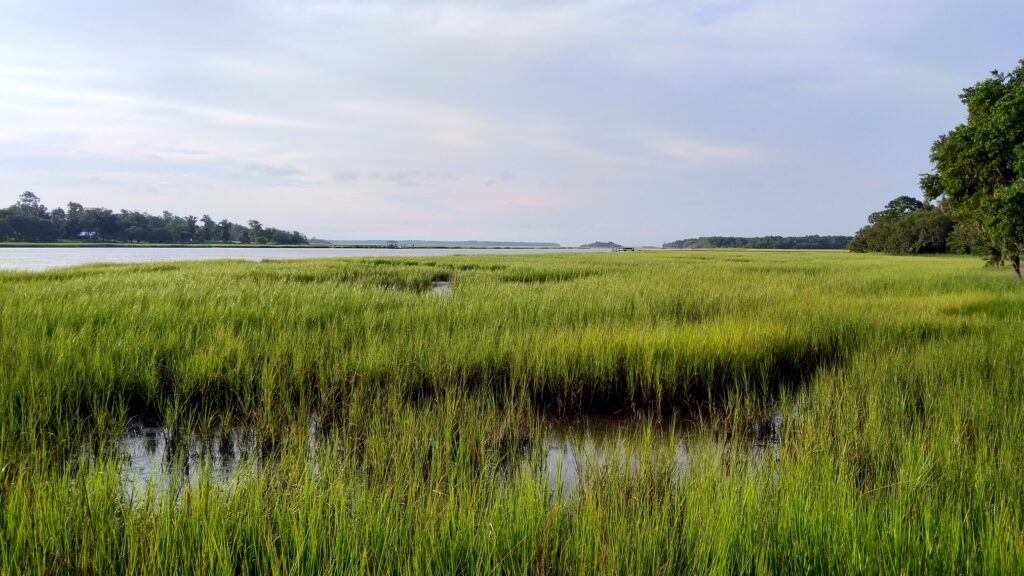
This week for Flora and Fauna Friday, we’re briefly talking about the most ecologically and economically important species in Coastal South Carolina: Smooth Cordgrass (Spartina alterniflora).
Smooth Cordgrass, or more commonly just called Spartina, is a species of grass that’s specially adapted to growing in salt water. This is by no means a trivial feat. Black Needlerush (Juncus roemerianus) is the only other vascular plant in our area that comes close and even its roots can’t handle more than a few hours of saltwater inundation each day. Mangroves in the tropics can accomplish this too but they can’t survive freezing temperatures. Spartina is a perennial grass that spreads via roots and disperses with floating seeds. It dies back to the roots each winter, grows all spring and summer, and flowers in early fall. The processes by which Spartina can survive being submerged for half the day, dry the other half, and exposed to extreme salinity levels throughout its lifespan are downright fascinating and ingenious.
I’ll try not to be long winded but I need to give a little background into plant physiology. Plants are in a constant war with each other over water, sunlight, and nutrients. Losing this competition means death. The best way for a plant to avoid competition and ensure it has enough of all of these resources is to carve out a “niche”. An ecological niche is a stable combination of habitat and resources that an organism is best suited to live within. These niches can be very specific or fairly broad. Spartina fills a rather narrow niche environmentally but it has no competition. With no other plants to compete with, Spartina is bathed all day by sunlight, its roots are submersed in a nutrient rich tidal soup twice a day, and it has more water than it could ever need. In fact, there is such an excess of resources in this habitat, that the conditions are deadly to any other plant. That’s what makes Spartina special. Excessive sunlight can cook a plant alive. Excessive water will drown a plant’s roots. Excessive nutrients will “mummify” a plant from the outside in. Spartina thrives in the extreme of all three.
What makes Spartina an ecologically and economically critical species is its ability to fill this niche. Without Spartina there would be no Salt Marsh. The Salt Marsh is a critical habitat for thousands of species of animals, many found nowhere else. This includes economically important species like Red Drum, Sea Trout, Oysters, White Shrimp, and Blue Crabs. Not only does the Salt Marsh provide direct economic benefits in the way of food resources, it also provides a myriad of indirect benefits to humans. Spartina, and the Black Needlerush that grows in its wake, slows down waves. This reduces the severity of storm surges and prevents erosion. Both of which can cause extremely costly damages to the infrastructure of human coastal communities. When these waves slow down, they deposit the sediments they’re carrying. The roots of Spartina grow in and over them, holding them in place. This slows erosion and can even reverse it. In this process of sediment collection, Spartina also captures and stores huge volumes of Carbon from the atmosphere. A good portion of this sediment is composed of tiny bits of organic matter (most of which is last year’s stalks of Spartina) and it settles out to form the fragrant slate-gray goop we know as pluff mud. With each generation of Spartina, the roots of the previous get buried in the sediment, trapping more and more Carbon. Storing Carbon is important to the regulation and stabilization of our global climate.
This is why it’s important to protect the Salt Marsh. As sea levels rise, the band of Spartina along the coast will become increasingly narrow. It will never completely disappear but we will lose most of the ecological and economic benefits it provides in its current state. So every acre we can protect now will help mitigate our losses in the future. So, the next time you’re crossing the McKinley Bridge, appreciate that one of a kind view and everything the Salt Marsh does for you.
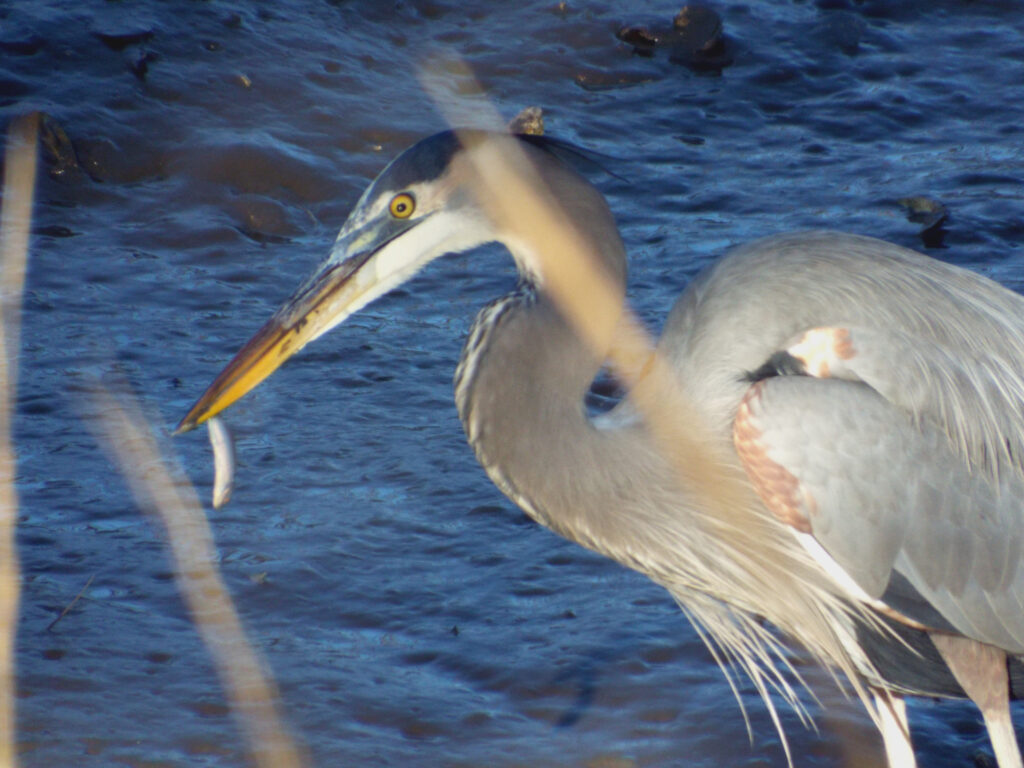
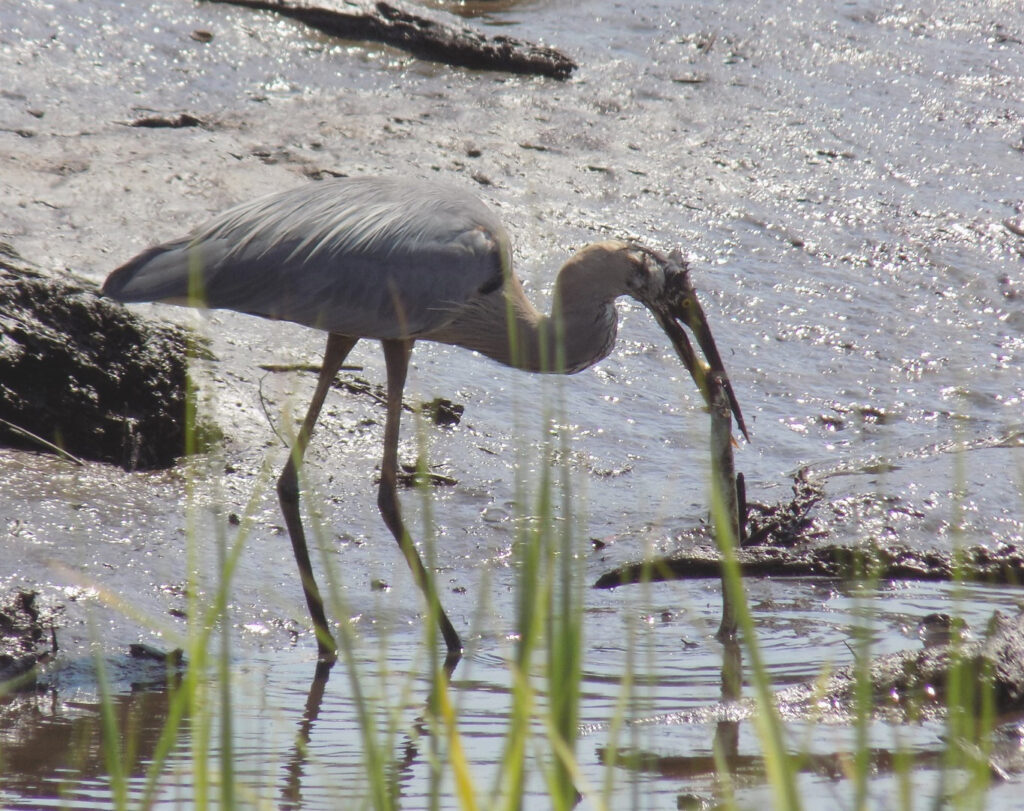
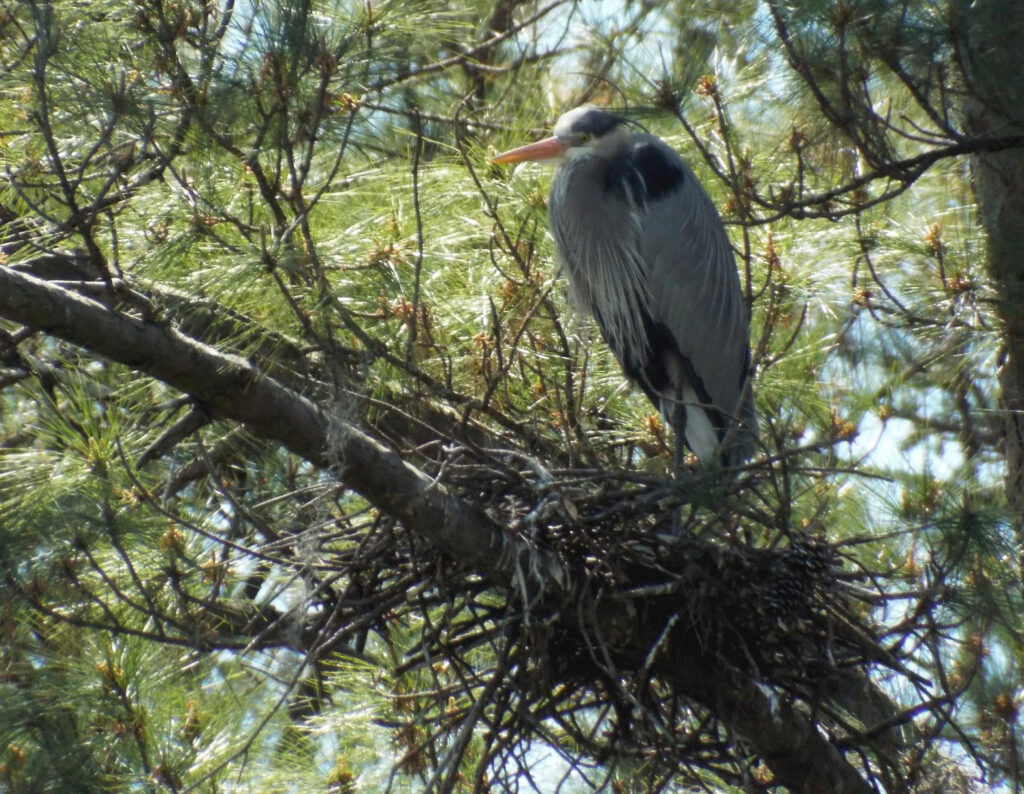
This week for Flora and Fauna Friday, we’re looking at the largest and most widespread of the North American Wading Birds: the Great Blue Heron (Ardea herodias).
The Great Blue Heron is an aptly named species. Their impressive size and gray-blue plumage make them difficult to miss or to even mistake for anything else in the USA. They stand a little over 3 feet tall and have a wingspan of over 6 feet. That impressive wingspan is only matched by Eagles and Pelicans in the Eastern US. Like most herons, the Great Blue Heron has long legs, a long, dagger-like bill, and a long, curved neck. All of that lankiness is necessary for how Herons feed. The Great Blue Heron is an ambush hunter. It stands still, almost statue-like, using its excellent vision to spot prey. When it acquires a target, it will retract its neck against its body, lean forward, and poise itself for attack. When the prey wanders into range it will launch its head forward with great speed and precision, grabbing or spearing its meal with that pointed bill. This is similar to how constricting snakes hunt.
Great Blue Herons are found throughout southern Canada, the United States, and Central America. This wide range is due to their large size and extremely versatile diet. Most Herons are fairly specialized in what kinds of habitats they hunt in and what foods they’ll eat. Many are restricted almost entirely to brackish or saltwater habitats. However, not the Great Blue Heron. The Great Blue Heron readily hunts anywhere there is water and eats anything it can catch. They will also hunt in fields, lawns and floodplains surrounding bodies of water. Their large size and long legs allow them to hunt in deeper water and eat larger prey than any of our other Herons. Their legs also allow them to hunt in fairly tall grass and their larger size allows them to tolerate colder temperatures than most Herons. They primarily eat fish, ranging in size from 2 inch minnows to 20 inch Bass and Carp. (They’re notorious for de-Koi-ing Koi ponds.) However, Great Blue Herons also eat: Snakes, small Turtles, hatchling Alligators, Frogs, Toads, Salamanders, Tadpoles, Eel, Mice, Rats, young Muskrats, Gophers, Squirrels, Rabbits, Grasshoppers, Crayfish, Shrimp, Crabs, and even Ducklings. I wasn’t exaggerating, they’ll eat pretty much anything they can swallow whole.
Down on Edisto you’re most likely to see Great Blue Herons in the salt marsh at low tide, hunting for minnows and shrimp along the tidal streams or on the edges of farm ponds stalking frogs and bream. Keep an eye out the next time you’re passing the marsh and you’ll likely see this steel-blue statue standing erect on the pluff mud or knee deep in brine with eyes on a crustacean.
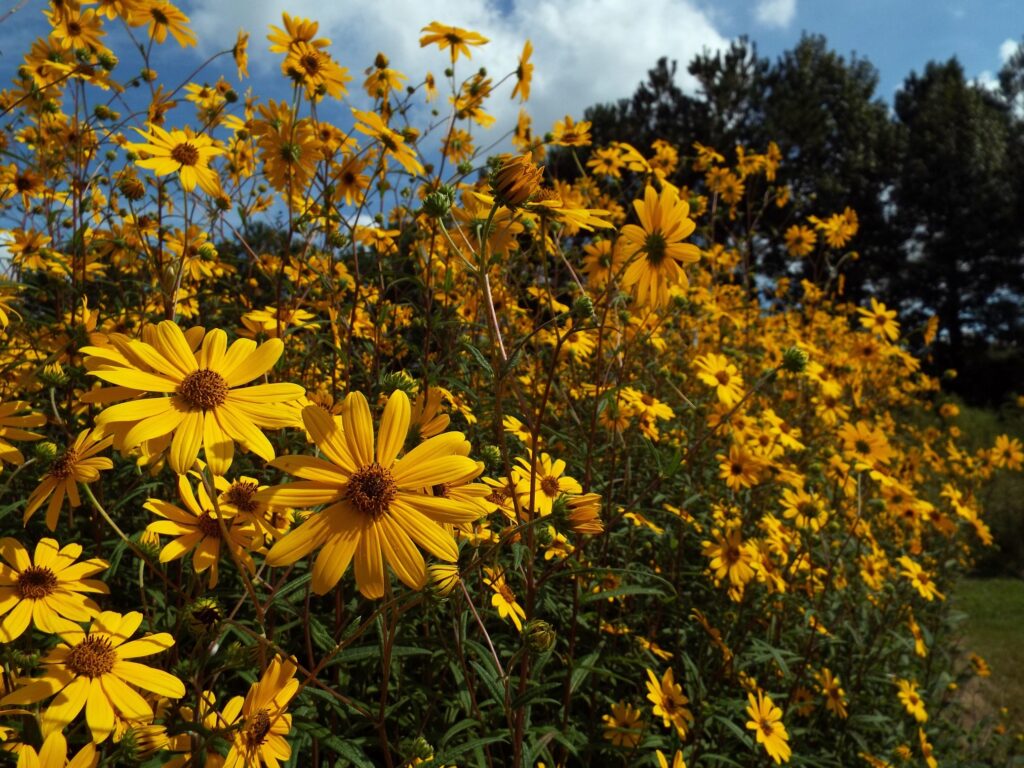
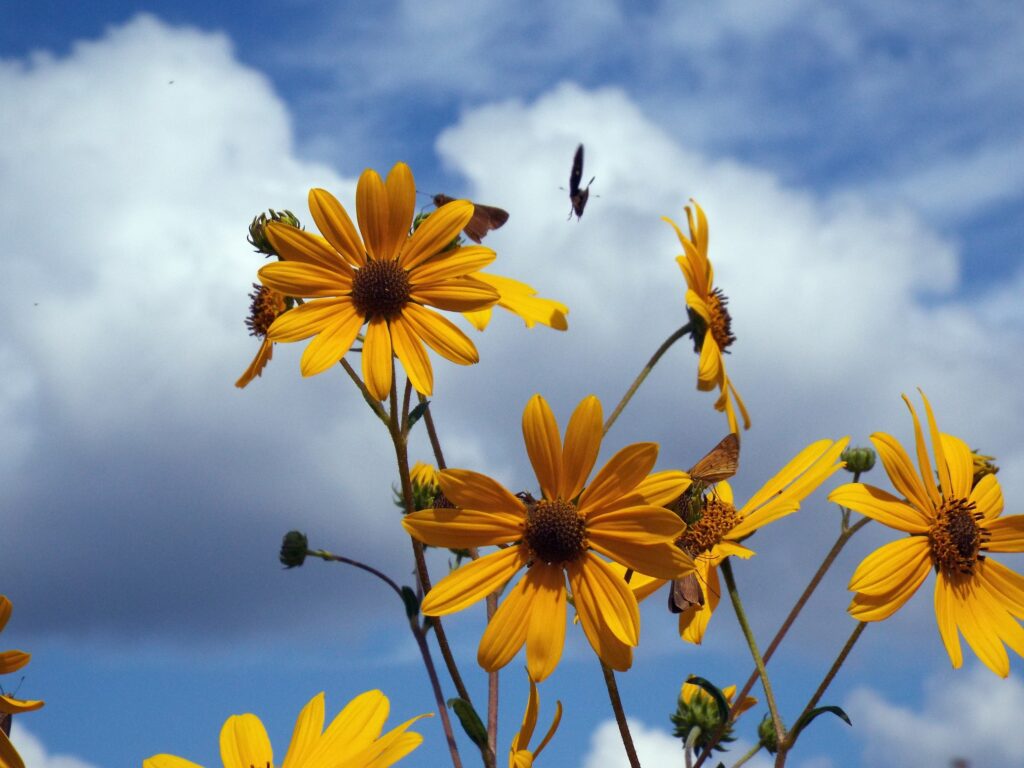
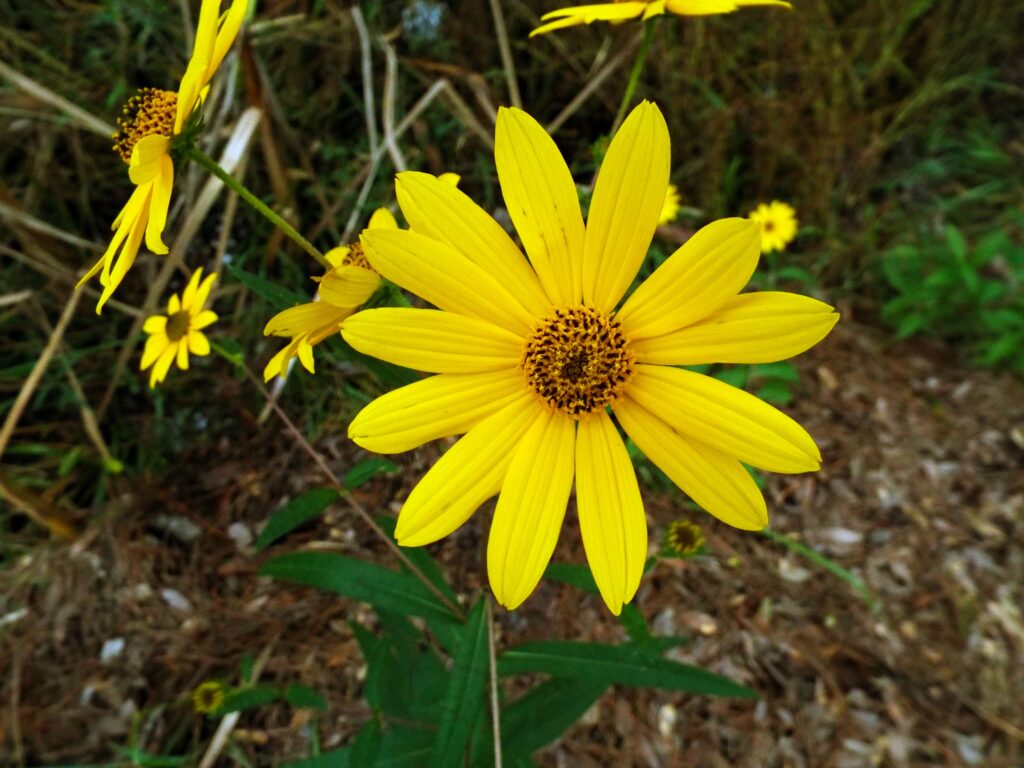
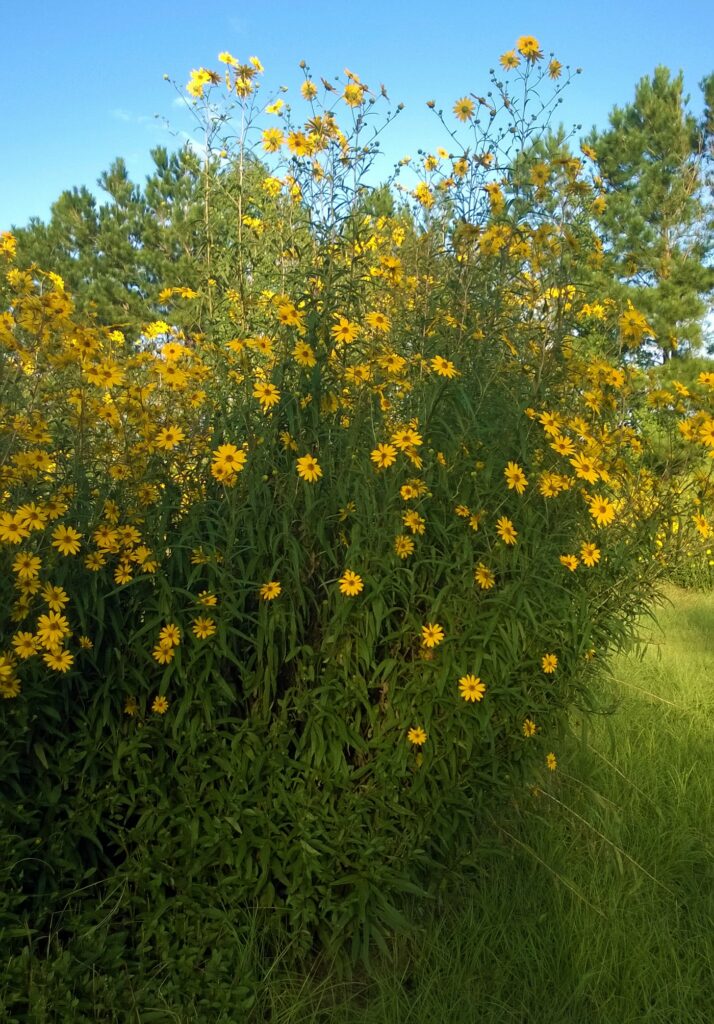
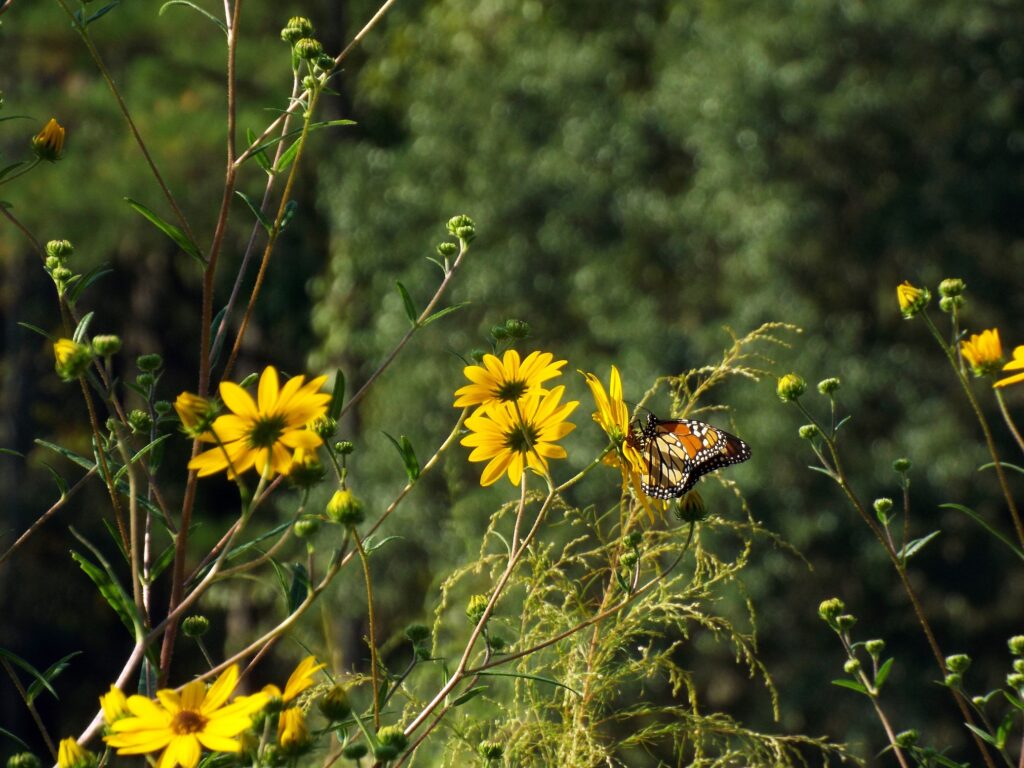
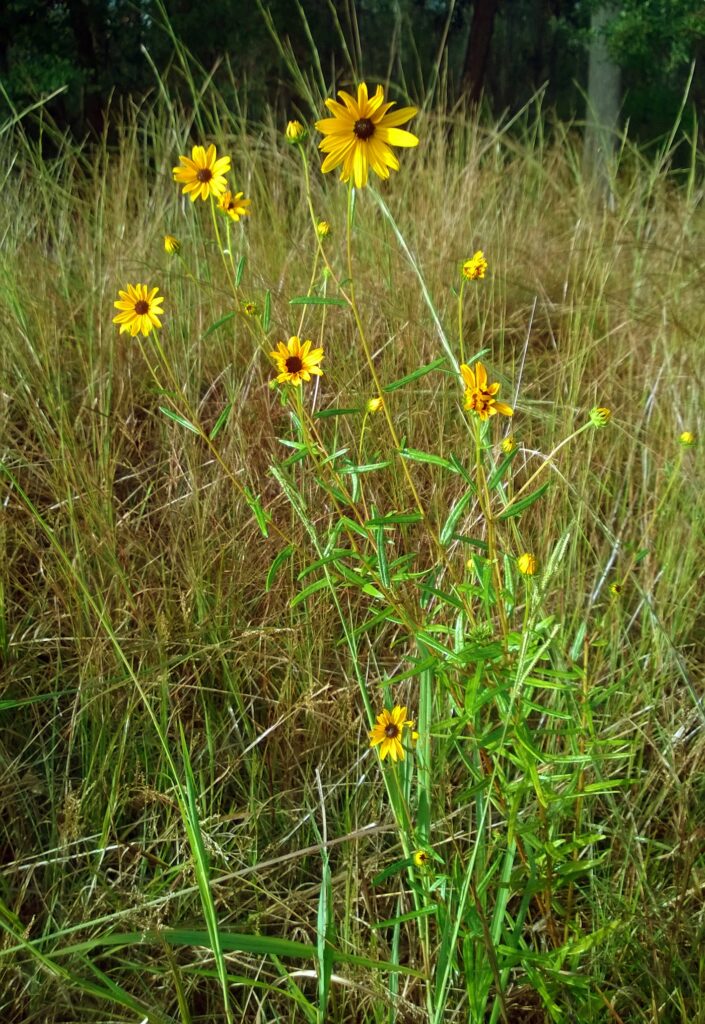
This week for Flora and Fauna Friday we’re examining a roadside flower that’s in full bloom this time of year. You’ve probably seen it all along HWY-174 these last few weeks. Today we’re putting the spotlight on the Swamp Sunflower (Helianthus angustifolius).
The Swamp Sunflower is a common fall flower on Edisto. Its common name comes from its love of wet, sunny habitat. With their moist soil and regular but widely spaced mowing schedule, ditches in rural roadsides are a preferred habitat for Swamp Sunflowers. It’s a plant that can be quite variable in appearance. Plants in shadier areas or those that are cut backed more frequently, may not even reach two feet in height. Where ornamental plantings in ideal conditions can reach 10 feet in height. Swamp Sunflower gets its scientific name, Helianthus angustifolius, from its narrow leaves and large, bright yellow flower. Helianthus angustifolius directly translates to Narrow-leaved Sun-flower (which is another common name for the species). The most easily recognized feature of this plant are those large, vibrant yellow flowers that bloom high off the ground. The flowers look much like a Black-eyed Susan or Coreopsis but the flattened, black disc in the center distinguishes it as a Sunflower. These flowers are a big pollinator attractor, especially for butterflies. Their seeds are also a source of food for Goldfinches and Sparrows. Swamp Sunflowers are perennial but they die back to the ground each winter. From the first frost until spring, Swamp Sunflowers are only visible by last year’s flower stalk and what’s known as a basal rosette. A basal Rosette is simply a whorl of leaves laying directly on top of the soil. This is a common adaptation many perennial wildflowers deploy. It allows the plant to continue to photosynthesize a small amount throughout the winter while keeping the leaves out of the cold, dry winds and within the warm layer of air right above the surface of the soil. From mid-spring, they grow slowly through to the end of summer before finally putting out a foot or more of flower stalk around the beginning of fall. They bloom for about a month, usually late September until Halloween. Sunflowers have a behavior know as heliotropism. This is the act of a plant or animal moving or orienting itself in response to sunlight. In Sunflowers, they orient their leaves and flowers to face the sun, slowly moving throughout the day so that the plant is always facing the sun. Plants do this by altering the internal pressure of their cells, causing uneven pressure in the leaf or flower stalk and bending the plant towards or away from sunlight. In Sunflowers, the plants face towards the sunlight. This is called diaheliotropism. It allows the plant to maximize its photosynthetic potential by catching as much sunlight as possible. Sicklepod, a plant I talked about back in August, is also heliotropic but in a different way. Sicklepod, and many other species of plants, orient their leaves edge on with the sun. This is called paraheliotropism. They minimize the amount of sunlight that contacts their leaves to avoid overheating. Plants typically only do this during the hottest part of the day, where the surface of the leaf can reach dangerous high temperatures when there is no breeze or the soil is dry.
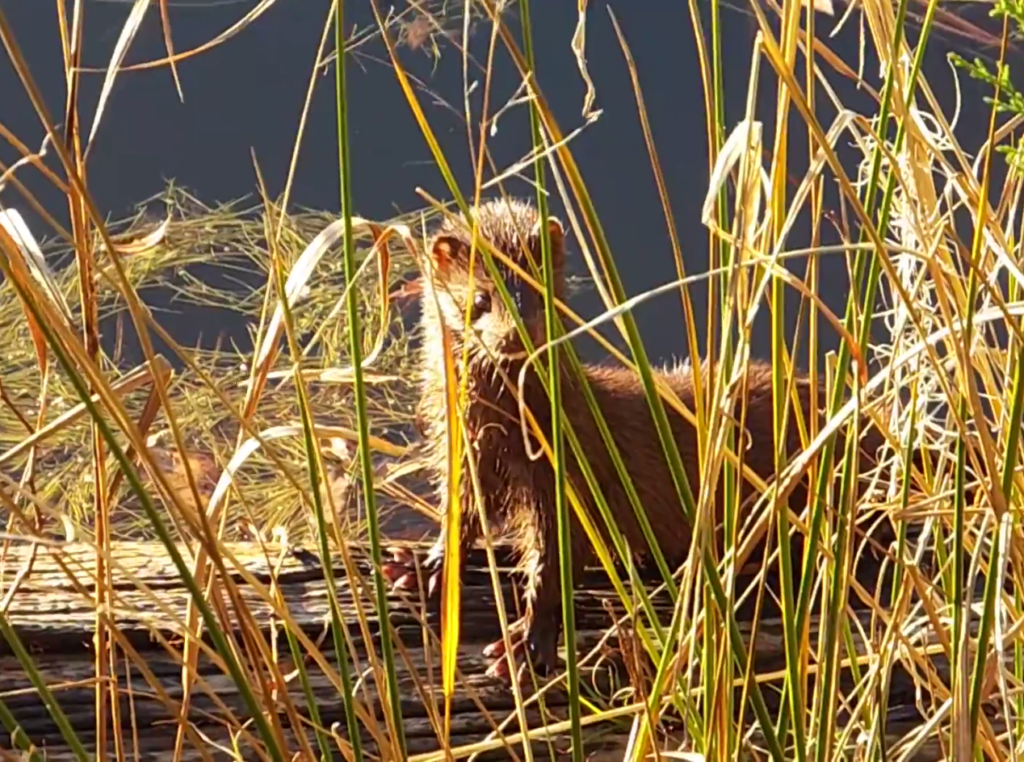
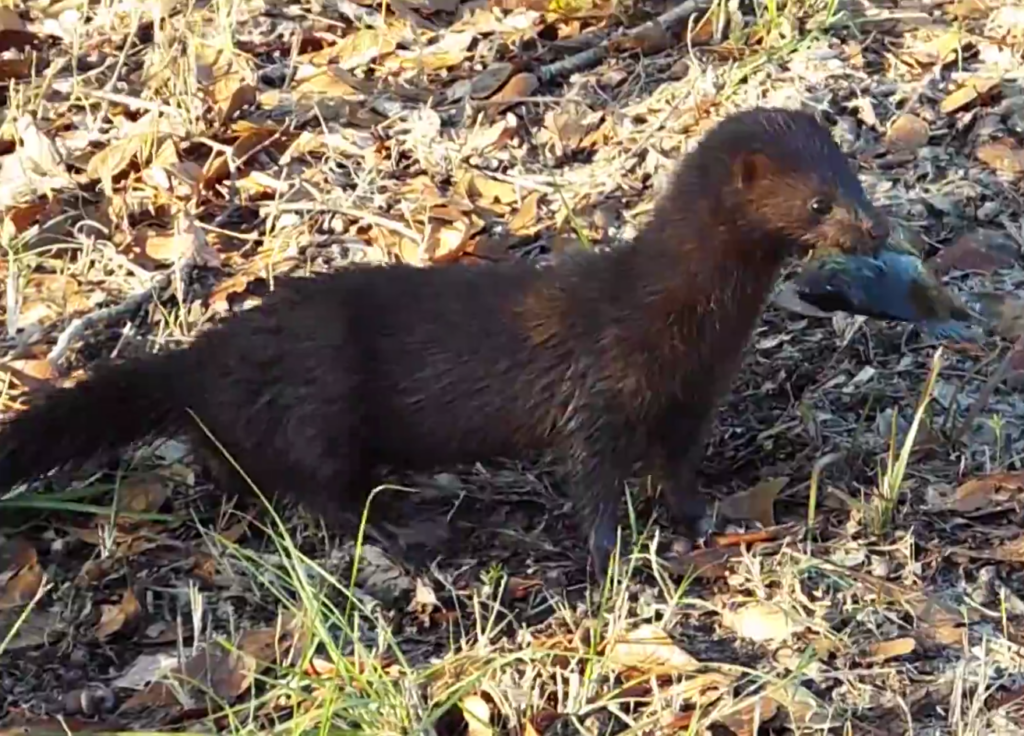
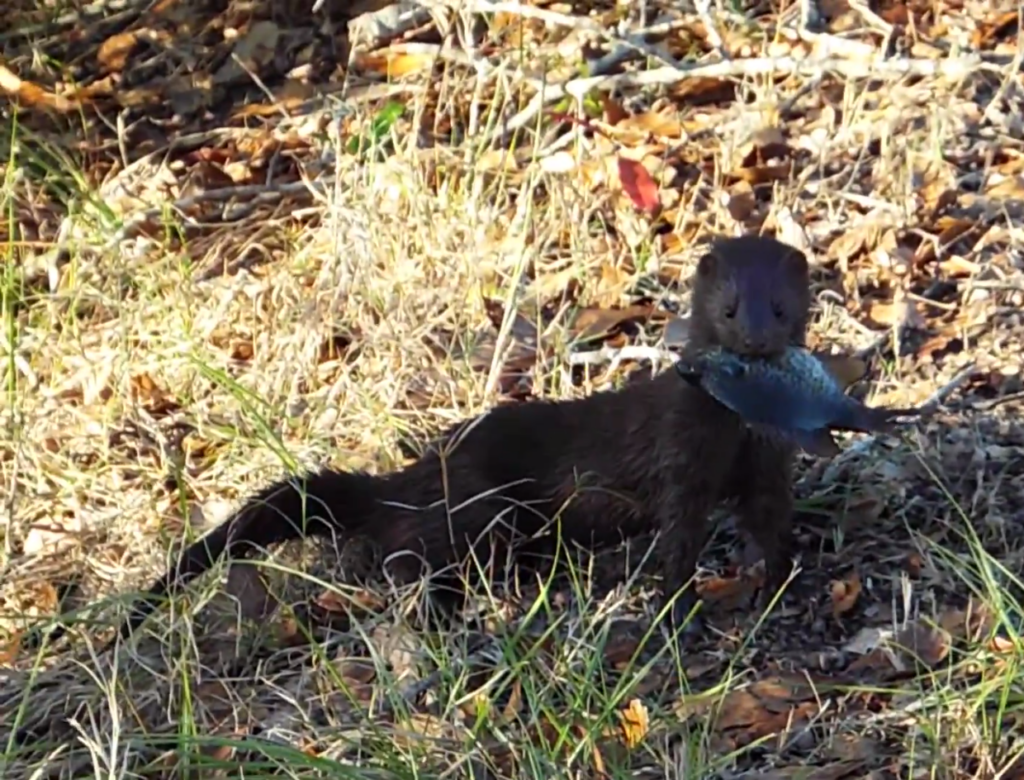
This week for Flora and Fauna Friday we’re talking about: the American Mink (Neovison vison).
Minks are members of the Weasel family, Mustelidae. We have three species of Mustelid in our area: the Long-tailed Weasel, the North American River Otter, and the American Mink. (We’ll likely touch on Otters another time.) The American Mink is found throughout the United States and Canada, excepting the Southwestern US. There are currently 15 recognized subspecies. Here in coastal SC, our one subspecies is the Atlantic Salt Marsh Mink (Neovison vison lutensis).
Our Mustelids are characterized by their long, slender bodies, short legs, and agile movements. Mink have a thick, fluffy, chocolate-brown coat, white chin, small ears, and thick tail. They can get up to two and a half feet in length, with the tail making up about a quarter of that. You’re most likely to see them at dawn or dusk, hunting on the edges of ponds and marshes. On land they move with a playful bounding and they are quite agile underwater. Mink are solitary animals and only interact during their breeding season. They live in burrows on river banks or berms.
Like most Weasels, Mink are fearless predators. They will attack anything that strikes their fancy including: fish, crustaceans, sea birds, rats, ducks, squirrels, chickens, frogs, and even snakes. The one in my photos below caught a Shellcracker, or Redear Sunfish, from a freshwater pond and was taking it back into the saltmarsh to eat. They will hunt in a variety of habitats including: burrows, fields, ditches, marshes, forests, rivers, ponds, and they’ll even climb trees. Don’t let their cute appearance fool you, Mink are ruthless. Weasels don’t use ambush tactics like other mammal predators, they charge their prey head on. Mink with their soft fur, large feet, short legs, and slender body have a stealthy approach. Their feet and fur dampen the noise they make on brush during their approach, masking their size. Their short legs and slender body keep them low to the ground and out of sight while allowing them to squeeze through rocks, roots, and into tunnels while in pursuit. Counterintuitively, the constant subtle noises they make when approaching fools their prey’s instincts into thinking the Mink is not a threat until it’s too late to react. This is because most predators are much heavier than a Mink and make as little noise as possible when stalking prey until using a sudden burst of speed to close the gap. Upon capturing prey, Mink grab their prey by the back of its neck while holding onto its back with their feet. They control the struggle with their serpentine bodies while they try to sever the animal’s spinal cord. Mink often kill more prey than they can ever hope to eat and will store the leftovers for later. This can give them a terrible reputation with anyone who maintains a chicken coop, as they can kill an entire flock overnight and not eat a single bird.
Mink have also been semi-domesticated. These domestic breeds are used in fur farming or as a hunting companion. In some regions, Mink are commonly used as ratters instead of cats or terriers and are trained to hunt Muskrats. The domestic breeds not only retain their ruthless hunting instincts but are even more fearless than their wild cousins.
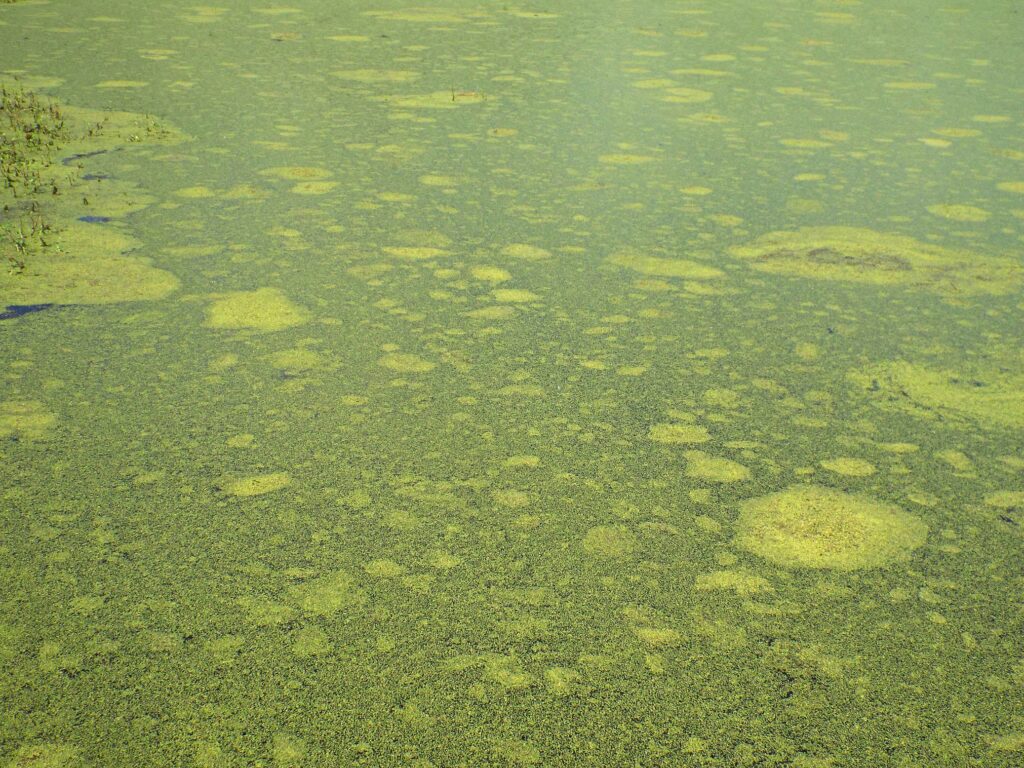
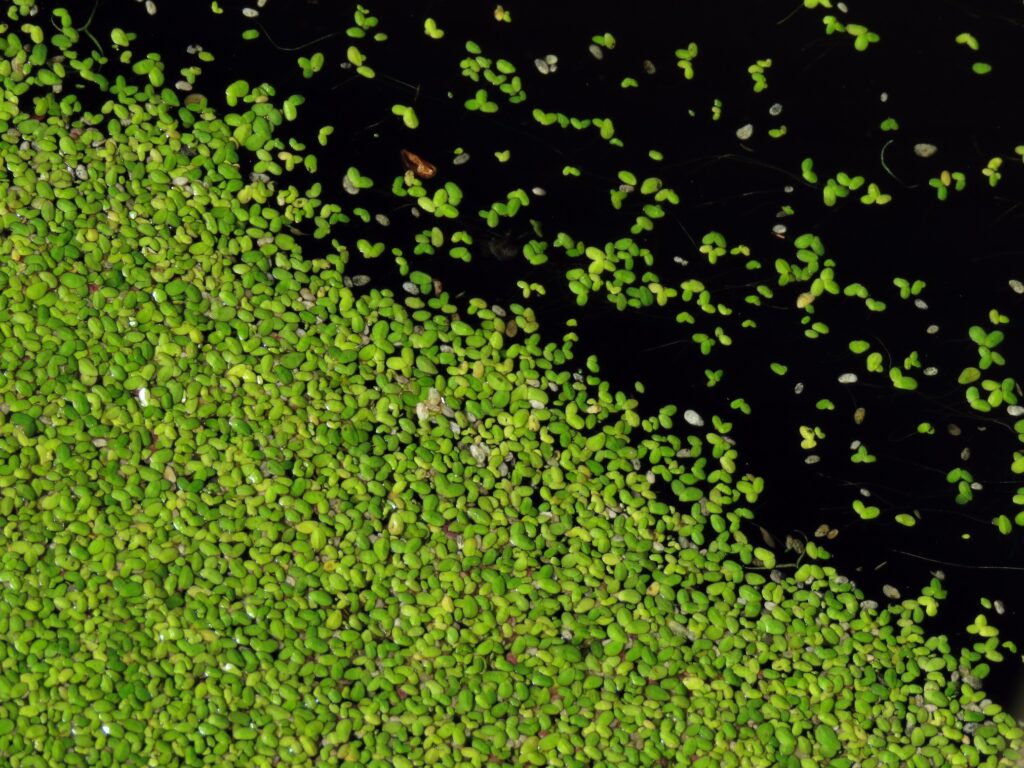
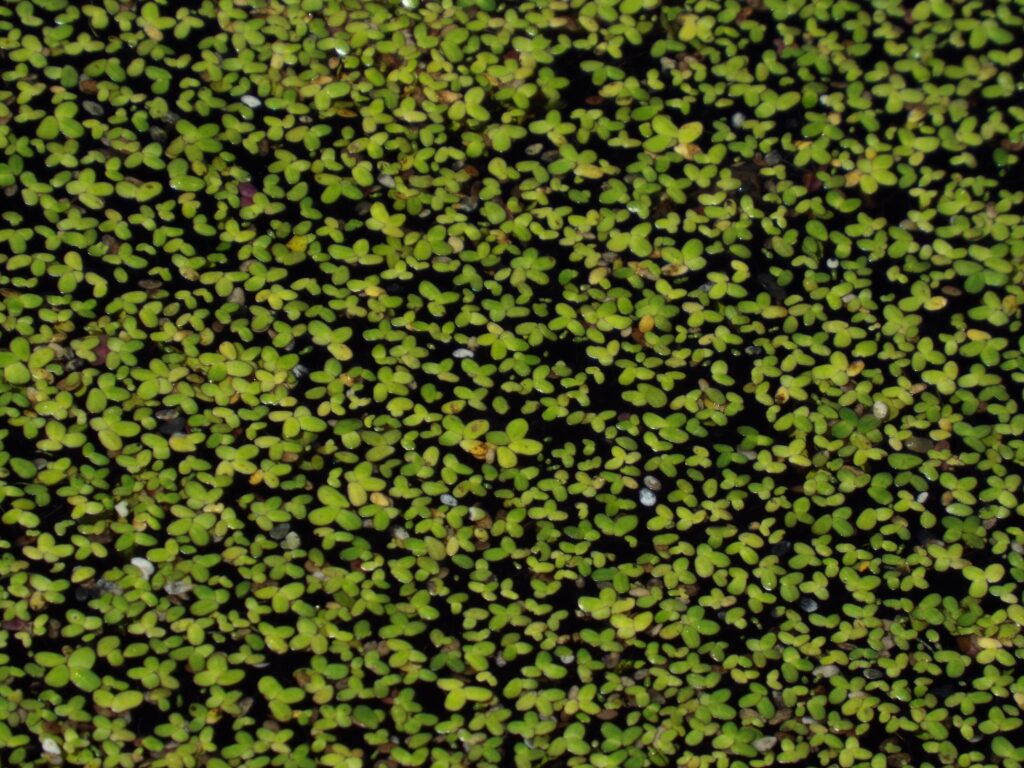
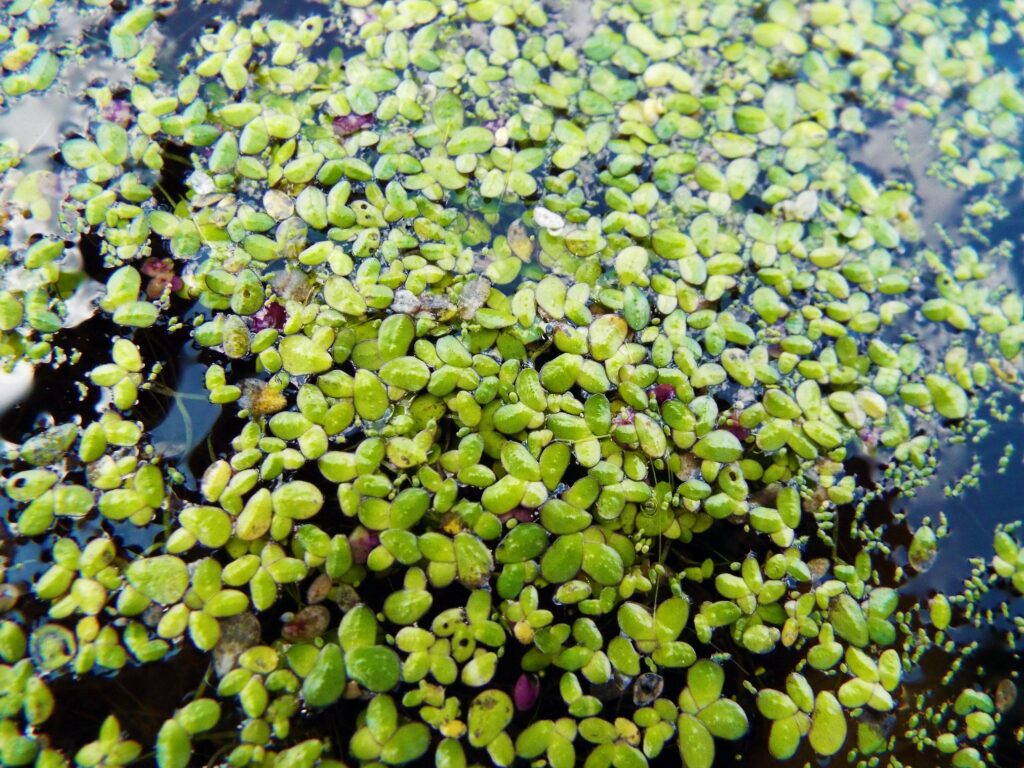
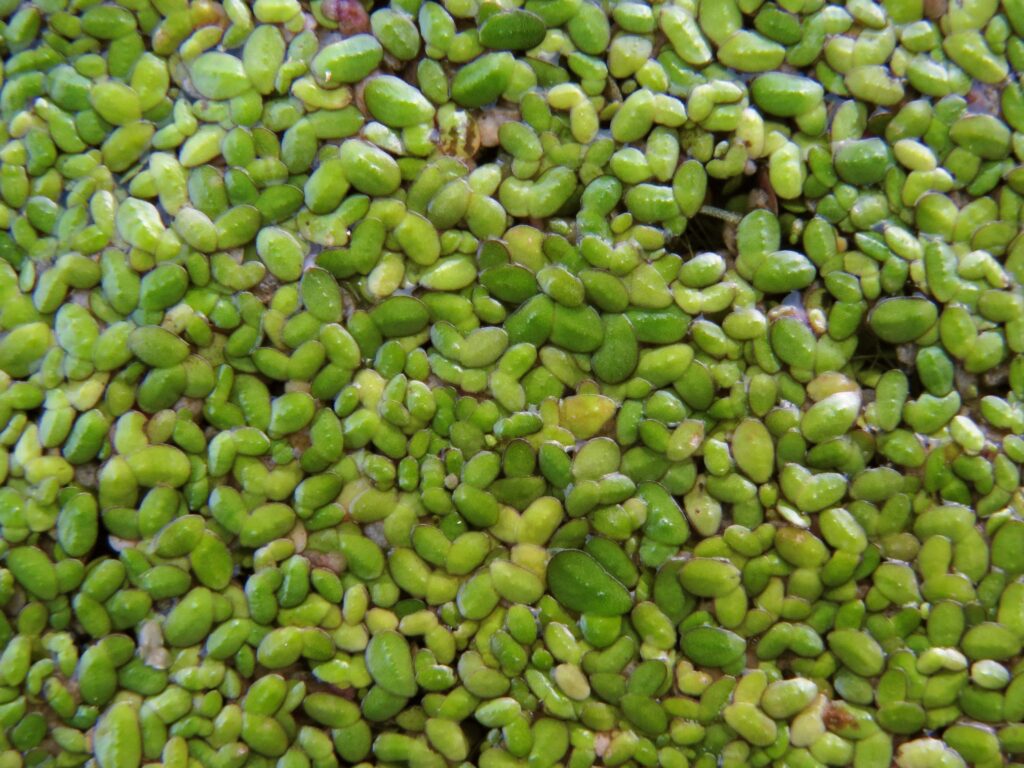
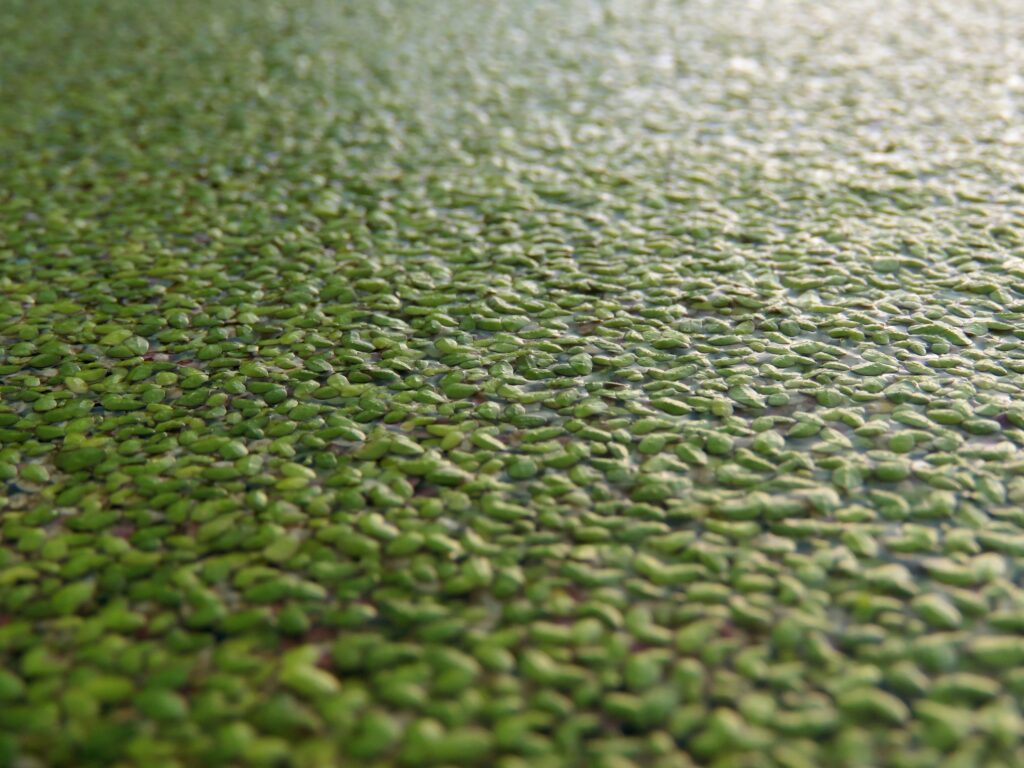
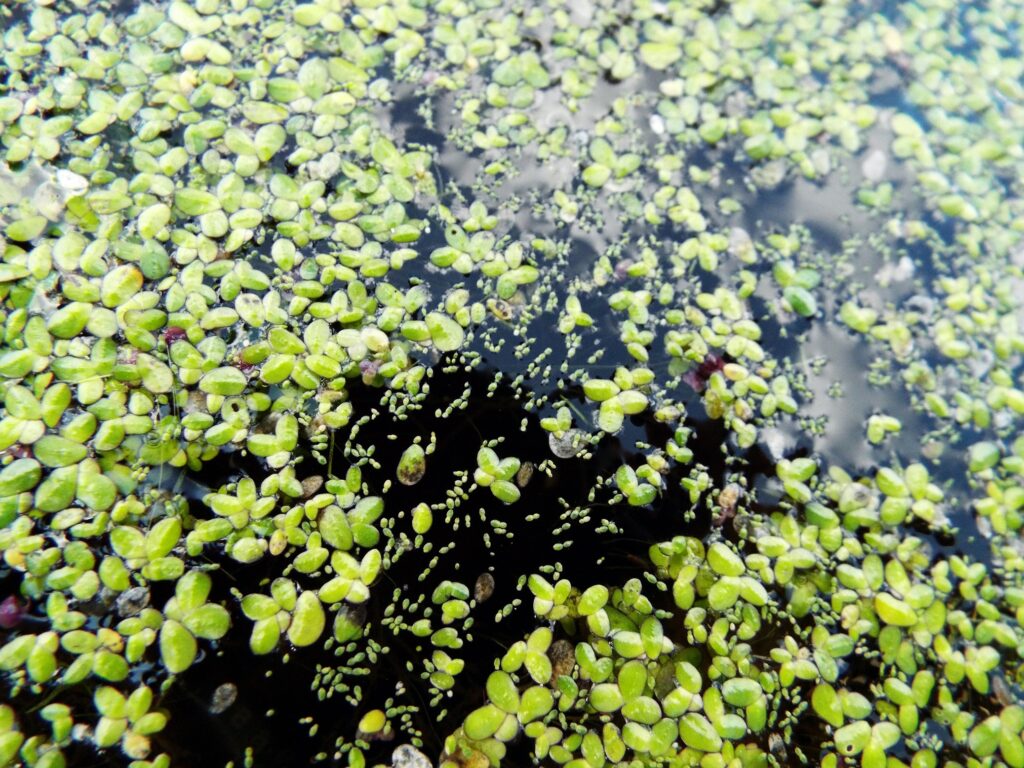
This week for Flora and Fauna Friday we’re taking a look at a group of oddball plants that you can find right here on Edisto: Duckweeds.
The Duckweeds, subfamily Lemnoideae, are a small group in the Arum family. At least one species from the five genera found in North America can be seen in our area. All are tiny, light green, floating aquatic plants that are planktonic in nature. Meaning they survive entirely within the water column and have no roots anchoring them to the soil. They live their entire lives drifting on the surface of a pond or wetland absorbing nutrients dissolved in the water. They are flowering plants so they can reproduce with seeds but they predominantly reproduce asexually via budding.
The most common species in our area is Dotted Duckweed (Landiolata punctata). This is the larger species pictured below. Individual Duckweed plants are small, light green, and roughly the size and shape of a Flax seed. Each plant has several roots of roughly a half inch long. Several plants can remain stuck together until they are ready to bud apart. They form dense, expansive mats on the surface of freshwater ponds. This species’ origins are unknown. It is certainly native to both Southeast Asia and Australia but it is unknown if it is native to the United States. Researchers don’t know if it was introduced by migratory birds or by humans. Regardless, the species is well established across the Southeast.
The most diverse genus in our area is Lemna. There are several species native to our area and all are very similar in appearance. Although they can’t be easily told apart, they can easily be separated from other members of the subfamily by having only one root per plant. The species I tend to encounter the most in our area is Lemna valdiviana.
Common Duckmeat (Spirodela polyrrhiza) is the only member of the Duckmeat genus, Spirodela, native to North America. This species is very similar to Dotted Duckweed in appearance and habitat but is a little larger and more round in shape.
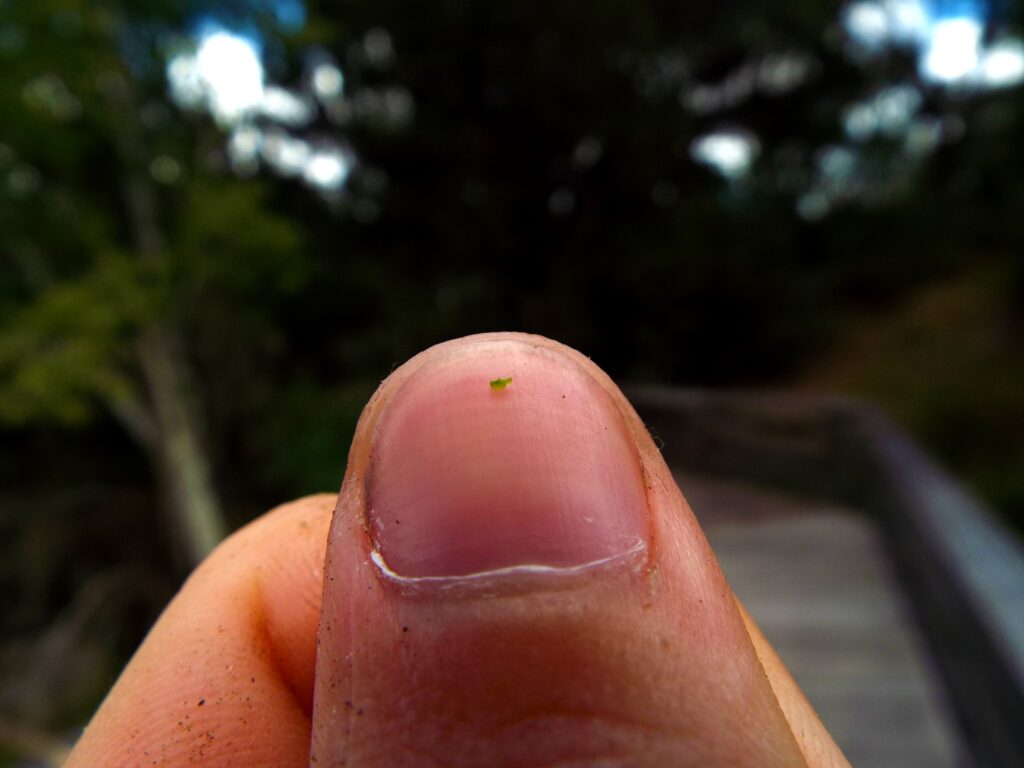
Brazilian Watermeal (Wolffia brasiliensis) is our one representative of the Watermeal genus, Wolffia. Brazilian Watermeal is the smallest plant in South Carolina and the genus contains the smallest flowering plants in the world. Wolffia also hold the record for smallest flower and fruit of any plant in the world. This miniscule plant is maybe a third the width of a mustard seed. You can’t quite appreciate how small they truly are until you see them in person. These plants are rootless and float entirely above the surface of the water. They can thrive in the gaps between other Duckweed plants. Even the densest mats of Lemna, Landiolata, or Spirodela.
Florida Mudmidget (Wolffiella gladiata) is our one member of the Bogmat genus, Wolffiella. This plant is different from our other Duckweeds in its appearance and ecology. Instead of a disc that floats on the surface of the water, it resembles a sparse mop-head hanging just below the surface. These tiny floating plants are rootless and consist of only a floating rosette of thin green leaves. They are larger than our other Duckweed species but would still fit on the tip of your finger. You can just about make out a few of these in my photos below, floating beneath the Duckweeds and Watermeals.
To many, our Duckweeds are nothing more than a nuisance. That green mess covering up their backyard pond. However, Duckweeds provide a slew of benefits to fish, waterfowl, water quality, restoration ecologists, and the farmers of the future. Duckweed is insanely high in protein and has a fairly high fat and starch content. This makes it an easy and nutritious meal for many species of fish and waterfowl. Since Duckweeds have no link to the soil, they must draw all of their nutrition from chemicals dissolved in the body of water they inhabit. This makes duckweed excellent at cleaning water systems that are contaminated with sewage or agricultural runoff. As the plants grow they absorb these chemicals and process them into yet more Duckweed. Duckweed grows at an extremely rapid pace. This makes it a useful tool to restoration ecologists seeking to remove an excess of dissolved nutrients from a water body, particularly Nitrogen and Phosphorus. Duckweed will also outcompete algae for sunlight, preventing algal blooms that are dangerous to fish populations. However, if you want to clean up a body of water, you have to remove the Duckweed at the same rate it grows. Otherwise the plants will simply die, decompose, and return their nutrients back to the water. What use is there for piles and piles of Duckweed? Livestock and fish feed of course! That high nutritional content makes them a great source of food for fish farms and as a protein supplement in the diets of most livestock, especially ducks, geese, and chickens. Did I mention that all species of Duckweed are edible to not only fish, fowl, and livestock, but humans as well? Their rapid growth, high nutritional yield, ability to clean wastewater, no need for agricultural land, and counterintuitively low water requirements have led Duckweed, particularly members of Wolffia, to be touted as a potential superfood for future human civilization. I’ve never tried Duckweed myself but it apparently has a taste somewhere between watercress and spinach.
I won’t recommend that you start eating Duckweed scooped from your local swamp, not without a thorough washing at least, but Duckweed salads may make their debut in a restaurant near you sometime soon.