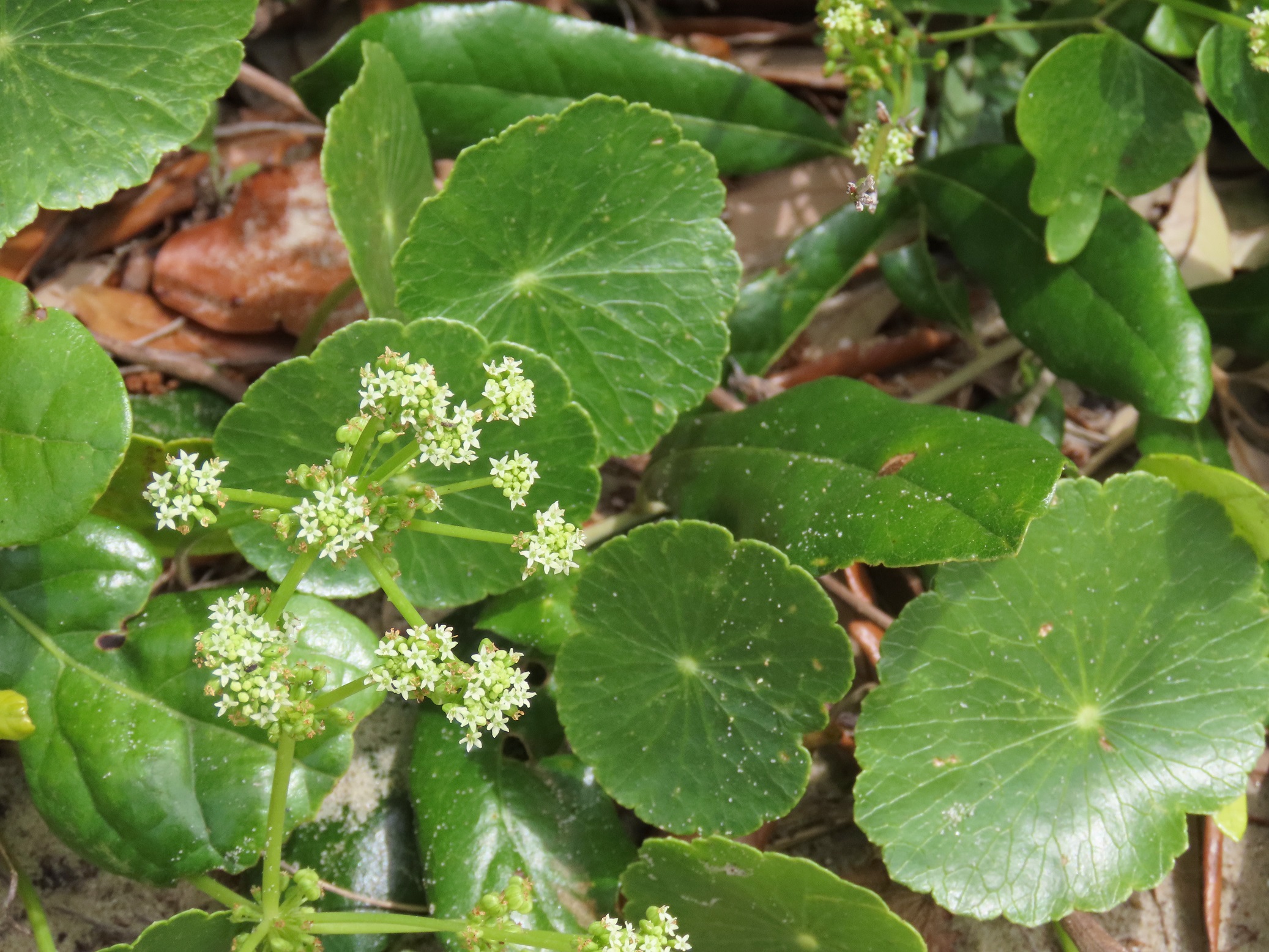
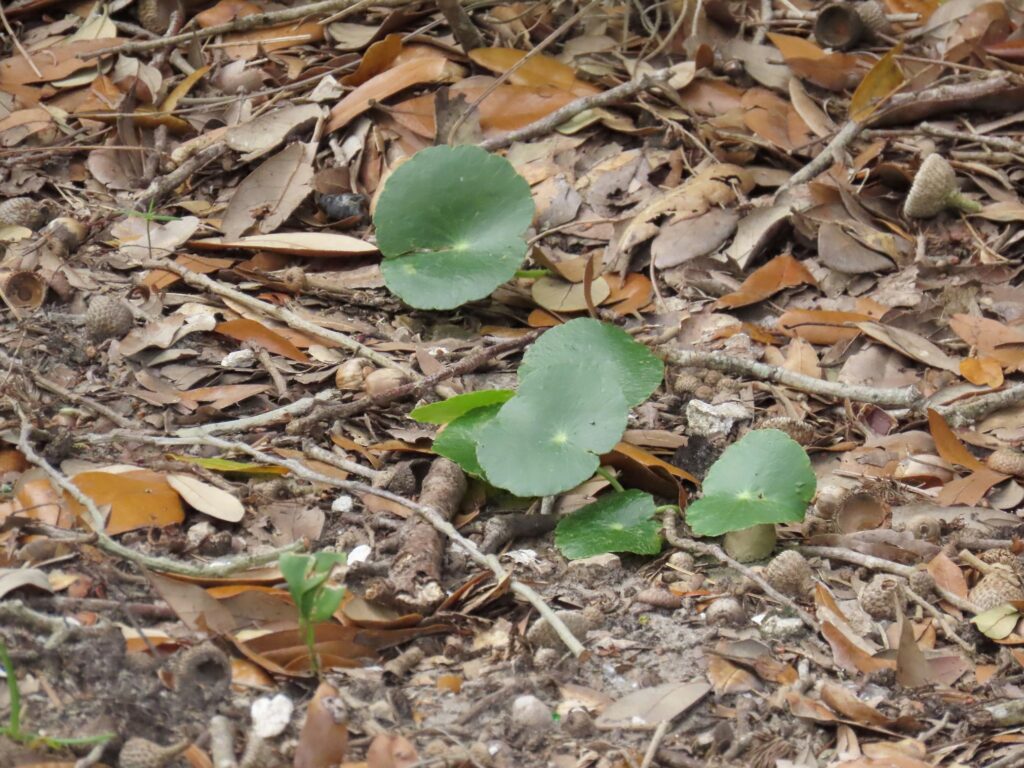
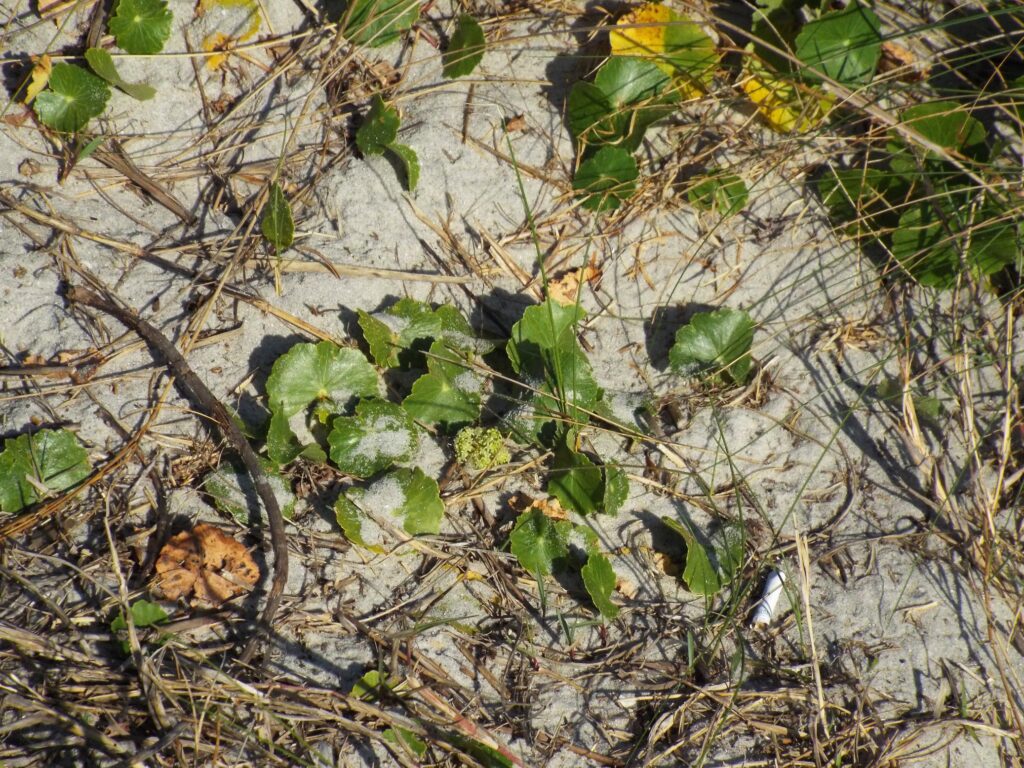
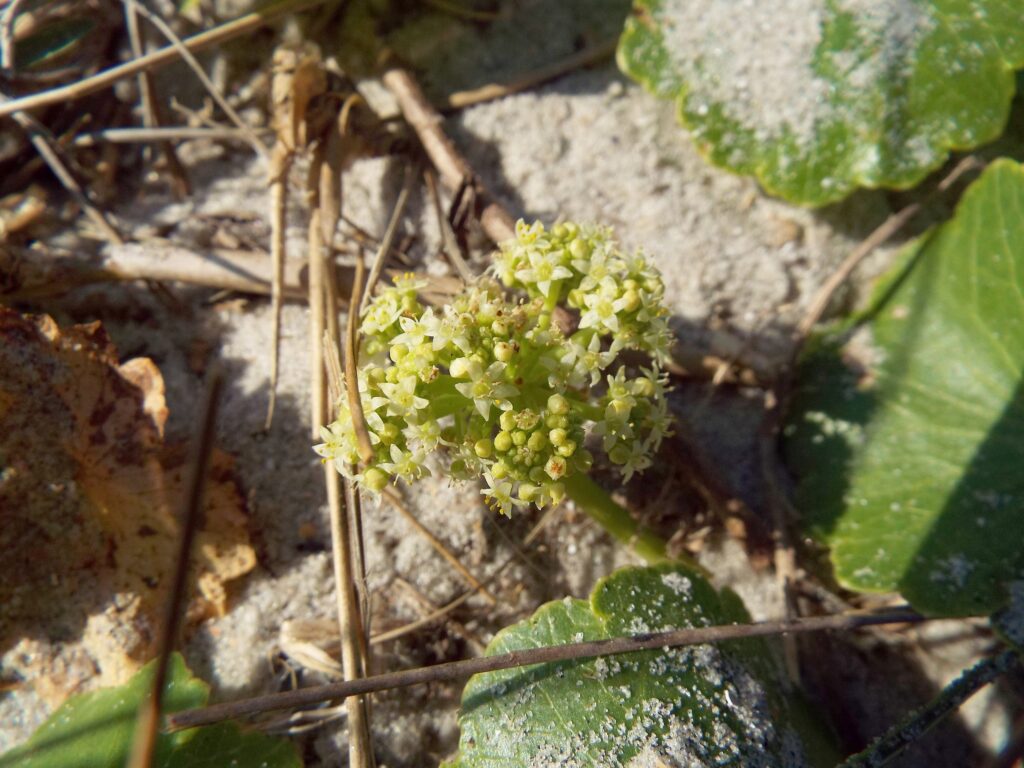
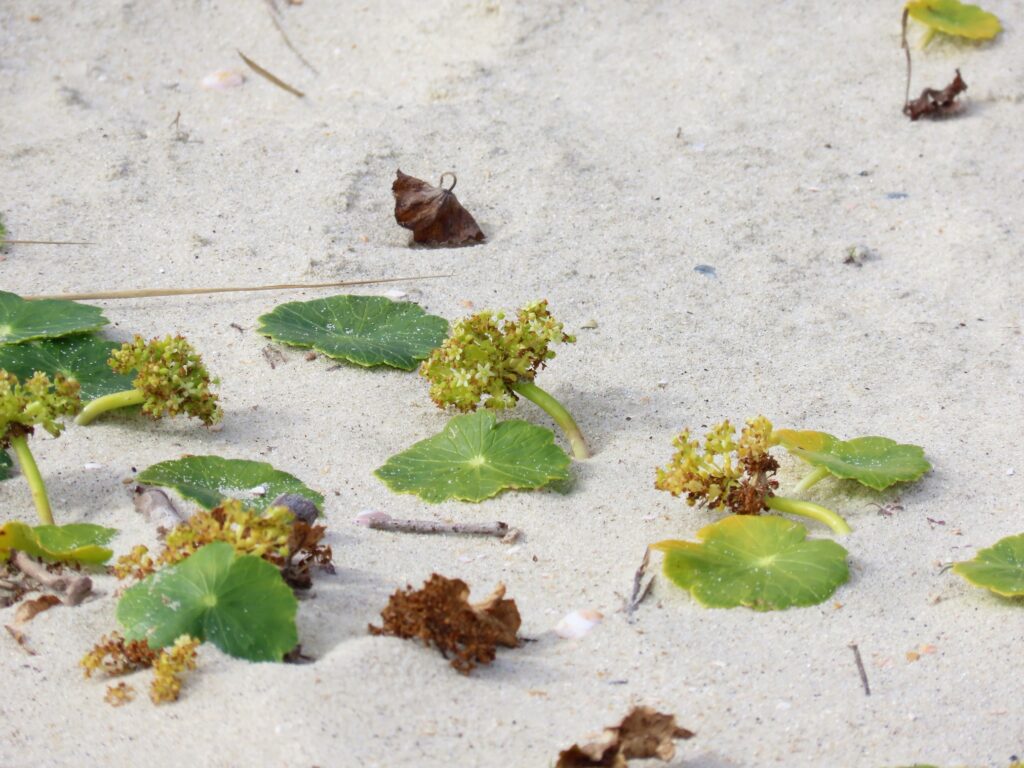
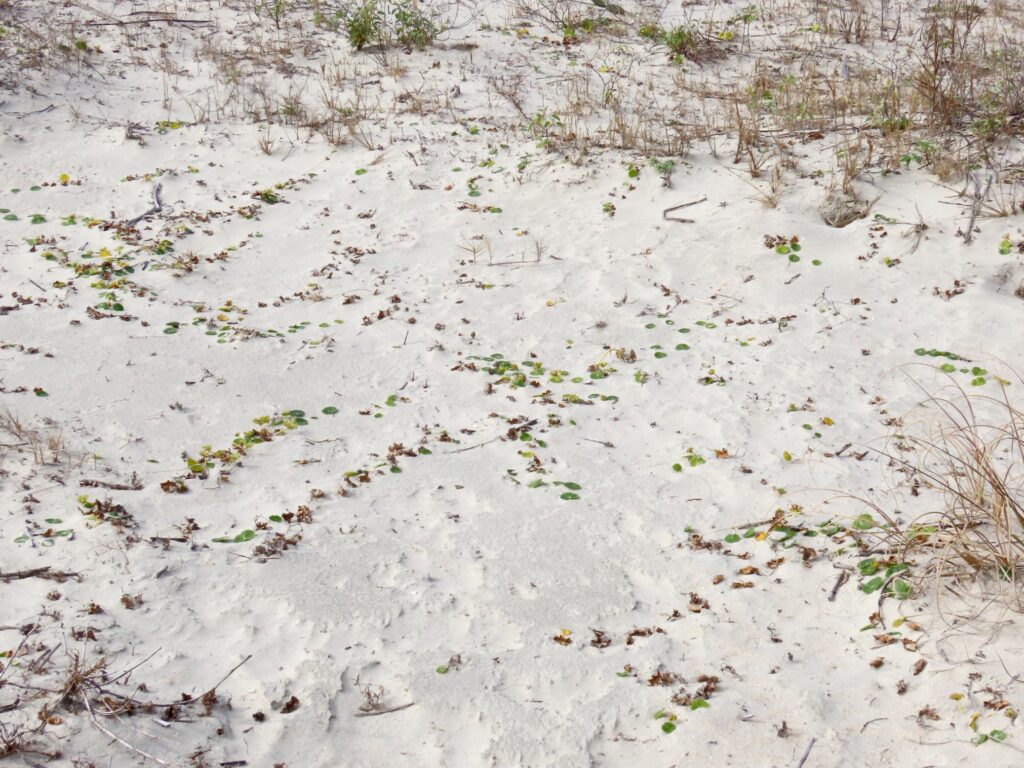
This week for Flora and Fauna Friday, we’re examining the verdant doubloon of the dunes, Largeleaf Pennywort (Hydrocotyle bonariensis).
Largeleaf Pennywort is one of four native species of Pennywort found here in the Lowcountry of South Carolina. Its other three local siblings are: Manyflower Marsh-Pennywort [AKA Dollarweed] (Hydrocotyle umbellata), Whorled Marsh-Pennywort (Hydrocotyle verticillata), and Floating Marsh-Pennywort (Hydrocotyle ranunculoides). Each of these four Pennywort species are common and often evergreen perennials that each look quite similar and have the same growth form. This makes the Hydrocotyle genus, as a whole on the Sea Islands, instantly recognizable. They have what’s called a peltate leaf-shape, characterized by a flat leaf with its petiole attached to the underside at a roughly perpendicular angle. It’s the same leaf anatomy as a lily pad. Pennyworts, generically, have a leaf shaped like a round bar table: a flat, circular leaf supported centrally from below by a round, even-width petiole. Pennyworts have a prostrate growth-form, spreading laterally with running stems in much the same way a turfgrass does. These lateral stems are called stolons and each node of the stem produces both upright leaves and downright roots. In Pennywort species, these stolons most often grow underground and so the leaves appear to poke singly from the earth along wiggly lines. Each node also bears rounded clusters of small greenish-white flowers on free standing flower stalks.
These four species, all looking quite similar, can be hard to tell apart. Thankfully, these four Pennyworts each have their own habitat preference as well as a combination of traits that help distinguish them. Floating Marsh-Pennywort is the easiest to identify. It has smaller leaves with obvious fine scalloping, partial lobes, and often an off-center stem, it produces a small spherical cluster of flowers, and it grows most often as a floating mat on the surface of freshwater swamps and swales. Whorled Marsh-Pennywort is similar to its floating cousin, but its small leaves are more symmetrical and have coarser scalloping around the edge, its flower clusters can have multiple tiers, and its stolons grow underground in the mucky soils surrounding and beneath shallow, ephemeral freshwater wetlands. Manyflower Marsh-Pennywort is the most variable in shape and the most generalist in habitat. It tends to have a larger leaf, sometimes as wide as your finger is long, and produces spherical clusters of more white-colored flowers than the other species. Manyflower Marsh-Pennywort is most often found on moist, sandy soils throughout the coastal plain such as ditches, pond-banks, wet meadows, wetland margins, and most prominently in lawns, where it’s infamous and better known as “Dollarweed”.
Lastly we have today’s subject, Largeleaf Pennywort, which is very similar in leaf appearance to Manyflower Marsh-Pennywort. Largeleaf Pennywort has consistently large, circular leaves and bears yellow-white flowers in relatively large umbrella-shaped clusters. But what sets it apart is where it grows, the beach. More specifically in the harsh environment of our barrier islands’ beach dune systems, adding it to the ranks of a select few plants that can tough it out at land’s end. Largeleaf Pennywort has some salt tolerance, allowing it to brush off a surge or king tide every now and again, but it’s no halophyte. It is best adapted to life in the back dunes but will run on the front beach when it must. The large, leathery, waxy, evergreen leaves of Largeleaf Pennywort allow it to tolerate the drying effects of continuous wind and salt spray while also mitigating the heat and radiation stress of continuous direct sunlight. Its underground stolon weaves it an expansive root system, allowing the plant to anchor itself in the ever shifting sands while finding and storing scant sources of fresh water. The long chains of leaves it shoots up through the sand also serve as a tiny sand fence, slowing air and trapping sand to help better stabilize the dune system. This makes Largeleaf Pennywort an important part in the beach dune system and one of the frontline plants that collectively help hold the beach together.
Largeleaf Pennywort has some other unique things about it worth mentioning. Firstly as a beach adapted species, it’s not just found in the southeastern United States but has a very wide distribution globally, as it can disperse on oceanic currents. This species can also be found on beaches in South America, West and South Africa, Taiwan, Malaysia, and Australia. This has led botanists to suspect that Largeleaf Pennywort may not be “native” to the United States and instead has spread from South America across the Atlantic relatively recently as a consequences of transatlantic trade during European colonization. Or, conversely, it may be a natural advent that spread of its own accord. The jury is still out. But evidence seems to indicate the prior, as it was first described botanically in South America in 1789 and is noticeably absent from early botanical records for the Southeast.
Largeleaf Pennywort is edible and can be eaten as a green, a pot herb, or made into a juice. However, some folks report a nauseating affect. So snack with caution. (And in general, never forage plants from a lawn you don’t manage yourself. You never know what someone may have sprayed on it nor how recently they did so.) There is also long ethnobotanical history between humans and Hydrocotyle species globally, and many purported health benefits from their consumption. Thus, there has been some scientific interest in the plant for pharmacological use and agricultural cultivation. Modern scientific studies indicate that the species appears to be safe to eat (excepting the potential for nausea), it is relatively nutrient dense, and contains a suite of phytochemicals that may prove to be beneficial to human health when taken as a dietary supplement. However, few, if any, efficacy trials have been published to date and so the plant’s potential health benefits are still purely speculative. But recent early research places Largeleaf Pennywort in a category as a candidate “superfood” and an ecologically sustainable crop for future human use.