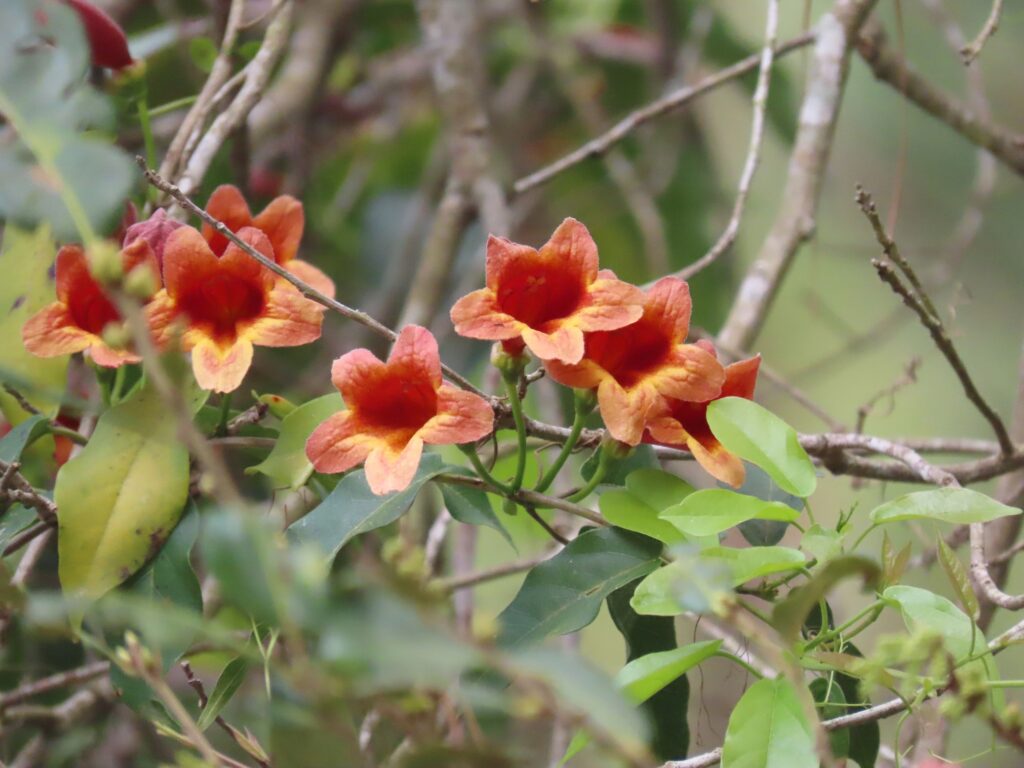
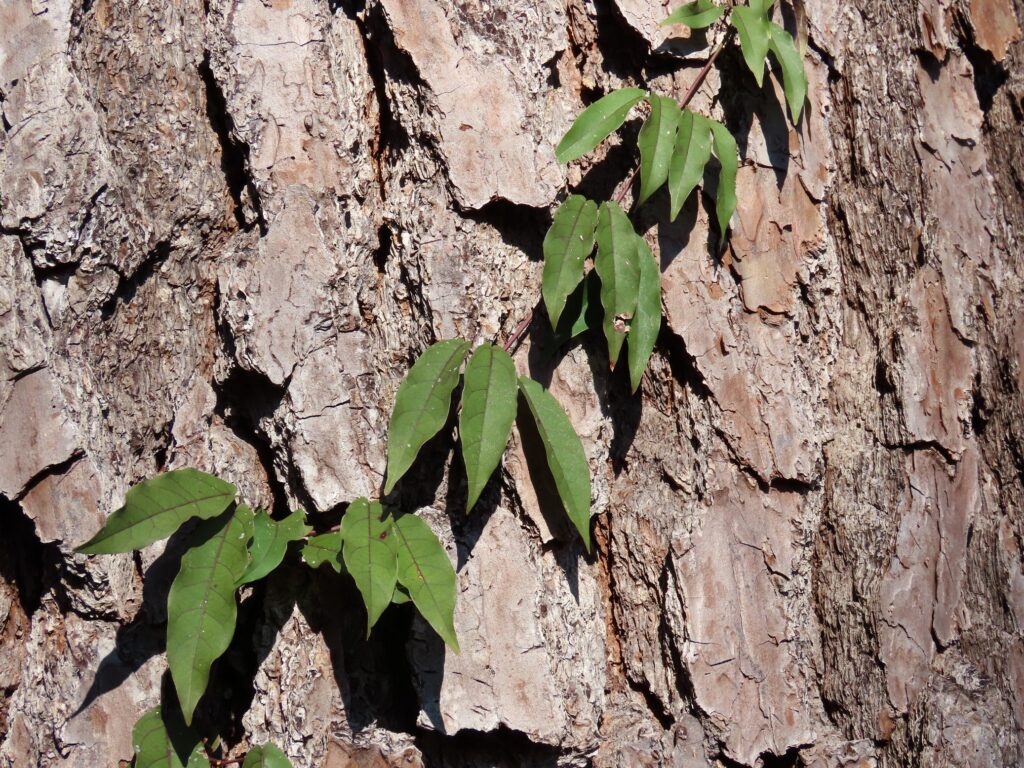
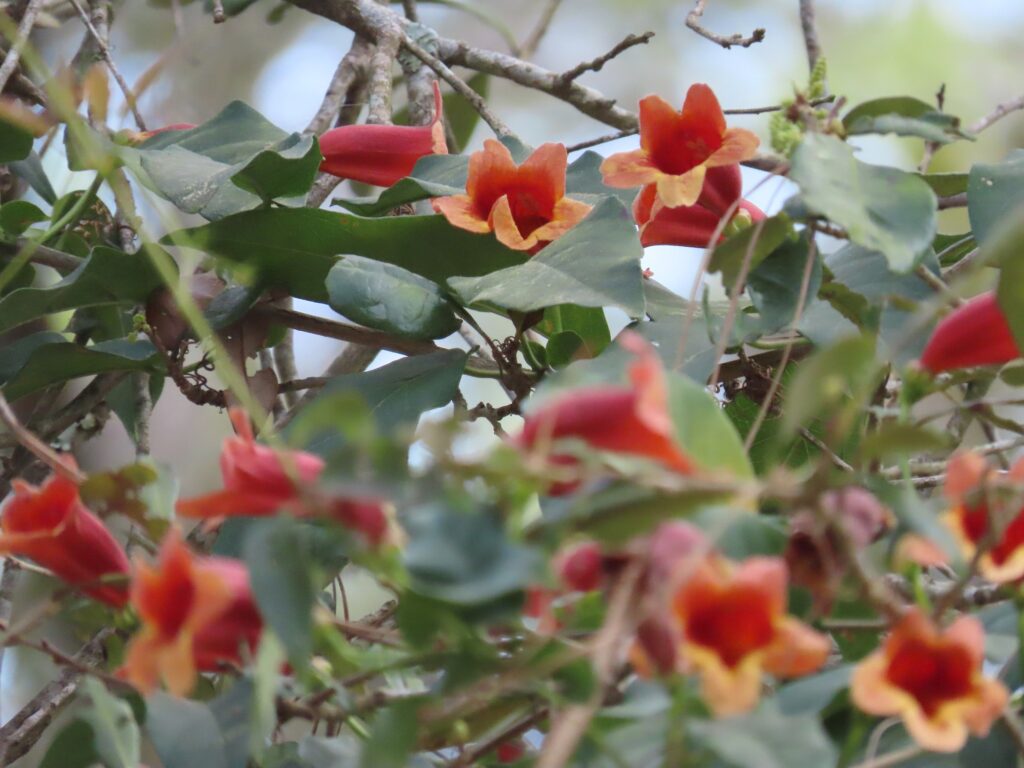
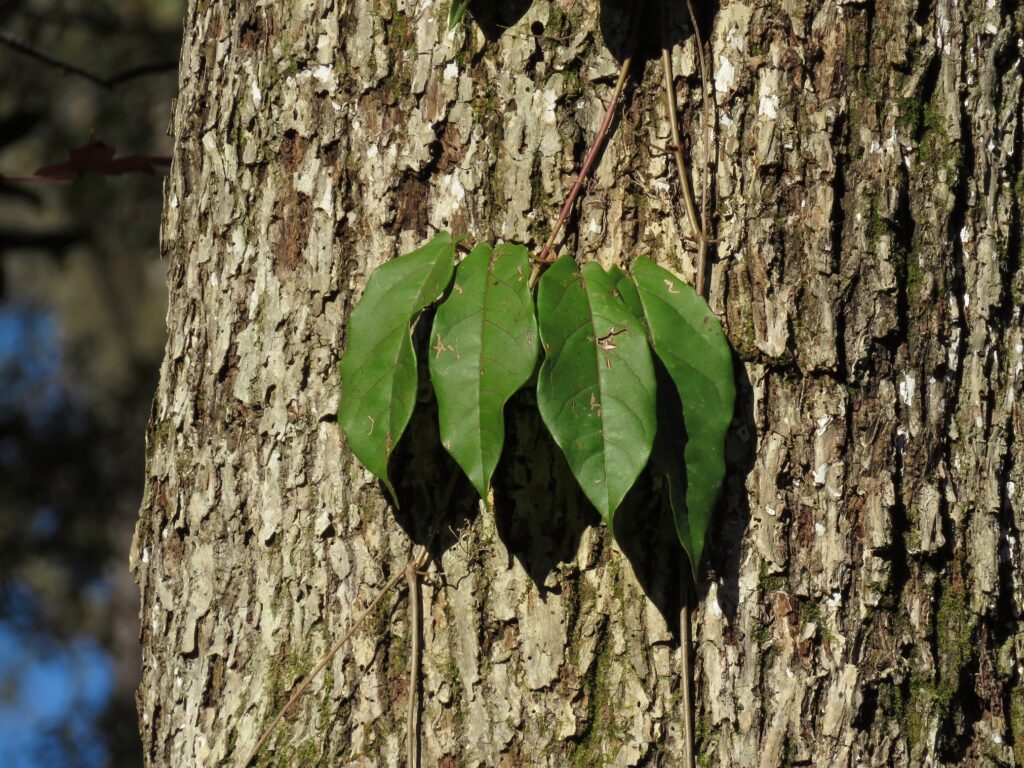
This week for Flora and Fauna Friday we have spring’s climbing coral choir: Crossvine (Bignonia capreolata).
Crossvine is a high climbing native vine that can snake its way to the tops of even the tallest canopies. It adheres to the trunks of trees with tendrils that wriggle and wedge their way into the crevices of bark or wrap around any tiny projection. Crossvine has a remarkably thin stem for the length it grows. When cut, this stem reveals the cross of its namesake, four pithy rays extending into the wood of the stem in a cross-pattern. Crossvine has large evergreen leaves. Each leaf is split into two separate leaflets and paired oppositely with another leaf, giving the plant the appearance of four pendulous leaves per node.
Crossvine’s best known character is its flowers. Blossoms of coral pink with orange accents, a deep bugle shape, and wide mouth rimmed with five petals. Crossvine blooms in early April right as Ruby-throated Hummingbirds begin to arrive in droves. Crossvine is a species of plant specially adapted for pollination by Hummingbirds. Its deep, wide flowers are the perfect shape to fit a Hummingbird head, dusting it with pollen. This pollination route is a common one for high-climbing vines like both Crossvine and Trumpet Vine. Hummingbirds have a much easier time finding and accessing these high-flying flowers than bees and butterflies. That skyward bloom is advantageous because Crossvine has wind dispersed seeds. The higher it can bear flowers, and subsequently fruit, the farther it can expect its seeds to scatter on the wind.


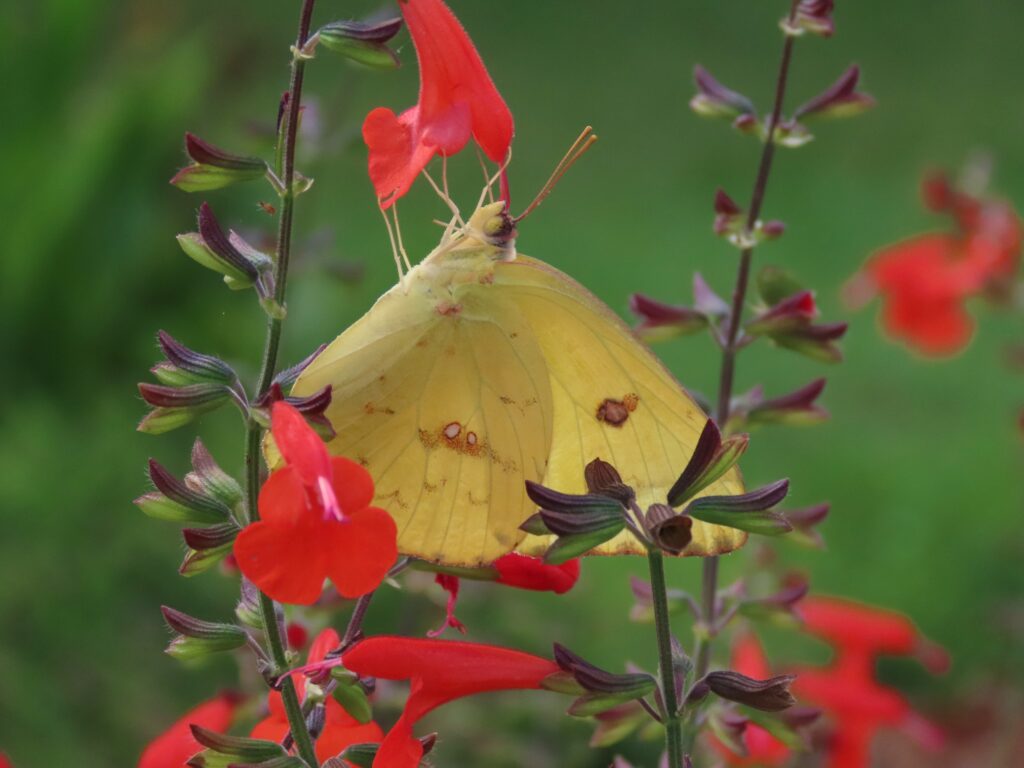
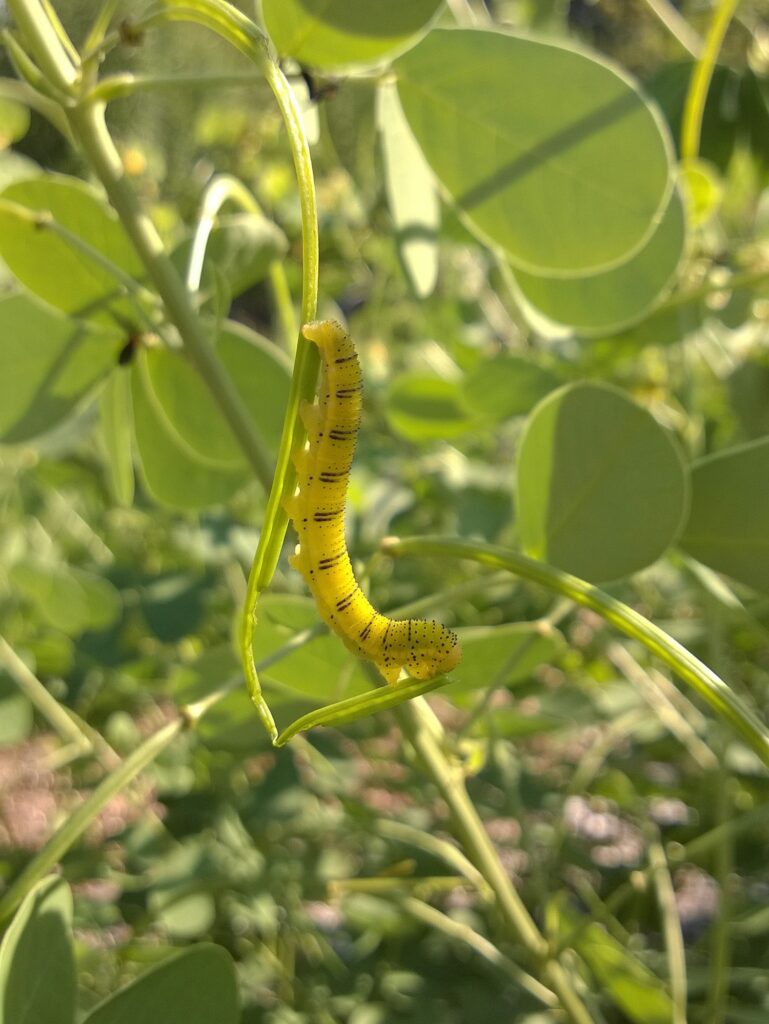
This week for Flora and Fauna Friday we have an insect you can’t possibly miss, the Cloudless Sulphur (Phoebis sennae).
The Cloudless Sulphur is a large butterfly and a member of the White family, Pieridae. Members of this family are most often white, yellow, orange, or a combination of the above in color. They’re strong fliers, perch with their wings closed, and have a roughly circular silhouette. The Cloudless Sulphur is no exception.
They’re a common species found throughout the eastern half of North America and one of those few insect species that everyone is aware of, no matter how disinterested they may be in the subject. With their safety-vest-yellow wings and three-inch wingspan these butterflies are just screaming for attention. Males have cleaner hindwing coloration than females, who typically sport more obvious brown accents as well as noticeable wing-spots. Males will incessantly patrol a territory, back and forth, over and over, in search of females and warding off competing males. Cloudless Sulphurs are a common sight along roadsides and field edges where they search for nectar. They are one of the least picky butterfly species when it comes to nectar sources. They’re known for sipping from any and every species of flower they can find, especially those that other butterflies refuse to touch. Their caterpillars feed on Sicklepod and Partridge Peas, common weeds in fallow fields and road shoulders.
Although present from spring into winter, Cloudless Sulphur populations peak in late summer. This is not just because their local population has returned to where it was before. Their numbers have been bolstered by out-of-towners. Cloudless Sulphurs migrate just like Monarchs. In spring they head north to breed in more temperate areas. As the days begin to shorten, they start fluttering south. By late August their numbers explode in the Lowcountry as a chartreuse wash paints our roadways. Tumbling winds of lime butterflies funnel down our southwest bound highways and byways. Their ultimate destination is Florida, the Caribbean, and Central America, where they ride out the winter.
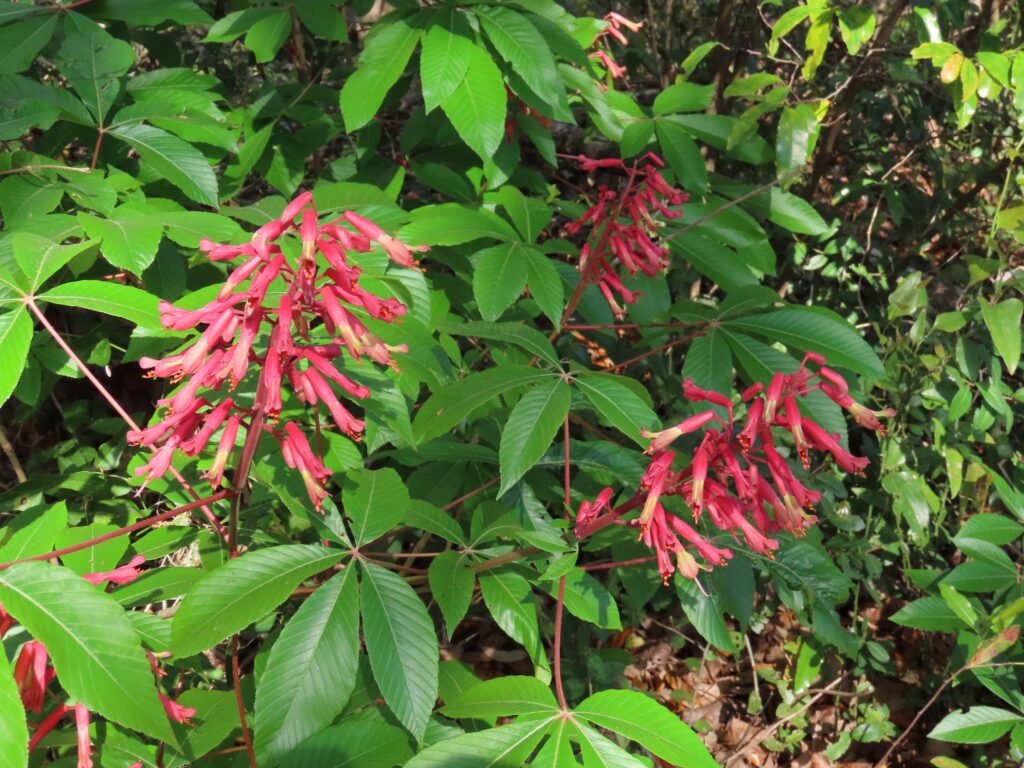
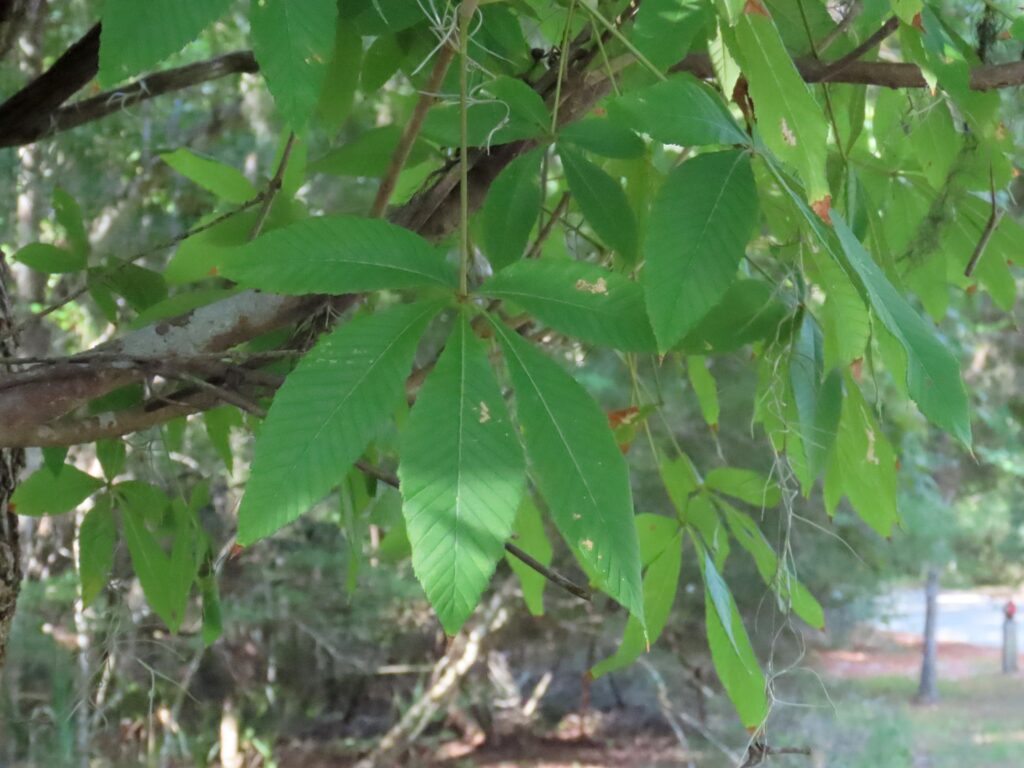
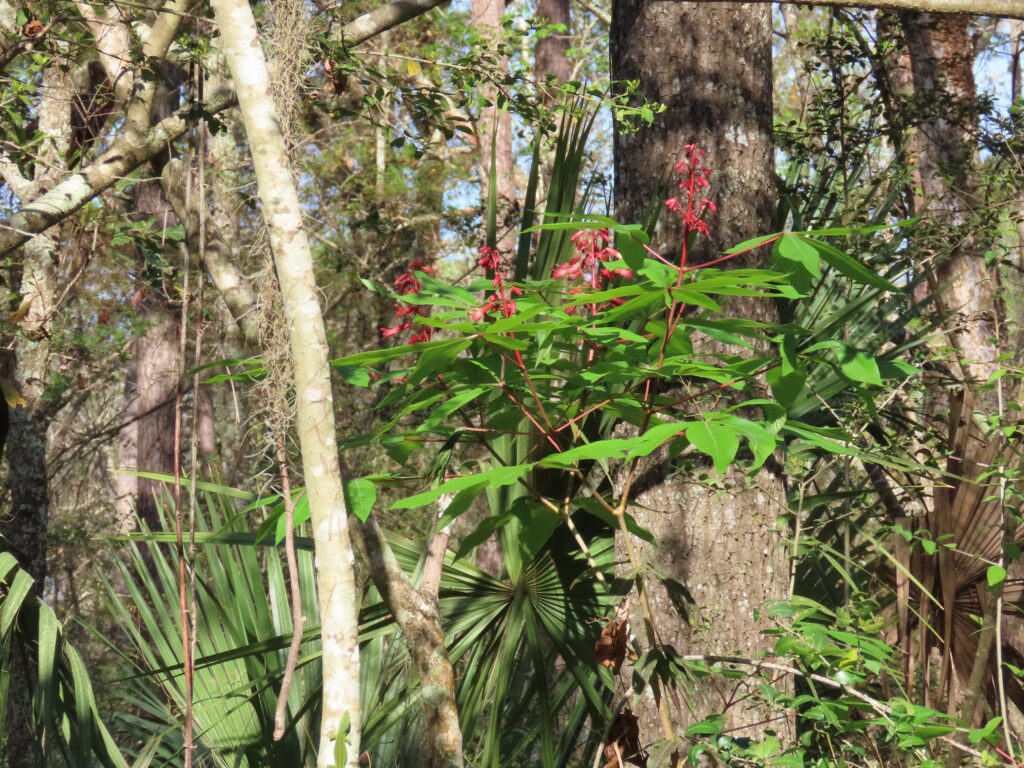
This week for Flora and Fauna Friday we have a squat, native, strawberry-blossomed shrubbery: Red Buckeye (Aesculus pavia).
Buckeyes are a genus of trees native to the eastern United States and west coast. The Red Buckeye is found throughout the coastal plain of the Southeast and is the only species of the genus found in the Lowcountry of South Carolina. They grow on the shady edges of forests atop well-drained sandy soils.
Red Buckeyes grow as small trees or, more often, shrubs. Their bark is a smooth gray blemished by warty orange lenticels and flakes of old bark. Leaves are oppositely arranged, uncommon for trees, and palmately compound, also uncommon for trees. These distinct hand-sized leaves make this plant easy to pick out from other forest flora. Those leaves dangle five simply-shaped jade-green leaflets with finely serrated margins and pale leaf veins, thin and many like the ribs of a fish. Red Buckeye blooms early each spring, breaking buds just after the solstice. Flowers are borne in upright spikes of many tubular grapefruit colored flowers. Each bush produces multiple sets of flowers across its crown. These flowers are adored by our Ruby-throated Hummingbirds, just arriving for the season, and add to the conspicuous nature of this plant. Pollinating insects appreciate them as well. These flowers set fruit and mature throughout the year to produce another key feature of the Buckeye.
The seeds of Buckeyes are their namesake, a large glossy nut the size and shape of a buck’s eye. This seed is grown inside a sand-tan pod that splits along its seams. The nut of Red Buckeye is a glistening pearl of caramel orange swirls and about the size of a strawberry. Although eaten by squirrels, the nuts of Red Buckeye are poisonous to humans, along with the leaves and wood of the plant. Certain species were even used by Native Americans to paralyze fish. They’d grind the seeds and stems of Buckeyes into a powder or pulp before scattering it into a small pond. The toxin would leach into the water, stunning the fish long enough for them to be scooped up.
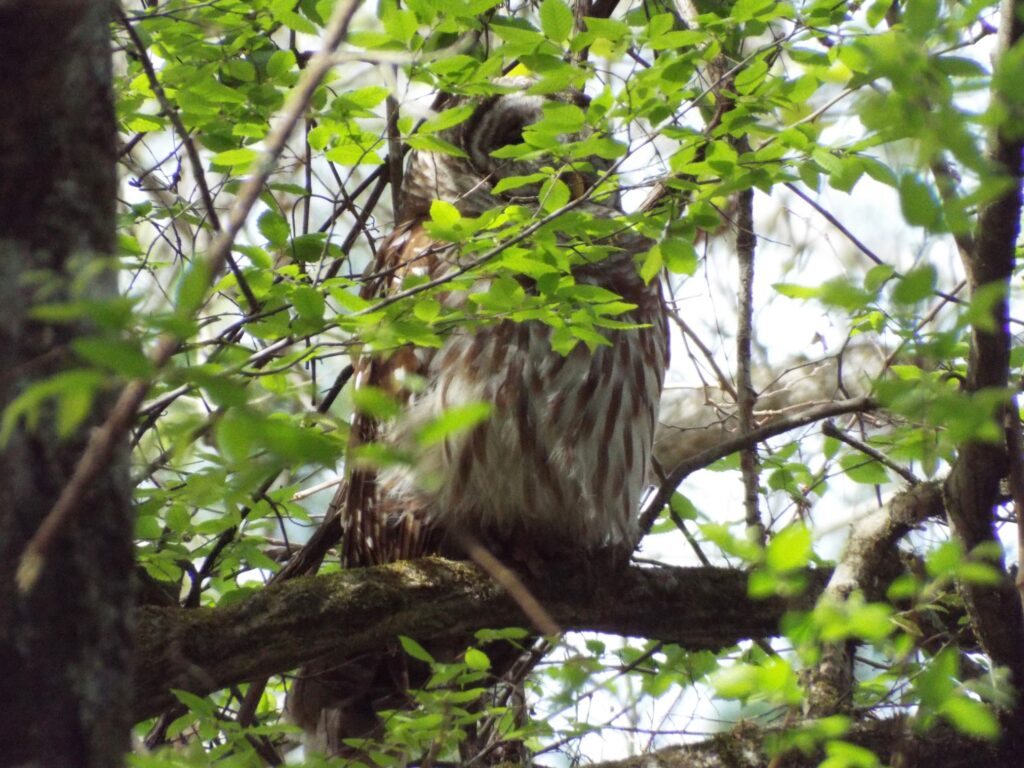
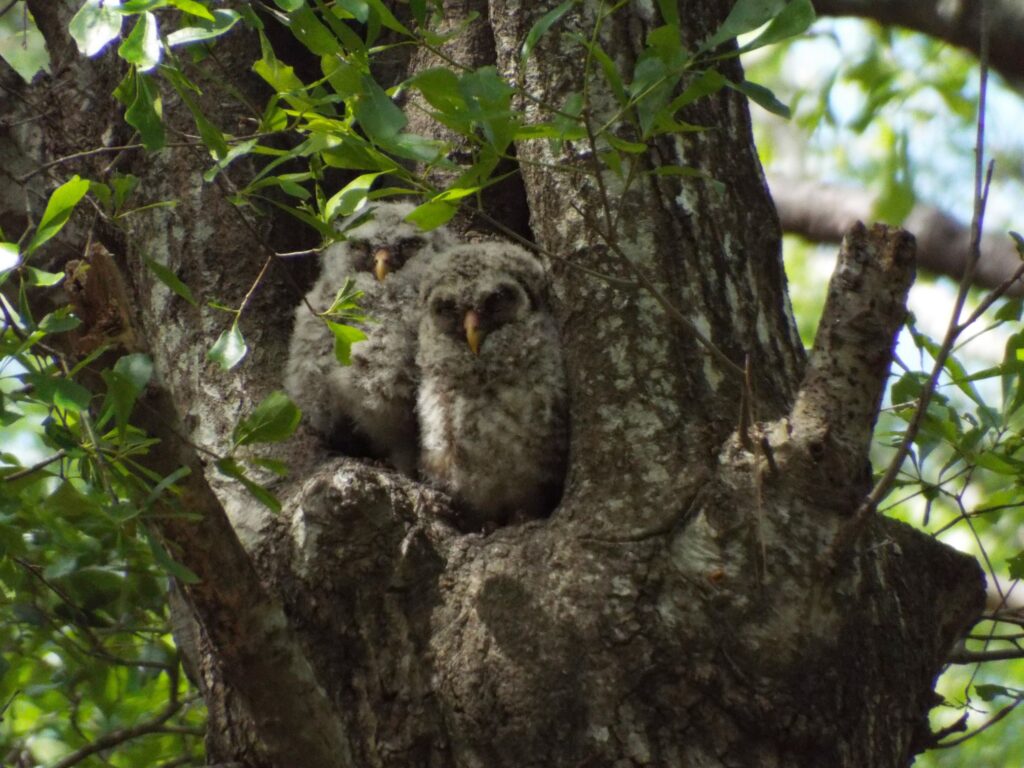
This week for Flora and Fauna Friday it’s the streaky sneaky inquisitive wide-eyed owl of copse and glade, the Barred Owl (Strix varia).
Barred Owls are one of our four resident species of Owl. We have another four vagrant species who drop into the state every now and again but let’s ignore them. Barred Owls are our second largest and most numerous species of Owl here in the Lowcountry. They are common throughout forest habitats, particularly bottomlands. They perch in trees where they scan the shadows of the dimly lit dusk for scurrying mammals and creeping amphibians. Swiveling their head to hear for the jostling of leaves and pitter-pattering of little feet.
A Barred Owl’s plumage is barred below and banded behind in ashen-gray and chocolate-browns. Their eyes are an empty black glass, large and set deeply into a flat, pale gray face. Their thin bone-yellow beak is buried below a bushy moustache that blends smoothly into their strong nasal bridge. About their face rings two arches of brown that run from their jowls around to their forehead. One of these “eyebrows” always sits slightly higher than the other, giving Barred Owls a wide-eyed and skeptical expression.
That asymmetrical forehead is a deliberate adaptation. Just like our ears, the feathers of an Owl’s face are concave to focus sound towards the center. Many species of owls have asymmetrical ears. The Barred Owl is one such species, although its asymmetry is certainly not as pronounced as others. This cock-eyed cranium allows Owls to better pinpoint the elevation of prey. An adaptation like this is advantageous because Barred Owls rely on their amazing sense of hearing to hunt. Those ears, in combination with their sharp eyesight and the unmatched night-vision of an owl, lets them nimbly meander between trees through the forest understory during the dead of night to drop like a brick onto a shrew shivering 20 feet below under the leaf litter.
Owls, like many raptors, are prone to tunnel vision. A state of hyper-focus that many predators enter when pursuing prey, losing their situational awareness in the process. This is a double-edged sword in the modern world as young Barred Owls are at risk to become roadkill. Barred Owls like to hunt along roadsides, perching on limbs and power lines to spot prey crossing over causeways and roadways. If an Owl spots a mouse in the headlights of an approaching car, it won’t hesitate to dive onto the blacktop, putting itself directly in harm’s way without a chance to react. Red-shouldered Hawks encounter the same problem in the daytime. It’s a sadly ironic fate for birds as keenly perceptive as Barred Owls.
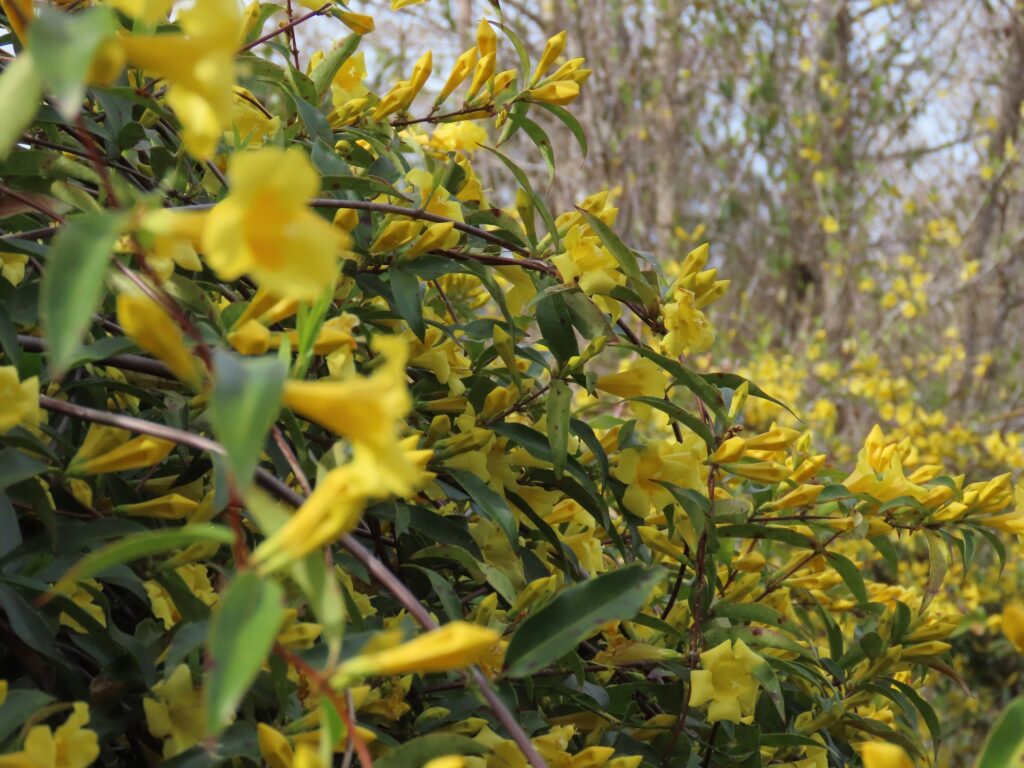
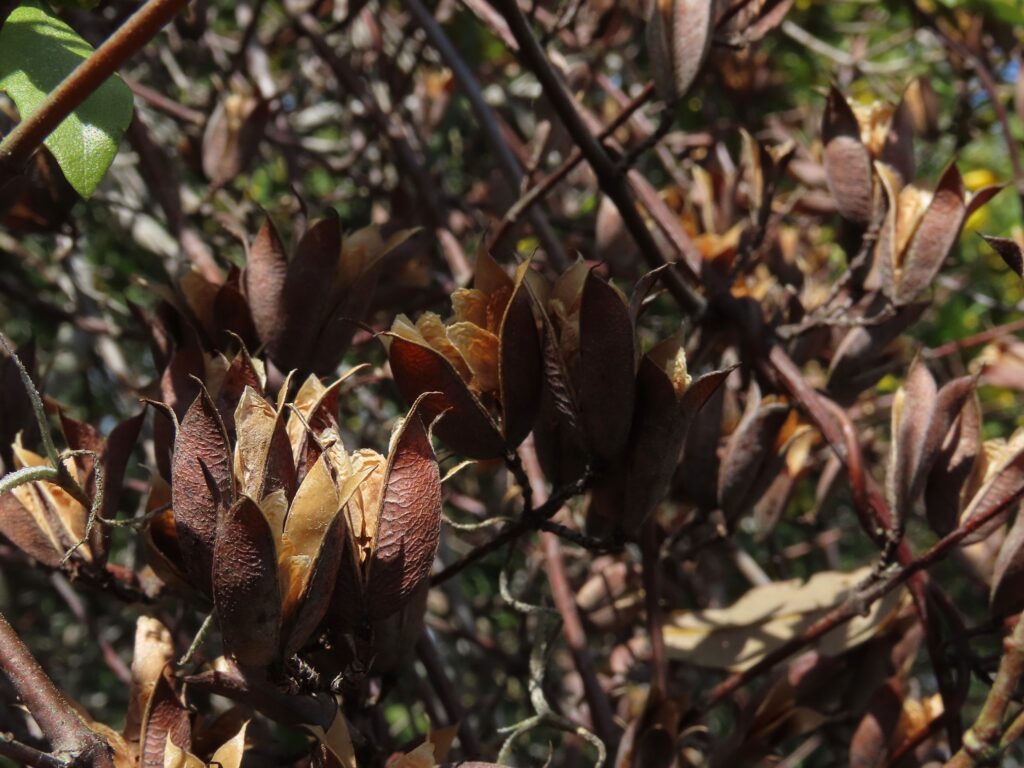
This week for Flora and Fauna Friday we have the South Carolina state flower: Yellow Jessamine (Gelsemium sempervirens).
Yellow Jessamine is an evergreen perennial vine common throughout our forests, thickets, hedgerows, and wetlands. Jessamine climbs both high and low on thin but sturdy twining vines of mauve and burgundy. Although it does not climb so high as some other woodland vines, it makes due in the midstory of our forests. Where Jessamine really shines is on the wood line and fencerow. In sunny scrub, Jessamine thrives to smother shrubs and saplings. It’s narrow tangle of stems crisscrossing and ensnaring their woody victim in a net of leaves. But Jessamine is not so vigorous as to suffocate, just to stifle as it makes up lost time in winter with its year-round greenery. What is spectacular about Yellow Jessamine is its spring outfit.
As the soil begins to warm and the bugs begin to stir, so does our plant. Its web of wiry vines blister and burst forth into a glow of golden flowers. Five-lipped trumpets of saffron belch out the scent of spring in their cloud of sunlit song. Among the first to bloom, Yellow Jessamine feeds our Bumblebees as they stir from hibernation. A gift of color and a break of fast from an otherwise stingy vine. You see, Jessamine is miserly in its ways. It does not grow its own trunk but clings to that of its neighbors. Its growth is greedy as it gleams the solar succor between the leaves of its captive ladder. It does not lower its leaves in fall, holding them dearly through the cold to wring out the trickles of soft sunlight. Nor does it freely give that foliage to passersby, filling its flesh with neurotoxins to repulse other freeloaders. Yet, on winter’s eve it invites in insects on golden trays to share, just briefly, in a banquet; the profits of its penny-pinching.
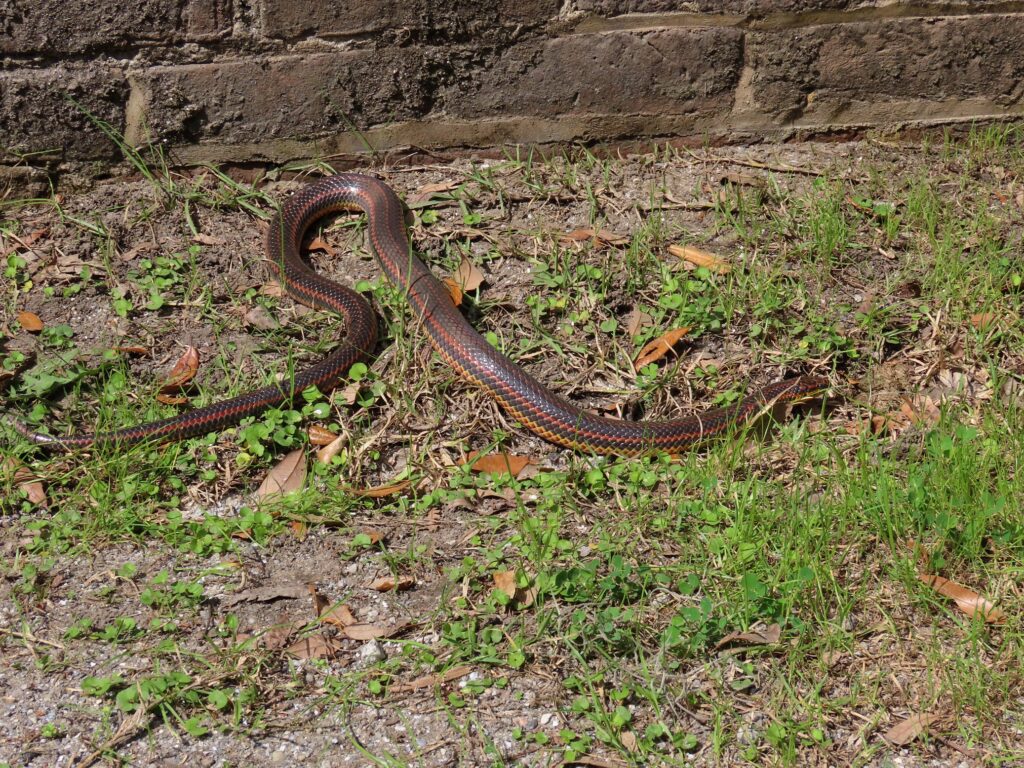
This week for Flora and Fauna Friday it’s a secretive spectral serpent of southern swamps: the Rainbow Snake (Farancia erytrogramma).
The Rainbow Snake is a widespread but seldom seen snake throughout the southeastern coastal plain. They’re partial to blackwater swamps, rivers, cypress bottoms, and other forested wetlands with freshwater flow. They spend their lives hunting underwater for eels and amphibians, swallowing their prey whole. They’re nonvenomous and totally harmless to people. They rarely, if ever, bite when handled.
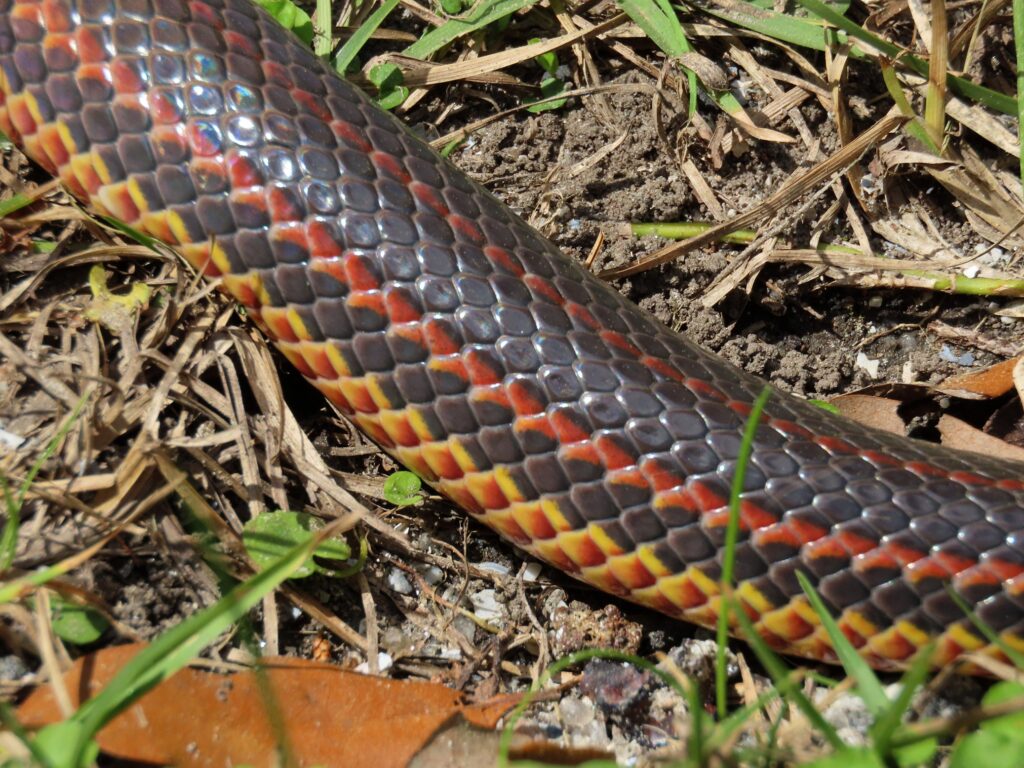
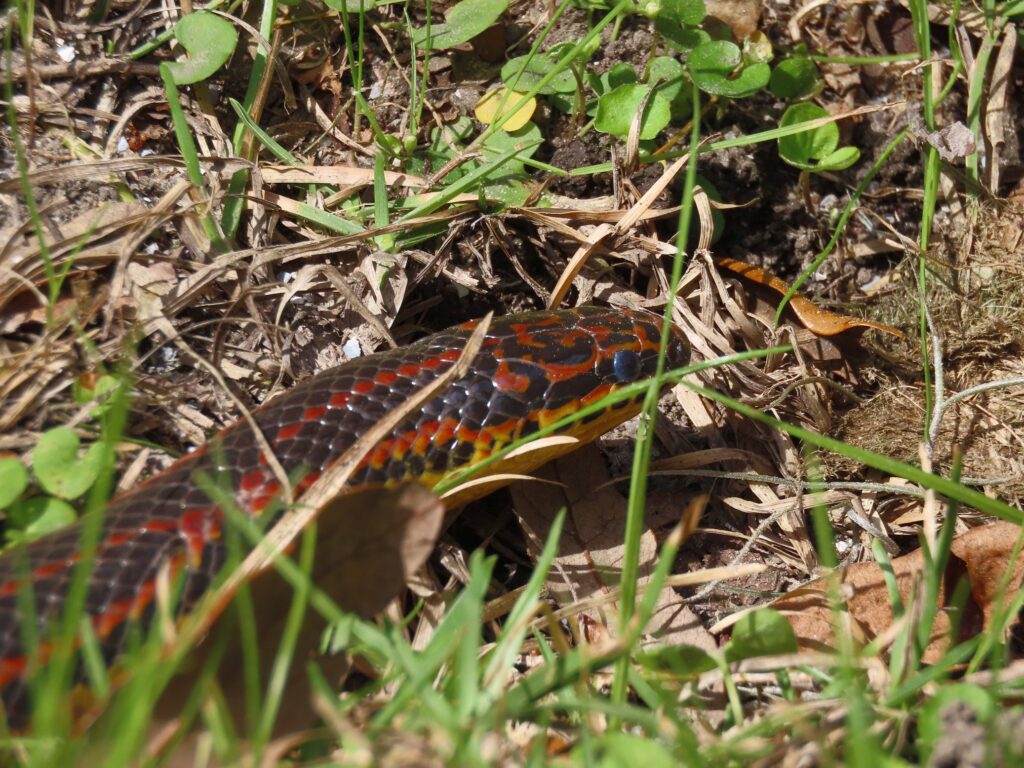
Rainbow Snakes are sizable serpents that can exceed five feet in length while retaining a stout diameter. Their features are soft, smooth, and rounded, hinting at their aquatic nature and a capacity for burrowing. This species is hard to find in the wild as they typically don’t sunbathe and rarely leave the water, except to commute between wetlands. They often go unnoticed, slithering through shallows or floating between flotsam, in spite of earnest efforts put forth by herpetologists to find them. Yet, the Rainbow snake is every bit as spectacular as it is secretive. That common name is no misnomer. This snake is streaked in smoldering scarlet over a back of greasy black and belly of glowing golden-yellow, all while blanketed in scales bearing subtle iridescence. It’s a species that’s hard to get a hold of but difficult to ignore!
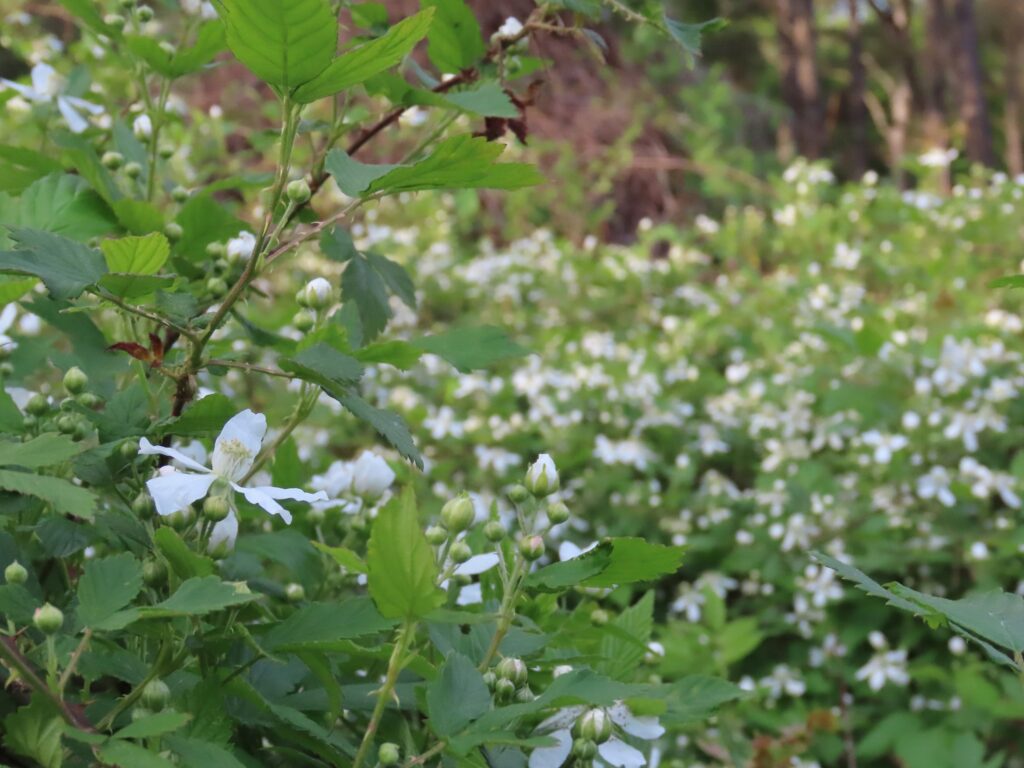
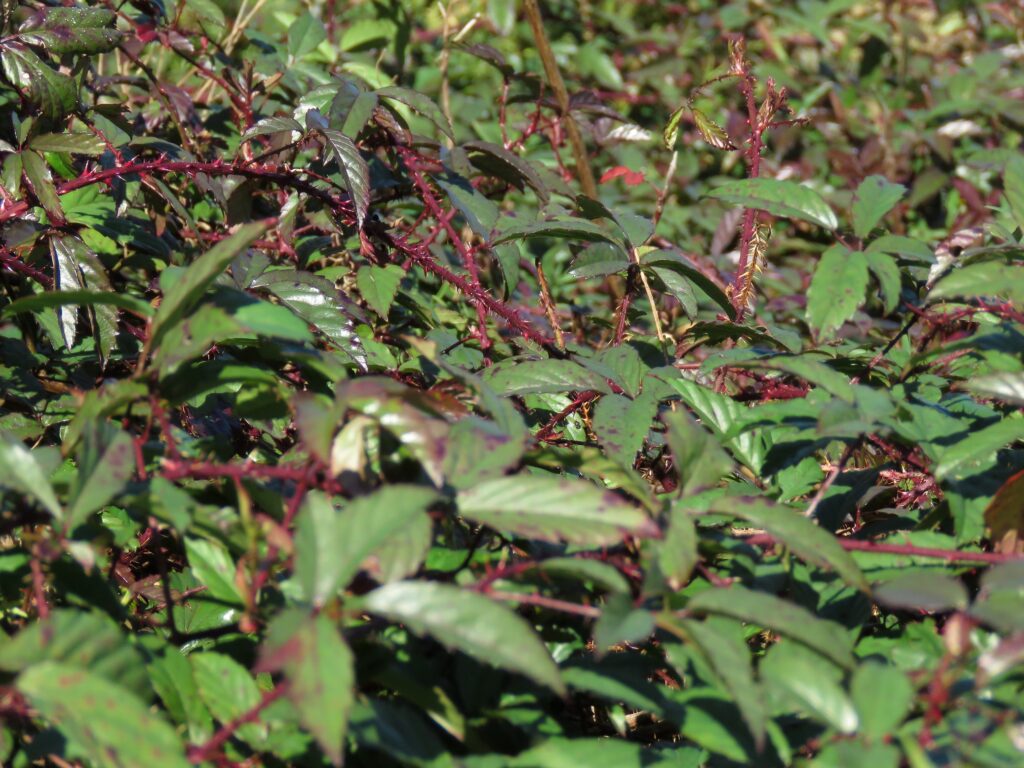
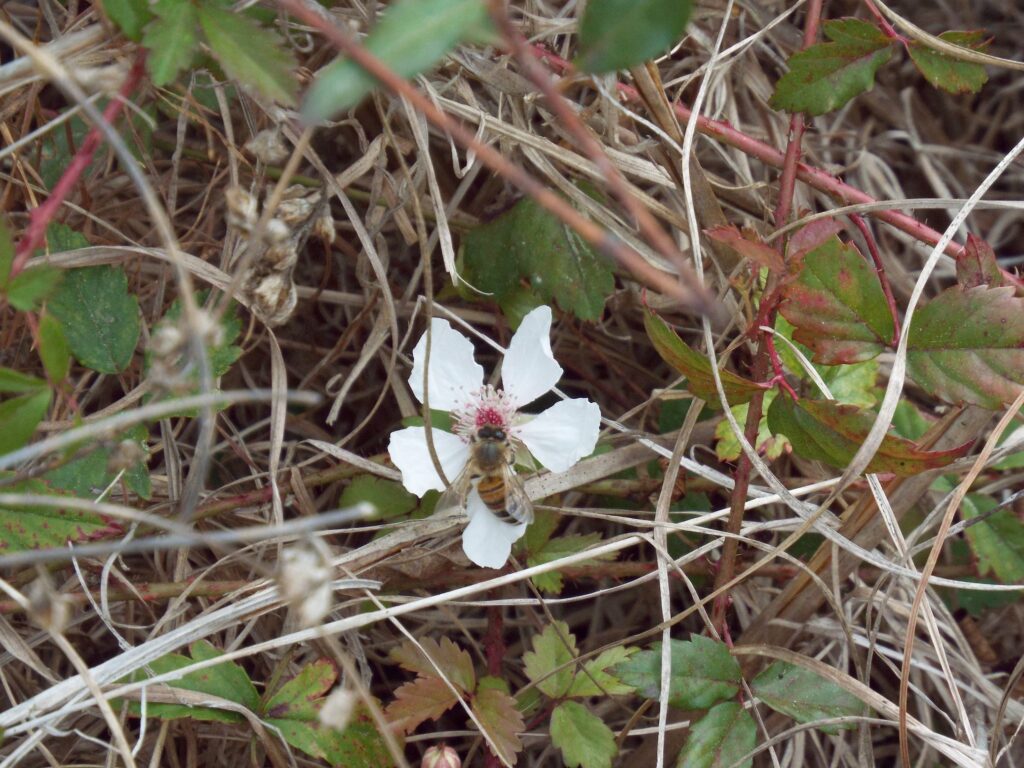
This week for Flora and Fauna Friday our secret ingredient is a mean, tart, tangle of a plant: the Blackberries of genus Rubus.
Blackberries are a diverse genus of perennial vine-like shrubs that belong to the Rose family, Rosaceae. Here on Edisto we have four common species, two very common and two not as common. Sawtooth Blackbery (Rubus argutus) and Southern Dewberry (R. trivalis) are in the common camp. Sand Blackberry (R. cuneifolius) and Northern Dewberry (R. flagellaris) are in the latter. All share great similarity but differ in the details. Sawtooth Blackberry is tall and fierce with great streams of corrugated, serrated stems that swallow up wood lines. Southern Dewberry is sprawling and electric with long ribbons of ruby-red stems that snake their way through field and forest, enveloped in full by a halo of the finest prickles to guard against even the tiniest of attacks. Northern Dewberry is much the same but less red with anger; its thin green stems wind along the woods armed with a sparring set of spines. Sand Blackberry is sparse and short; its stem stiff over sandy barrens with waxed lime leaves upholstered below by ashen suede. Southern Dewberry is the common species you’ll see worming through lawns and woods. Sawtooth Blackberry prefers to build thickets along fields. Sand Blackberry is best seen in sand barrens and pine savannas where fire is prominent and Northern Blackberry in forest openings less prone to combustion.
Just like Roses, Blackberries form a tangled mess of vines and limbs that smother and stab the world around them. Great arches and chains of barbs and hooks that instruct an unforgettable lecture to those who boldly march into their iron maiden embrace. Blackberries detest trespass and vandalism. They advertise that innocuously with an armory of prickles, needle sharp protrusions across the full sum of their surface. The only places they’re approachable are their at flowers and their fruits. Blackberries bloom through March and April. Their flowers are white and bushy, with five petals as white and delicate as tissue paper affixed below a burst of brush-like anthers. Each flower an inch across and discrete on its own stem. Blackberries are a special favorite of honey bees, as their prolific pollen-packed flowers are one of the first to bloom each season as the bees stir from their hives. What’s best known and most attractive about Blackberries are their black berries. (Who’d a thunk?) Blackberries are a productive and delicious fruiting plant, thanks to most vegetarians leaving its foliage be. All species have edible berries that age from green through red into a glistening black. Each berry is really a tightly packed cluster of fleshy drupelets, each with a tiny seed at their center. In my opinion, the Dewberries are the tastiest and easiest to collect. Sand Blackberry only produces few and small fruits. Sawtooth Blackberry is by far the most prolific per unit of plant but not as flavorful, and requires more of a blood sacrifice to acquire.
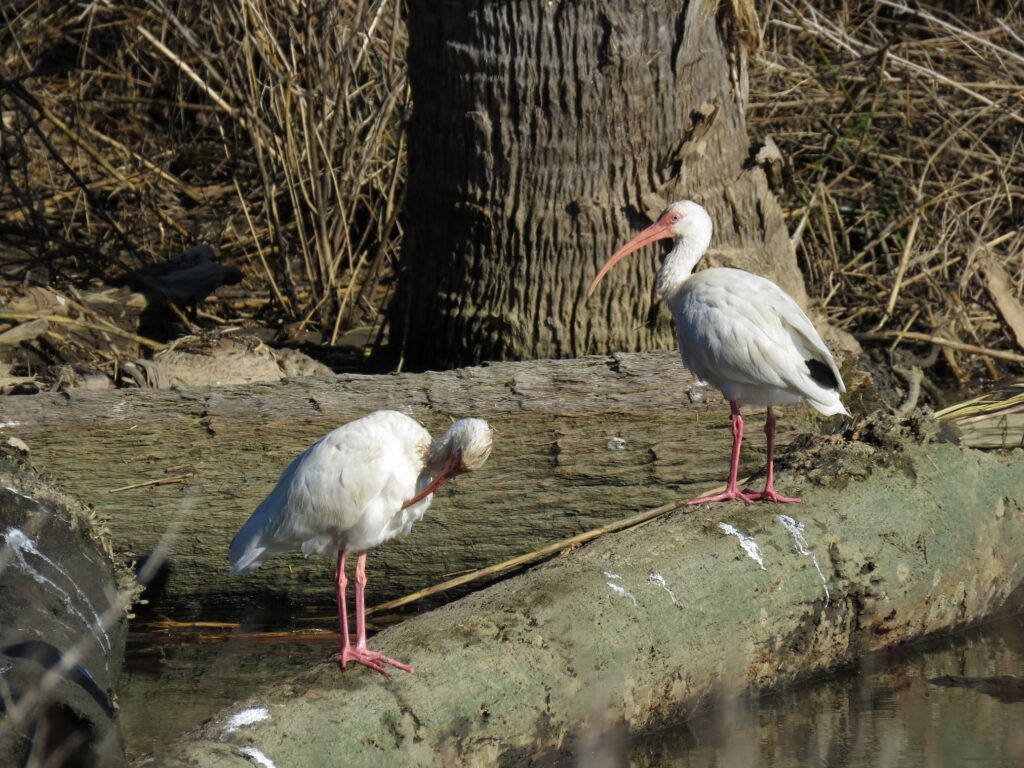
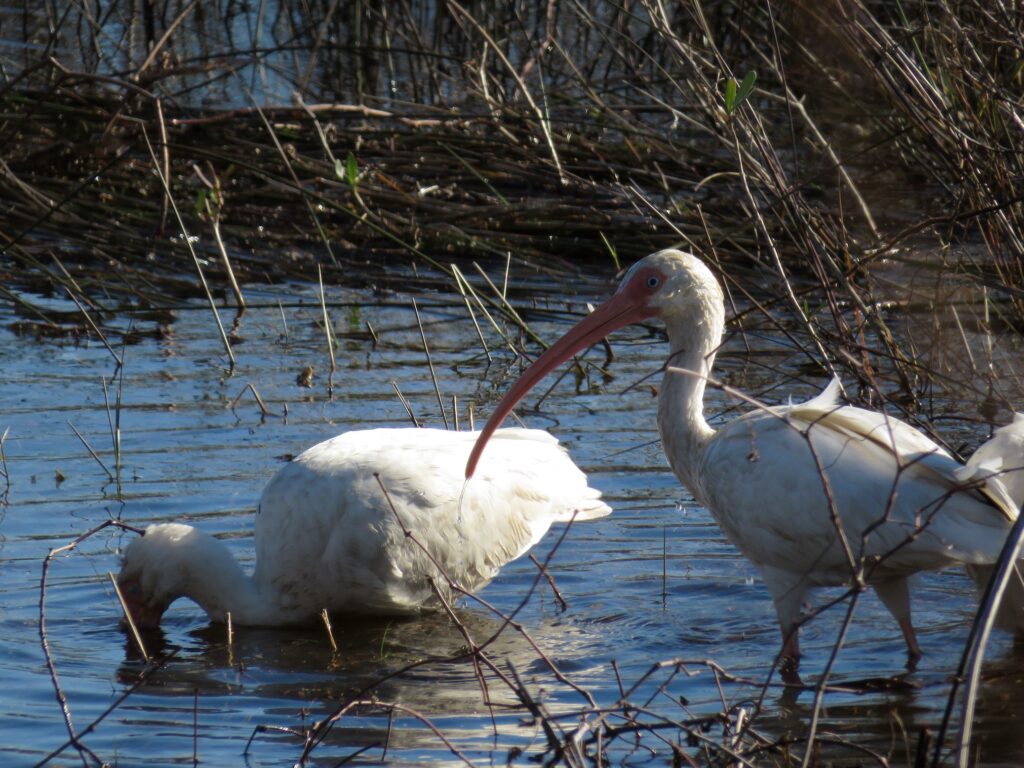
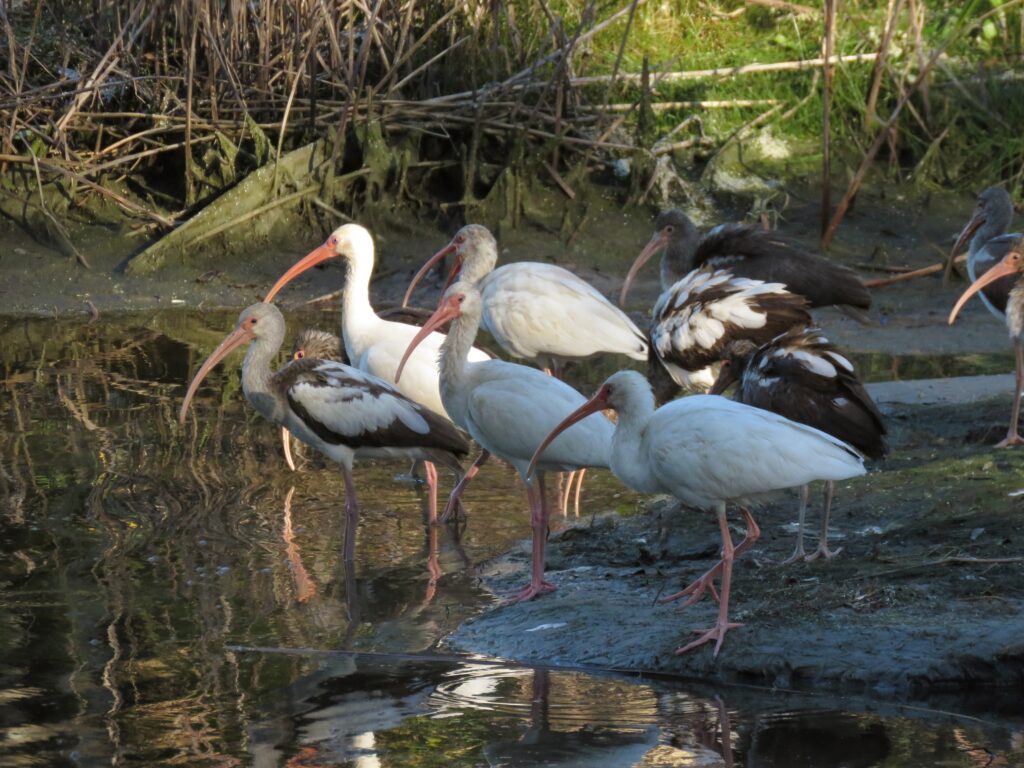
This week for Flora and Fauna Friday it’s a snowy crook-billed critter who’s not afraid to get its feet wet: the White Ibis (Eudocimus albus).
Breeding birds are an icy-white with a rosy-red face and strong bubblegum-pink legs. In flight their wings show tips of contrasting black. Immature birds are a patchwork of warm mocha-brown, cold snow-white, and soft gray. Their body has a streamlined profile and their neck is long and sinuous. Their eyes are a clear sky-blue and their long, drooping bill is dripping with that same bubblegum hue. Ibis are both compact and lean which gives off an athletic vibe. We have a second species of Ibis regularly seen on Edisto Island, but never commonly, called the Glossy Ibis (Plegadis falcinellus). A gorgeous bird of oily-black draining away from a cinnamon neck with dark beady eyes bordered by shining Xenon lines. Ibis are most closely related to our Roseate Spoonbills, outside of other Ibis.
The White Ibis is a common wading bird throughout the coastal plain of the Southeastern United States and Central America. They’re here year-round but their numbers ebb and flow as birds cycle between seasonally preferred habitats. In winter our populations peak as the birds chase warmer weather and better forage. White Ibis love wetlands. Stagger stepping while stabbing through stagnant stands of sedge or sod they forage and feed their way over the shallow waters of our state. They’re ever present every winter in our ephemerally flooded forests and fields as they descent in flocks upon the soggy soil. They’re partial to marsh lands as well and regularly plop down beside our Egrets along the pluffy tidal creeks. White Ibis are rarely seen alone, usually being accompanied by at least two if not two dozen compatriots. Occasionally, mass flocks of hundreds of birds will appear on farm fields following seasonal flooding. I’ve seen them in waves of thousands on the fields surrounding Russell Creek!
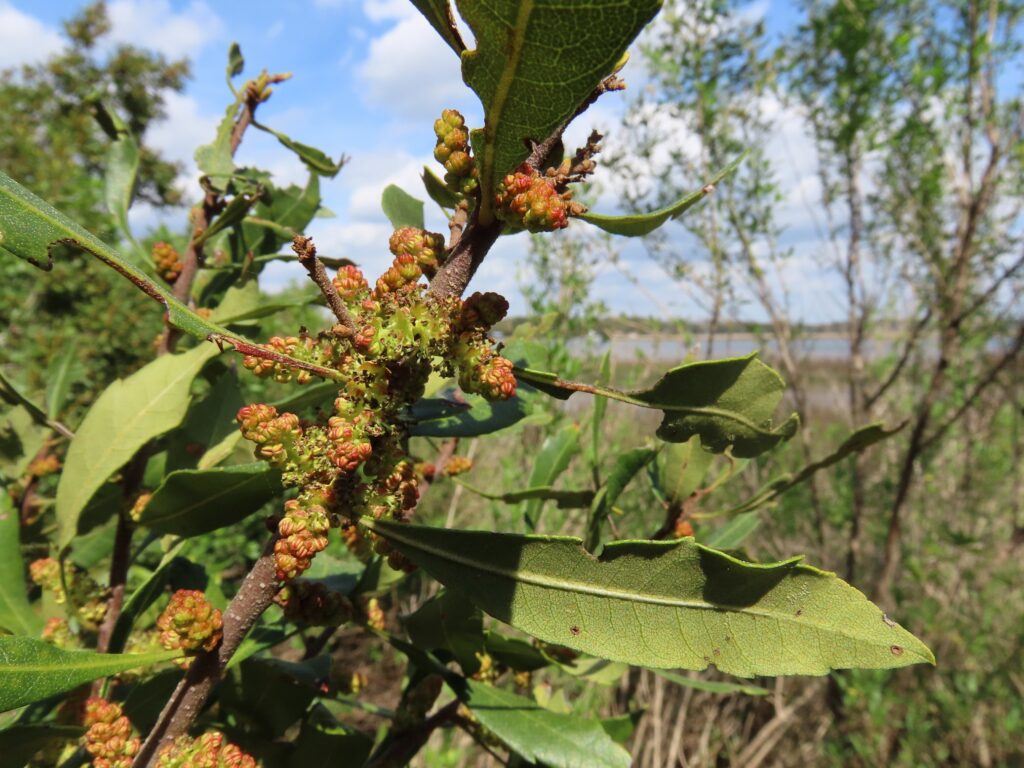
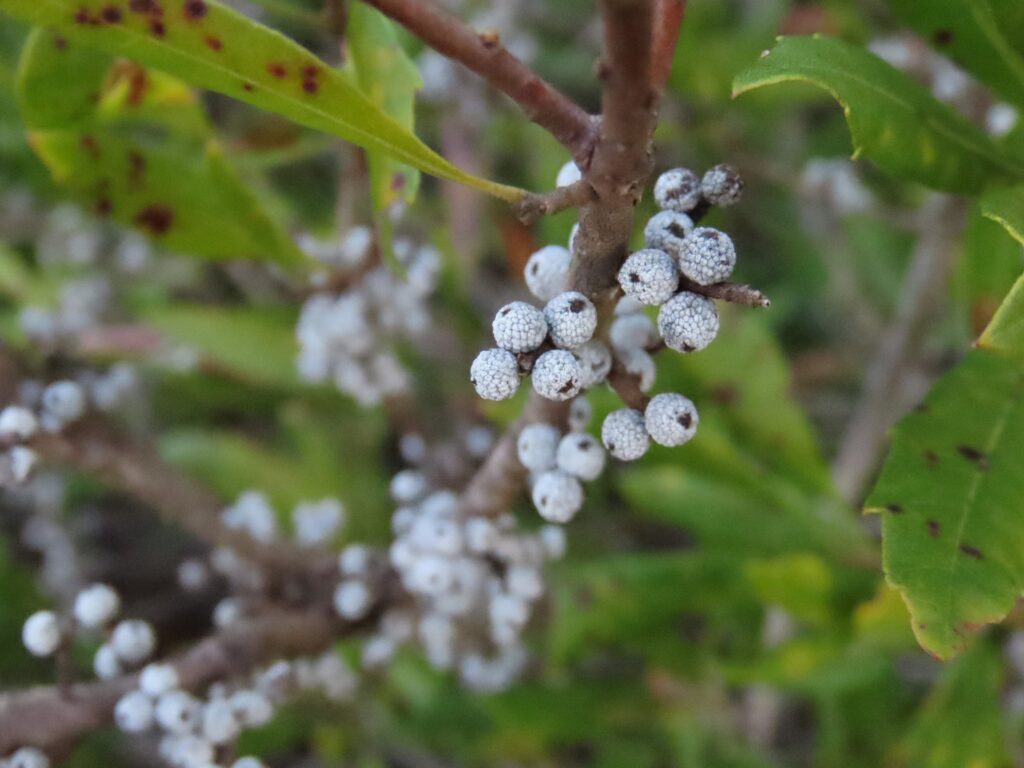
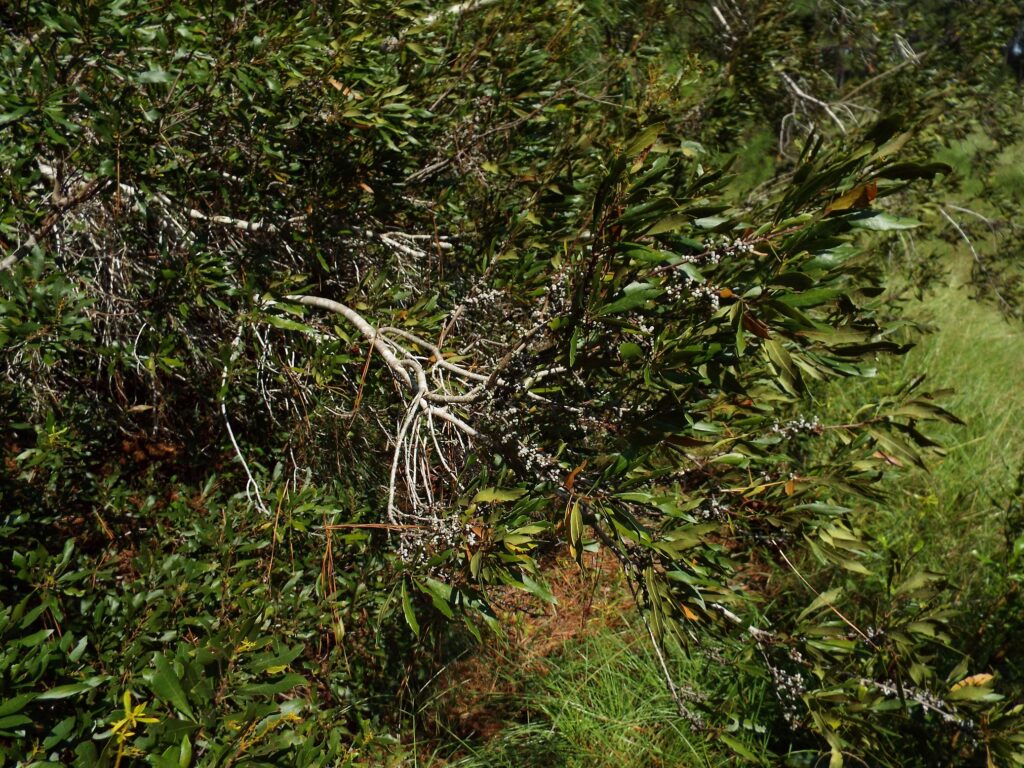
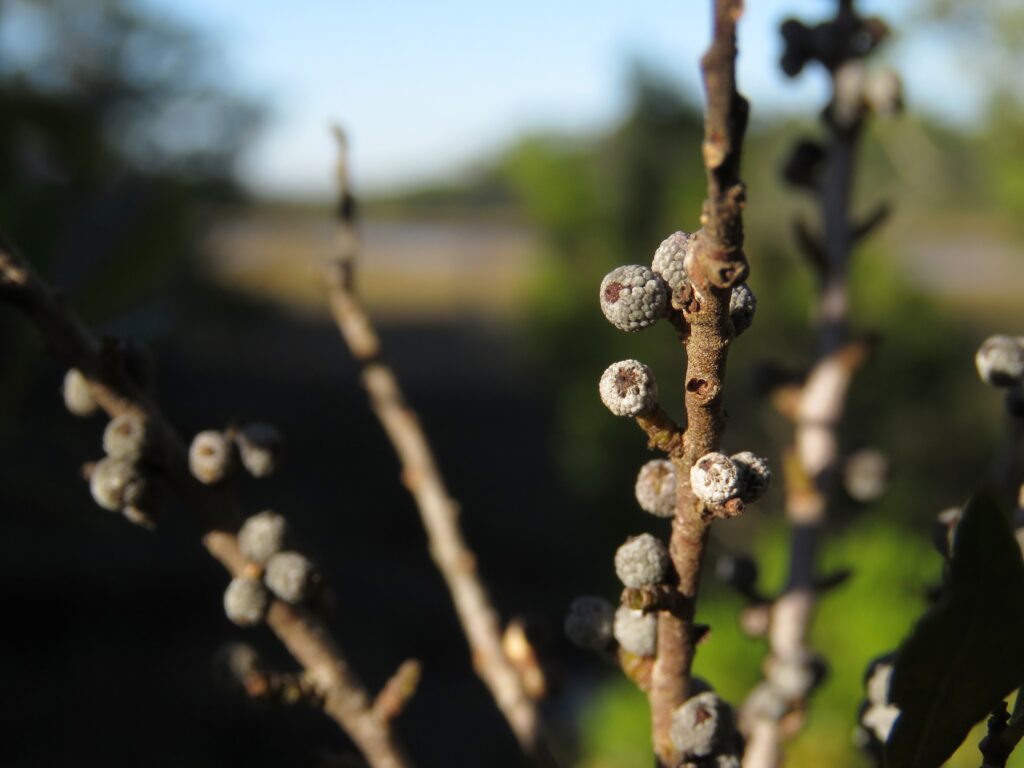
This week for Flora and Fauna Friday the subject is a flammable, fragrant foliage: the Southern Wax-Myrtle (Morella cerifera).
The Southern Wax-Myrtle is one of those inescapable fixtures of Edisto’s flora. A shrub found on every causeway, woodlot, lawn, and hammock. It is quick to grow almost anywhere thanks to its ability to fix atmospheric nitrogen and tolerance of flooding, drought, and salinity. It’s unkempt, swelling body of leaves hovers above the ground on gnarled, twisting trunks of gray ringed in white. The leaves are simple and plain of shape but more unique in their details. Those piney, evergreen leaves wear a dull sheen pocked by minute dimples while radiating an aura of yellow. That appearance is belayed by a trait of Wax-Myrtle, its fragrance. Wax-Myrtle has a spicy, pungent scent produced by a cocktail of chemicals found in the yellow pinprick resin glands that pepper its leaves. These chemicals ward off herbivores of both the six and four-legged varieties. Yet, Wax-Myrtle has use for the two-legged types.
Wax-Myrtles are a dioecious plant, having both male and female trees. Its flowers are a twisted affair of green and red nodules that arise from its stems. Male flowers are larger and more open but both sexes rather innocuous. Female Wax-Myrtles come to bear a buffet of berries as we enter autumn but these teeny blue-gray berries are not sweet, they’re greasy. Or more precisely, they’re waxy. The berries of the Southern Wax-Myrtle are the staple in the winter diet of the Myrtle Warbler. These normally insectivorous birds have developed a mutualistic relationship with the Wax-Myrtle. The fatty fruits provide an easily digestible, calorie dense bounty for the warbler to survive on through the winter. In return these petite songbirds spread the seeds of the Wax-Myrtle throughout every inch of South Carolina. The berries are also of use to people as they can be gathered and boiled to yield wax for candle making. This is where the wax for bayberry candles comes from. This waxy coating also extends to the leaves of Wax-Myrtle making them both drought resistant and highly flammable. So I wouldn’t recommend planting them next to your fire pit or propane tank.
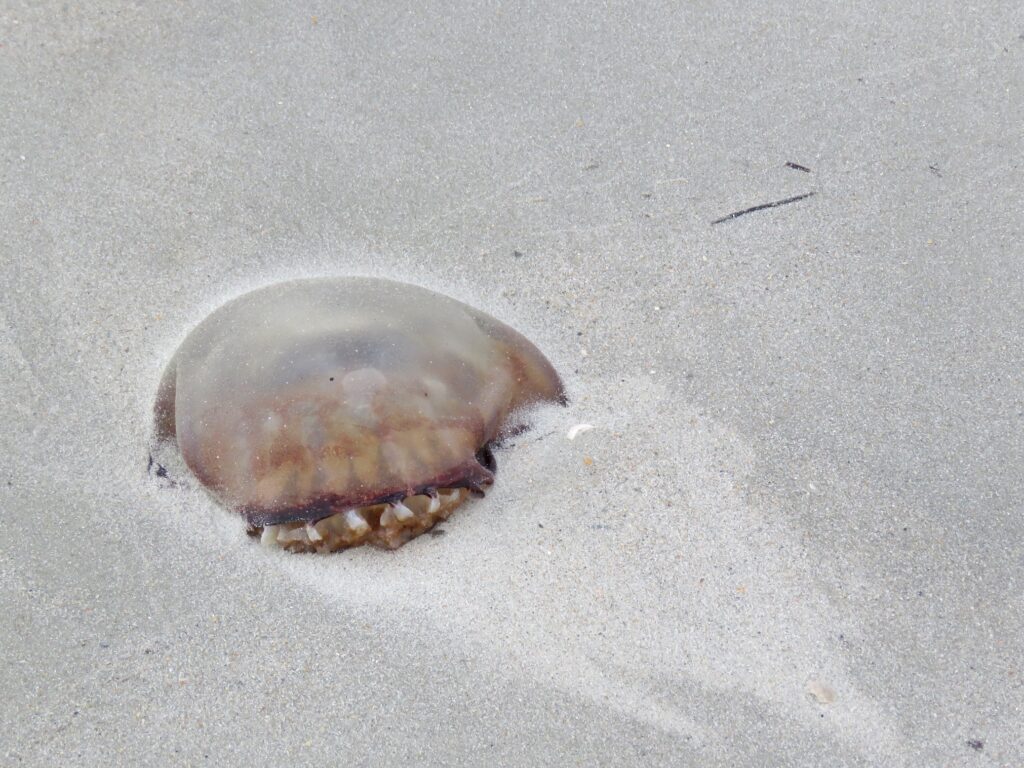
This week for Flora and Fauna Friday we have a gelatinous, spherical, planktonic animal who gets eaten in interesting ways: Cannonball Jelly (Stromolophus meleagris).
The Cannonball Jelly is the most common Jellyfish in the tidal rivers surrounding Edisto Island. The Cannonball Jelly, like most Jellyfish, is planktonic. They are totally subject to the whims of the ocean’s currents. From summer through fall, their numbers surge along the coast. They can often be seen floating past in blooms of dozens to hundreds or washed up en masse on beaches after storms.
Their common name accurately describes their simplistic shape, a helmet-like dome trailed by stubby, frayed tentacles. They can reach up to ten inches across and are quite drab in color, with only a washed-out burgundy belt to accent their translucent milky-gray complexion. Their stumpy, fluffy tentacles are rather unassuming as well and indeed lack pretty much any punch. They mainly feed on microscopic animals, including all manner of larval crustaceans, molluscs, and fish. Cannonball Jellies are still toxic but rather than wielding explosively venomous nematocysts, they only exude a poisonous slime. They’re difficult to get stung by and the effects are usually just mild irritation, to both parties.
The Cannonball Jelly is probably best known for getting eaten. They are a staple in the diets of the endangered Leatherback Sea Turtle (Dermochelys coriacea). Leatherbacks are specially adapted to eating Jellyfish and our rotund Jelly is quite the appetizing meal. Jellyfish are also eaten by people, just usually not Americans. The Cannonball Jelly fishery is a developing economy here in the Southeast and a potentially profitable export to Asian countries, where re-hydrated Jellyfish is a regular menu item. At the moment the business is exclusive to Georgia. Compared to most Jellyfish the Cannonball has a rather solid constitution, feeling more like rubber than Jell-O in the hand. This makes them well suited for harvest, drying, and subsequent eating!




© 2026 Edisto Island Open Land Trust.
Built by Colophon