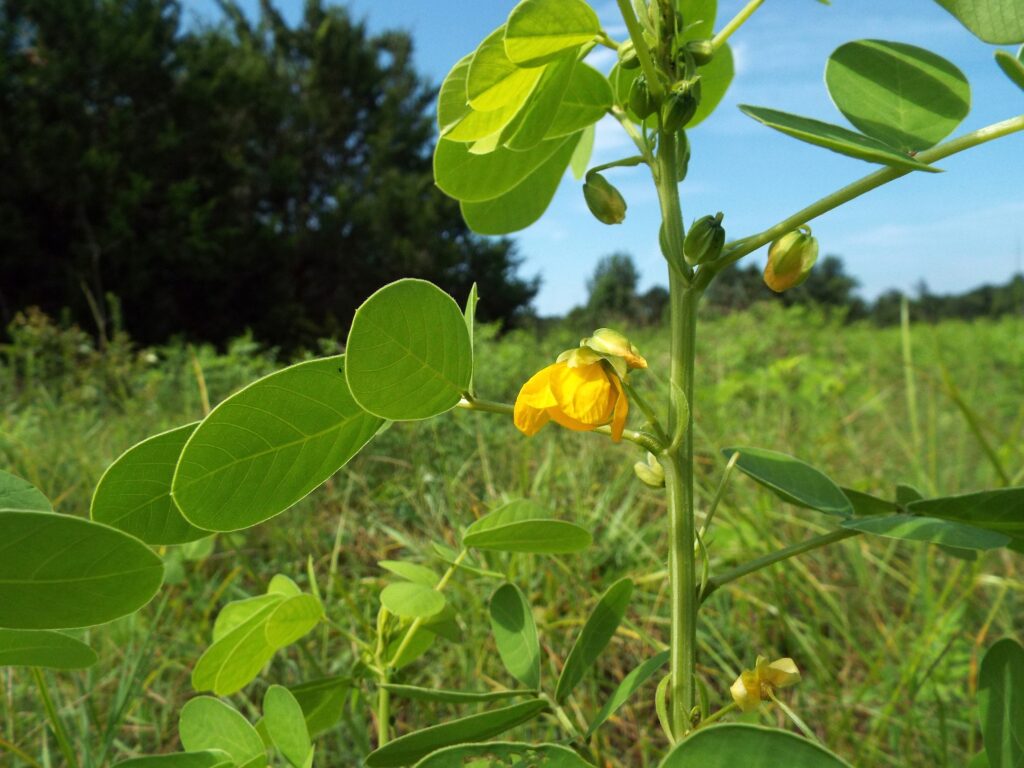
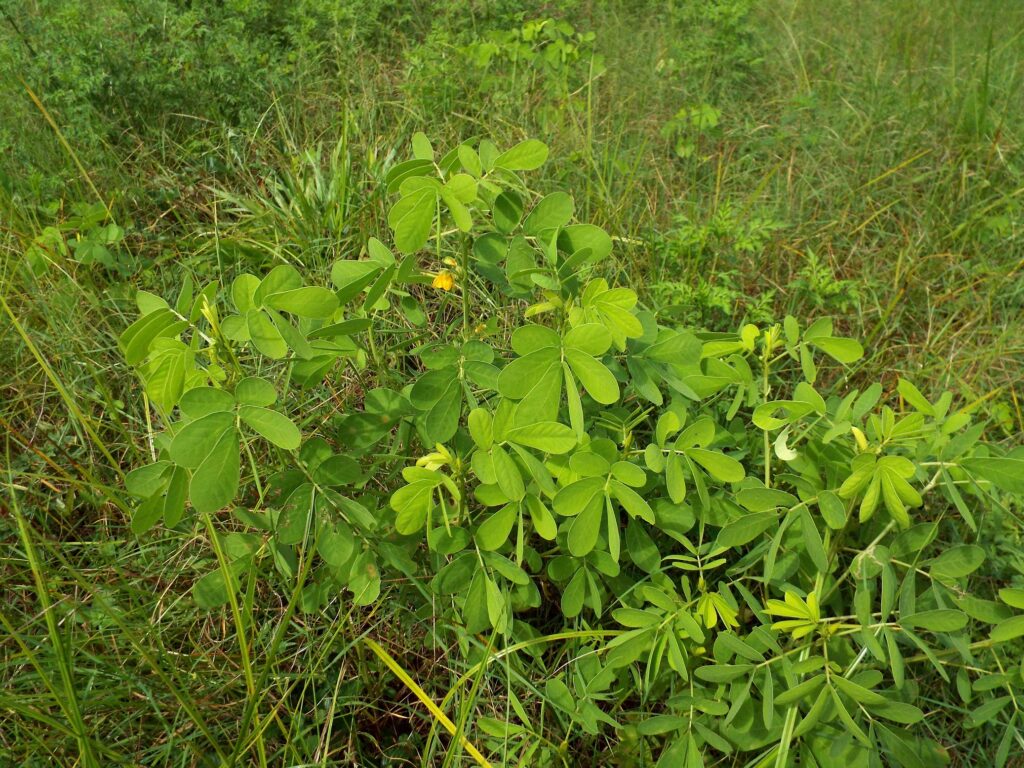
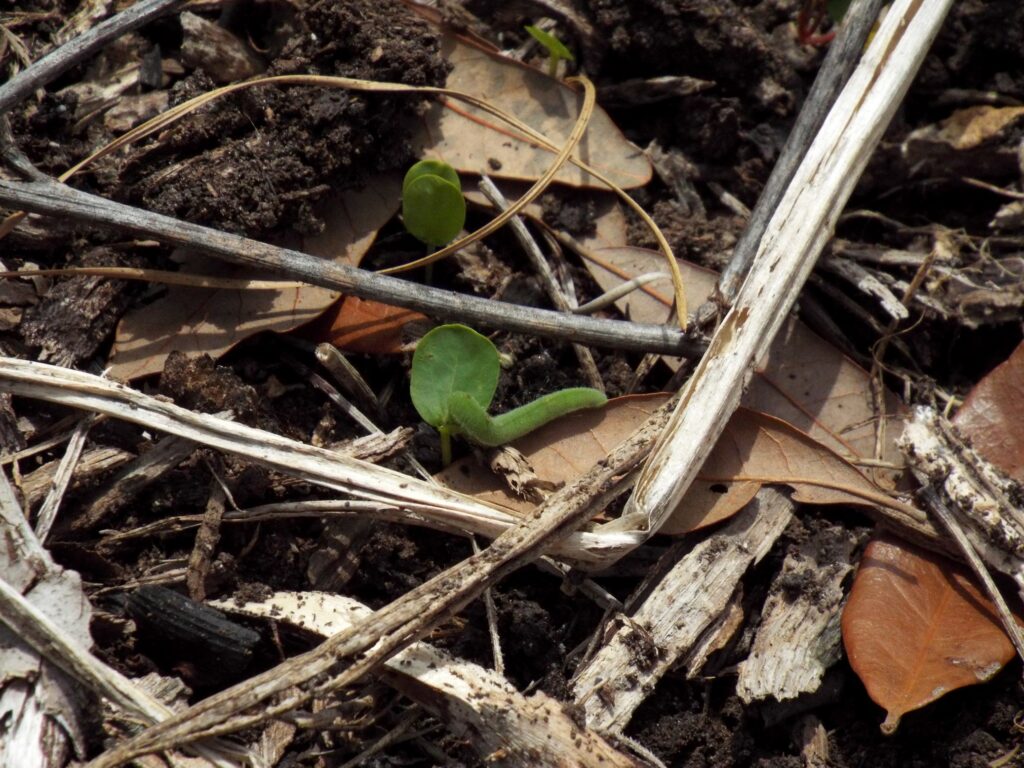
For Flora and Fauna Friday this week, it’s yet another plant. We’re taking a close look at Sicklepod (Senna obtusifolia). You may also know Sicklepod and its relatives as Cassia, which is the genus they formerly belonged to.
Sicklepod is a native, annual, herbaceous plant in the family Fabaceae, the Legumes. The same family as beans and peas. Like most Legumes, it can fix nitrogen from the air and loves sunlight. It grows best in full sun and in disturbed habitats, such as roadsides, fallow fields, and clear cuts. But, it will grow just about anywhere as long as it gets enough sunlight. It can grow up to 6ft tall in ideal conditions but is usually closer to 3ft. It has compound leaves divided into 6 teardrop-shaped leaflets. It blooms in late summer throughout the fall. The flower is yellow, bowl shaped, usually downward facing, and not particularly showy.
Sicklepod gets its common name from its fruit. The fruit’s shape is reminiscent of a sickle’s blade: long, thin, and curved. The fruit is a pod that’s packed with small, cube-shaped seeds. The plant disperses these seeds through its fruit. When dry, the pods will explosively split, scattering seeds for several feet. The technical term is “explosive dehiscense” and is a common form of seed dispersal for many Legumes.
Sicklepod is what most people call a weed: something that grows where you don’t want it to. However, calling a plant a weed or pest is really a relative term. Whereas something like the term invasive is an absolute, referring to any non-native plant that has a consistent and measurable negative impact on a native ecosystem. What makes a plant “weedy” all depends on what you’re trying to accomplish.
Sicklepod, from my perspective as an ecologist, is a fantastic native plant. It can grow almost everywhere, it requires almost no upkeep to maintain a population, it adds nitrogen to the soil, and, most importantly to me, it is a great source of nectar for pollinators and a larval host plant for several species of butterfly. Sicklepod is a major host for the caterpillars of the Sleepy Orange and the Cloudless Sulphur butterflies. The adults will also nectar on its flowers.
One man’s trash is another man’s treasure and one gardener’s weed is another’s centerpiece. It only depends on your perspective.

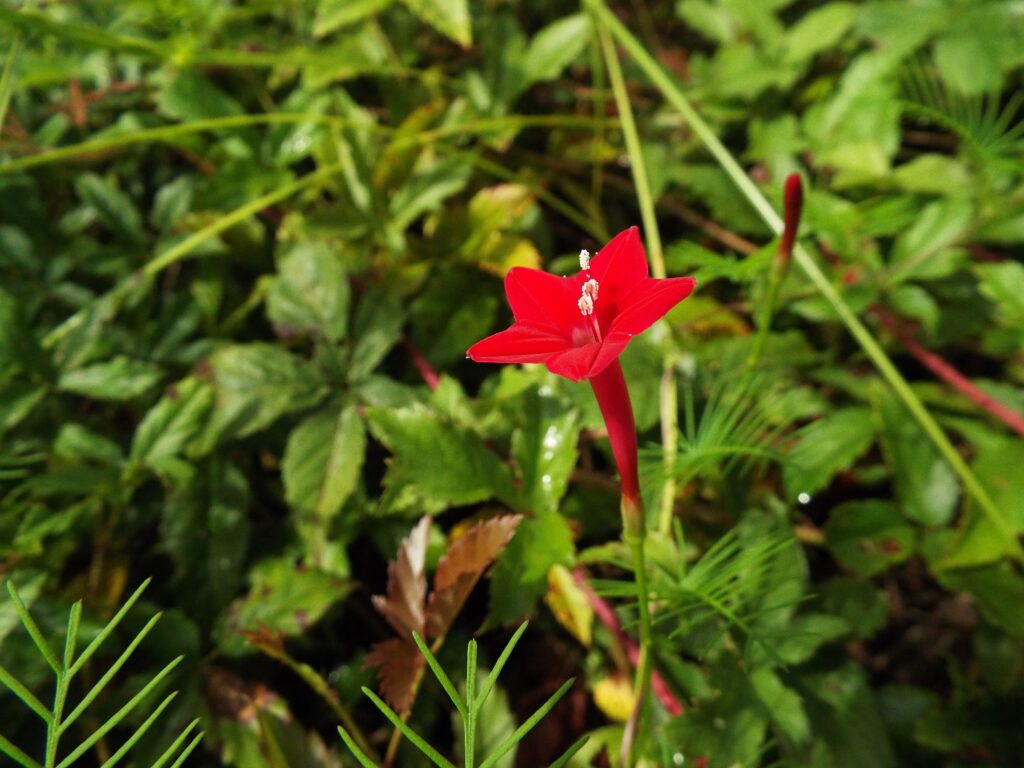
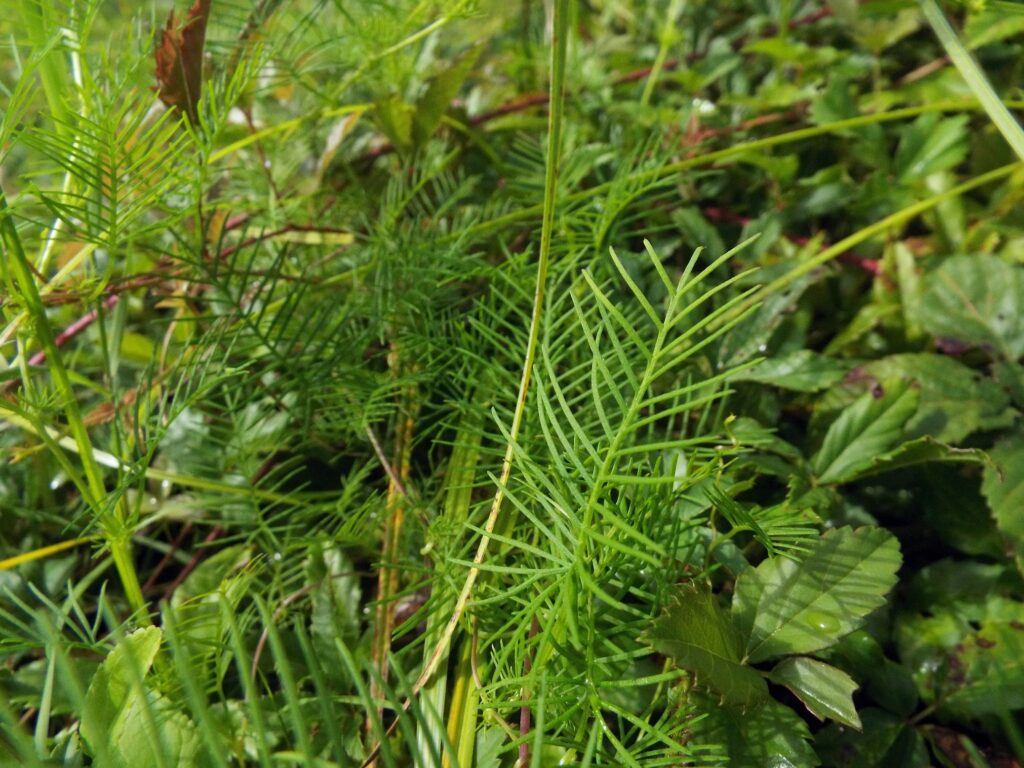
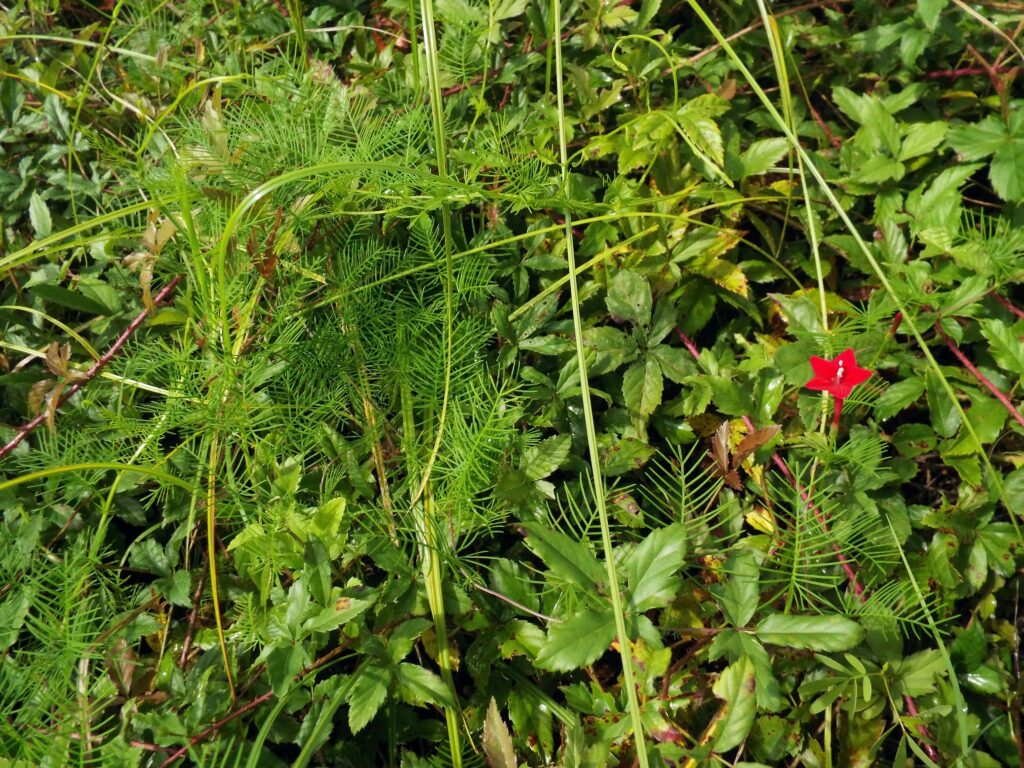
For this week’s Flora and Fauna Friday, we’ll be taking a look at another flowering vine: Cypressvine (Ipomoea quamoclit).
Cypressvine is not a species native to the USA. It’s from to tropical America, with a native range stretching from Mexico down to northern South America. It was introduced to the United States as an ornamental and has taken hold in the coastal plain of the SE-US. The hot summers and short winters here allow it to thrive. However, unlike most established exotics, Cypressvine is fairly tame in its ecological effects.
Cypressvine is a member of the Morning Glory family, Convolvulaceae. It’s not to be confused with Cardinal Climber (Ipomoea sloteri), which a hybrid between Cypressvine and Red Morning Glory (Ipomoea coccinea). Like other Morning Glories, it is a fast growing, herbaceous vine that climbs by twining; it simply wraps its soft stems around its surroundings. It is an annual and reliable self-seeder. The leaves are lobed to the absolute extreme and exhibit a feather-like appearance. This is where it gets its common name of Cypressvine, as its leaves look very similar to those of Cypress trees (Taxodium spp.). Cypressvine boasts a beautifully scarlet flower, delicately built and trumpet shaped. This flower is a favorite nectar source for hummingbirds and large butterflies.
Cypressvine requires full sun and plentiful moisture to thrive. This is necessary to support those feathery leaves. In plant ecology, you can tell a lot about a plant’s habitat requirements and lifestyle just by examining its leaves. In simplified terms, the wider and more circular a leaf is, the more sunlight it can catch and photosynthesize. The narrower and more complicated a leaf is, the less sunlight that will hit it. So why would a plant have such complicated leaves if it loves full sun? Photosynthesis isn’t 100% efficient. If a leaf receives too much sunlight, then it will cook alive and die. Plants in high light avoid frying their leaves by using a process known as transpiration, evaporative cooling from the microscopic pores of their leaves. It uses the same physics as sweating, what we humans use to cool ourselves with. The greater the surface area of a leaf is, then the more water it is able to “sweat off”. The greater the ratio of surface area to volume, the faster that “sweating” can cool the inside of the leaf. If the shape of a leaf prevents the plant from cooling down faster than it heats up, then it won’t be able to survive. Leaves that are as feathery as those of Cypressvine tell you that this plant requires full sun and a reliable source of water. Those feathery leaves allow Cypressvine to grow non-stop in the most intense sunlight without burning up. The leaves act like hundreds of tiny heat sinks/radiators. In order to maintain all those leaves, a reliable source of water is needed. This is why Cypressvine prefers to grow in shallow ditches or along fence lines. The shade and dense vegetation helps keep the soil cool and moist while giving the plant something to climb on.
The ecological value of Cypressvine in our area is complicated. It’s obviously an exotic plant that has escaped cultivation and demonstrated its ability to both grow vigorously and establish new populations. In high enough densities, it can dry out wetland soils with the sheer volume of water it loses through transpiration. However, it has fairly particular habitat requirements, it only thrives in areas where human disturbance is high, it’s feathery leaves block very little sunlight making it unable to choke out the majority of native plants, it dies off completely each year, and it provides a valuable source of nectar for pollinators throughout the summer and fall. In many ways Cypressvine fills an ecological niche that was wide open. The take away is: you can’t judge a book by its cover and you can’t always judge an exotic plant by its alien origin, sometimes they can end up helping more than they hurt.
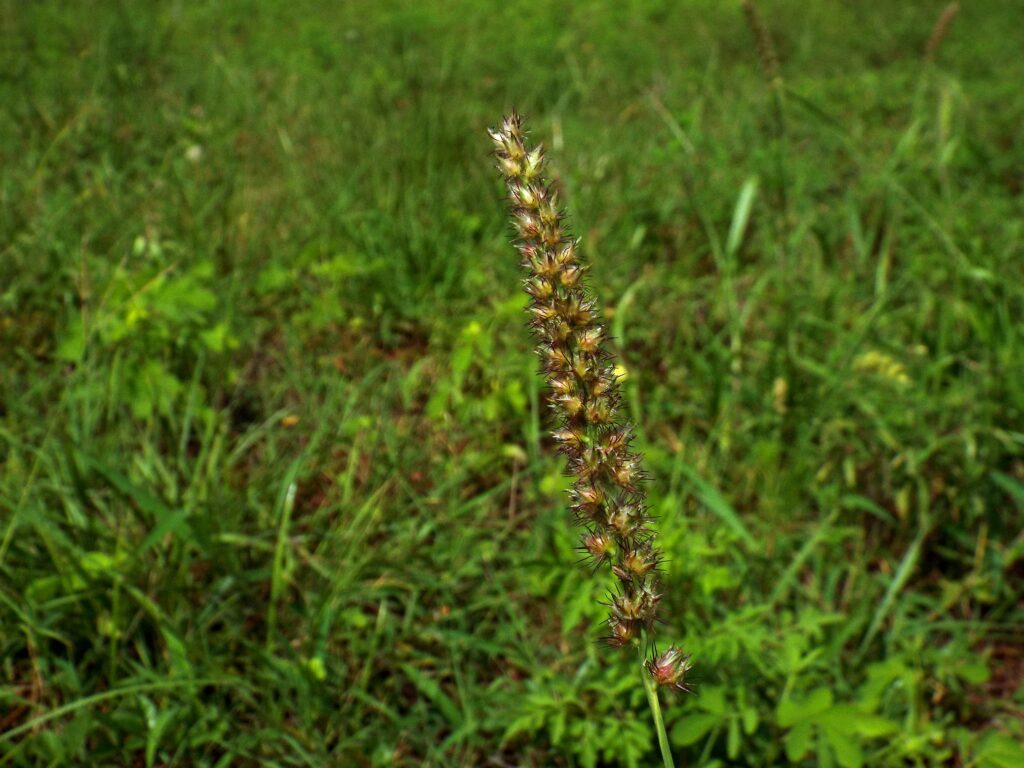
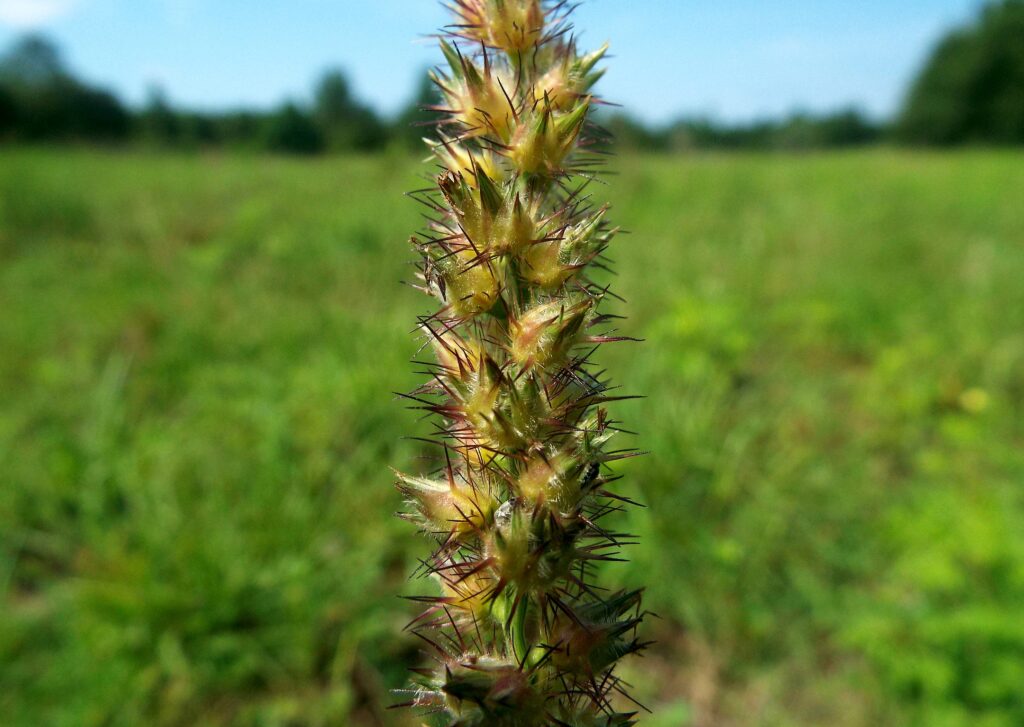
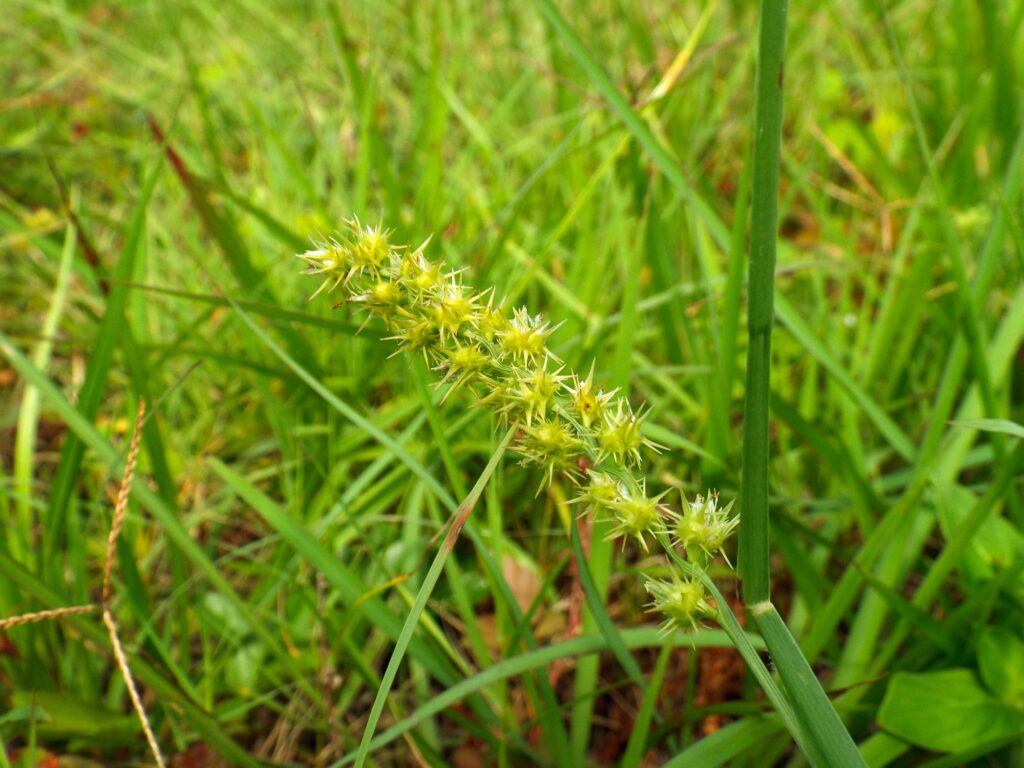
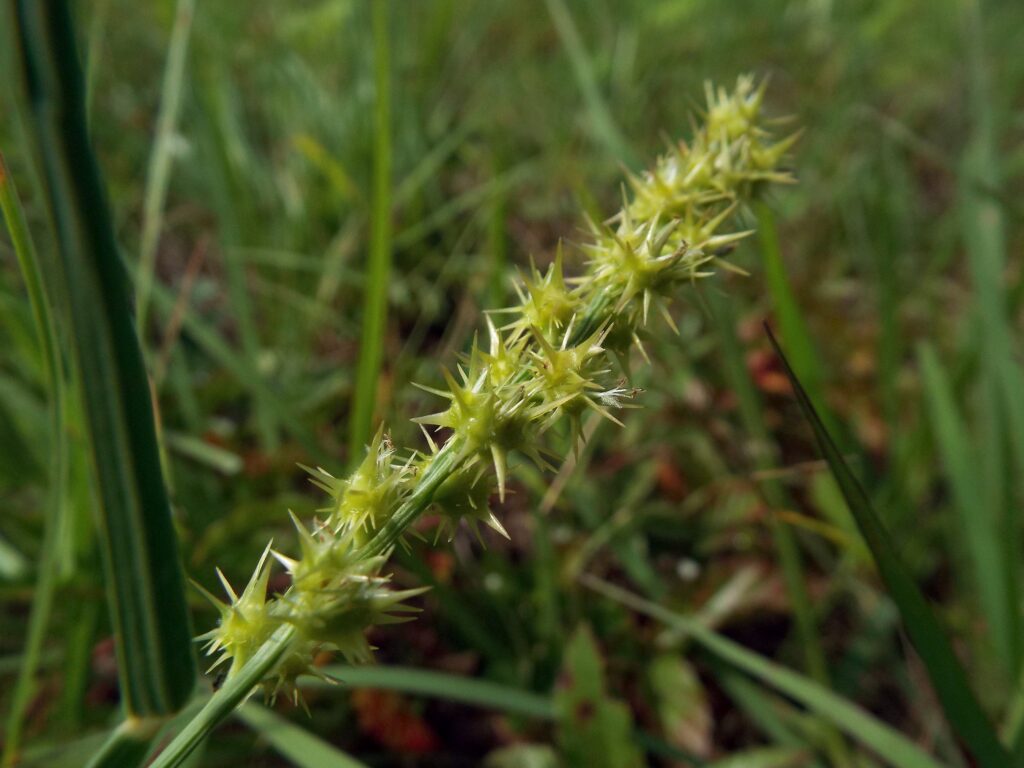
For today’s Flora and Fauna Friday we’re going to take a look at a type of plant that some of you may be more familiar with than you might like. We’re talking about the Sandburs, genus Cenchrus, also known as Sand Spurs or colloquially as “Stickers.”
There are four species of Sandburs native to our area: Southern Sandbur (Cenchrus echinatus), Long-spined Sandbur (Cenchrus longispinus), Dune Sandbur (Cenchrus tribuloides), and Coastal Sandbur (Cenchrus spinifex). I’ve placed those in order of least to most painful to step on.
The two species in my photos below are Southern Sandbur and Coastal Sandbur. The reddish one is Southern Sandbur. It’s our tallest member of the group and it has fairly delicate spines. The green one is Coastal Sandbur. The next tallest and the one with the most savage of spines. Coastal Sandbur is the species that grows in my yard and, let me tell you, they are not fun to step on. (They can go clean through a foam flip-flop.) Dune Sandburs are the ones you find (usually inadvertently) in and around the dunes of the beach. They’re low growing and not fun to step on either. Long-spined Sandburs are also a low growing species. I can’t attest to their spiny-ness, as I’ve never had the displeasure of stepping on one, but they don’t look they’d hurt too bad.
Sandburs are a member of the Grass family, Poaceae. Like all Grasses, they have a fruit that is, in simple terms, a seed surrounded by several types of specialized leaves, called bracts. In the case of Sandburs, some of those bracts have become highly specialized, fusing together and producing numerous spines. This specialized fruit gives Sandburs a huge advantage over other grasses. Those spines lodge into the fur and skin of passing animals that brush against or step on the plant. That animal is then forced to carry that seed away from the original plant, whether that be a few feet or several miles. When the seed is finally scratched, chewed, or brushed off the animal, with any luck, it will be in an area perfect for it to take root.
It seems like a straightforward idea to us as humans but it’s quite an ingenious strategy on multiple levels. Since they don’t have to rely on wind, gravity, or sheer numbers to disperse their seeds, Sandburs can spend more energy to make their seeds much larger than other Grasses. That gives their offspring a head start. Meaning they can get a more solid foothold in whatever habitat they end up in. Having big seeds also makes you a target for seed eating animals but those spines are pulling double duty. Very few animals will eat the seeds of Sandburs. It’s just not worth the pain and effort. Those spines have microscopic barbs and serrations across their entire surface, giving them a texture like a wood rasp. Invisible to the naked eye but easily felt in the mouth of a deer or in the sole of a barefoot beachgoer.
However, this strategy is not without its drawbacks. Sandburs require full sun in order to have enough energy to produce those big, spikey seeds. They also have to be low growing since they require mammals to disperse their seeds. Most mammals are fairly low to the ground, think Raccoons and Opossums. So if you want them to brush against your seeds, then you need to be the same height as your target mammal. Being lower growing also means the plants can spend less energy growing the stronger, thicker stems required to support the weight of those big seeds. Remember, plants can’t move so they need to outcompete their other plant neighbors for resources if they want to survive. So needing to be short while still having access to full sun is an extremely picky set of habitat requirements for a plant. Sandburs get around this by also being well adapted to dry, sandy soils that are nutrient and water limited. They’re also annuals for good measure. They’re very drought tolerant, so instead of trying to outcompete the other grasses, they’ve instead adapted to growing in the places that little else will grow. Like sand dunes, beaches, sandy grasslands, pastures, and old agricultural fields. Instead of persisting through the winter, they die off each year. Relying on the seeds they couldn’t disperse to sprout right back up in the same place. This means they can put all of their energy into seed production without having to worry about having enough stored in their roots to last through the winter.
The next time you’re barefoot on the beach and you get that sinking feeling in your soul as you feel that stabbing pain in your sole. Instead of cursing that Dune Sandbur’s very existence as you pick it out of your heel, take a minute and appreciate the ferocity of life in that small but savage plant. It’s very existence is that of extremes. It grows in a trying place that few are able to take hold in. With nothing but sand to support it and salt water to drink. Instead of withering it thrives. The animals that would eat this little plant for their own needs not only find themselves incapable of consuming it but become the very shepherds of its progeny. Ferrying the next generation of Sandburs to a distant dune. I like to say, “There’s a history behind every blade of grass. It’s just a matter of looking close enough to read it.” and that holds true for the Sandburs.
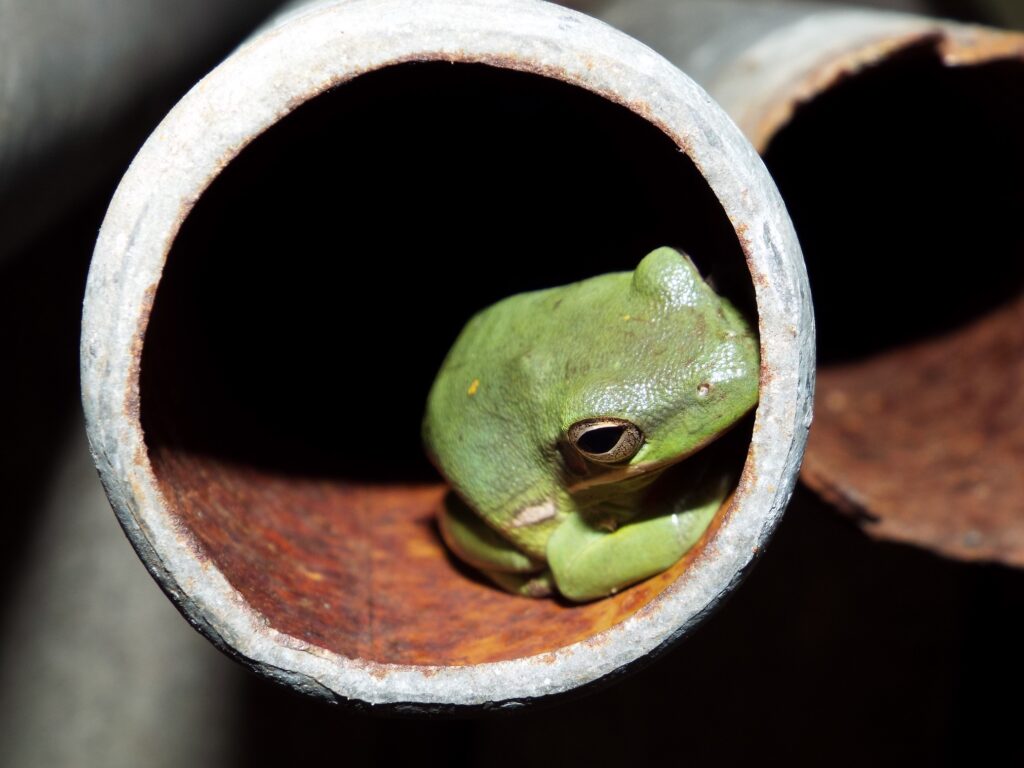


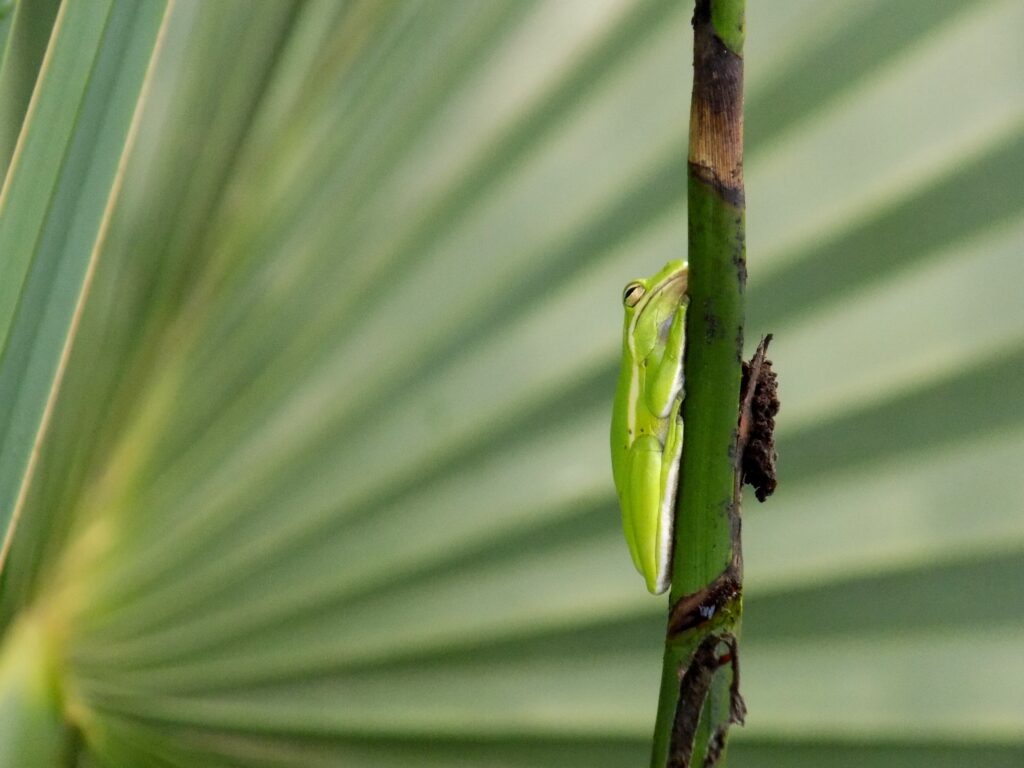
This week for Flora and Fauna Friday, we’ll be taking a look at the American Green Treefrog (Hyla cinerea).
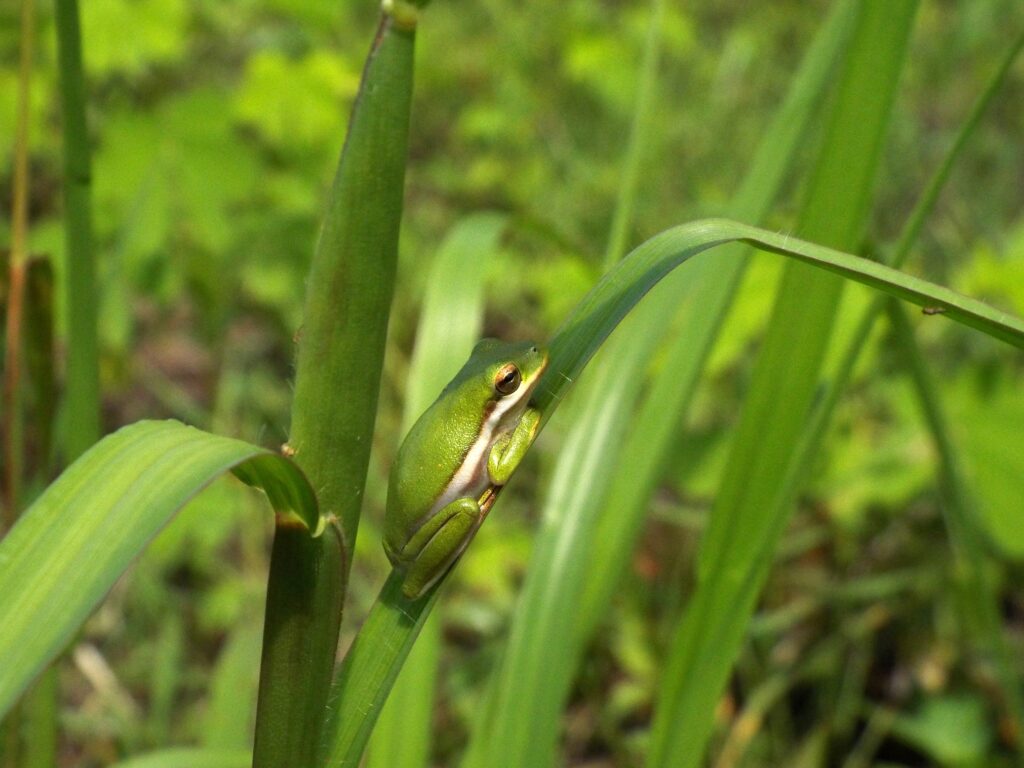
The Green Treefrog is our most common Treefrog in the SC Lowcountry and there’s no exception on Edisto Island. They’re easy to tell apart from the other 5 species of Treefrog found in our area. Just look for that well-defined, solid white stripe down the side and smooth, solid green back that’s sometimes accented with a couple tiny yellow-orange dots. They’re most easily confused with the Squirrel Treefrog (Hyla squirella), which is less common, smaller, typically mottled on the back, and often has a poorly-defined stripe along its side.
Green Treefrogs aren’t picky about where they live. In fact, I found this immature Frog in the middle of a sandy field on one of the Edisto Island Open Land Trust’s protected properties. You’ve probably found them clinging to the windows of your home. As long as they’re someplace that’s humid and full of bugs, they’ll thrive. (I can think of no place that better fits that description than the Lowcountry!) To go into a little more detail, Green Treefrogs are amphibians. Like most amphibians, they need to stay near water to keep their skin moist and to reproduce. This means you’re most likely to find them in places like ditches, pond edges, wet depressions, freshwater marshes, and bottomland forests. If you find yourself in one of these habitats, chances are there’s a Green Treefrog somewhere within arm’s reach of you. During the day, they cling motionless, flush against the leaves of a reed, cattail, grass, or sedge. Unlike their name suggests, they’re not commonly found on trees like some of our other Treefrog species. Their flat body and solid green coloration provides great camouflage within the grasses of the wetlands they inhabit but sticks out against the dark bark of a tree.
Green Treefrogs are nocturnal. They spend the day sleeping on the side of a leaf to conserve water and energy, as well as to avoid predators. As dusk approaches, they begin to rouse. Night is when the air is the most humid and insects are the most active. A perfect hunting opportunity for an ambush predator like the Green Treefrog. Green Treefrogs follow insect activity, and when they find a plant, puddle, or something else that’s bringing in the bugs, they position themselves and wait for something to come to them. When an unsuspecting critter come into range, they lunge forward and grab it with their short, but sticky, tongue. This is why they’re a such common visitor to the porches of our homes. They’re there for the bugs! Nocturnal insects are drawn to the lights on the inside and outside of our homes. Green Treefrogs follow the insects. And, when morning rolls around, the nooks and crannies of our porches provide a nice shady retreat from the day’s heat.
Night-time is also the best time to find Green Treefrogs. Just follow your ears! Like all of our frogs and toads, male Green Treefrogs attract a mate by singing. Green Treefrogs are particularly vocal and make up the bulk of the nightly chorus you can hear in our area throughout the year. They have a simple but distinct call. It’s basically just the phrase “Beh!” repeated over and over at a somewhat high pitch, about 1-2 times a second. Green Treefrogs breed all spring, summer, and fall on the Island. If there’s a dry spell followed by a heavy summer rain, their nightly serenades can become deafening.
Green Treefrogs lay their eggs in ephemeral or shallow wetlands. Their preferred wetland breeding grounds are shallow or temporary enough to prevent fish from moving in. This allows most of the eggs to hatch and the tadpoles to grow enough to metamorphosis, without getting eaten first. Once the tadpoles become large enough, they metamorphose, and begin growing their legs and jaws while shrinking their tails. When metamorphosis is complete, a tiny Green Treefrog will emerge from the water and venture onto land, ready to grow up and start the life cycle over. Now is the time of year to keep an eye out for “baby” Treefrogs. It may not look like it, but this frog in the photo was less than an inch long and I’ve found a few fingernail sized Treefrogs in my yard this week.
So next time you’re fishing from the bank at your favorite watering hole or listening to an evening rain shower from your porch. Take a minute and try to spot a Green Treefrog in the reeds right beside you or cock your ear and pick out their beseeching sonata through the pattering of raindrops.
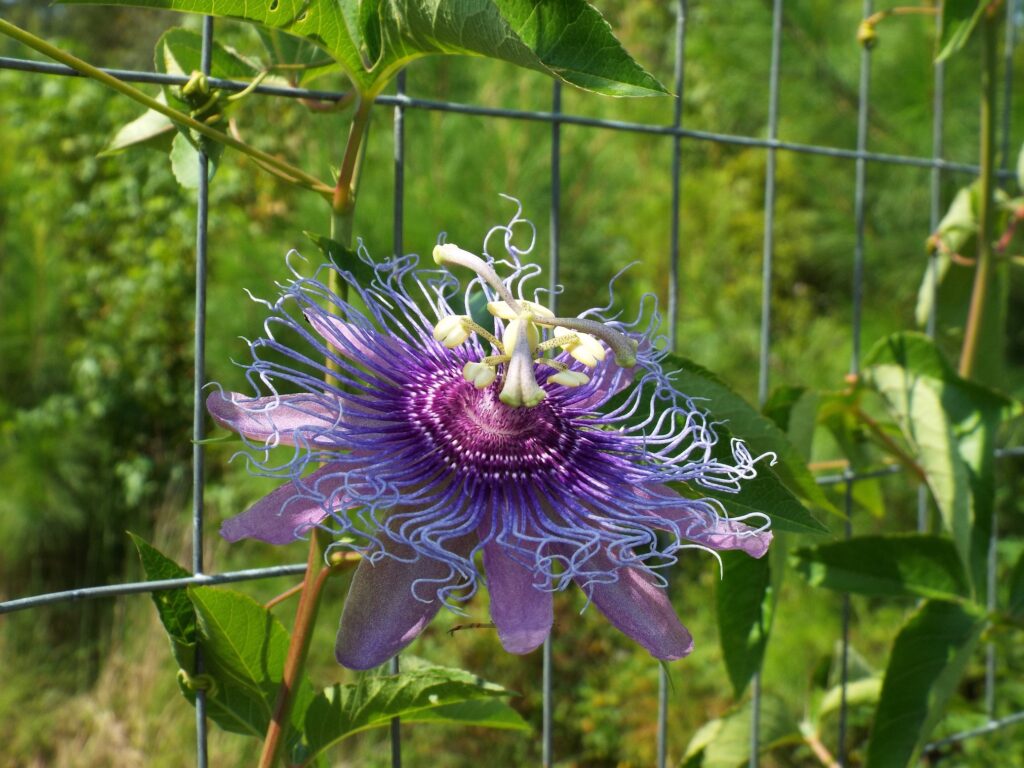
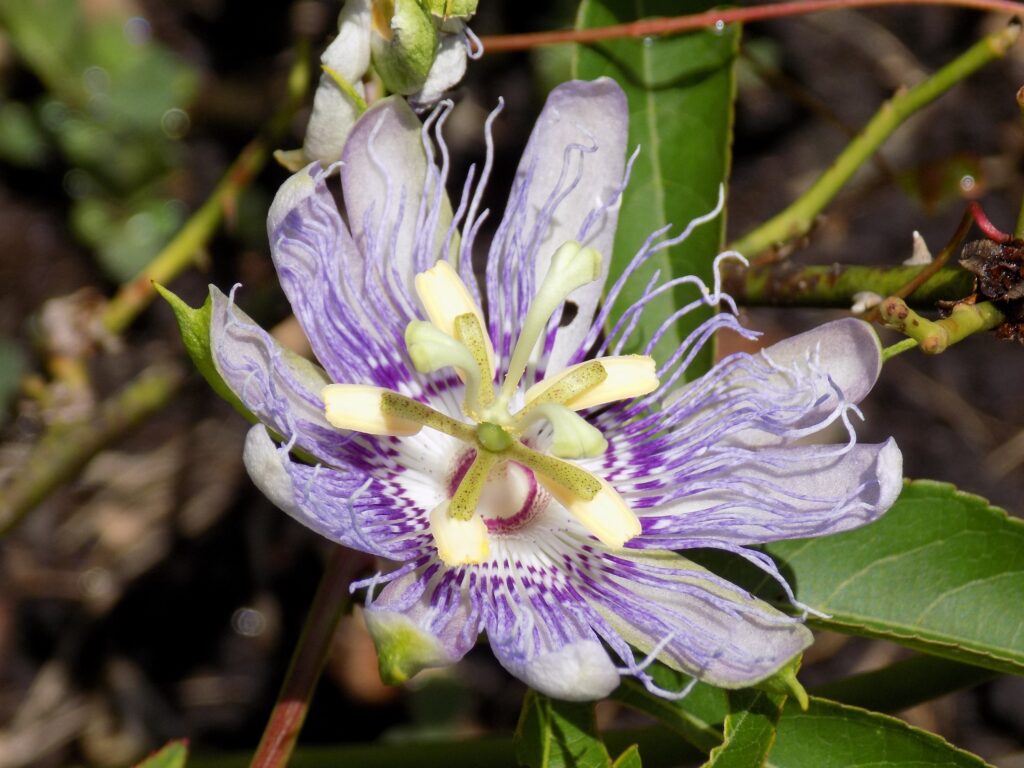

Today we’re starting a new weekly social media series called Flora and Fauna Friday where we focus on a facet of the flora and fauna found on Edisto Island. Each week we’ll post about a different plant or animal that you should be on the look for that week around the Island. We’ll also try to tell you a little bit about their biology and ecology.
To kick off Flora and Fauna Friday we have the beautifully intricate flower of the Purple Passionflower, also called Maypop, (Passiflora incarnata). This flower was blooming in the front yard of the Hutchinson House yesterday, one of the properties the EIOLT protects.
Purple Passionflower is native to SC and found throughout the southeastern United States. It loves sunny areas on the edges of pastures, roadsides, powerline right-of-ways, thickets, and other disturbed habitats. Purple Passionflower grows as a vine that climbs using tendrils and has large, 3-lobed leaves.
The plants bloom from late spring through the end of summer and display a large, complex violet and white flower. The flowers are as showy as they are because they require pollinators to produce seeds. This makes them a favorite of bees. Purple Passionflower is also a favorite of the Gulf Fritillary, Variegated Fritillary, and Zebra Longwing butterflies. Not just for the flower’s nectar but as a place to lay their eggs. All three of these butterflies host and feed on Passionflowers as caterpillars.
Once a flower is pollinated, it will begin to produce a green fruit, roughly the size and shape of an egg. Once ripe, the fruits are edible. Purple Passionflower is a close relative of Passionfruit (Passiflora edulis) but the fruit is fairly bland compared to its tropical relative. The fruit can be eaten whole raw but the flesh surrounding the seeds is the most palatable. It can also be boiled or strained to make juice or jam. The fruit is also where the plants get the common name of “Maypop”. If you’re not careful when walking along the edge of a field, you might step on a Purple Passionflower fruit and it MAY POP with a loud popping sound, startling you and spraying seeds across the ground.
Come winter, Maypops lose what leaves the caterpillars didn’t eat and then die back to the ground. Lucking, they’re perennials and will return the following spring to flower anew.
Purple Passionflowers do great in backyard gardens, as long as it gets enough sun. It loves to grow up fences and trellises but will also grow just fine along the ground or over the top of small bushes. Purple Passionflower is also a sure fire way to get butterflies into your garden. A single Purple Passionflower vine can feed more than 50 caterpillars each year. Just make sure you have enough Passionflower leaves to go around or the caterpillars might strip it down to nothing. And once you have butterflies, make sure you have enough fall flowers to feed them!