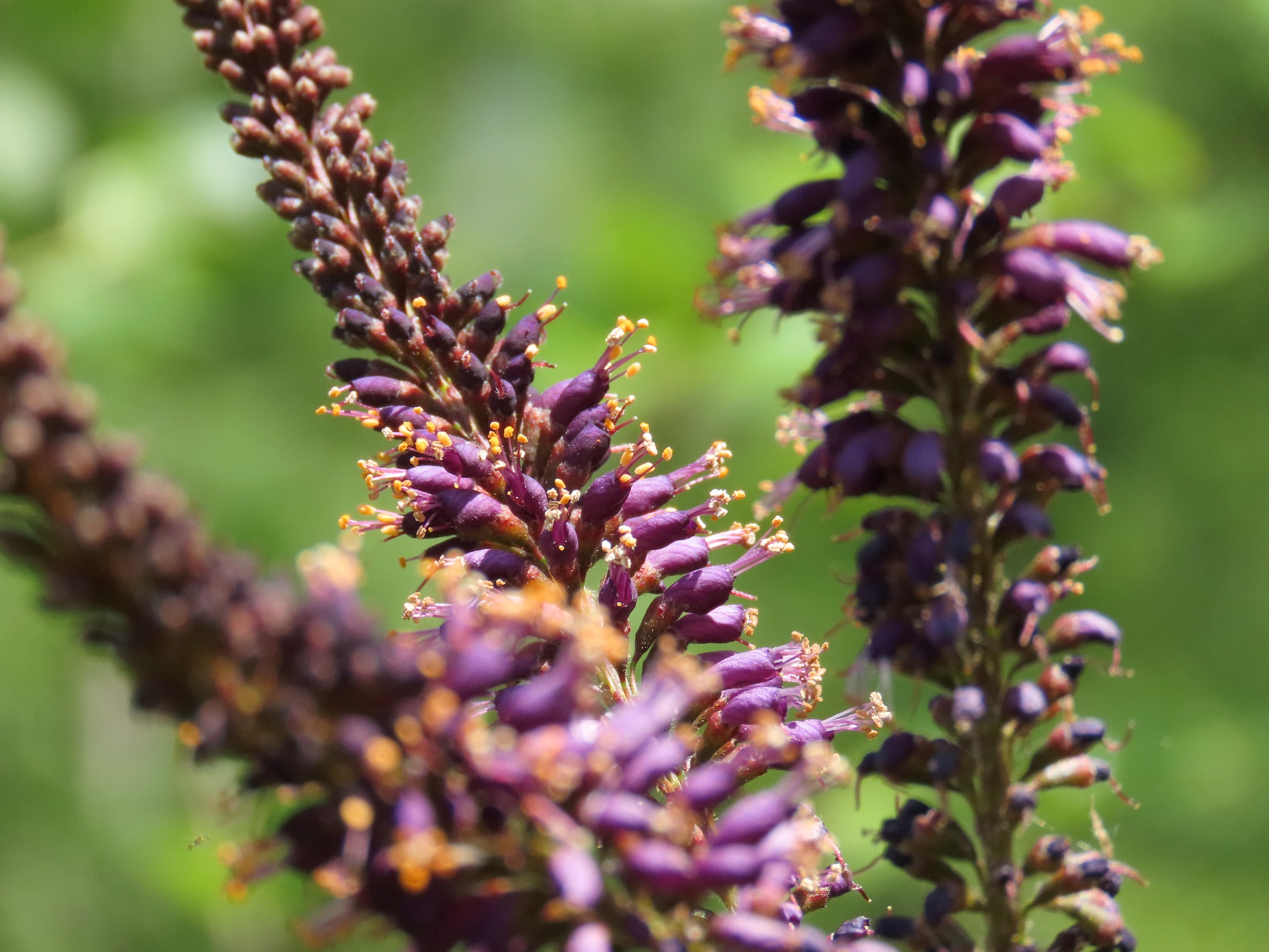
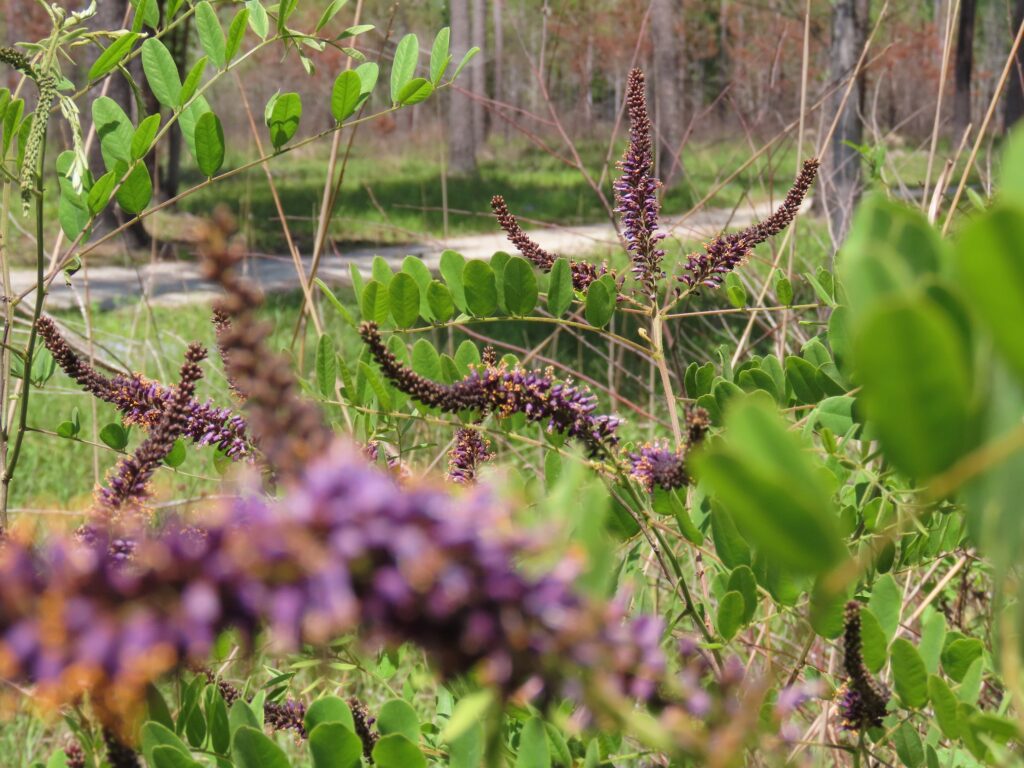
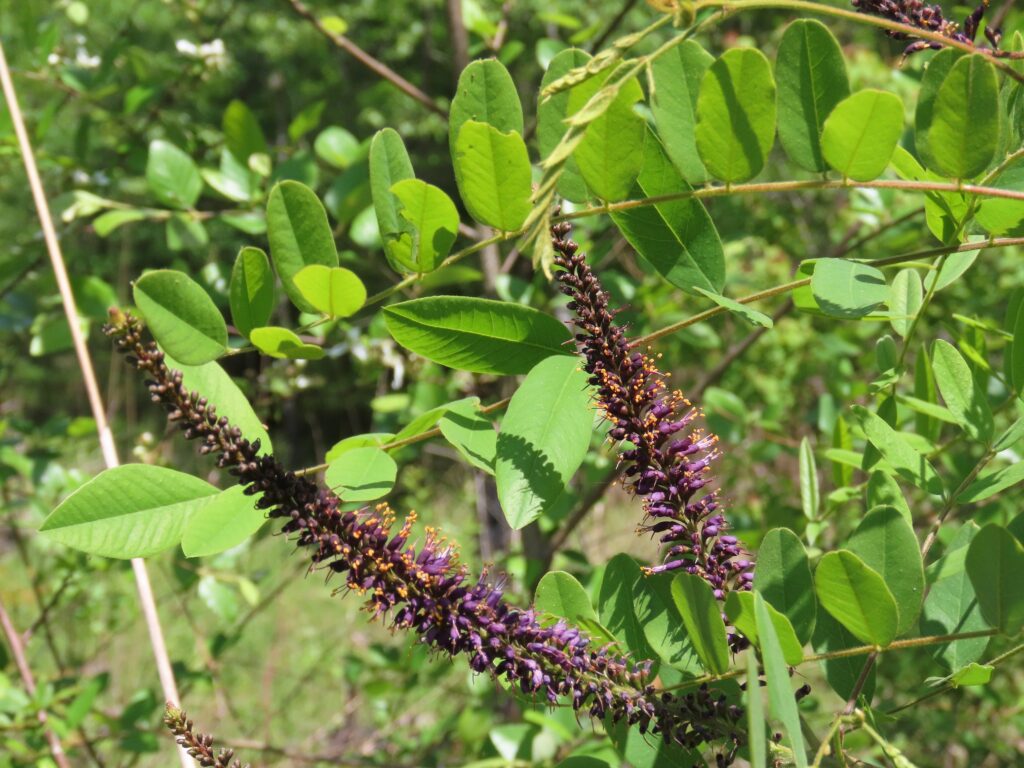
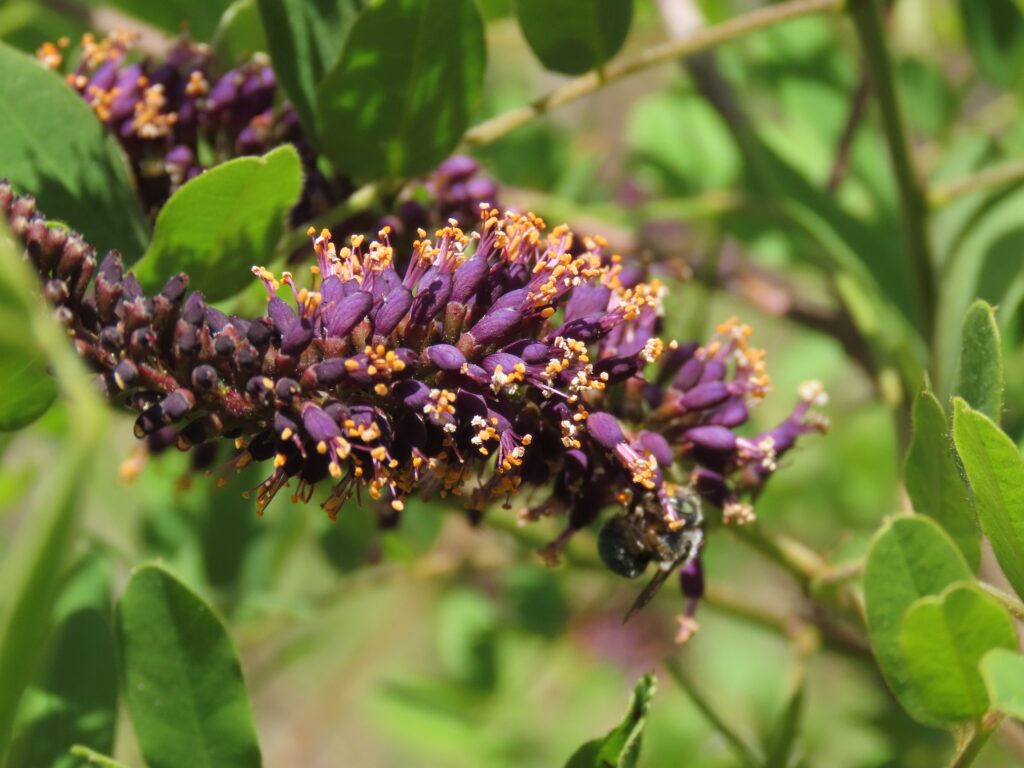
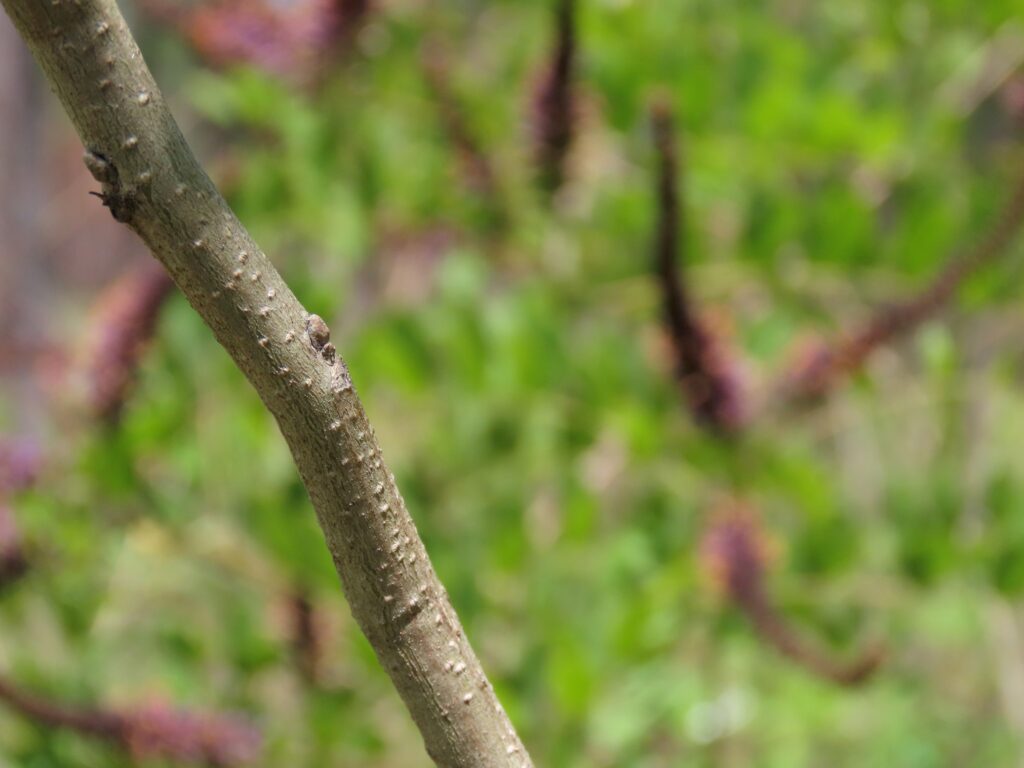
This week for Flora and Fauna Friday we have the purple plumed imposter of the swamp, False Indigo-Bush (Amorpha fruticosa).
False Indigo-Bush is found across much of the South and Midwest, and is distributed throughout much of South Carolina. Here in the Lowcountry, it’s most often encountered in the floodplains and margins of freshwater rivers, particularly the fresh but tidal reaches of blackwater rivers, like the South Edisto. False Indigo-Bush is a member of the legumes and a mid-sized shrub, growing most often a bit over head high, and just as broad, on tangled twisting stems. It can spread through its roots to form small colonies, but around here is usually encountered as a singular clump or two. Its leaves are pinnately compound, with small ovular leaflets, and roughly hand length. It blooms here in April and May, peaking near the end of April. From the ends of its upper stems it bears half-foot long, dense, clustered spikes of flowers. Each flower is cylindrical in shape, with a single rolled royal-purple petal and a bouquet of golden-orange anthers bursting out from the center. It is a uniquely delightful color combination. Come summer into fall, the flowers of False Indigo-Bush mature into brown seedpods, each shaped like a tiny, warty butterbean and containing on average just one or two seeds. Birds and small animals feed on its scattered seeds. Its flowers provide nutritious pollen for bees, wasps, and other native pollinators. Some butterflies will even host their caterpillars on its leaves, such as the Silver-spotted Skipper.
It’s been a hot minute since I’ve done one of these, but I reckon today is a good day to dust off and bust out the ‘name game’, as this plant is ripe for an etymological adventure. The common name “False Indigo-Bush” is pretty straightforward. This plant is a bush and it looks like Indigo (Indigofera spp.), except it’s not Indigo. The leaves of this plant are very similar in size and shape to cultivated Indigo species and the two genera looks especially similar when young or regenerating. The seedpods of False Indigo-Bush are also very similar to those of our native Carolina Indigo (Indigofera caroliniana), although the two inhabit very different habitats and have very different growth forms. More relevant, False Indigo-Bush does actually contain the precursors phytochemicals that can be processed into usable indigo dye. Yet, they are generally not in a high enough concentration within the plant tissue, nor is there often enough young plant tissue altogether, to be worth extracting and processing the dye at any meaningful scale. On an aside, a decent number of our native legumes contain the precursor compounds that can be processed to generate indigo dye. This collection of related phytochemicals have some insecticidal properties that help protect the plants producing them from insect munching.
The scientific name for this plant, “Amorpha fruticosa“, roughly translates as “Bush without Shape”. That’s a pretty apt name for this bush with a chaotic, disordered growth form in its branches. But many other bushes grow just the same way and this is oddly generic for a generic name. Therefore, we have to dig a bit deeper to reveal the whole truth hidden in its name. The genus name “Amorpha” really refers to this clade’s flowers. Botanists and taxonomists have long categorized clades of plants based on the shapes of their flowers. Flower shape is closely linked to reproductive success for plants. If they don’t reproduce, their lineage won’t survive through the ages. Meaning flower shape is often a ‘do or die’ trait, onto which natural selection then applies the adage of ‘if it ain’t broke, don’t fix it’. Mutations in flower shape are rarely inconsequential to the offspring of the individual expressing them and so they quickly get weeded out. Thus, flower characteristics are broadly well preserved through even 1,000s of generations and can be used to readily and reliably differentiate different lineages of plants into higher classifications, as the scientific community feels its way backwards through evolutionary history. But on the flipside, things like leaf shape, growth form, height, hairiness, and even flower color can mutate much more often and randomly with wanton abandon. These mutations can more easily persist for multiple generations, or even diverge a population into a unique form or subspecies if it confers a benefit in that space at that time. But I digress. What was I typing about? Oh yeah, “Amorpha” is really describing the shape of the flowers within this genus. They only have one, singular petal that rolls itself up like a burrito around its anthers and styles. This is an odd trait for the legumes (family Fabaceae) and that singular dimension of petal equated to a “shapeless-ness” for the botanists first describing its flowers, relative to other more “shapely” legumes.





© 2026 Edisto Island Open Land Trust.
Built by Colophon