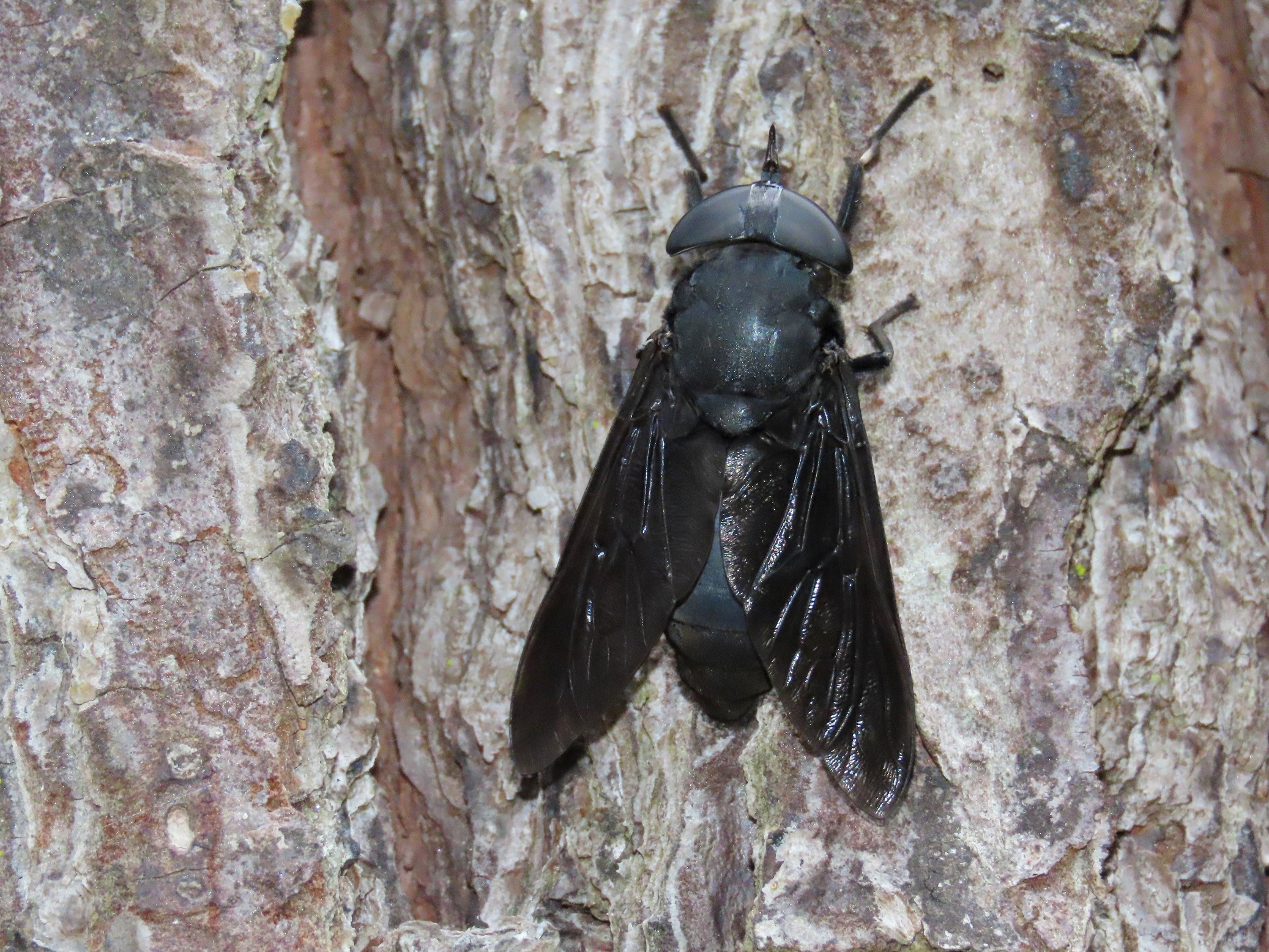
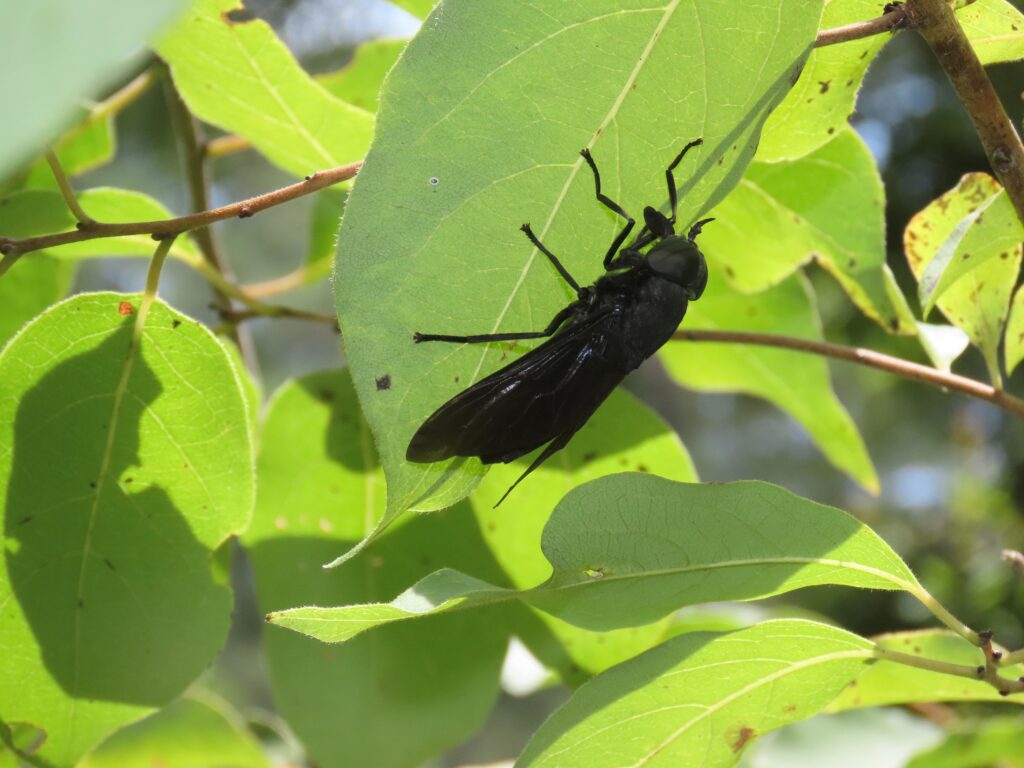
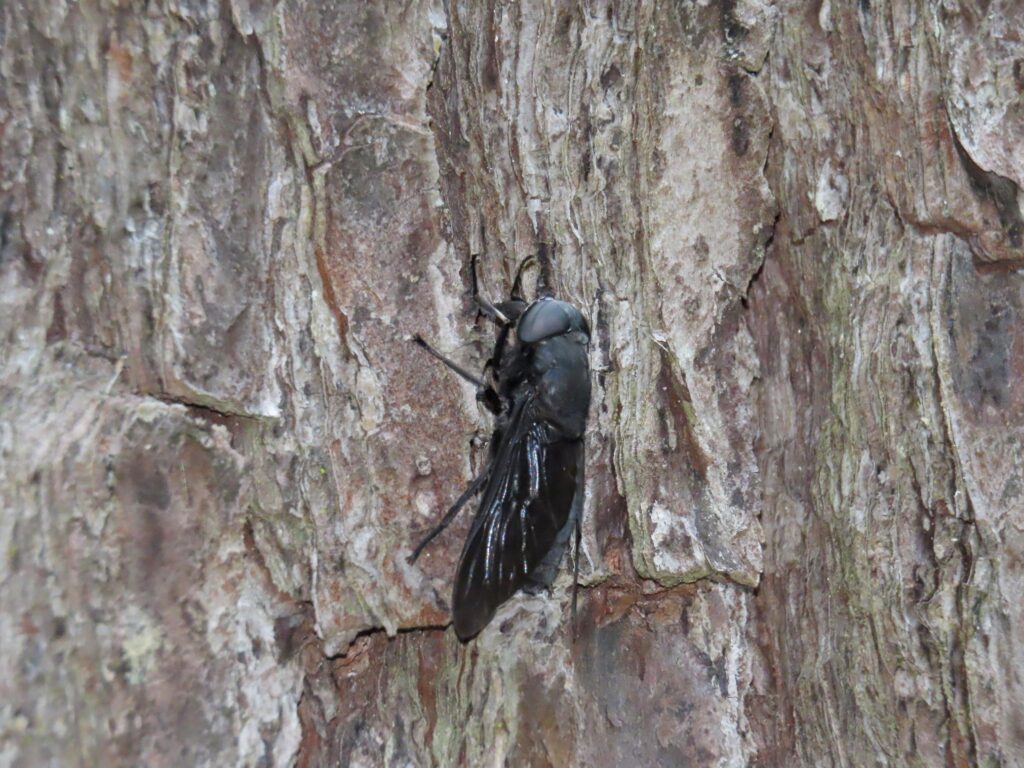
This week for Flora and Fauna Friday we’re dodging the shadowy approach of the buzzing bloodsucker of the bottomlands, the Black Horse Fly (Tabanus atratus).
The Black Horse Fly is a hard bug to miss, especially when one comes buzzing out the brush aimed at your back like a black heat-seeking missile. It’s our easiest biting fly to identify by a wide margin. Measuring in at a bit over an inch in length, the Black Horse Fly is a contender for our largest biting insect as well as one of our largest Flies, order Diptera, found in the Lowcountry. This fly is stoutly built, torpedo-shaped, and solid black from antennae to abdomen tip. Males and females look nearly the same, but males have larger compound eyes that press against each other, leaving nothing but a seam between running down their forehead.
The Black Horse Fly can be found throughout all the Eastern United States and all across South Carolina. Males are pollinators that subsist on flower nectar and plant sap. Females are ectoparasites that bite and drink blood from large mammals. This includes deer, bear, bison, and elk, as well as more domestic animals like hogs, cows, and horses. They rarely bite humans, and generally get gone if shooed away. Often times Horse Flies will chase slow moving vehicles and land on them, being attracted to the large, hot, carbon dioxide leaking thing moving through their airspace. They’ll stay perched on that car, boat, or side-by-side until they realize there’s no blood to be sucked. Female Black Horse Flies, and in general all female biting flies, use this blood meal to garner the nutrients they need to lay their eggs. Females lay their eggs in conical masses on the underside of a grass blade or leaf overhanging a pond, marsh, or other permanent wetland. Those eggs eventually hatch and the larvae plop down into the wetland below. Under that murky water, a white and gray banded maggot will feed on aquatic insects over the next two years, eventually growing to nearly two-inches in length, before it crawls on land and pupates in the soil. Adult Black Horse Flies emerge near the start of summer and fly until September, with females being longer lived than males.
To talk on Tabanid taxonomy a tad bit, a distinction needs to be made between the three main tribes within the overarching Horse Fly family, Tabanidae. In one subfamily you have the Deer Flies (most are Chrysops spp.). In another subfamily are both the Yellow Flies (Tribe Diachlorini) and the Horse Flies (Tribe Tabanini, most are Tabanus spp.). Deer Flies (Chrysops spp.) are all small, measuring in at roughly three-eighths-of-an-inch long. They tend to be striped black and yellow on the body and will bite just about anything that moves, be that a deer, dog, jogger, or car. There are over a dozen species of Deer Flies in South Carolina. The Yellow Flies are small in total number of species but quite varied in appearance. Most are white, green, or yellow in color. The eponymous Yellow Fly (Diachlorus ferrugatus) is its most infamous member. The Yellow Fly looks much like a Deer Fly, but is a solid golden-yellow in color, and bite just that little bit harder. The Horse Flies are the largest group and range in size from half-an-inch up to just over an inch in length. There are well over seventy-five species of Horse Fly (Tabanus sp.) in the United States and over twenty species found here in South Carolina, including both the insatiable Greenhead Fly (Tabanus nigrovittatus) and the rather satiable Black Horse Fly.





© 2026 Edisto Island Open Land Trust.
Built by Colophon