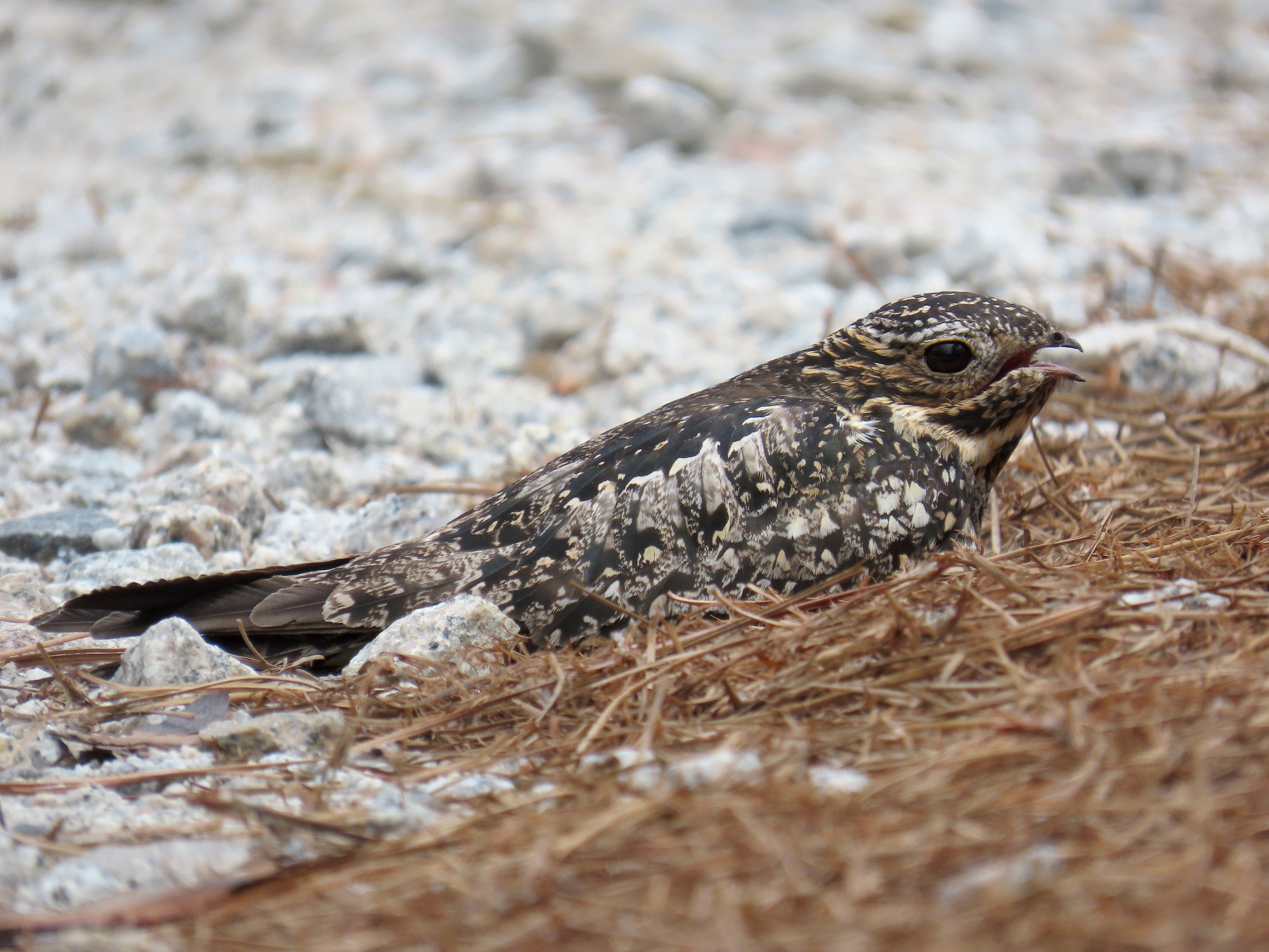
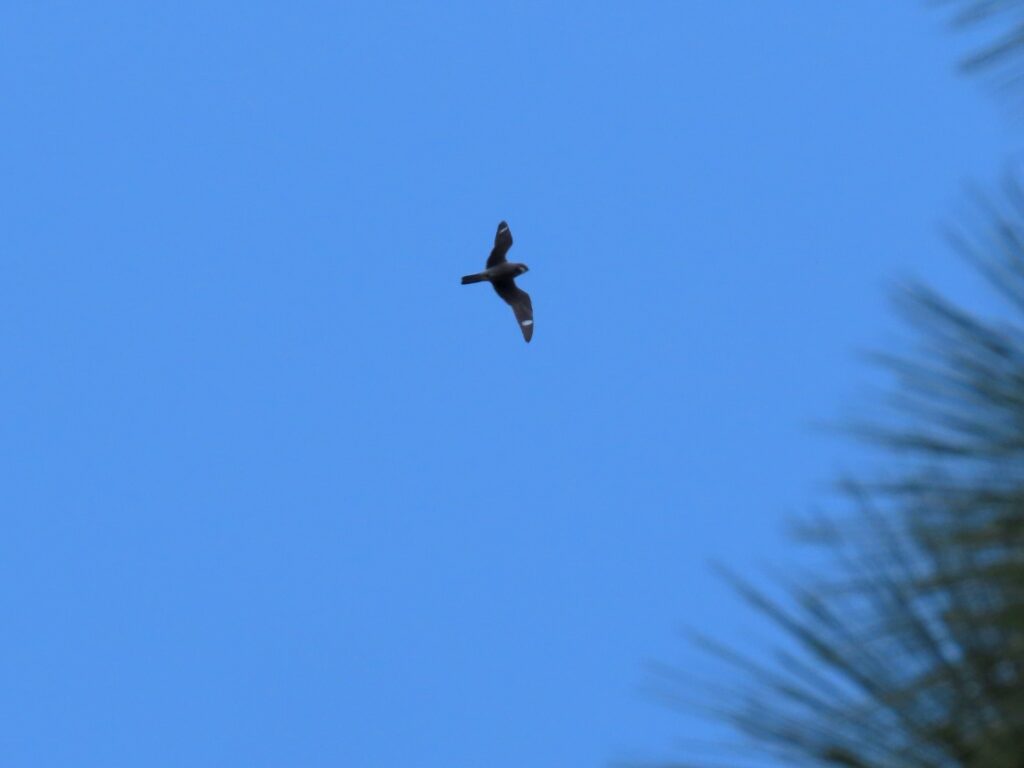
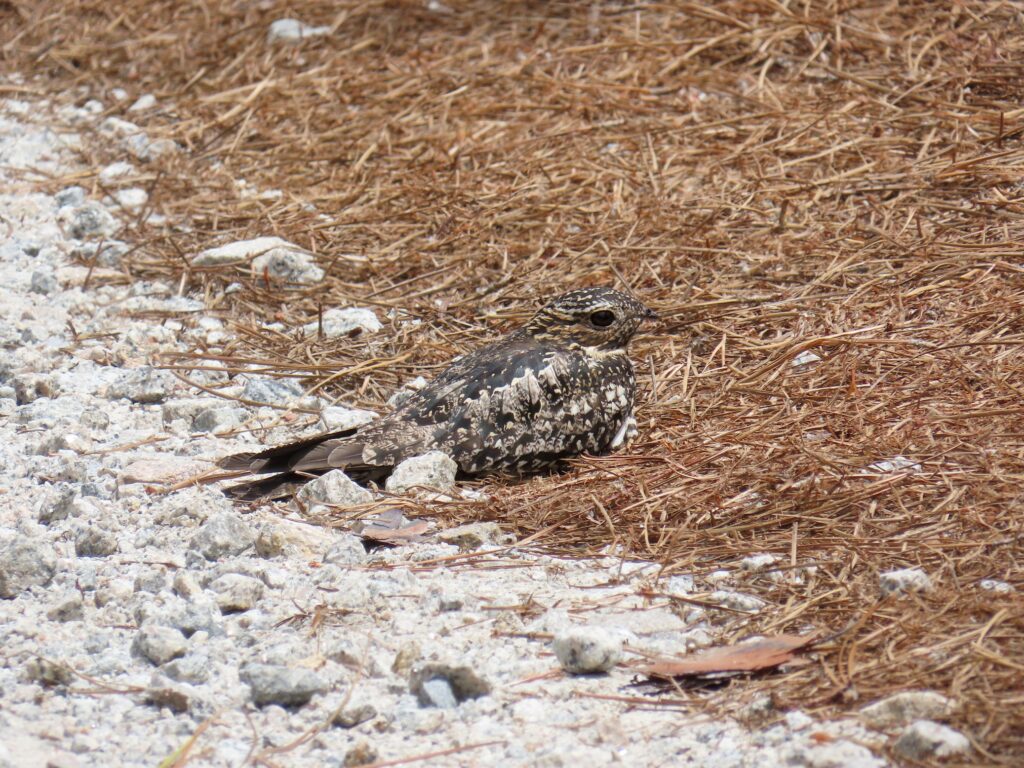
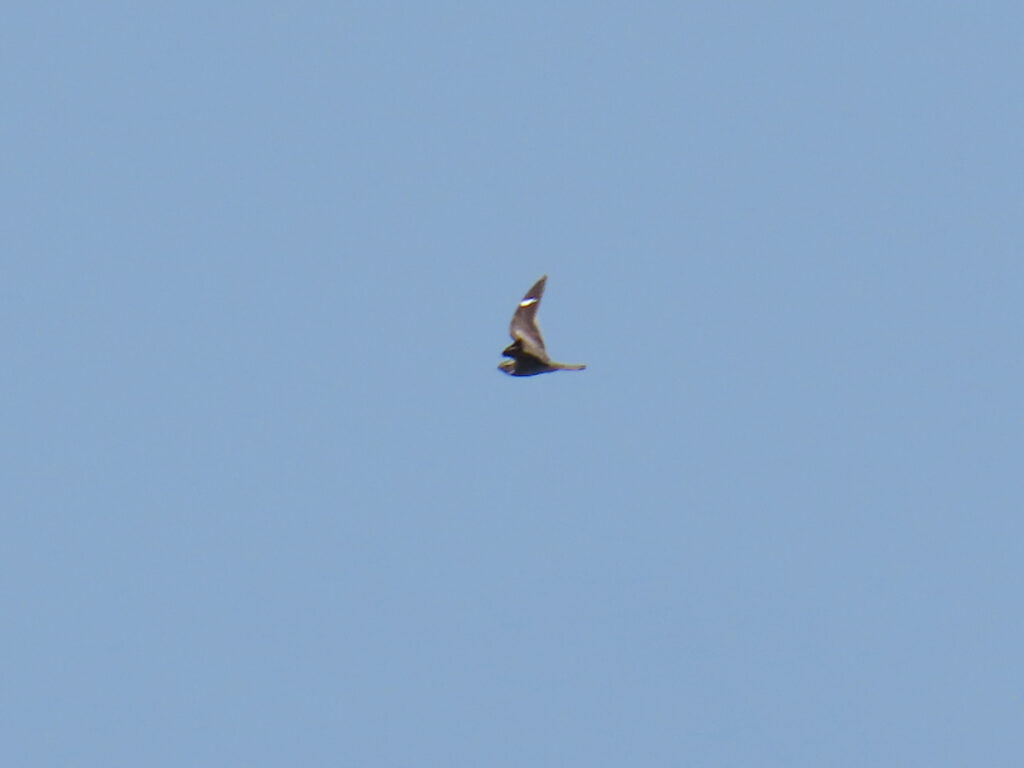
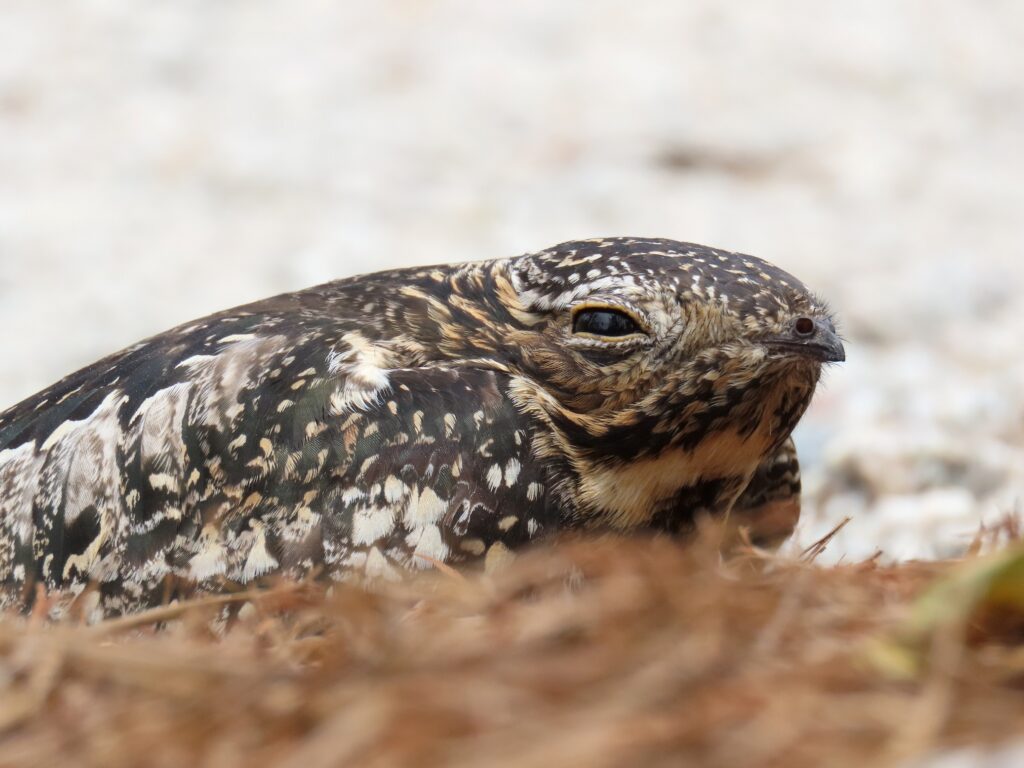
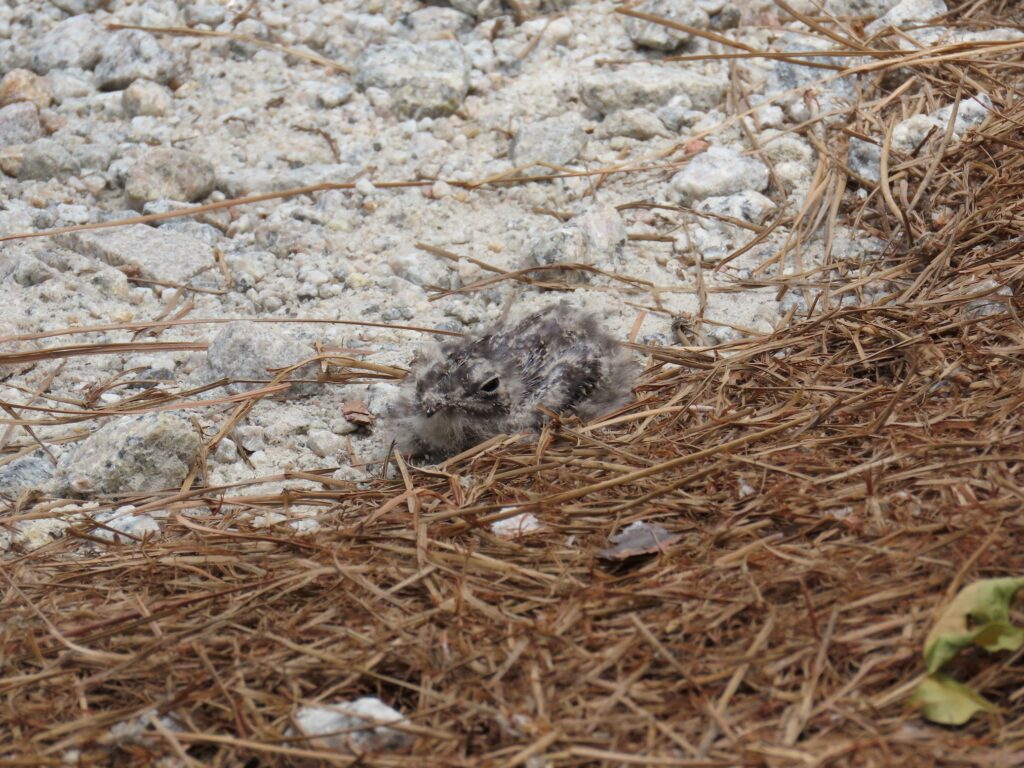
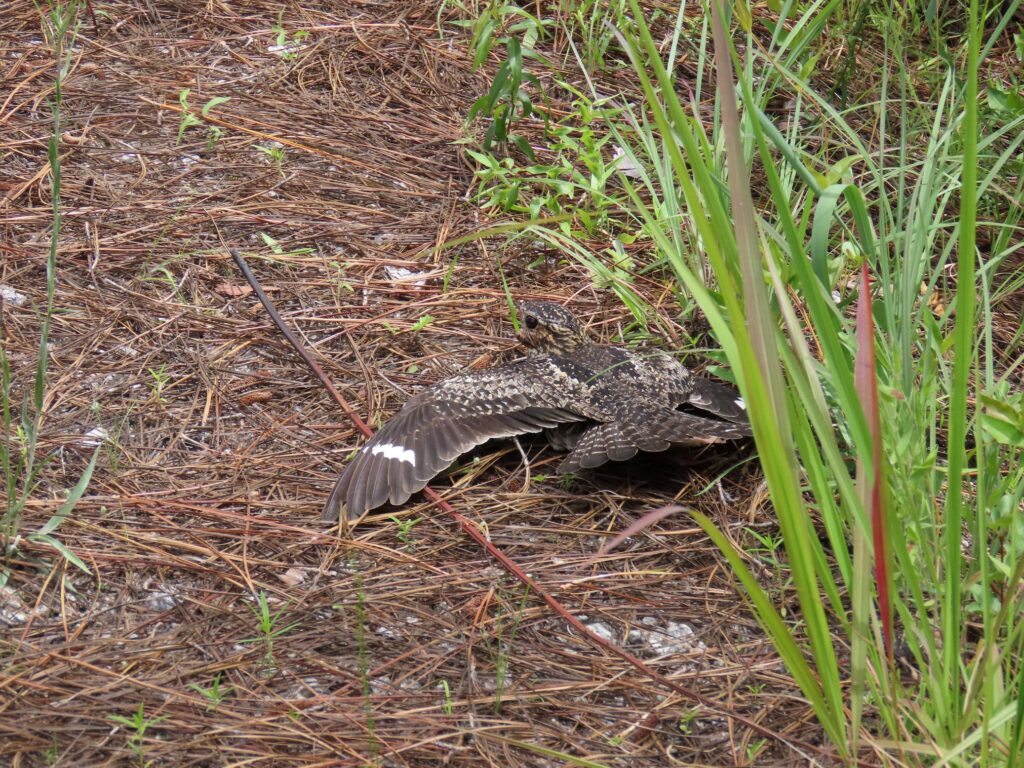
This week for Flora and Fauna Friday, we’re trying to catch a glimpse of the booming bullbat, the Common Nighthawk (Chordeiles minor).
The Common Nighthawk can be found across most of the United States in summer, including all of South Carolina. It’s one of three species of Nightjars found in the Southeast, along with the Chuck-will’s-widow (Antrostomus carolinensis) and Eastern Whip-poor-will (Antrostomus vociferus). Nightjars are an odd clade of birds and our three local members all share a few common traits. They sport long wings, cryptic brown plumage, big eyes, a small beak, and a huge mouth. Our Common Nighthawk ticks all those boxes and stands out with its larger frame more streamlined pointed wings, with a white band near each wingtip, as well as a white crescent under its chin.
The Common Nighthawk, and our other two Nightjars, are insectivores. They hunt by hawking, snatching insects from the air while flying on the wing. Their streamlined shape lets them be fast fliers and their large eyes give them impressive vision during their preferred hunting hours at dawn and dusk. Their secret weapon, however, is their gaping maw. Despite having a tiny little beak, a Common Nighthawk can open its mouth about as wide as its whole head! They fly head first, mouth agape, right at prey, scooping it up in their mouth like a butterfly net. Their acrobatic twilight twirlings gave them the common name of “bullbat”, in ye olden parlance that means the “big bat” or “boss bat”.
Common Nighthawks come to the United States to nest each summer and can be found in open habitats across the Country. Here in the Lowcountry I see them most often near rice fields, beaches, big clearcuts, and expansive savannas. They’re a scarce bird here and don’t often make an appearance. Common Nighthawks, alongside our other Nightjars, are ground nesters. They lay usually just two camouflaged eggs in a shallow depression on the ground and prefer to nest on gravel or coarse sand, but will pick the best substrate available to them to nest. Often times they end up nesting on gravel roofs, parking lots, or infrequently traveled road. Once those eggs hatch, their young’uns will be force-fed as many bugs as they can gulp down and should be ready to fly within the month. When a mother Nighthawk is incubating her eggs or chicks, she’ll do her best to remain motionless and use her camouflage to hid from sight. But if stumbled upon too close, she’ll burst from the nest, drop a few yards away, flail her wings, and make a ruckus in an attempt to distract any would be predators away from the nest by playing like she’s injured and can’t fly. She’ll then lead whatever bothered her along a ways before flying off and circling back to her nest.
Usually you hear a Common Nighthawk long before you see one. The call of the Common Nighthawk is a loud, nasally, vibrating “Beent!” Hollered forth on the air waves every few seconds. But males have another trick up their sleeve. The Common Nighthawk is also renown for their booming courtship call, which is a deep, loud industrial ruckus sounding somewhere between a bullfrog and a 10L jake-brake. Males make this sound to court females during breeding season. They accomplish this cacophony by diving straight down into a freefall. They then shift the feathers of their wingtips just so, to change their aerodynamics to vibrate violently in the turbulent air.





© 2026 Edisto Island Open Land Trust.
Built by Colophon