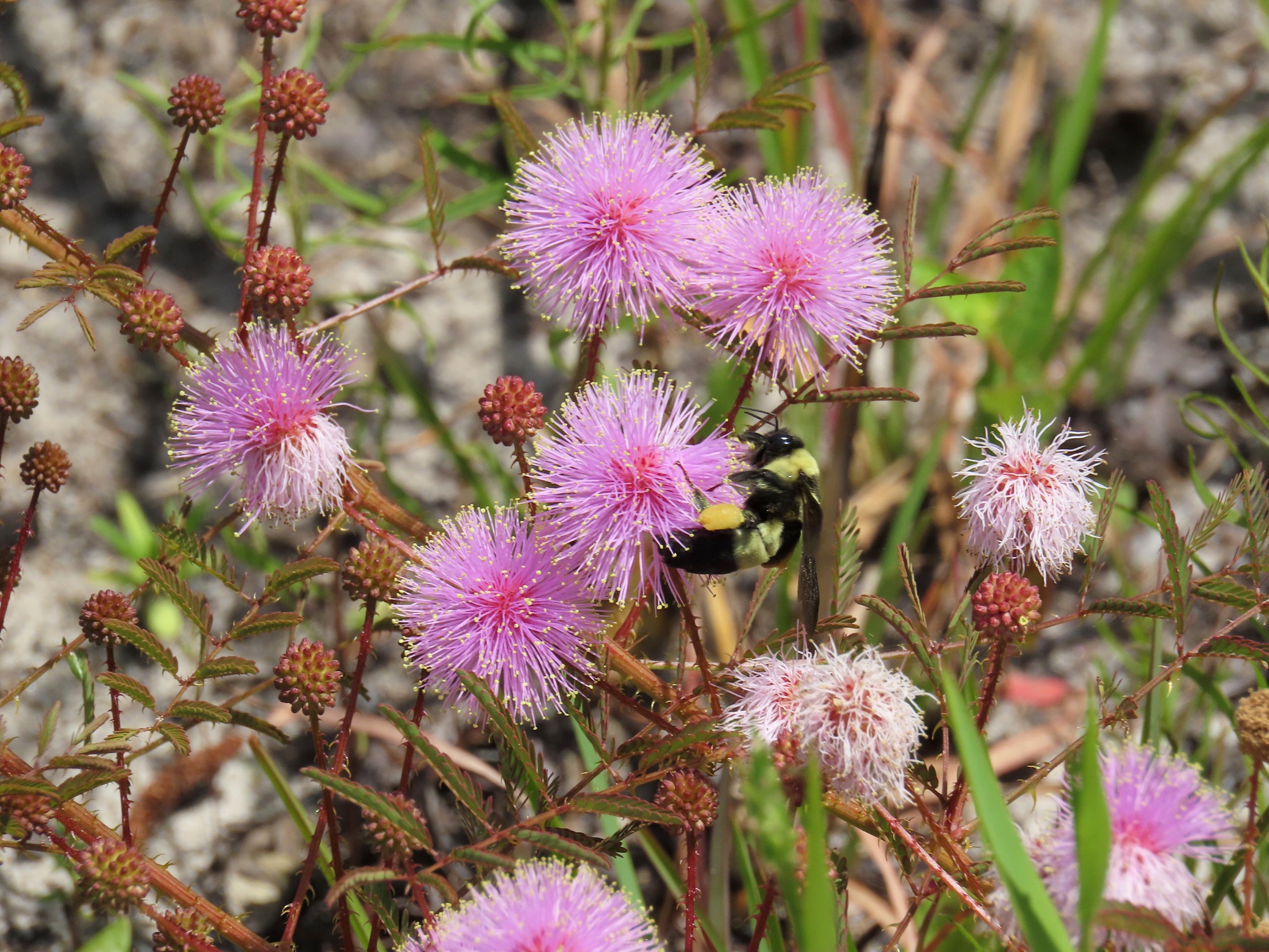
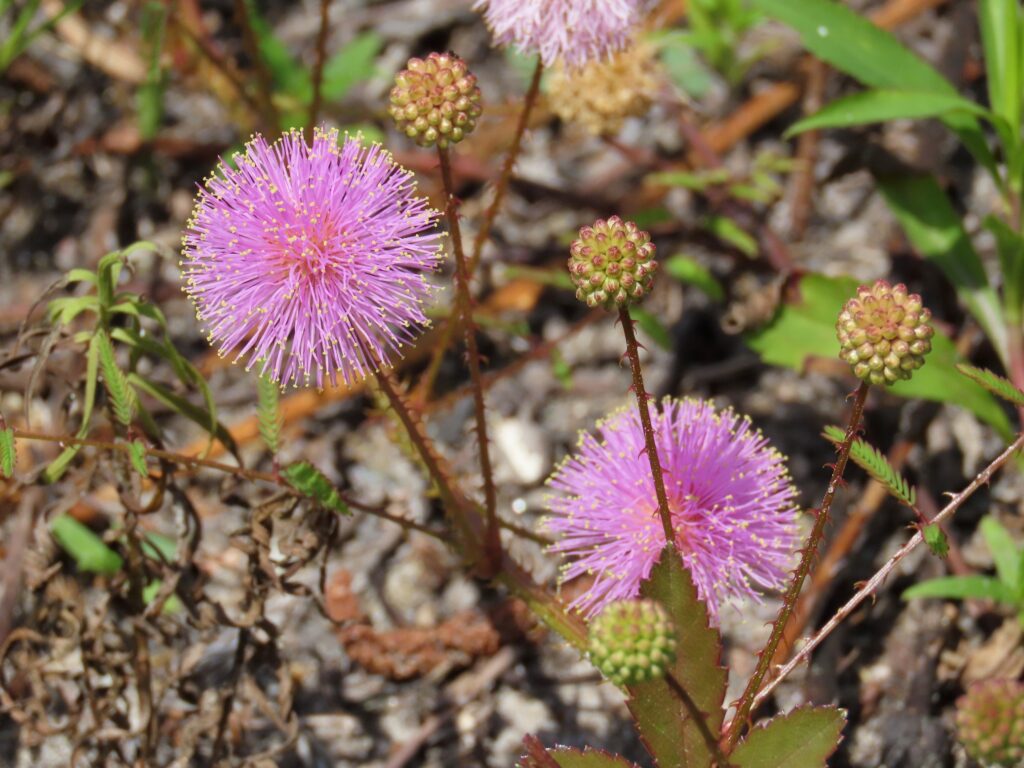
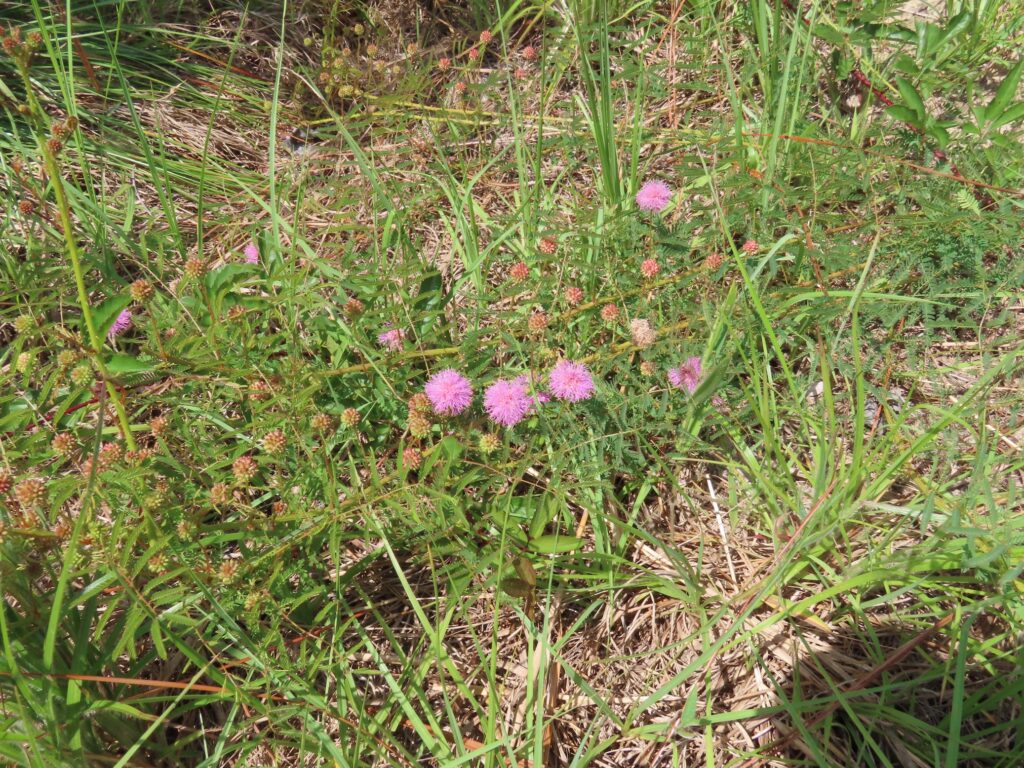
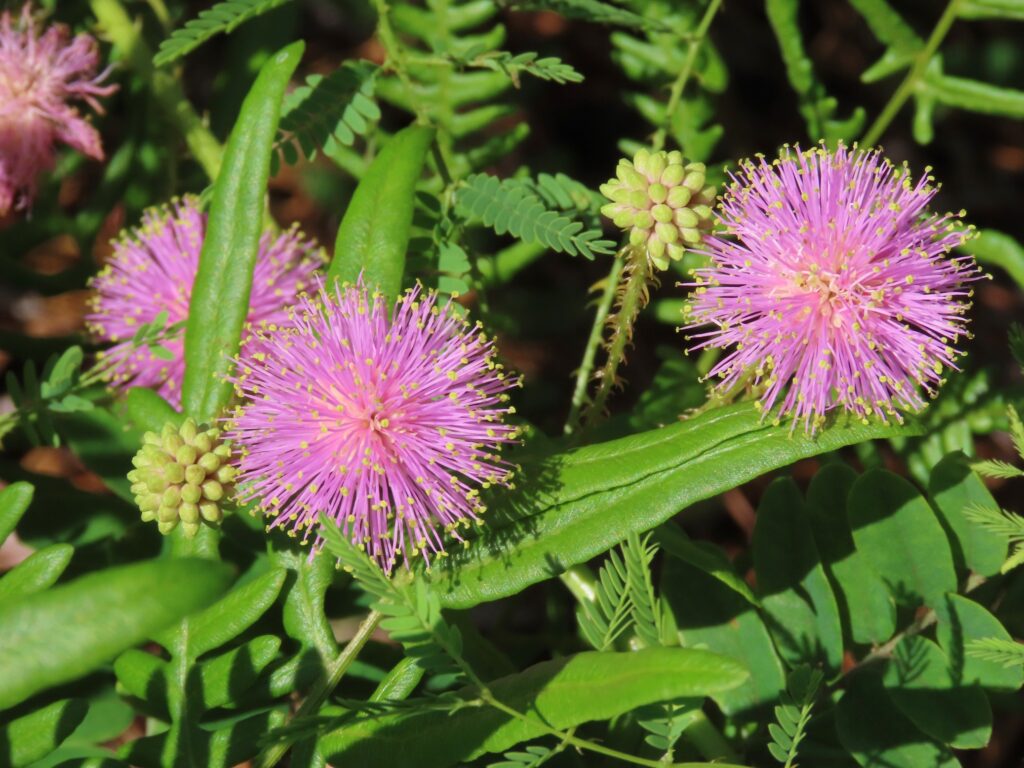
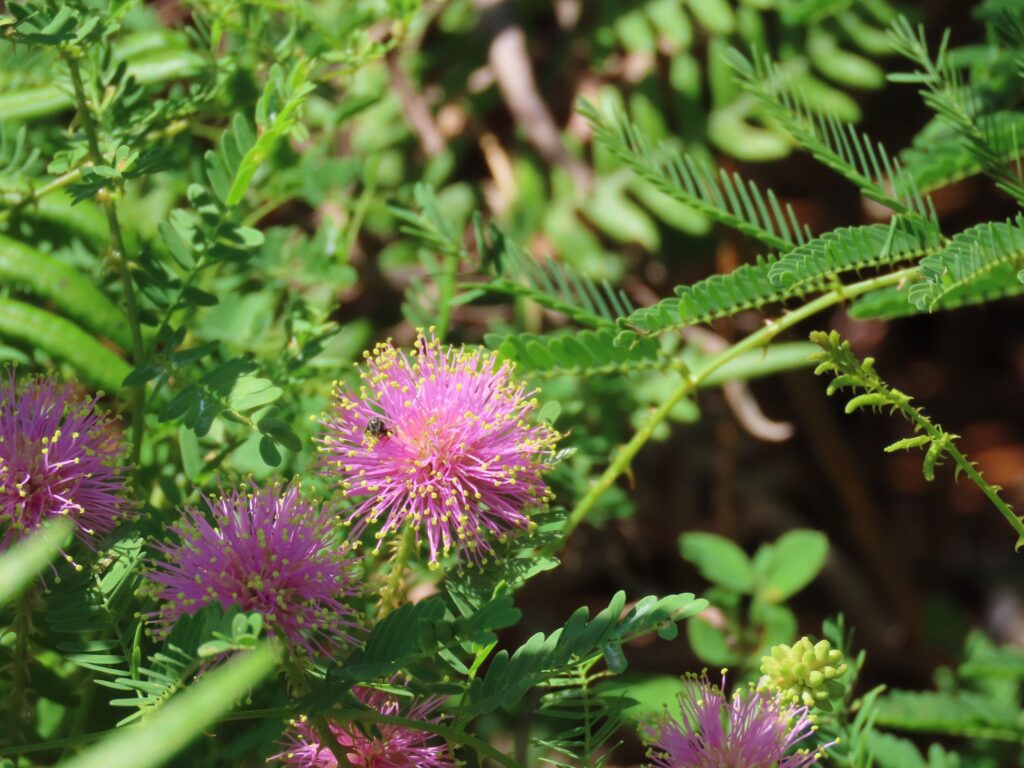
This week for Flora and Fauna Friday we’ll behold a beautifully blooming briar of a bean, Littleleaf Sensitive-Briar (Mimosa microphylla).
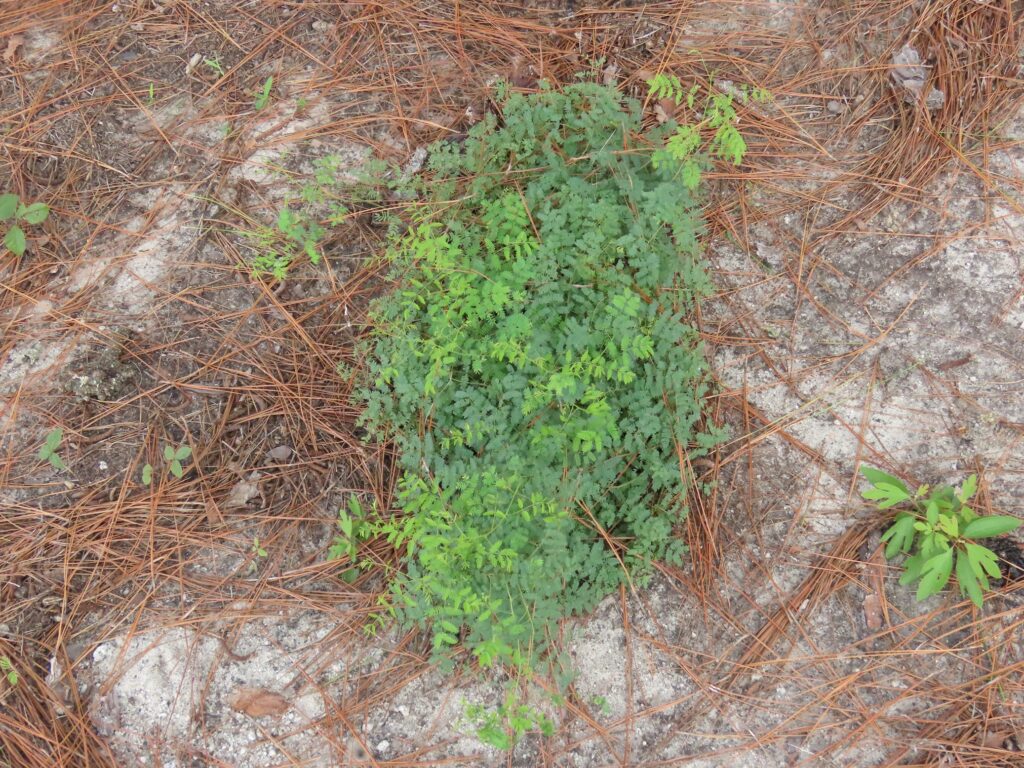
Littleleaf Sensitive-Briar is one of three species of Mimosa native to the Southeast but the only species native to South Carolina. It’s a low growing, sprawling legume found on dry sandy soils throughout the state, being most abundant on open hill tops in the Upstate and Longleaf Pine savannas here in the Lowcountry. It often forms dense, flat, circular mats of foliage radiating out three to four feet from its roots. Its thin, wiry stems and leaf veins are lined with enumerable fine hooked prickles, much like a Blackberry. And let me tell you, it’s a joy to walk through barefoot! These prickles defend the plant from grazing herbivores. The leaves of Littleleaf Sensitive-Briar are predictably little. Each leaf, as a whole, is about palm-sized but is bipinnately lobed, bearing roughly five-hundred individual leaflets, each not much bigger than a grain of rice. Beginning in May and continuing through June, Littleleaf Sensitive-Briar produces a profusion of eye-catching blooms along its trailing stems. We’re talking one-inch hot-pink spherical pom-poms orbited by golden pinpricks of pollen-packed anthers. These flowers not only pull in unsuspecting naturalists but have an almost magnetic draw on native bees, who clamor all over these fluffy flowers, sweeping up as much pollen as they can muster. These flowers mature into a string bean looking seedpod thoroughly cloaked in a shield of fine prickles.
Now, let’s take a moment to think on this plant’s names and what they mean, starting with the genus Mimosa. Apart from being a legume and sharing a similar leaf and flower shape, Mimosa species are only distantly related to the invasive Mimosa-Tree (Albizia julibrissin), which bears a similar common name. Mimosa is a name often applied commonly to members of the Mimosoid clade of legumes, which all have similar spherical flowers. (And, if you’re wondering, the mimosa cocktail is named after a different Mimosoid plant from Australia, which has bright yellow pom-pom flowers.) However, this unique but shared name belies another similarity. The term “Mimosa” boils down to meaning “to mime” or “mimic”. The leaves of Littleleaf Sensitive-Briar, as well as numerous other Mimosoids and other legumes with a similar finely divided leaves, can move! They are able to fold up their leaves when touched, ‘mimicking’ animal movement, at least as far as early botanists were concerned. They do this through the manipulation of osmotic pressure in specialized cells at the base of each leaflet. Running your finger down the midrib of a Littleleaf Sensitive-Briar leaf is all it takes for them to clam up.
Littleleaf Sensitive-Briar and its relatives fold their leaves for two reasons, to make it more difficult for things to eat their tiny leaves and to save water. When folded, the leaflets point upward. This improves its odds against all kinds of herbivores, even if just slightly. For big grazers like deer, this makes the plant look small and wilted, and assumedly less appetizing. For small browsers like mice, it points the leaflets away from their reaching paws and nibbling mouths, making it harder for them to avoid the numerous prickles along the bottom of each leaf stem. And for insects crawling on the leaf itself, pointing the leaflets upward forces them up into the blistering sun and the line of sight of any patrolling wasps and birds. Their leaves also fold up in the rain and strong wind, which helps protect the fragile leaflets from being battered against their surroundings. Apart from folding when touched, Littleleaf Sensitive-Briar also folds its leaves up based on environmental cues at night or during extreme heat, to help conserve water. A folded leaf has less surface area and thus transpires less water at night while idle. Similarly, a folded leaf points towards the sun and thus captures less sunlight when it is too hot or too droughty for the plant to keep up with the water demands of peak transpiration. In fact, the finely divided leaves and low growth form of Littleleaf Sensitive-Briar are both adaptations for heat, just different sorts. Finely divided leaves maximize the ratio of their perimeter to their surface area. This promotes air circulation around and through the leaf, helping it to avoid overheating under intense sunlight while it cranks out as much sugar as it can. The sprawling growth form of this plant is an adaptation to a different heat, fire specifically. Littleleaf Sensitive-Briar needs regular fire to keep the land open enough for it to persist. By staying short and low, it gets readily burnt up by fire. Yet, since it loses little resources in the fire, it can rapidly regenerate from its roots back to what it once was and continue on as normal.





© 2026 Edisto Island Open Land Trust.
Built by Colophon