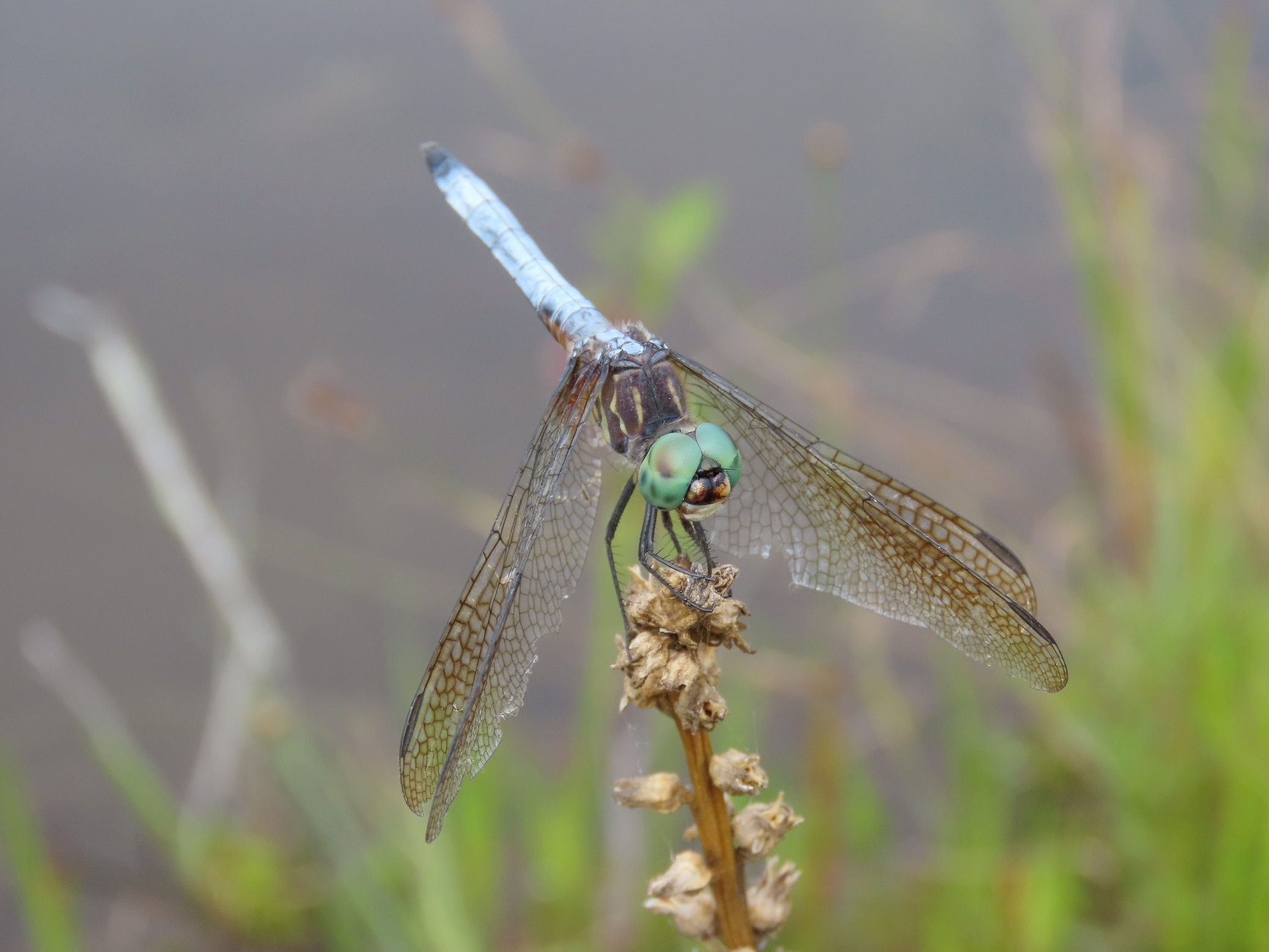
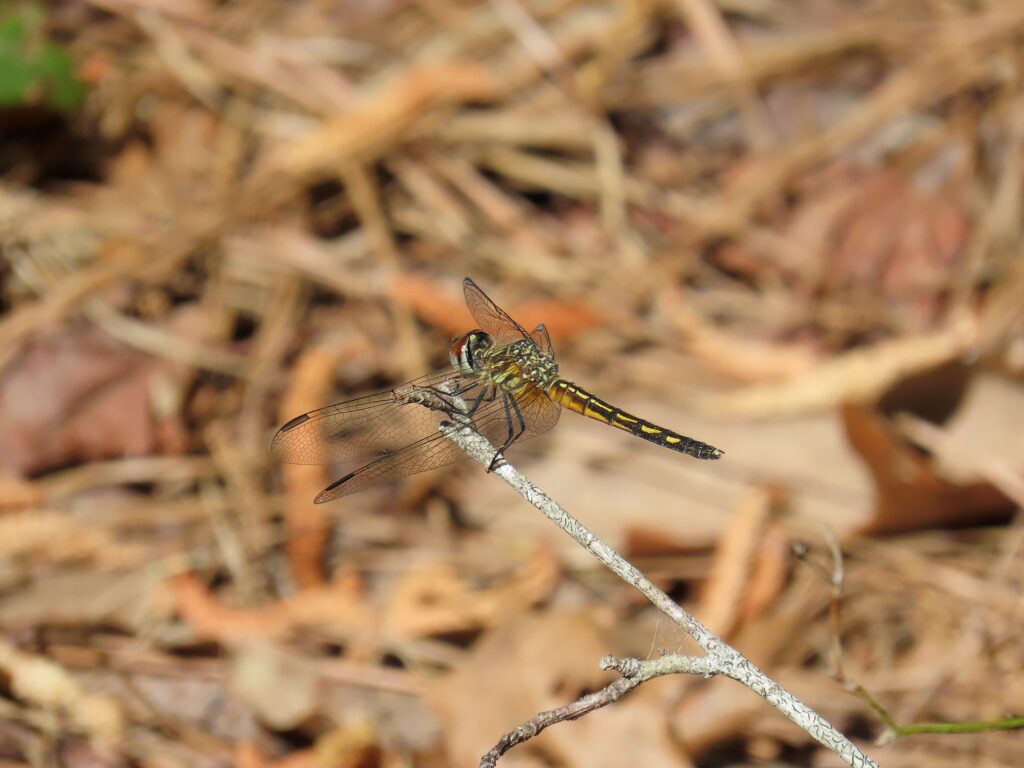
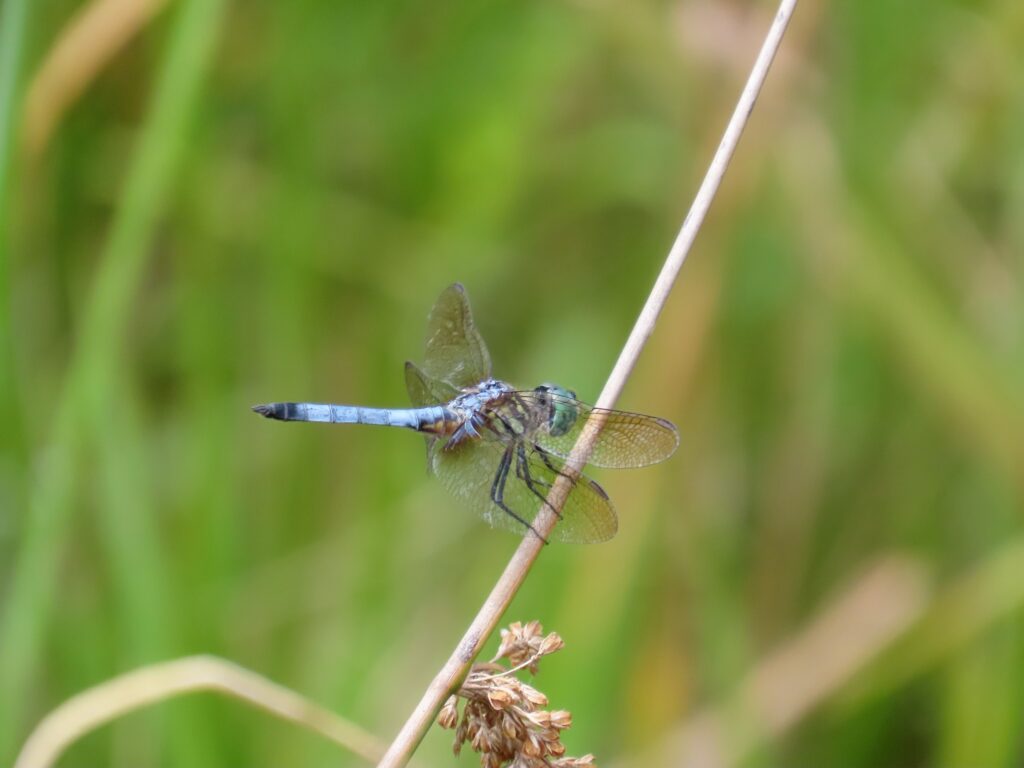
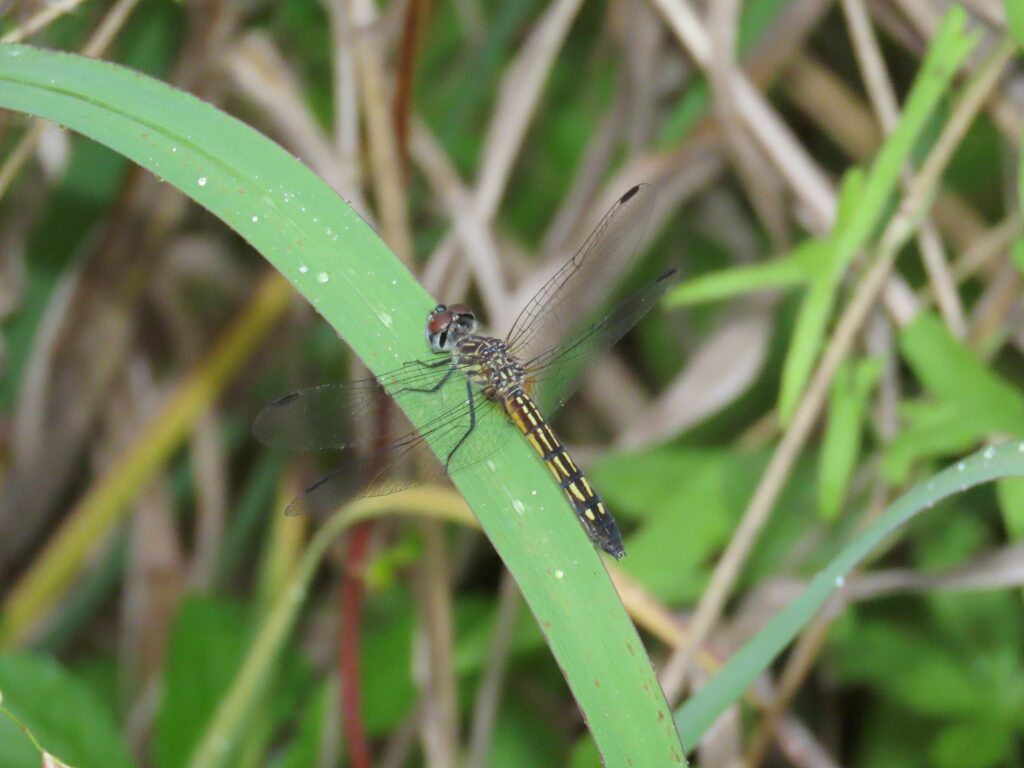
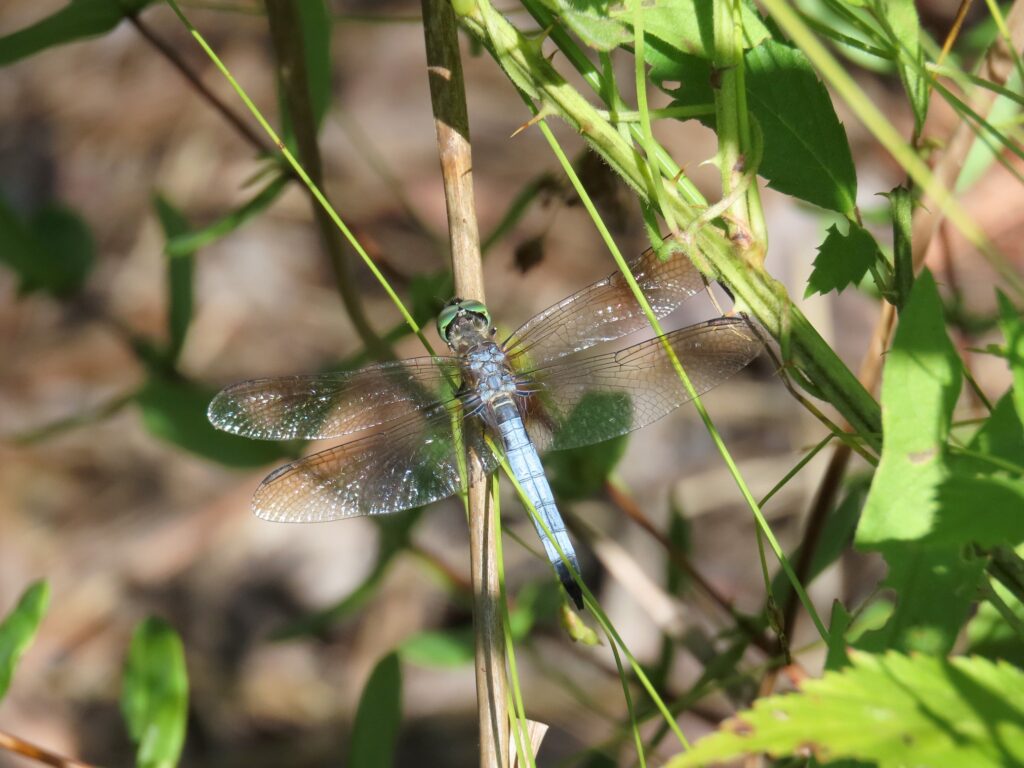
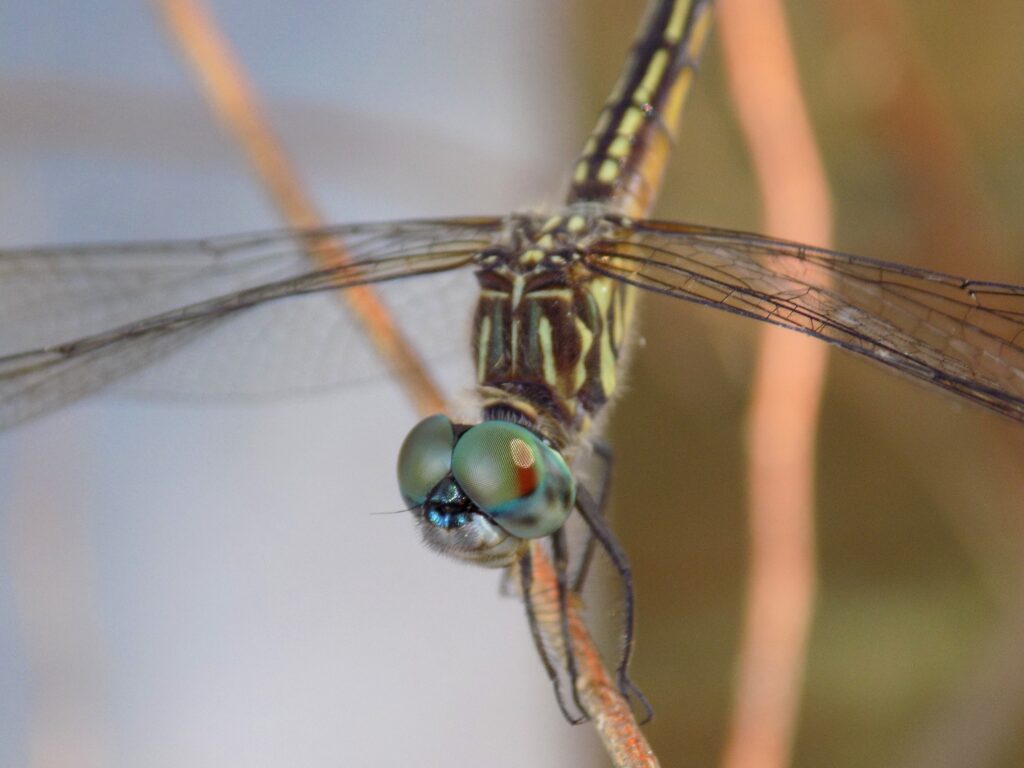
This week for Flora and Fauna Friday we’re watching the whirlings of a dashing little dragonfly, the Blue Dasher (Pachydiplax longipennis).
The Blue Dasher is a small dragonfly found across much of the continental United States, including all of South Carolina. It’s quite the adaptable generalist and does well in wide array of wetland habitats. They are ‘perchers’ or stationary, territorial hunters. They perch most often upright on the tip of a stick, stalk of vegetation, flower, or some other pointed structure and remain motionless except for the craning of their necks to and fro to follow potential prey. When they spot a suitable snack, or an unwelcome competitor, they launch from their perch to pursue, before returning to resume the watch. Blue Dashers also readily assume the ‘obelisk posture’ where they raise their abdomen straight up into the air. Males do this as a means of saying, “This spot’s mine bud, you wanna fight about it?” to other intruding males. Both sexes will also obelisk when its hot as blue blazes out, pointing their abdomen directly at the sun to reduce their surface area and keep from overheating.
Blue Dashers measure about an inch-and-a-quarter in length with a compact frame and broad wings. Blue Dasher males and females are sexually dimorphic, and have markedly different color patterns. Males are powder-blue on their abdomen which is capped with a black tip, have aquamarine eyes and a white face, a thorax either solid blue or alternating with vertical streaks of pastel-yellow on dark brown, and have clear wings with black stigma and a varying degree of distinct smoky-brown staining across the base and tip of each wing. Females have two-tone red and green eyes like a half-ripe apple, a white face, clear wings, translucent-beige stigma, and a black and yellow body of alternating stripes, including distinct black pinstripes down the length of her abdomen leading to a black tip. Both sexes emerge from their larva with feminine colors and patterns, but males turn blue as they mature. Changing color after final molting is fairly common in insects, as their new exoskeleton has yet to harden and be flushed fully with pigments. This state is called being “teneral” and can result in some oddly colored insects for a couple hours. However, many dragonflies, such as the Blue Dasher, do a much more complex, gradual color change in their males, which can take many days to set in.
Like all dragonflies, the Blue Dasher has an aquatic larvae called a naiad, which prowls around underwater catching and consuming unsuspecting little aquatic critters. Many dragonflies’ larvae are picky about water quality and need to be in a relatively narrow window of water quality parameters to successfully make it to adulthood. But Blue Dashers? They just plumb don’t care! Apart from saltwater and extreme pollution, they can make do with most any wetland. This is why you can find Blue Dashers perched, patrolling, or pouncing on prey proximate to the perimeter of practically any pond, pool, or permanent puddle and darting and dashing down dikes, dams, and ditches. This adaptability has allowed Blue Dashers to become our most common and abundant species of dragonfly in urban and suburban locales, where human activities have radically altered, reconfigured, and impaired natural wetlands to meet the needs of civilization. Here, Blue Dashers provide an invaluable ecosystem service by scarfing down mosquitoes and other insects, both in the air and below the water, to control their populations. Blue Dashers themselves become food for Purple Martins, Barn Swallows, Flycatchers, and many other nimble insectivorous birds, and the odd Bullfrog or Bass. They’re thus not only a critical form of pest biocontrol and a major node in urban food webs, but an important pathway for nutrient cycling from aquatic to terrestrial ecosystems in your own backyard.