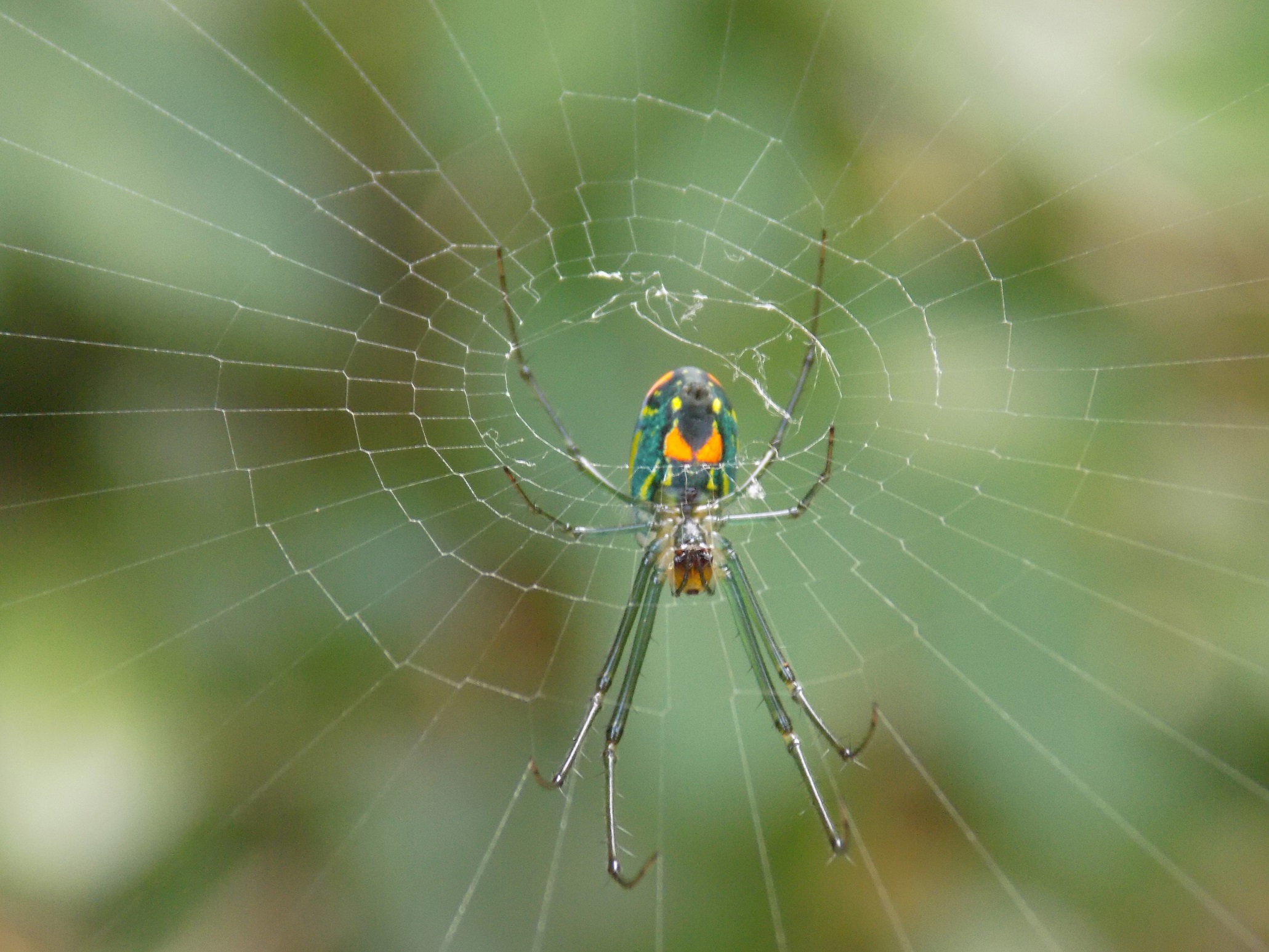
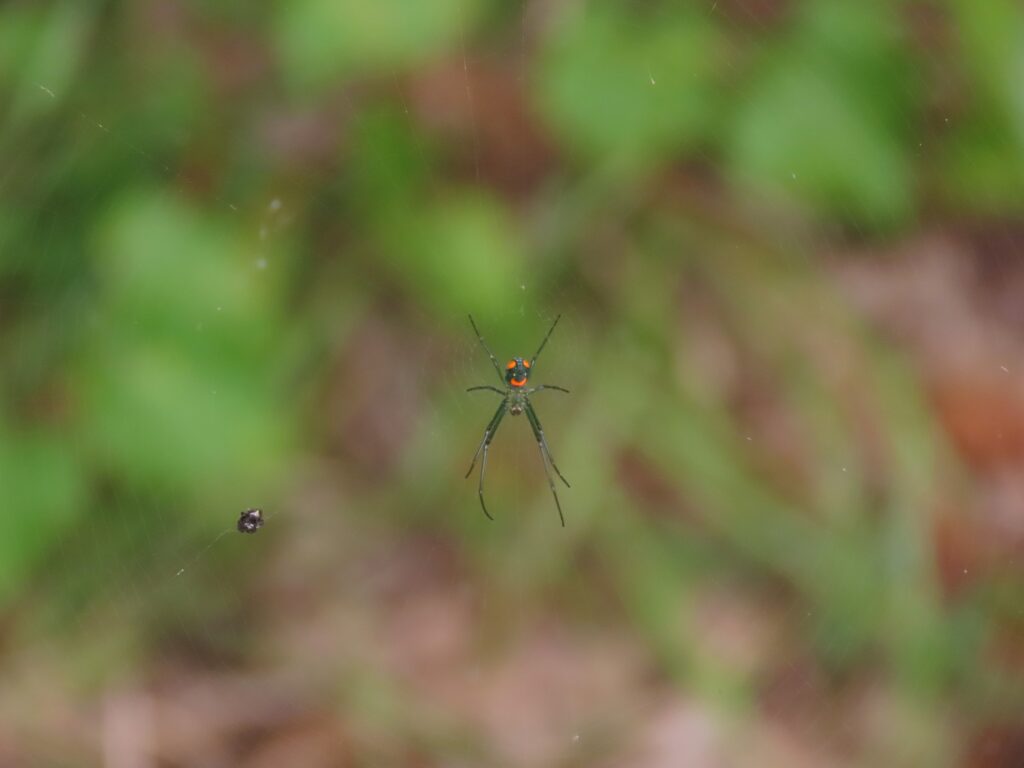
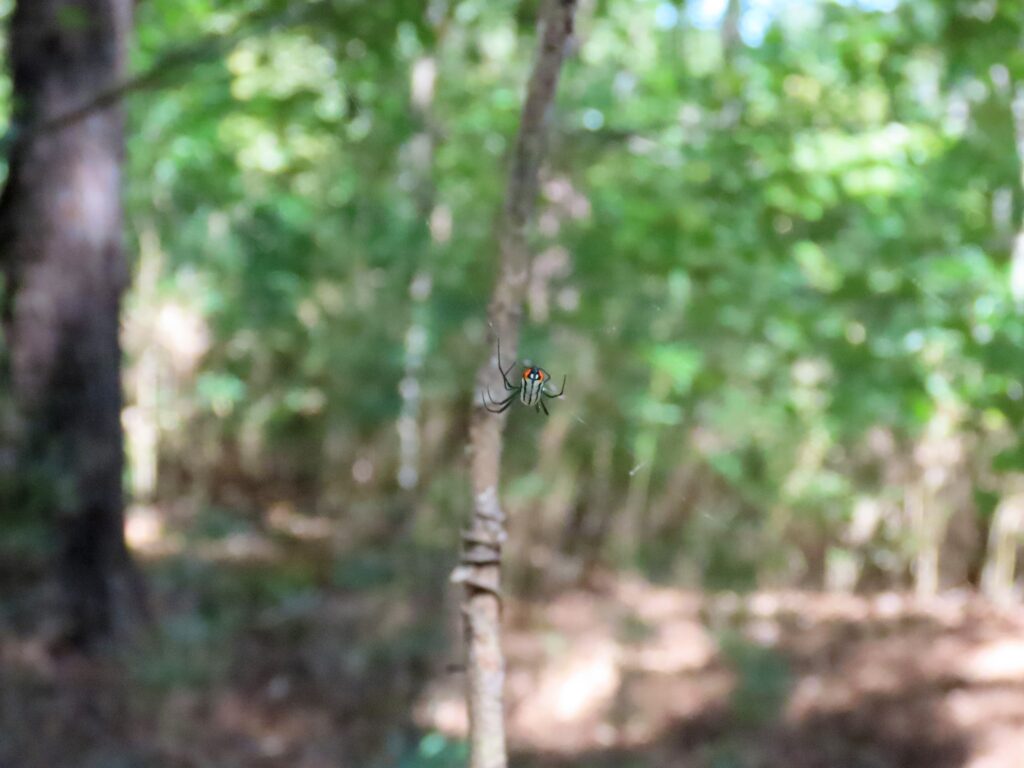
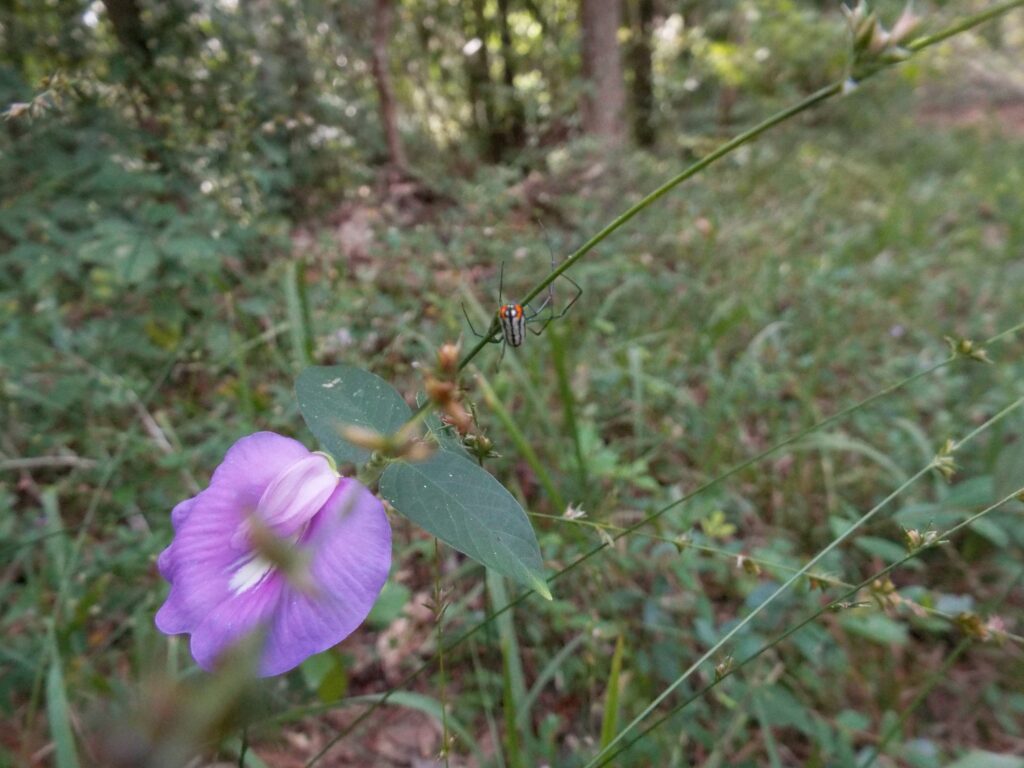
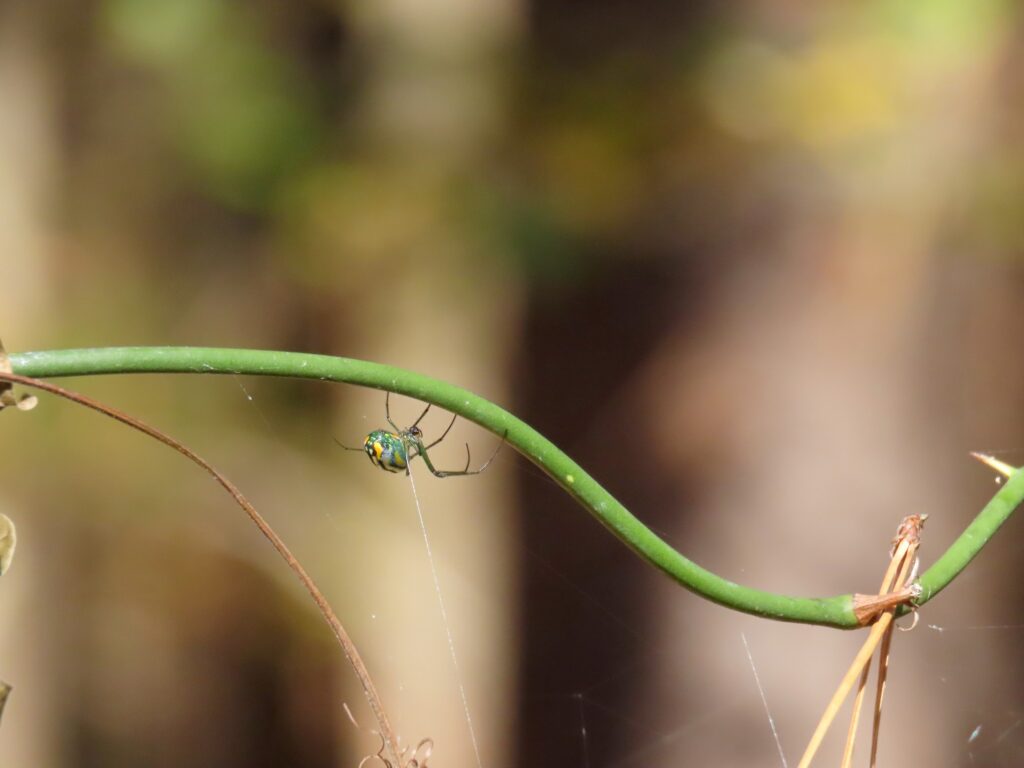
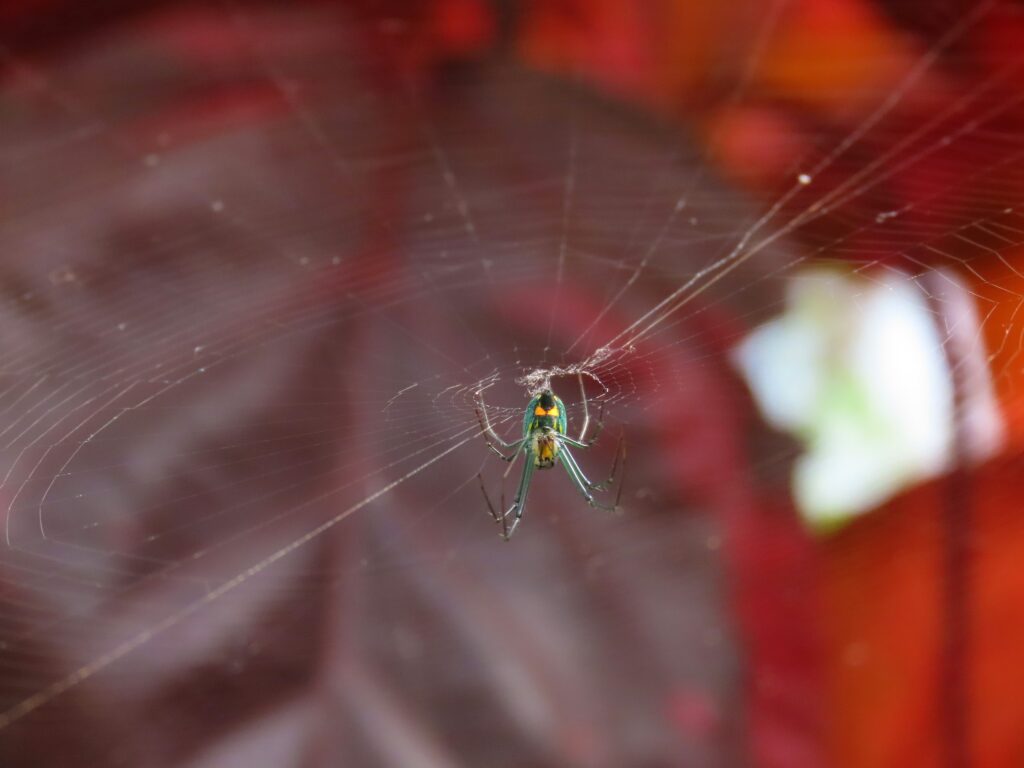
This week for Flora and Fauna Friday, we admire the neon glow through the dark of the woods of the Mabel Orchard Orbweaver (Leucauge argyrobapta).
Amidst the dim wet air, hovering above a stagnant forest floor, a faint sparkle of silver and flash of orange might draw your eye. Swamp gas or ghost lights? No, that’s the signature signal of today’s spider. Here is South Carolina we have two species in this Orbweaver genus, the Orchard Orbweaver (Leucauge venusta) over yonder in the upstate and the Mabel Orchard Orbweaver (Leucauge argyrobapta) down here in the Lowcountry. Both look very similar, apart from one clear field mark.
Both our Orchard Orbweavers are intricately colorful spiders with blue-green legs and pale-orange atop the thorax and head. On the abdomen its back is a silvery platinum-white split by vertical veins of aquamarine, flanks with flecks of sulfurous gold, and a belly of shimmering jade flowing in around two touching triangles of fluorescent neon-orange. That neon-orange is their trademark field mark, and it stands out with otherworldly aura under the inky-green darkness of the forest. Nothing else brandishes that eye catching color. It’s also part of the key distinction between these two sister species. The Orchard Orbweaver of the upstate has solely this twin triad tattooed across its belly. On the other hand, the Mabel Orchard Orbweaver also rocks a pair of broad neon-orange spots stamped upon either side of its rear end. Although this bright belly spot might be reminiscent of a Black Widow, fret not, as Orchard Orbweavers are harmless to humans.
Males and females of each species are roughly the same size with similar markings, but males have markedly smaller abdomens. Both our Orchard Orbweavers are small, maybe only a half-inch from toe to toe, and enjoy a quiet life in similar habitats. Here in the Lowcountry, Mabel Orchard Orbweavers live in closed canopy mainly hardwood forests, often with dense understory vegetation, high humidity, and little light. Think forested streams, maritime forests, and upper floodplains. Yet, they’ll spin a web in more open habitats if environmental conditions are right, like the orchards of their namesake. Wherever they happen to hitch their silk, they’ll spin a triangular web between two clumps of vegetation, with a sticky center roughly one-foot in breadth, and wait for hapless insects to careen towards the neon sign outside their pantry.





© 2026 Edisto Island Open Land Trust.
Built by Colophon