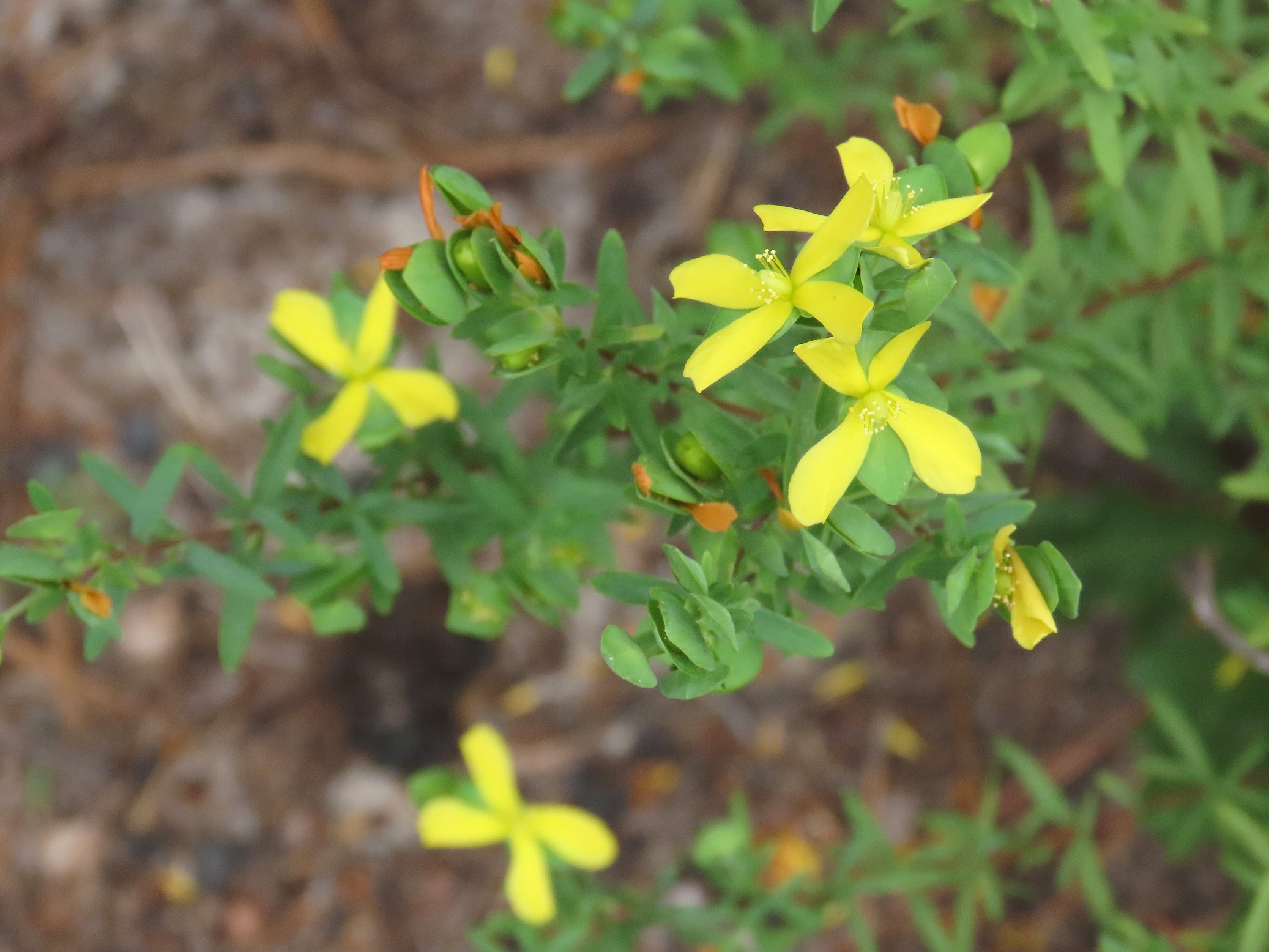
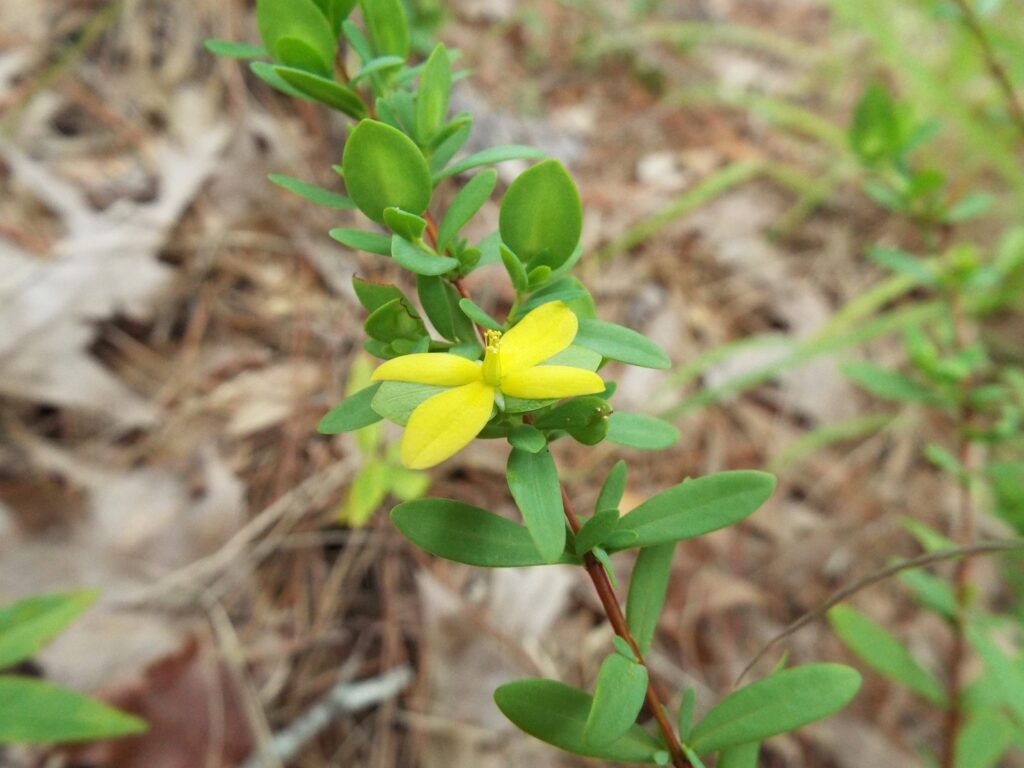
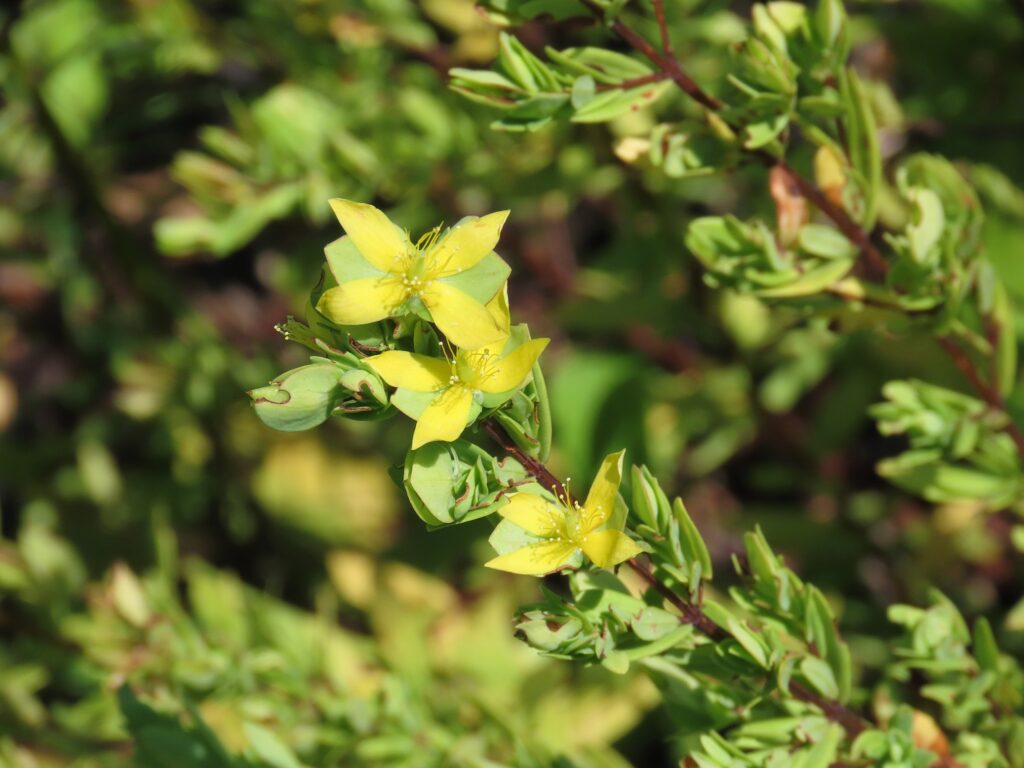
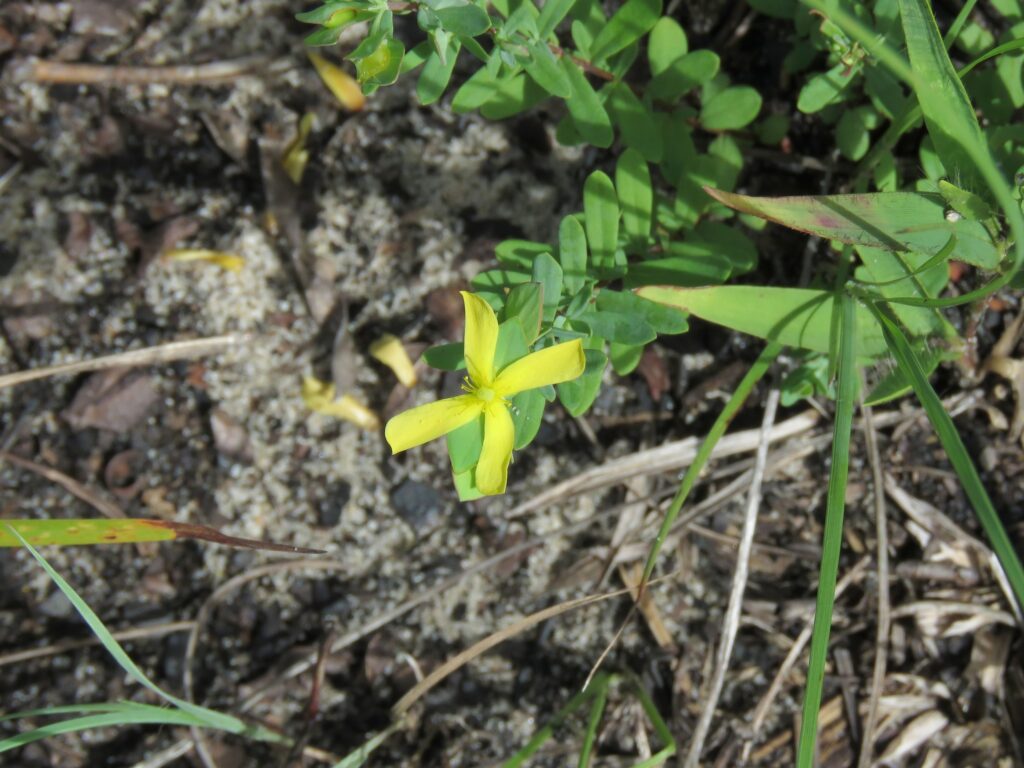
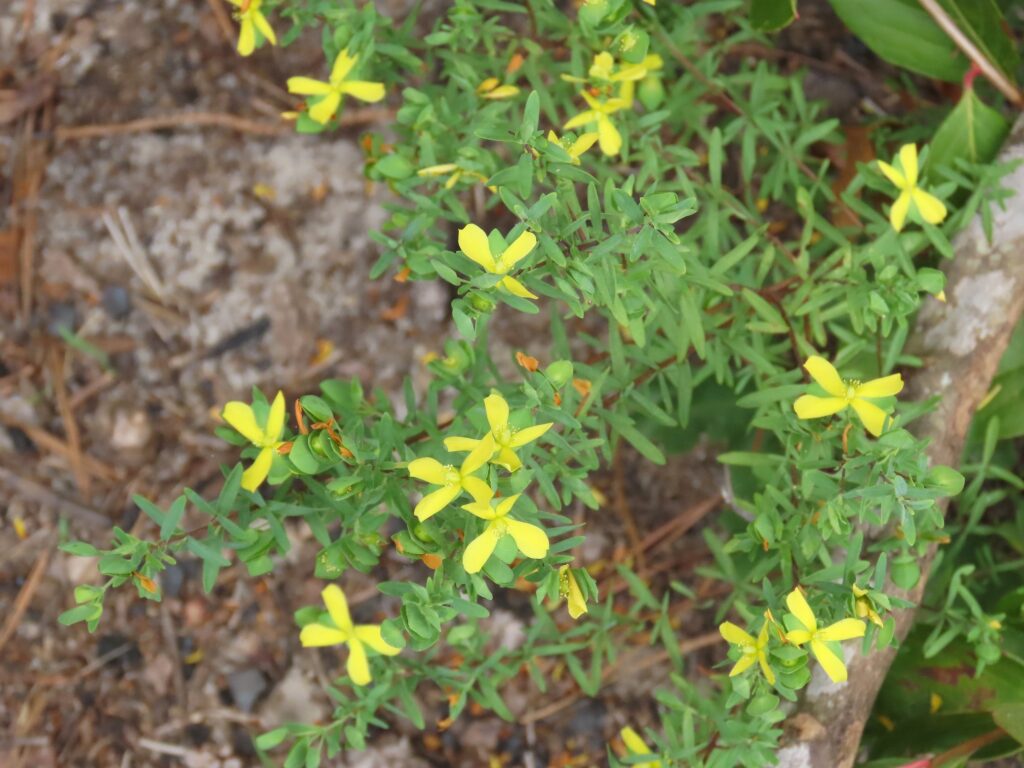
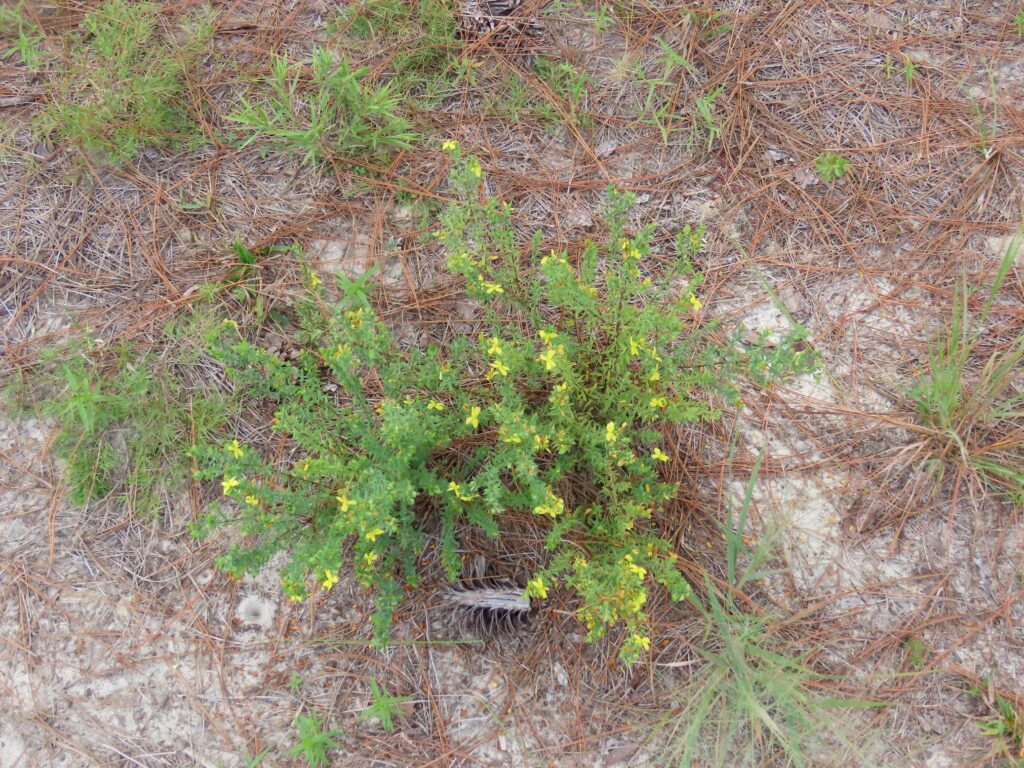
This week for Flora and Fauna Friday Saturday, we’re revering a saintly shrub that, blessedly, is easy to identify, St. Andrew’s Cross (Hypericum hypericoides).
St. Andrew’s Cross is a small, perennial and sometimes evergreen, woody shrub. It’s found throughout all of South Carolina and practically the whole of the Southeast. It prefers drier upland habitats in open woodlands, savannas, and forest edges. Yet, it is also an accomplished generalist that can grow well on most any upland site. St. Andrew’s Cross belongs to the genus Hypericum, the St. John’s Worts. Worldwide there are roughly five-hundred species of St. John’s Worts and, here in South Carolina, a little over thirty species call our state home. The St. John’s Worts are an incredibly diverse genus and individual species can be quite tedious and difficult to identify. On the other hand, hallelujah! This here holy hedge is not hard to get a handle on.
St. Andrew’s Cross grows as a low bush, usually one to three feet tall, with long, pendulous and arching, wiry branches slicked with smooth copper-brown bark. Its leaves are blue-green, small, simple, and opposite with a rounded tip. Each leaf pair is often at a right angle to the next, giving the stem a very orderly appearance, which is a trait common in this genus. St. Andrew’s Cross begins to bloom in early July and continues flowering usually well into October on the Sea Islands. Its bloom is a flattened four-way cross of narrow pastel-yellow petals draped over a platform of two flat, broad, pointed bracts and surrounding a tight vertical bouquet of anthers arising from its center. As the flowers age and the petals fall away, the two bracts beneath fold upward, like a clamshell, to caress and protect the fruit that will mature within. This fruit is a capsule, which will one day dry, crack open, and scatter its payload of tiny seeds from within to whichever way they may fall.
St. Andrew’s Cross gets its common name from Saint Andrew, one of the Twelve Apostles of Christianity, who was crucified on an elongated ‘X’-shaped cross, called a saltire. The petals of St. Andrew’s Cross form the shape of a saltire, which is quite a peculiar shape for a flower. Thus, it’s salutation became a salute to the saltire that silenced Saint Andrew. Similarly, there is St. Peter’s Wort (Hypericum crux-andreae), which confusingly bears the Latin specific epithet of “cross of Andrew” and also has a saltire-shaped blossom. St. Peter’s Wort has much wider petals and much broader leaves than St. Andrew’s Cross and grows in dry pine savannas.
More generically, St. John’s Worts get their common name from the Christianization of the midsummer holiday in Britain. Their solar-yellow flowers bloom around the summer solstice, and the plants were symbolically burned on the summer solstice in celebration of summer’s return. When Christianity became the dominant religion in the British Isles, the holiday was transformed into St. John’s Day, in celebration of the birth of John the Baptist. Yet the plant burning tradition continued. And so, the plant was christened St. John’s Wort, with ‘wort’ simply being the old English word for ‘weed’ or ‘herb’.
And if you aren’t bored of my nomenclatural pedantry already, here are some more etymological fun facts! The scientific name for St. Andrew’s Cross is Hypericum hypericoides. The genus name, Hypericum, means “above an image” which might sound strikingly poetic and provoke some deeply romantic pontification. But it is really just a literal description of an old cultural practice involving the plant. Folks in ye olden Britain used to hang blooming sprigs of St. John’s Worts above icons, paintings, visages, shrines, and the like within the home to ward off misfortune around the summer solstice. So the genus name is merely a riddle to describe a St. John’s Wort, with no deeper biological significance. The specific epithet “hypericoides” means “looks like a St. John’s Wort”. So, the plant’s full name roughly translated into modern parlance is, “that thing you put on top of pictures that looks like that thing you put on top of pictures”. Very helpful and very descriptive. This is a curious relict of very early taxonomy. The plant was first described by Carl Linnaeus as “Ascryum hypericoides” to distinguish it as significantly different from St. John’s Worts. However, science eventually determined that all the members of Ascryum were closely related to St. John’s Worts and should just be in Hypericum. When that happened, the older specific epithet was preserved through the standard rules for botanical nomenclature, which resulted in its current meaningless name. But what greater meaning did that now defunct genus name convey? “Ascryum” is an ancient Greek word for, drum roll please: St. John’s Wort.
[The astute among you may feel some deja vu. I’ve previously done an article on St. Andrew’s Cross, but felt inspired to redo it, yet better. Which is a polite way of saying I forgot I had written about it already. So here, have a bonus Saturday article this month!]





© 2026 Edisto Island Open Land Trust.
Built by Colophon