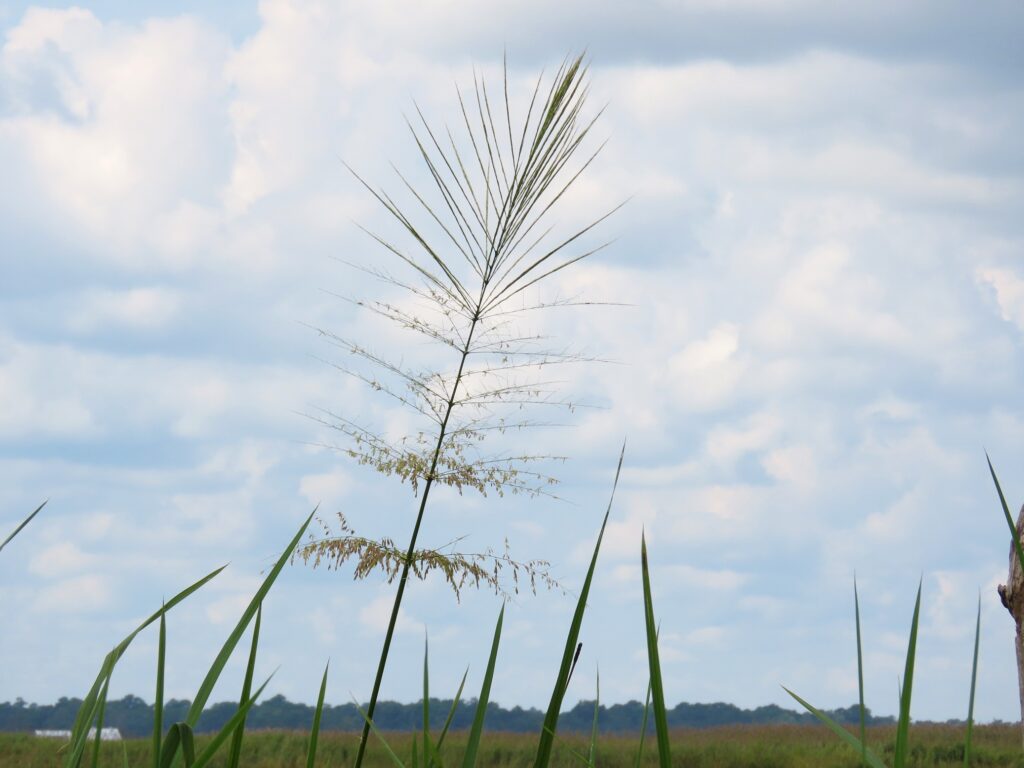
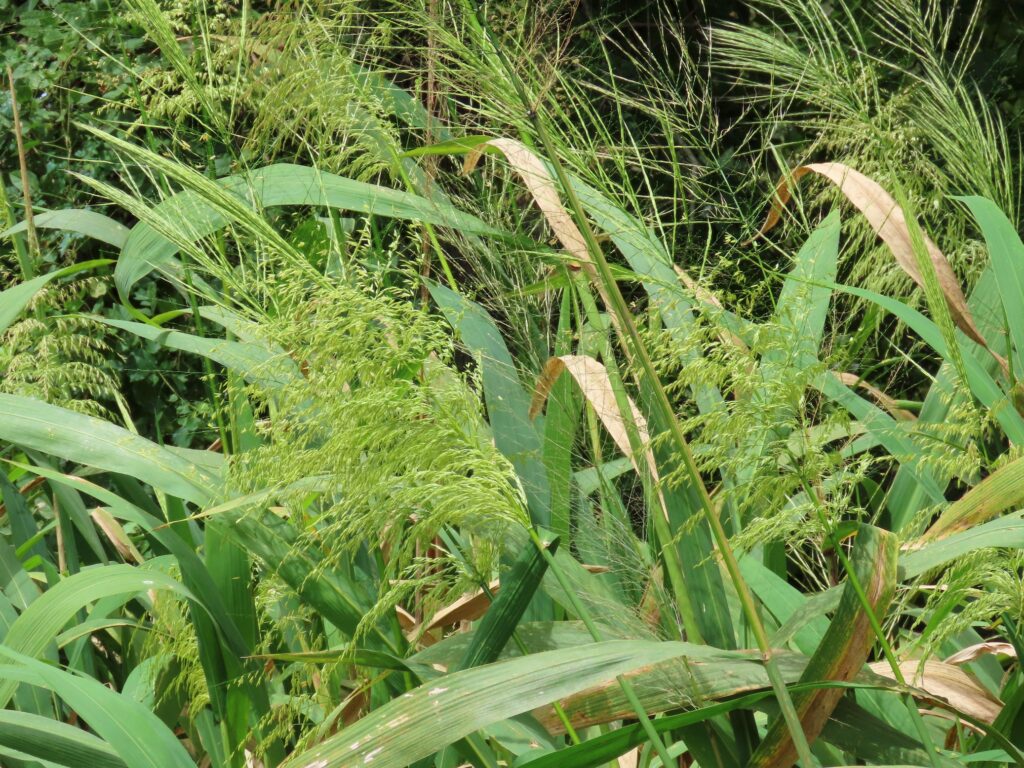
This week for Flora and Fauna Friday, we spending a minute with a shadow from the past, a doppelganger in the ditch and a facsimile of farms long gone, Annual Wild Rice (Zizania aquatica).
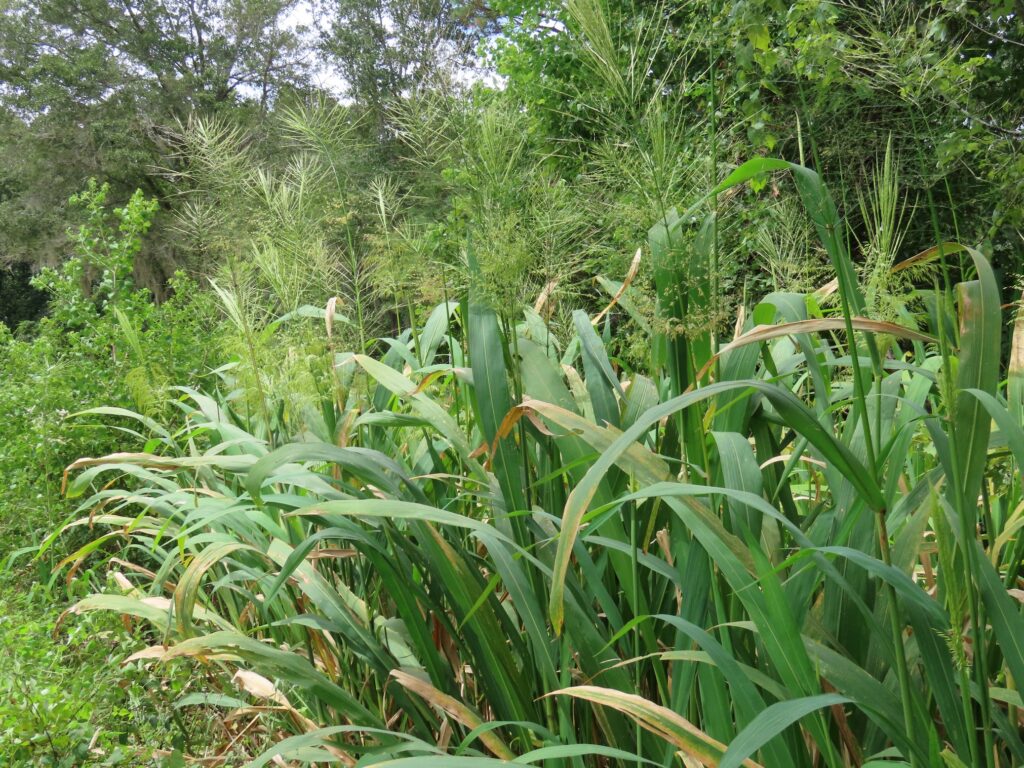
Annual Wild Rice is an aquatic grass that grows to over eight feet in height, not counting the flower stalks. Its leaves are broad straps of verdant emerald-green some two to three fingers in width that stand proudly together in an upright funnel. Its leaf margins are armed with fine serrations that feel like a mix of sandpaper and a hacksaw on the skin. Walking through a stand of Wild Rice can just about earn you a death by a thousand paper cuts. This is not an uncommon character among grasses, especially those in wetlands, used to ward off herbivores. Grasses achieve these super sharp serrations with tiny silica shards they grow from the edges of their leaves. Basically biological glass, but more chemically correct to call microscopic opals, the technical term is phytolith, literally meaning “plant stone”. Not only do some grasses cover themselves in razor sharp broken glass to irritate the mouths of grazers but they also imbed grains of silica all throughout their body, inside the leaves themselves. This is a secondary, insidious, almost spiteful defense against herbivory. Forcing anything brave enough to slice its mouth apart to get a full belly to also grind its teeth down to dust on a mouthful of sand. This won’t kill a critter outright but, big picture, it accelerates their tooth wear to an unsustainable rate and leads to an early death. That reduces their reproductive output, which slowly steers natural selection to disfavor herbivores that try to make a living on Wild Rice salad.
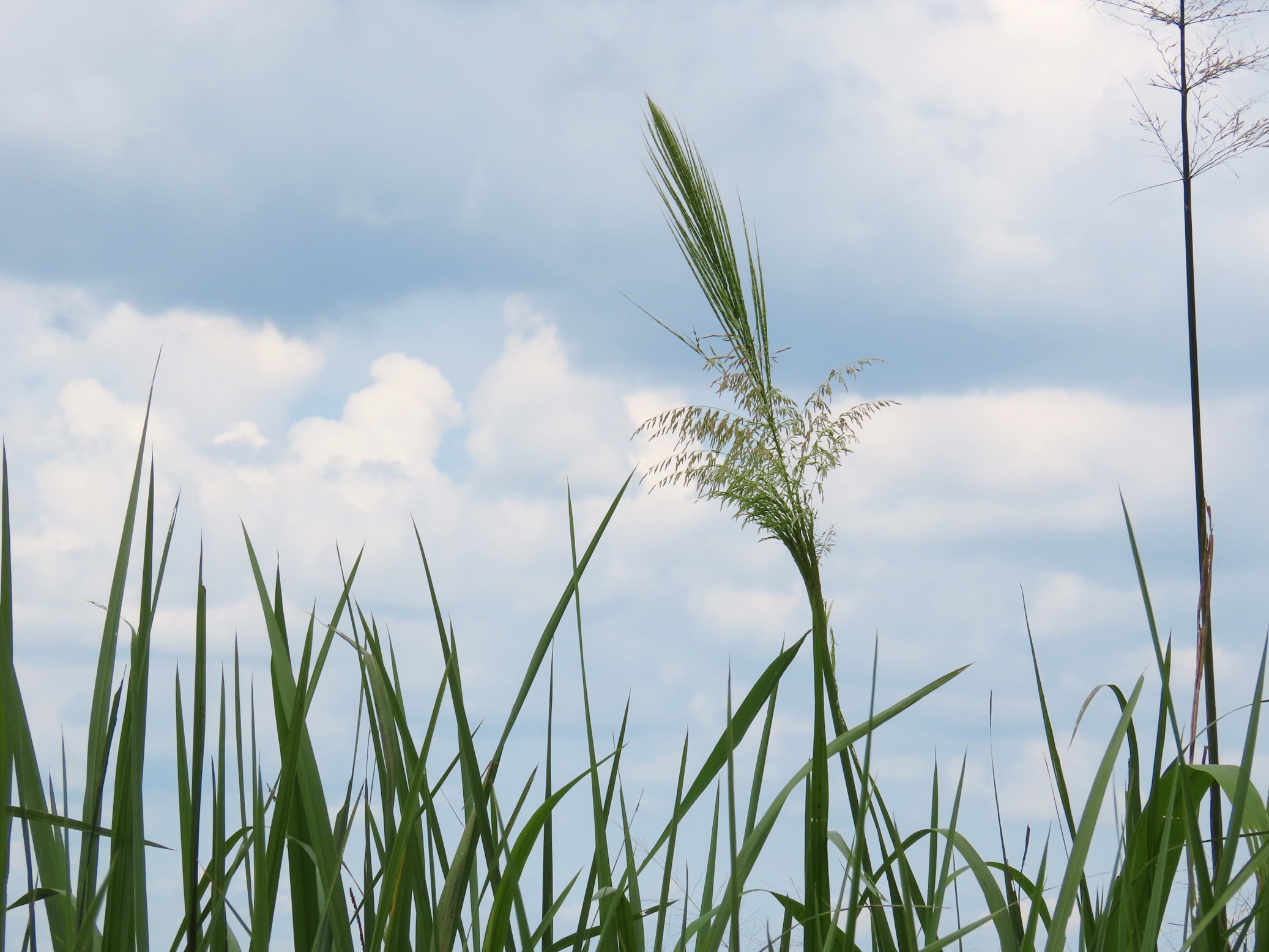
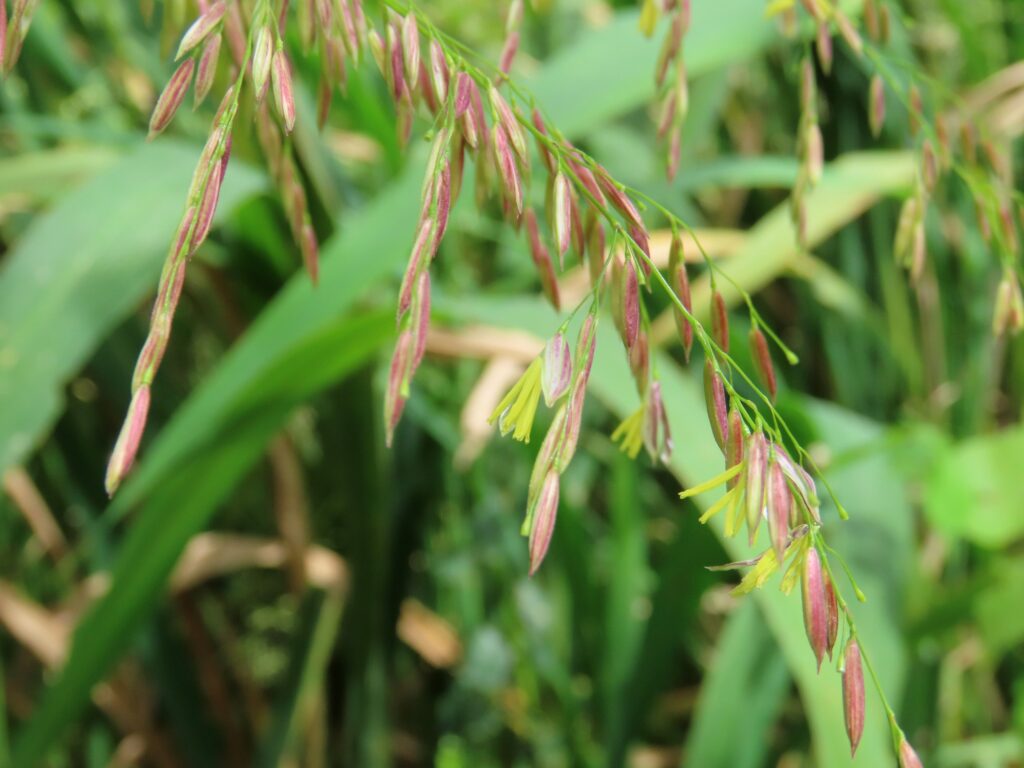
Wild Rice begins to bloom near the end of August. Tall, slender stalks rise up to twelve foot in height and produce a two-tiered foot long plume from their tip. The bottom is built of broadly splayed, bent stringy-stems laden down with golden and pinkish-green male flowers. The top is a tight tassel of upright stems that hold the pale female flowers. The male flowers open first in September, and the female flowers follow suit for a suitor sometime later. This allows the plant to spread its pollen far and wide before receiving pollen to set its own seeds, avoiding self-pollination. Its seeds mature through fall and fall away to seed the soil below come winter. Those seeds are about a half-inch long, thin and tubular, and black in color once hulled.
Pre-European colonization, Annual Wild Rice was an important staple grain for many Native American peoples. It could be reliably harvested by boat from wetlands in fall to help folks survive the winter. It stored well and so was both a good subsistence crop and useful as a commodity for trade between groups. Annual Wild Rice was actually formally farmed in some natural wetland systems, especially in the Great Lakes region, and it was even on the path to full domestication in this region. It continues to be grown today as a specialty grain. Apart from people, it’s a very important seed to wildlife, especially ducks, blackbirds, and seed-eating rails. It’s also the host plant for several species of wetland grass skipper butterflies, most notably here in the Lowcountry the Broad-winged Skipper (Poanes viator) and the Rare Skipper (Problema bulenta), which is fittingly named as its widely distributed but highly isolated populations are imperiled by coastal squeeze and habitat destruction.
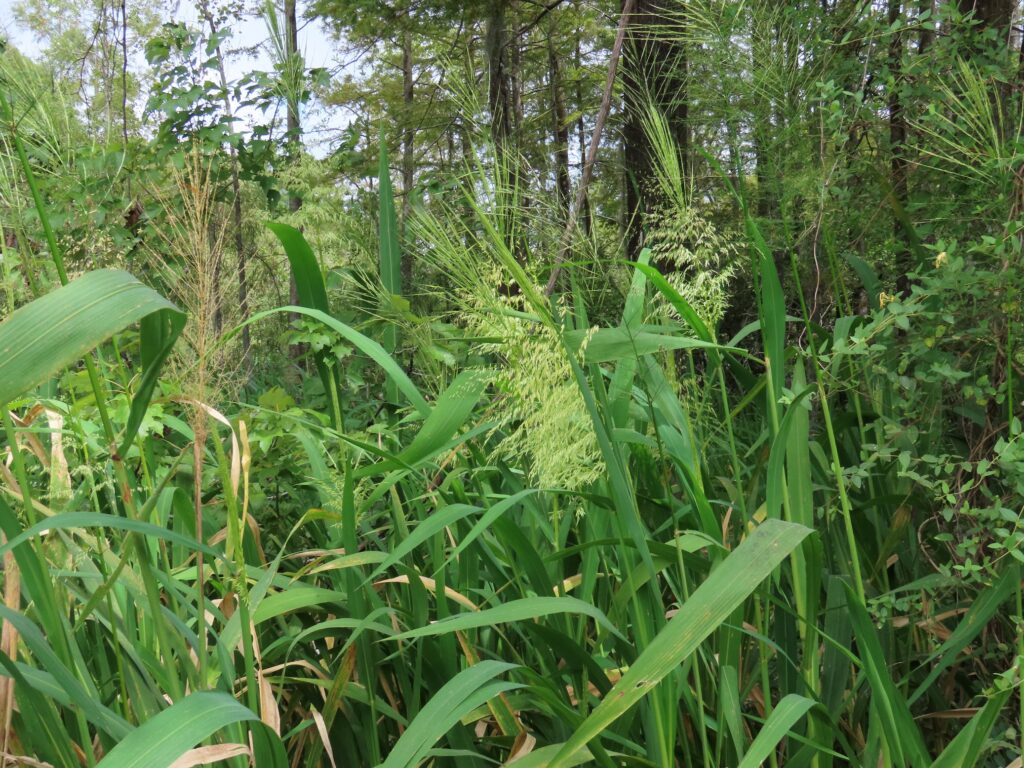
Wild Rice is an annual grass and so each plant has to achieve its staggering height from square one, in just a few months! In order to pull that off, it needs full sun, endless water, and rich mucky soils to succeed. Its favorite habitats are ditches, marsh swales, and side creek banks in tidal freshwater and brackish river systems. Places where the water moves gently, sediment settles, and water levels fluctuate throughout the day. These conditions provide it the goldilocks zone it needs to grow big in a hurry and smother any competitors. That’s a tall order.
Wild Rice is found all along the immediate coast of the Eastern Seaboard, from Louisiana to Maine and westward over around the Great Lakes. Here in South Carolina, it can be found in all our coastal counties and sporadically inland along our major rivers. Wild Rice is adapted to a rapid life in that narrow band of freshwater tidal marsh bounding the back of the Sea Islands. Funnily enough, it has found itself at home in the historic rice fields of the ACE Basin, Santee Delta, Waccamaw, and Savannah. Lands that were upended and reshaped from free flowing freshwater marshes into mammoth managed marvels of engineering to maximize the growth of Carolina and Charleston Gold Rice, both local cultivars of Asian Rice (Oryza sativa). Now these fields have been refit for feeding migratory ducks and bolstering wildlife of all walks of life. From these shadows of our past waves away the slender grains of Annual Wild Rice, from out the ditch and along the dike, a doppelganger plant that’s supplanted it domesticated rival.





© 2026 Edisto Island Open Land Trust.
Built by Colophon