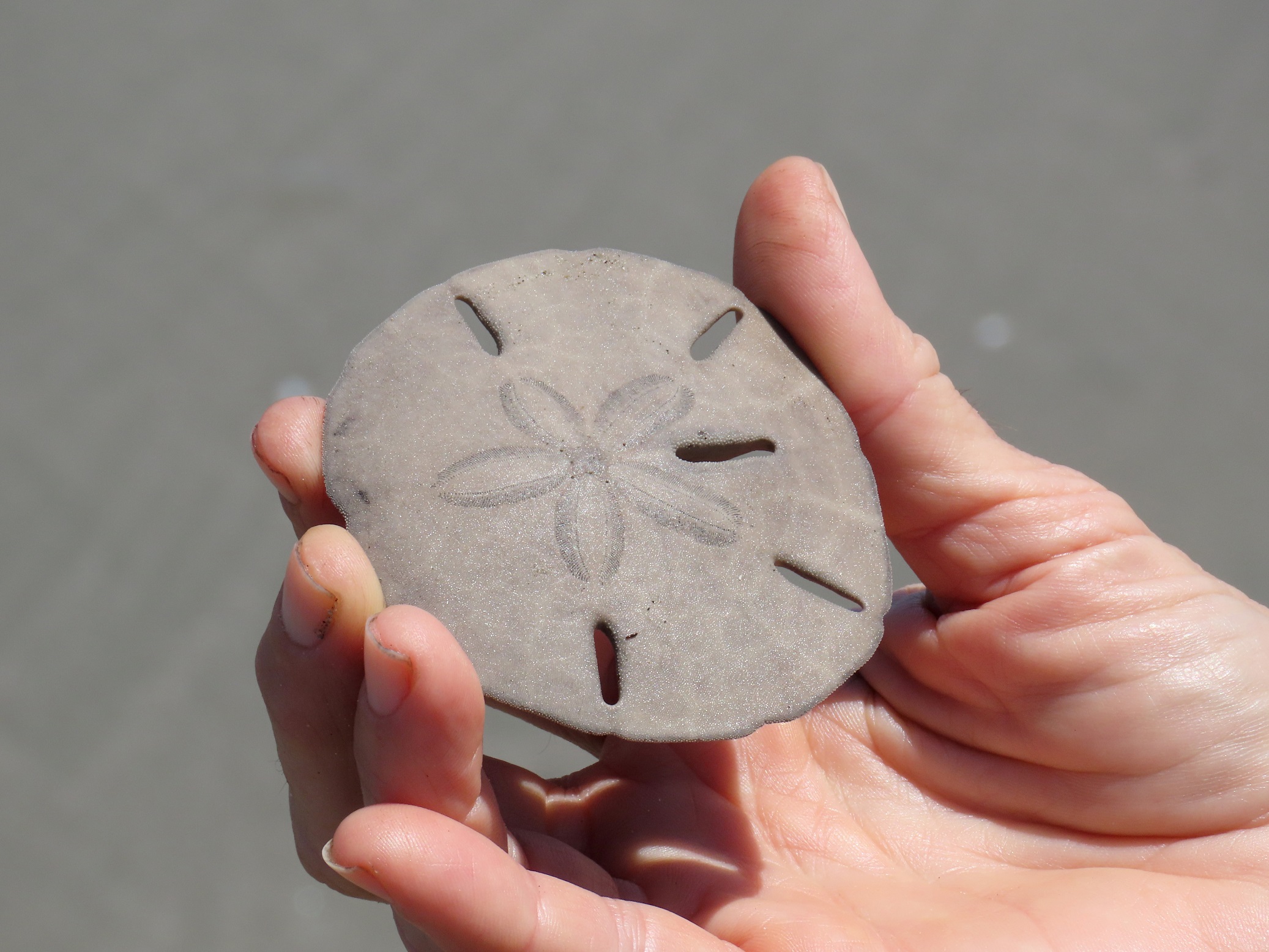
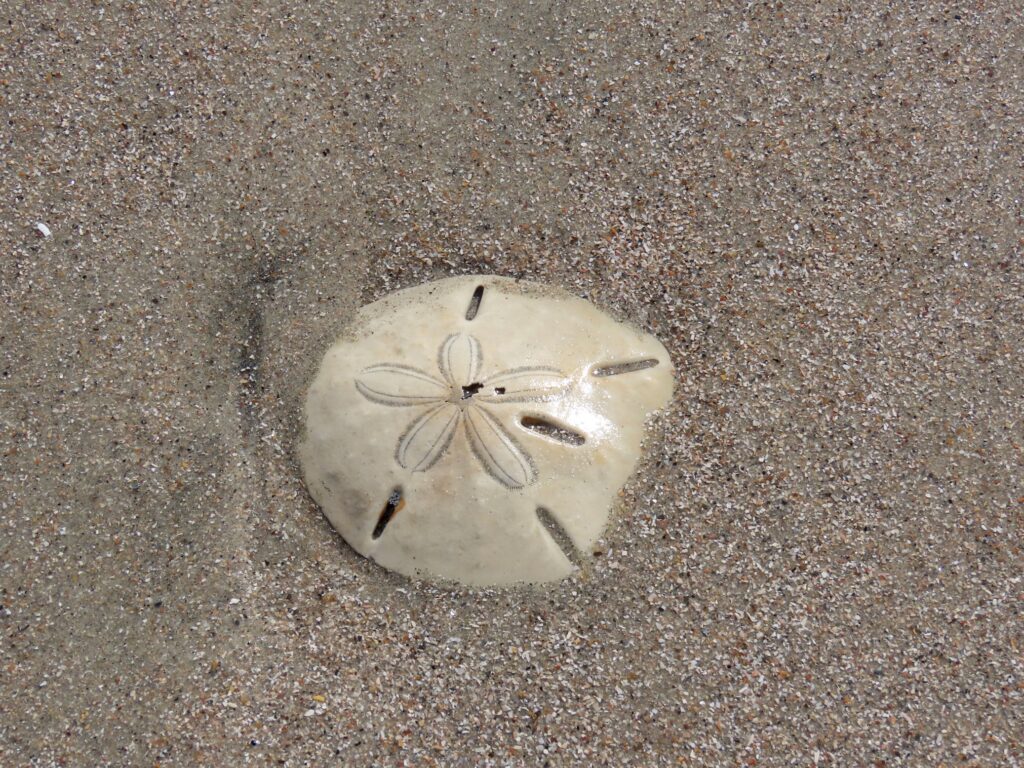
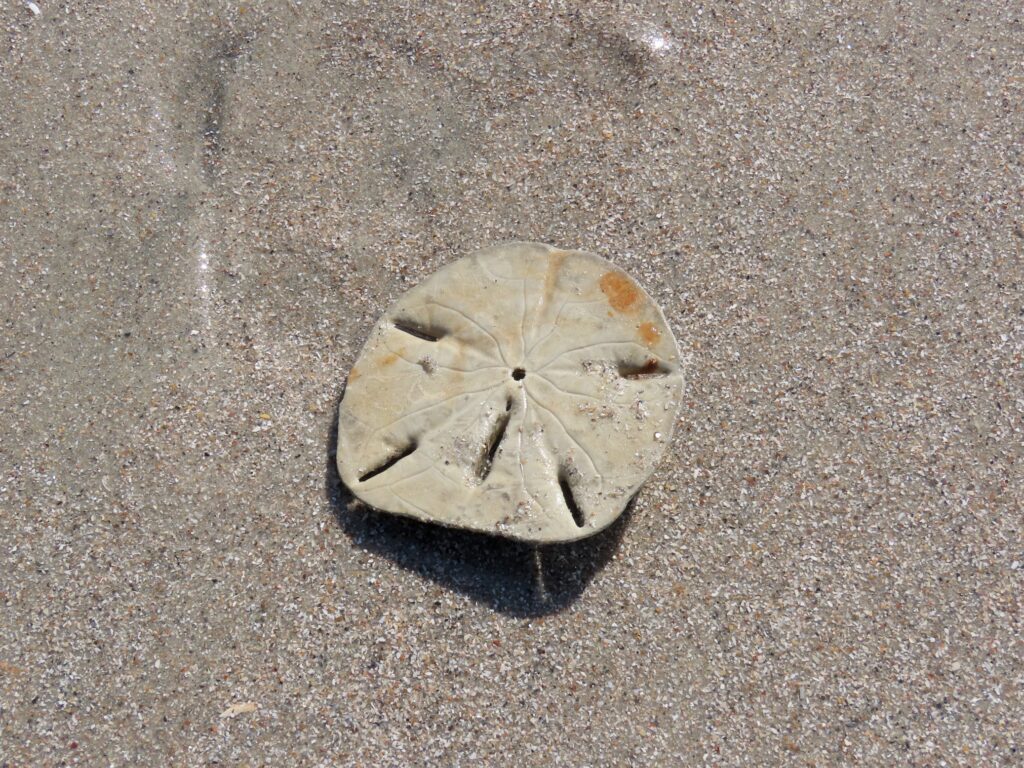
This week for Floral and Fauna Friday it’s the doubloon of the dunes, the Isometric Sand Dollar (Mellita isometra).
Combing the beach, roaming the shore, surveying land’s end for castaways galore. There’s something universally satisfying in beachcombing for the human psyche. The curiosity, the hunt, the discovery of something strange and something new, a captivating sight just for you. For me, my favored find has long been those tokens cached in by the currents, the Sand Dollars.
Sand Dollars belong to the order Echinolampadacea. All are echinoderms within the same phylum as starfish and sea urchins. Like other echinoderms, Sand Dollars have a single digestive orifice located at the center of their underside, an internal shell-like skeleton called a test, and they move around the sea floor slowly and methodically using hydraulicly actuated tube-feet. Their round, flat body resembles an oversized coin in shape, hence the Sand Dollar name.
In the center of a Sand Dollar’s back is a flower pattern with five petals called the petalloid. This structure is a string of pores permitting the passage of specialized tube feet that act as the Sand Dollar’s gills. At the center of their upper surface, between the petals, is a small, delicate five-pointed star called the madreporite, which functions like a pressure valve to help equalize the hydraulic pressures of their circulatory system. Some Sand Dollar species have rounded slots, called lunules, punched through their bodies. The largest lunule is called the anal lunule and is located towards the rear of the body. The others are smaller ambulacral lunules. The purpose of Sand Dollar lunules isn’t fully understood, but it is believed that the larger lunule helps establish one-way flow to expel waste and water while the Sand Dollar is buried. The smaller lunules help the Sand Dollar transport and funnel food from the top of its body down to its central mouth down below. Underneath, you’ll find another flower-like pattern of radial grooves extending from the mouth to the edges of the body. These are ambulacral grooves, or food groves, which hold specialized tube feet and cilia for conveying food to the central mouth.
Here along the shores of South Carolina we have one principal species of Sand Dollar, the Isometric Sand Dollar (Mellita isometra). You may know it instead as the Keyhole Sand Dollar (M. quinquiesperforata), but recent genetic work determined what once was one species is really three, with the latter having residence in the tropical Caribbean, a third species (M. tenuis) occupying the Gulf Coast, and the Isometric Sand Dollar depositing here on the Carolinas’ coasts. These three species all look very much the same. So just know that my description for the Isometric Sand Dollar applies to the other two as well. Isometric Sand Dollars are circular in shape, about three to four inches across, are flat as a pancake but with a slight dome, and have five rounded rectangular lunules, with the anal lunule being larger. Live Isometric Sand Dollars are greenish-brown and covered in fine “hairs”. When Sand Dollars die and decompose, their calcareous internal test is left behind. This smooth, bone-white skeleton is what one most often finds while combing the beach. If you happen to find a live Sand Dollar, do appreciate the wondrous beauty of this archaic invertebrate life form. Then promptly return it to Davey Jones’ locker. It’s illegal to collect or harm living Sand Dollars in South Carolina.
Isometric Sand Dollars live their lives in the shallow waters along the beachfront of the East Coast. They bury themselves just beneath the sand below any tumultuous tides above. Here in the ever-churning sand, they methodically riffle through each grain in search of morsels to make their meals. Feeding below the sand not only anchors them against rogue currents and hides them from patrolling predators, but also allows them to scavenge for food using both sides of their body.





© 2026 Edisto Island Open Land Trust.
Built by Colophon