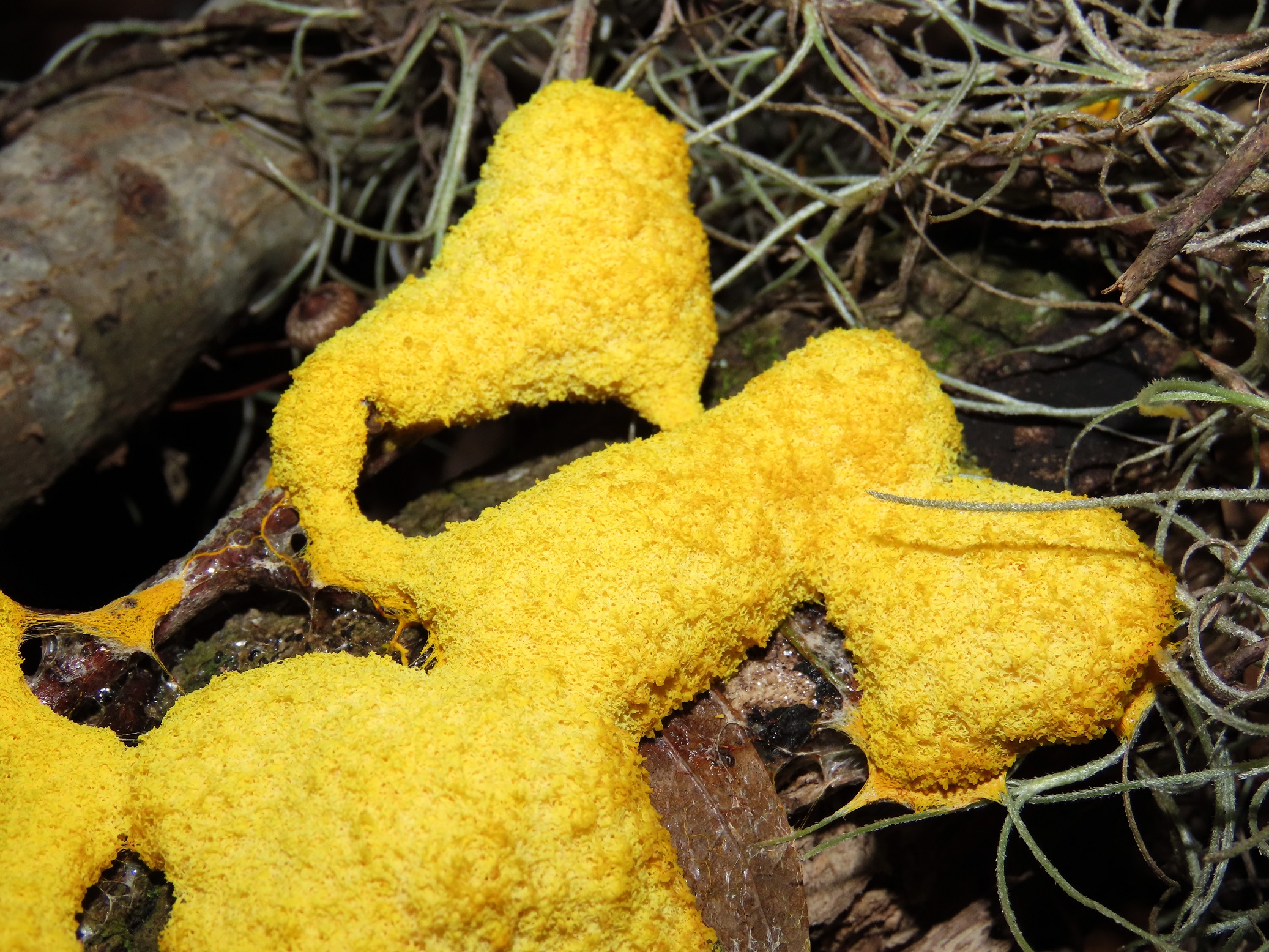
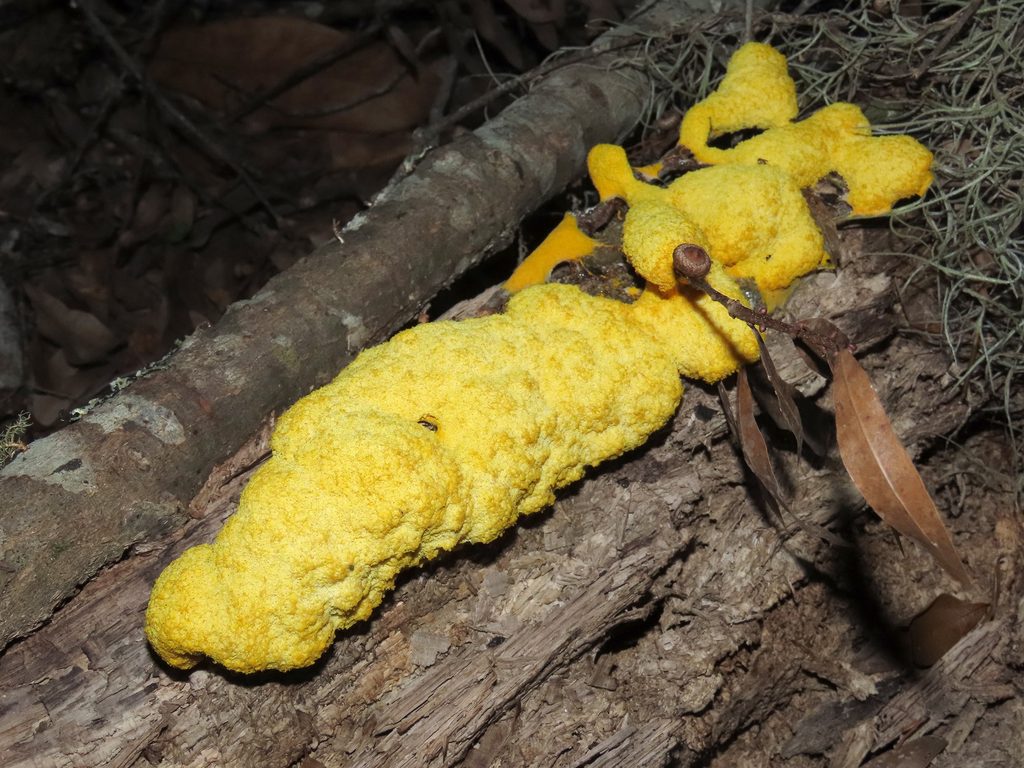
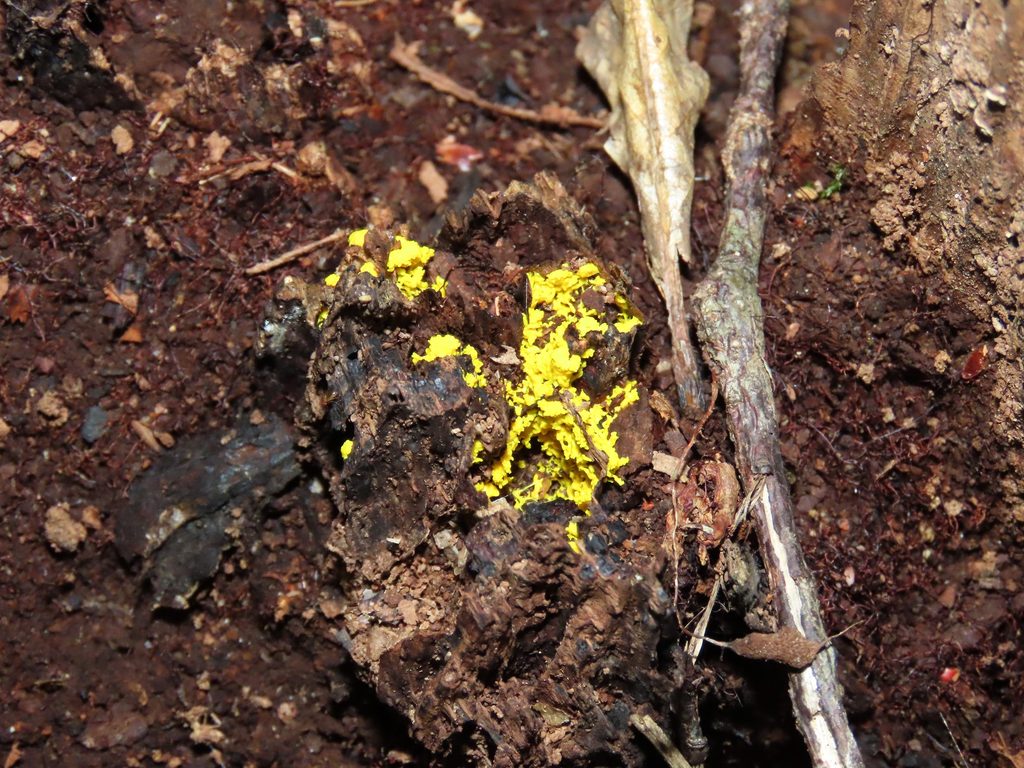

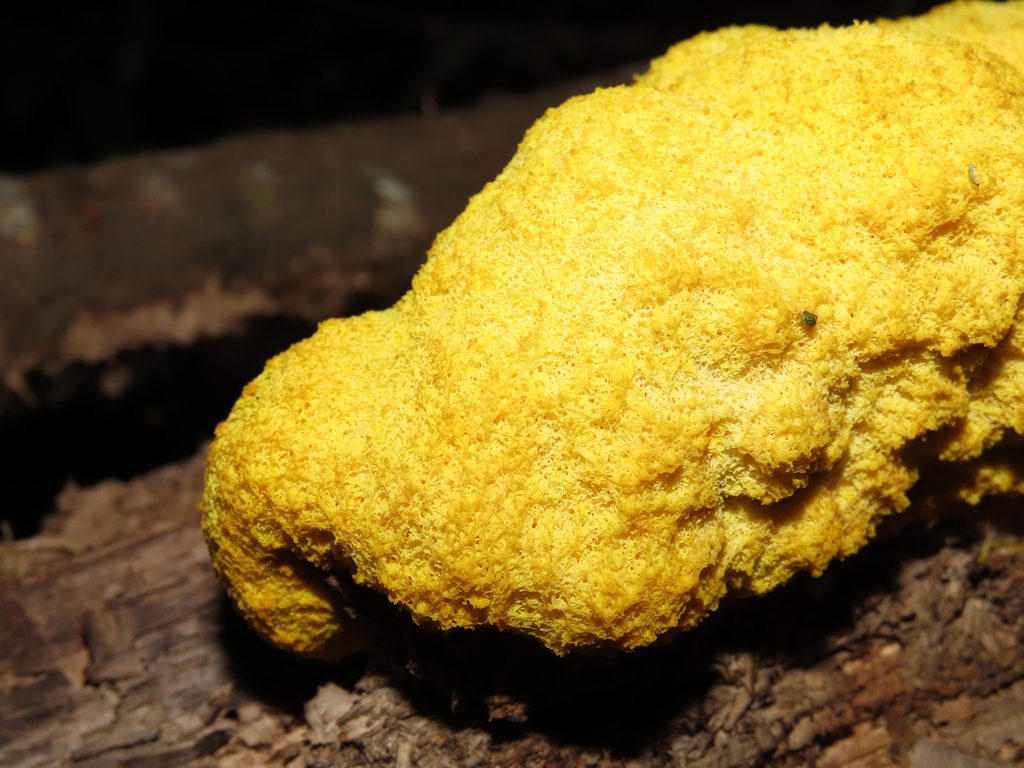
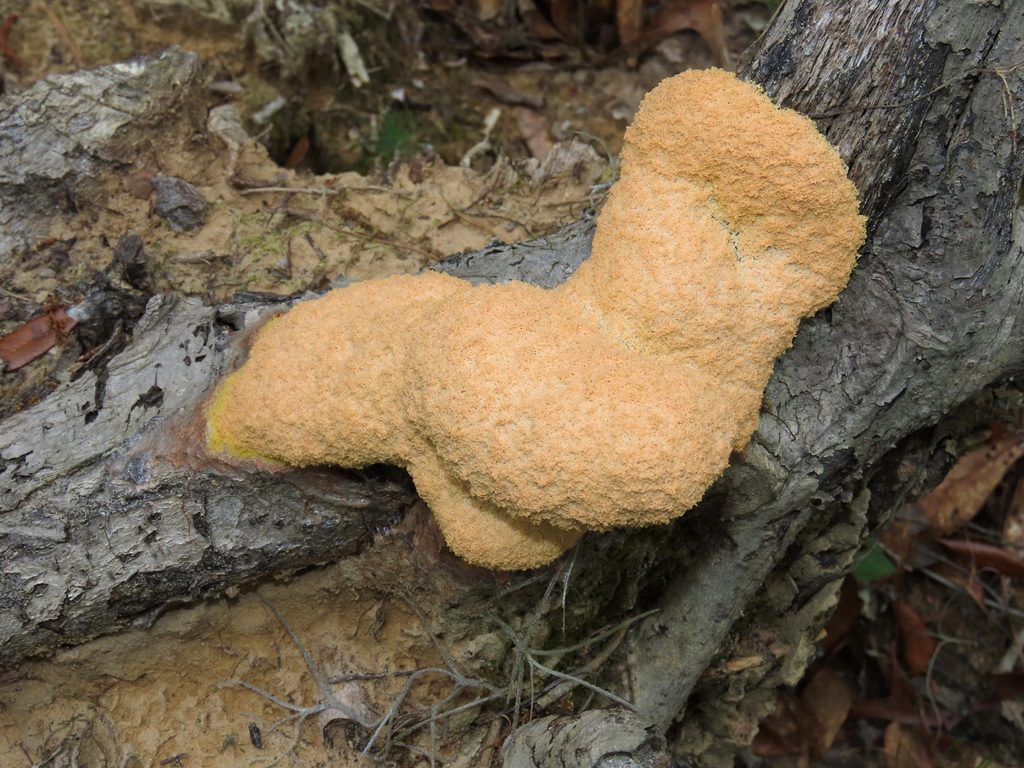
This week for Flora and Fauna Friday, we’re keeping an eye on that disturbing, pulsating mass spreading through the forest and into your garden, Dog Vomit Slime Mold (Fuligo septica).
Dog Vomit Slime Mold, also called Scrambled Egg Slime Mold if that better suits your sensibilities, is a curious lifeform found throughout the United States and much of Europe. It is quite common here in the South Carolina Lowcountry. Dog Vomit Slime Mold first manifests as a slimy, granular, yellow crust on a dense cluster of rotting organic matter. It’s often found on rotting logs, stumps, heavy leaf litter, turf grass, wood chips, and old compost. Anywhere with an abundance of moisture, humidity, and dead plants is a suitable home for this Slime Mold.
Dog Vomit Slime Mold grows from a single spore deposited upon the landscape by the wind. From that single speck it will quickly expand to nearly a foot in breadth. When it first begins to grow, it resembles half-cooked scrambled eggs with a bit of white around the edges. As it matures, the mass will take on a dry, crusty, foamy appearance with a drab pink-orange color, or in some locales a shade of pastel lavender. It looks a lot like spray foam degraded by ultraviolet light. (Or the emetic emissions of man’s best friend if you squint. I don’t really see the resemblance, and I’ve cleaned up my fair share of pup puke.) This dry exterior is loaded with spores that get thrown into the wind. That crust also acts like a shell to both trap in moisture during dry periods and wick in water when it does rain. Dog Vomit Slime Mold, although generally unsightly, is harmless. It’s an important member of nature’s clean up crew, as it is a saprophyte that decomposes rotting plant material and recycles those nutrients back into the ecosystem.
Dog Vomit Slime Mold belongs to an interesting lineage of life, the Slime Molds of infraphylum Eumycetozoa. It’s not a fungus nor a plant, it is a protist. A whole other branch of eukaryotes on the tree of life. Classically, protists have been classified through the filter of, “That looks weird, I don’t like it, put it in Protista”. This is what’s called a ‘waste bin’ taxa, where all the freaks and weirdos nobody wants to fool with get quarantined by taxonomists, who self-reportedly have better things to do. However, Protists are not necessarily all related to each other evolutionarily. They are just not in the big three kingdoms: Plants, Fungi, and Animals. Thus, they get lumped together. However, modern taxonomy is starting to make good progress disentangling them all. But that’s enough taxonomic rambling for today.
The cool thing about Slime Molds is that they are single-celled organisms. You read that right. That foot-wide foamy mass is a singular, macroscopic cell. Just like “The Blob”, of B-movie fame, Dog Vomit Slime Mold is a single-celled mass that surrounds, engulfs, and digests whatever it encounters, so long as that thing is rotten wood. This single-celled nature is shared by most Slime Molds and many other amoeboid protists. Dog Vomit Slime Mold is one of the larger species and pushes this trait to its extreme. Rather than dividing into multiple cells as the organism grows, it simply expands its cellular membrane ever outward, all while duplicating the nuclei and other organelles within the single intracellular space. This has downsides, as it impedes and complicates regional specialization and also facilitates the internal spread of infection. But it does have its upsides. Slime Molds can move, and they can think, in a primitive sense.
Slime Molds spread outward across a surface looking for the most nutritious and easily digestible food they can find. They do this by extending fine tendrils from their central mass in every direction over the surface. When a tendril encounters something worthwhile, it releases a chemical signal that diffuses rapidly and is amplified along the way through the interconnected, single-cellular protoplasm. This signal directs the whole organism to retreat from its other nearby exploratory tendrils and to direct its efforts into the one that struck it rich. Then the cycle starts again from that new node. At the same time, the main mass slowly shifts its center and moves between these nodes of food resources. It also withdraws from areas where resources are depleted. Moving slowly across the surface, not quite fast enough to be observed in real time. Yet it is always searching for more resources and refining its efficiency, bridging gaps and shifting routes to most economically and expeditiously move resources and chemical signals between all its nodes. This is a single-celled protist with no brain, it’s computing logic and managing resources with nothing but hard-coded instructions, hormones, and environmental cues. Yet it can always divine the shortest path from A to B. But not just A to B, also C to D, and D to A, and B to C, and A to C, et cetera. If given enough time and the opportunity, slime molds will create the most efficient multi-route network to move resources throughout a two-dimensional landscape. They’re better at it than we are. They’re great at solving mazes of any complexity, but also solving real world problems. Scientists have used slime molds creatively and successfully to answer a myriad of questions. Some examples are improving bus routes, mapping new rail lines, approximating road networks between historic civilizations, and simulating congestion relief from competing road improvement plans. All it takes is a scale model of what you’re mapping, some properly placed food bribes throughout, and a slime mold, and you’ve got your very own single-celled civil engineer. They’ve even been used by astronomists to simulate the distribution and flow of dark matter within the observable universe!





© 2026 Edisto Island Open Land Trust.
Built by Colophon