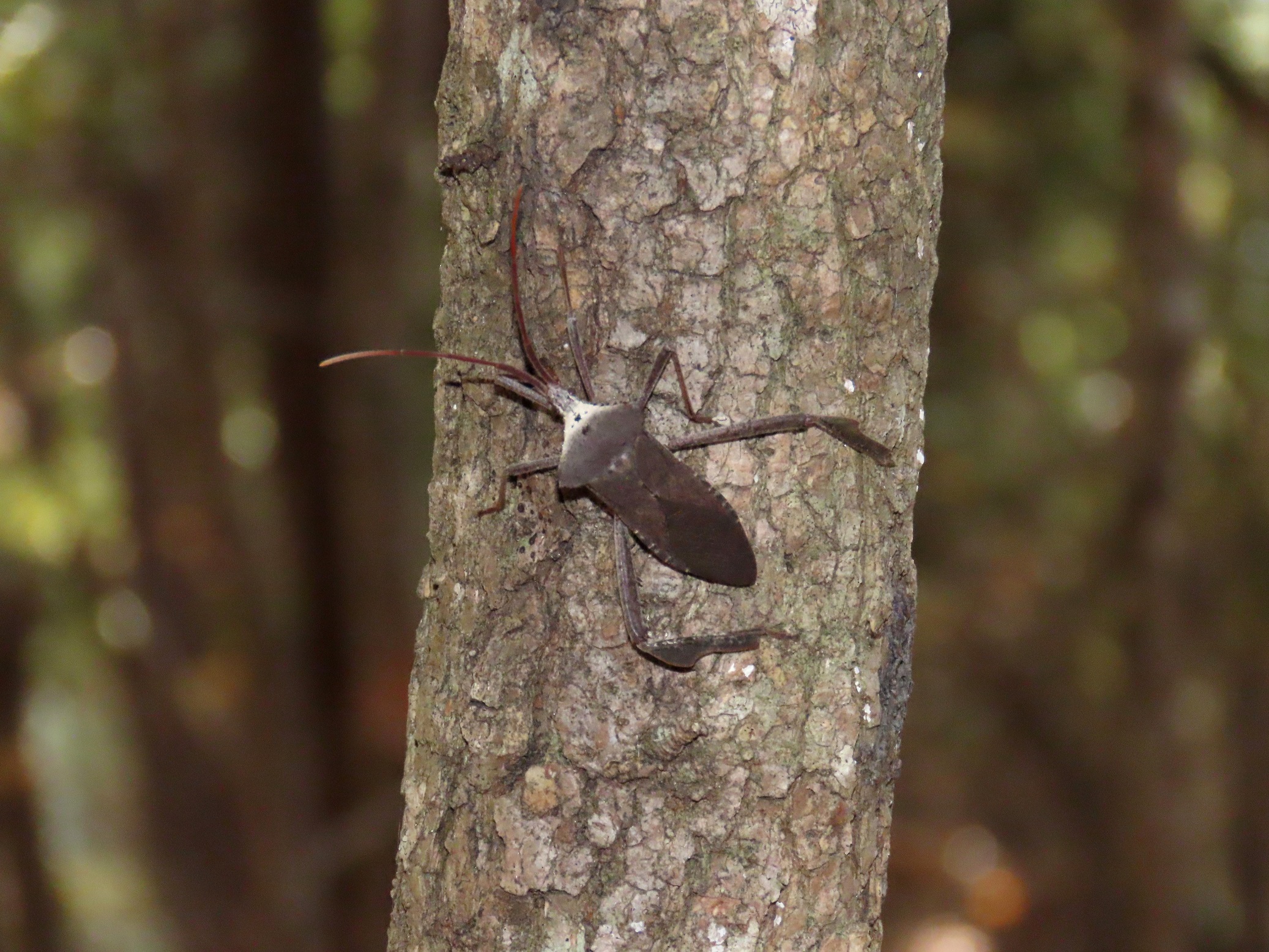
This week for Flora and Fauna Friday, we’re uncovering a trio of lanky, stinky, spiny, big bugs, the Spine-headed Bugs (Acanthocephala spp.).
Here in South Carolina we have three species of Spine-headed Bugs: the Orange-tipped Leaf-footed Bug (Acanthocephala terminalis), the Giant Leaf-footed Bug (Acanthocephala declivis), and the Florida Leaf-footed Bug (Acanthocephala femorata). All can be found throughout the State, Including here in the Lowcountry and on Edisto Island. Yet, they are rarely ever seen in any great number and usually spotted solo. All three species look similar, share similar life histories, and occupy similar habitats. They are most often encountered on forest edges, in hardwood forests, along wetland margins, in old fields, around gardens, and really any place with either abundant herbaceous vegetation or fruit bearing trees and shrubs. They feed by sucking plant sap through their needle-like mouth, piercing soft stems and fruits to drain them of their sweet sugary ichor.
Spine-headed Bugs belong to the family Coreidae, the Leaf-footed Bugs. This family has many common features such as a rectangular abdomen, elongated legs, bladed rear legs, the ability to emit a foul-smelling stench when grabbed, and sucking needle-like mouth parts. These are all features shared by our three Spine-headed Bugs. But, this genus also stands out prominently from all our other Leaf-footed Bugs. All three of our Spine-headed Bugs are a dark purplish-brown overall, have flattened “leaves” on their lower hindlegs, spines on the inside of their rear femurs, a long and slightly rounded abdomen, broad shoulders on their thorax, and a tiny pin-head bearing long antennae. They’re all big too, from an inch to an inch-and-a-half long on the body. The only other insect their size that looks similar here in the Lowcountry is the Wheel Bug (Arilus cristatus), which is an assassin bug and can be differentiated by the obvious cog on its back. To tell our three species apart, you need to look closely at their antennae and their hindlegs, as otherwise they look almost identical.
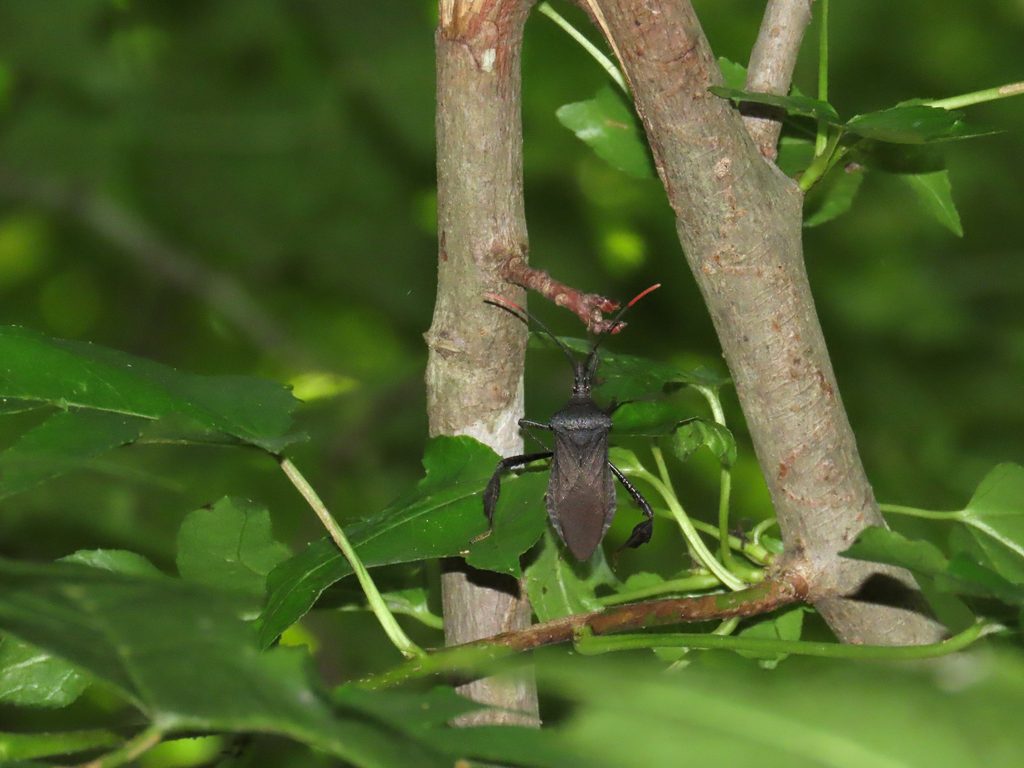

The Orange-tipped Leaf-footed Bug has normal femurs on its hindlegs and the tips of its antennae are orange, contrasting with the darker lower segments. It also tends to be the smallest of the three, usually just an inch long. They are most often encountered in the upstate and mountains of South Carolina and fairly scarce on the coast, but range widely across eastern North America, from Mexico up through Texas, and north and east into the southern fringe of Canada.

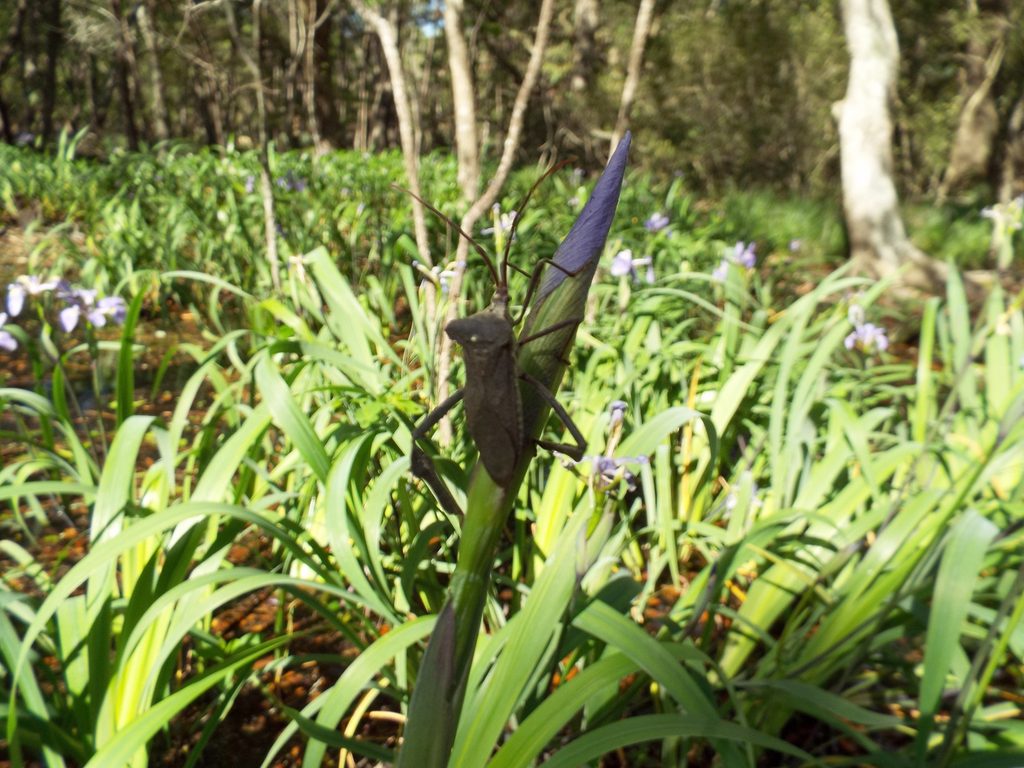
The Giant Leaf-footed Bug is the largest of the three, and typically hits an inch-and-a-half in length. It has dark-red antenna and normal shaped femurs on its hindlegs. They’re the most abundant species and are best adapted to sharing land with humans in urban centers. They’re found widely throughout the Southern United States from Virginia south and west to eastern Texas.

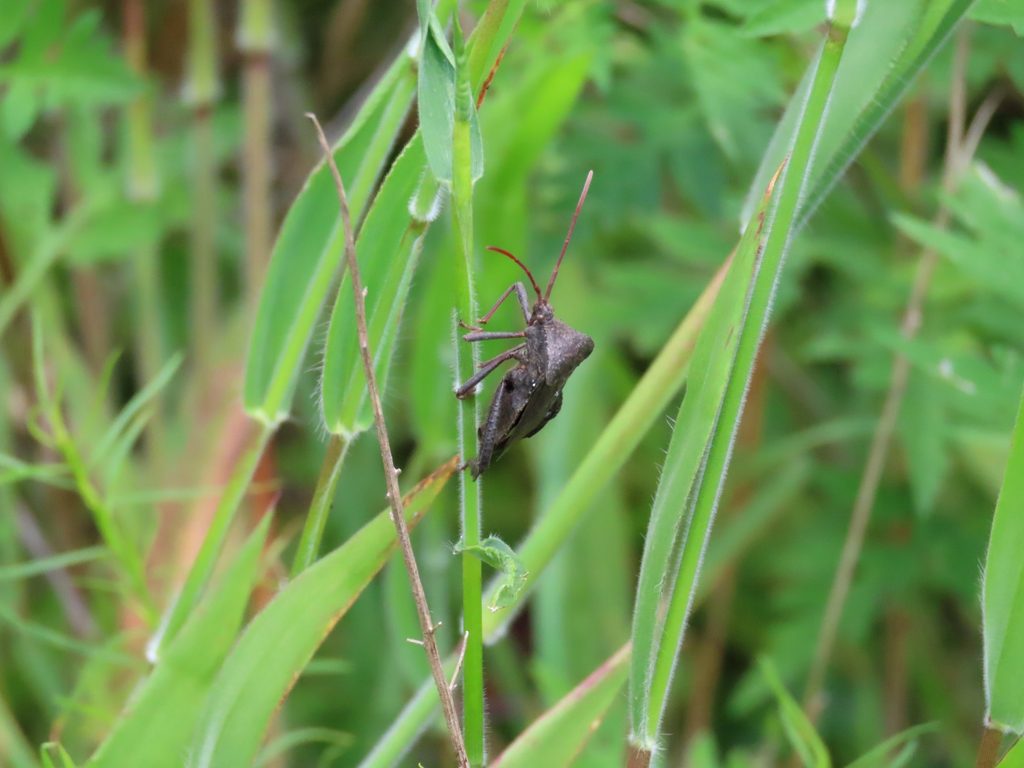
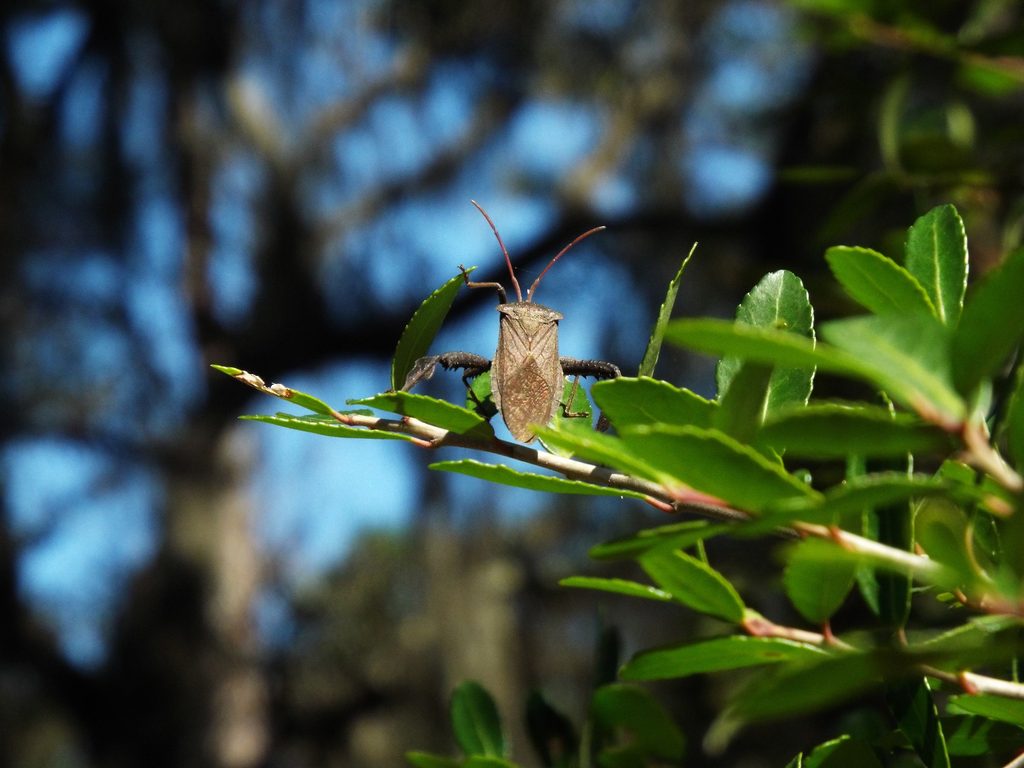
The Florida Leaf-footed Bug measures in most often just under and inch-and-a-quarter. Their antennae color varies from solely dark-red, to brown with orange tips. But what sets them apart from the other two are their hams. These bugs got thick thighs! The femurs of females are slightly enlarged, with a subtle bow to their shape and small spines on all sides. The gals also have prominent leaves on their tibia. The fellas on the other hand look like they’ve never skipped a leg day and cycle professionally. They have giant curved femurs covered in small bumps and armed on the inside with just one or two large spines. They also have next to no leaves on their tibia. It’s a one-of-a-kind look in our neck of the woods! The Florida Leaf-footed Bug is found mainly most readily on the coast, and in my experience is the most common species in wild areas on the Sea Islands. They’re found throughout the Southeast and down throughout Central America.
Spine-headed Bugs get their common name from the little sharp point on the tip of their head, their ‘nose’ if you will, which is an anatomical feature called a “tylus” that for some reason is pointy on these bugs. But apart from their pointy nose they also have prominent spines on their femurs, as well as those leafy projections on their tibia. Since they have these leaf feet and belong to the Leaf-footed Bug family, the common names for our three species use that moniker instead. Additionally, Acanthocephala terminalis doesn’t have a recognized common name that I can find, for whatever reason. So I’ve christened it the “Orange-tipped Leaf-footed Bug” for the purposes of this article. (We’ll see if that gets around.) And one last thing while I’m yammering about names again, these bugs belong to the insect order Hemiptera, the True Bugs, which means the term Bug here is taxonomically correct and more precise than insect. The name Hemiptera means “half wing” as the base of the forewing in many groups, like the Leaf-footed Bugs, is thickened and leathery to serve a shield for the more delicate wings folded up beneath them. This tends to lend an “X” patten onto their backs, with a distinctly and differently colored lower quadrant above the abdomen tip.
You might be wondering, “What’s the deal with funny hindlegs?” Me too. It’s not well researched, from what I can tell, as to what benefit these features confer. However, for species like the Florida Leaf-footed Bug that have obvious sexual dimorphism, the enlarged femurs appear to play a key role in male competition and female mate selection. Typically, body features used for male display accomplish three things: they look cool, they waste resources, and they are risky to have. (And they’re sometimes helpful in a fist fight.) These provide the ladies an honest estimate of a fella’s fitness. If he’s making his own day-to-day life more dangerous and wasting all his extra calories growing glorious gams but he still looks this good, then the rest of his genes must be pretty impressive, otherwise he’d be dead already. But for the other, less exaggerated species, I have two hare-brained hypotheses rattling around in my dome to explain their utility. First, the leafy legs might help these lanky bugs with steering and aerodynamics while in flight, either acting as a rudder and/or helping convey some lift to stabilize their flight. For the spines on the hindlegs, I reckon that’s a physical defense against predators. Spine-headed Bugs, like Stink Bugs and other Leaf-footed Bugs, can release a foul smelling, nauseating chemical from their abdomen when grabbed in order to force away predators. I think the long spiny hindlegs are a back-up and secondary counter-measure. The bug can flare its hindlegs out to keep from being swallowed whole if grabbed. Then if the predator flinches from the chemical defense, it can hook in and push away from its attacker with its feet and spines. But I can’t find much research to say one way or the other on either of these.
Spine-headed Bugs, like all True Bugs, are Hemimetabolous. They undergo incomplete metamorphosis. They emerge from the egg looking like a smaller, squishier, wingless version of their parents called a nymph. As they grow, they molt and iteratively get closer to their winged adult form. This is a simpler form of metamorphosis that allows the young to prioritize putting energy into rapid growth. Its strength and weakness is that the young and the adults both feed on nearly the same food resources. Thus when times are hard, all generations directly compete with each other for food on the landscape. Yet when times are good, it makes everything easier and they can readily boom in numbers. This can turn Spine-headed Bugs into crop pests for vegetables and fruits under some situations, but its usually other Leaf-footed Bug genera that cause problems here in the Lowcountry. On the flipside, Leaf-footed Bugs are an important fall food source for many species of birds, which have adapted to tolerate their chemical defenses.
Another interesting facet of their life history is that Spine-headed Bugs overwinter as adults. Come fall, cooling weather, and hibernating plants, these bugs will leave their favorite feeding places and venture into the wide world around them to find a warm, sheltered place to spend the winter. Then they reemerge in spring to lay eggs on fresh vegetation to pass the torch to the next generation. In fall, Spine-headed Bugs seem to suddenly show up everywhere you look on walls, porches, window sills, in sheds, and the like trying to find a cozy hole to crawl into.





© 2026 Edisto Island Open Land Trust.
Built by Colophon