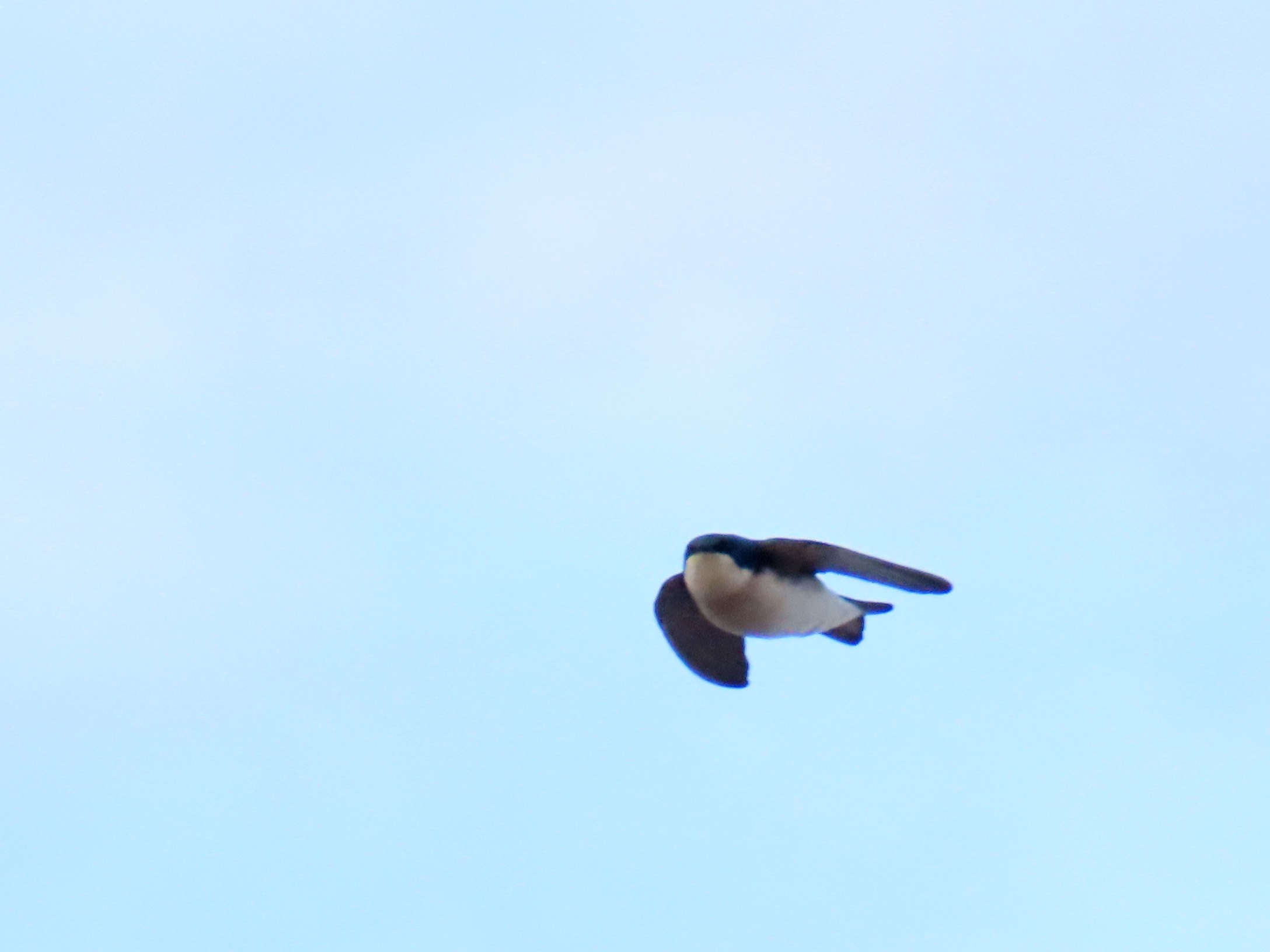


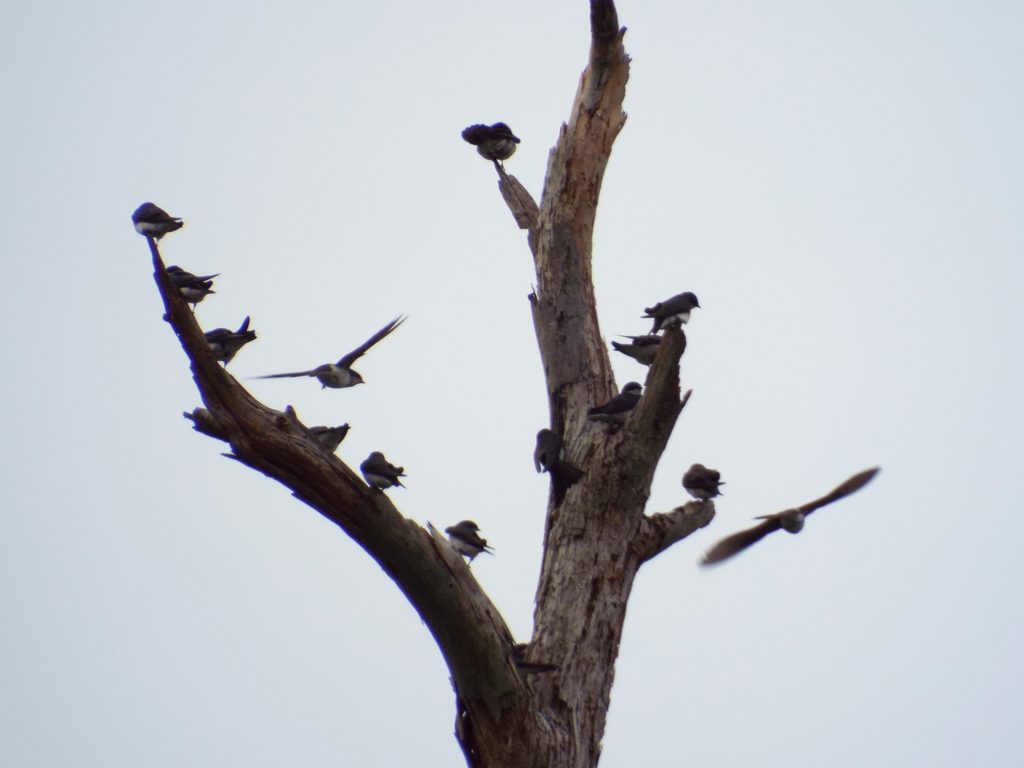

This week for Flora and Fauna Friday we have the arboreal acrobatic ace of the air, the Tree Swallow (Tachycineta bicolor).
Here in South Carolina, we have seven species of Swallow: the well-traveled Barn Swallow (Hirundo rustica), the backyard Purple Martin (Progne subis), the solitary Northern Rough-winged Swallow (Stelgidopteryx serripennis), the tunnelling Bank Swallow (Riparia riparia), the troll-like Cliff Swallow (Petrochelidon pyrrhonota), the vagrant Cave Swallow (Petrochelidon fulva), and today’s subject the Tree Swallow. Like all our Swallows, Tree Swallows are a songbird of middling size with a streamlined form, torpedo-shaped body, small bill, and pointed wings. They are extremely fast and agile fliers that subsist on a diet of insects snatched from the air. They even drink on the wing, skimming freshwater off the surface of a pond. Swallows rarely land, except to sleep at night. Somewhat uniquely for our Swallows, Tree Swallows will also land to feed on Wax-Myrtle (Morella spp.) berries, and other waxy fruits, in winter when insects vanish.
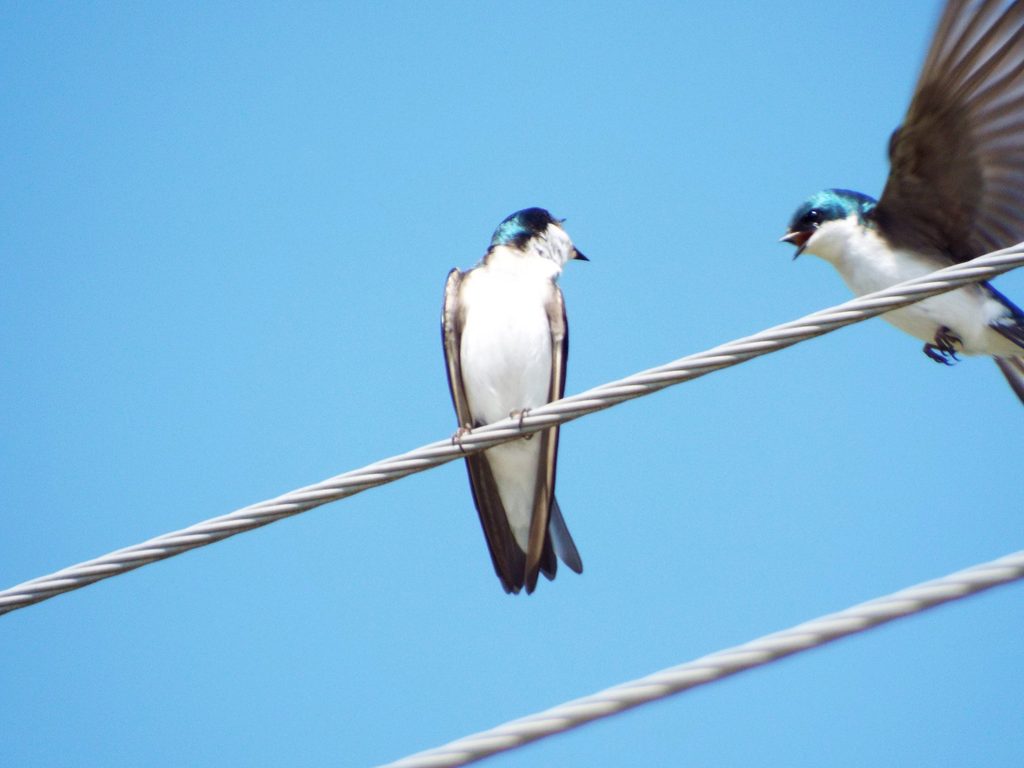
Tree Swallows are readily distinguished from our other Swallow species here in South Carolina by their strong two-tone plumage. They are frost-white below and a vibrant, iridescent aquamarine-blue over a base of dull black above. Younger birds are less brilliant. This pattern is called countershading. It’s a form of camouflage, more often seen in aquatic animals. This contrasting coloration hides a Tree Swallow’s silhouette in flight against the bright, light sky above and the dark, verdant forest below, making them harder to spot and track by falcons and hawks. This effect is amplified by their flocking nature and the controlled-chaos of their flight, making the act of catch a Tree Swallow on the wing nigh impossible. The Tree Swallow’s call is a short, buzzing chirp that is harsher in tone and usually higher in pitch than our other Swallows. It’s hard to describe a Swallow call with words, but each of our seven species is fairly unique.
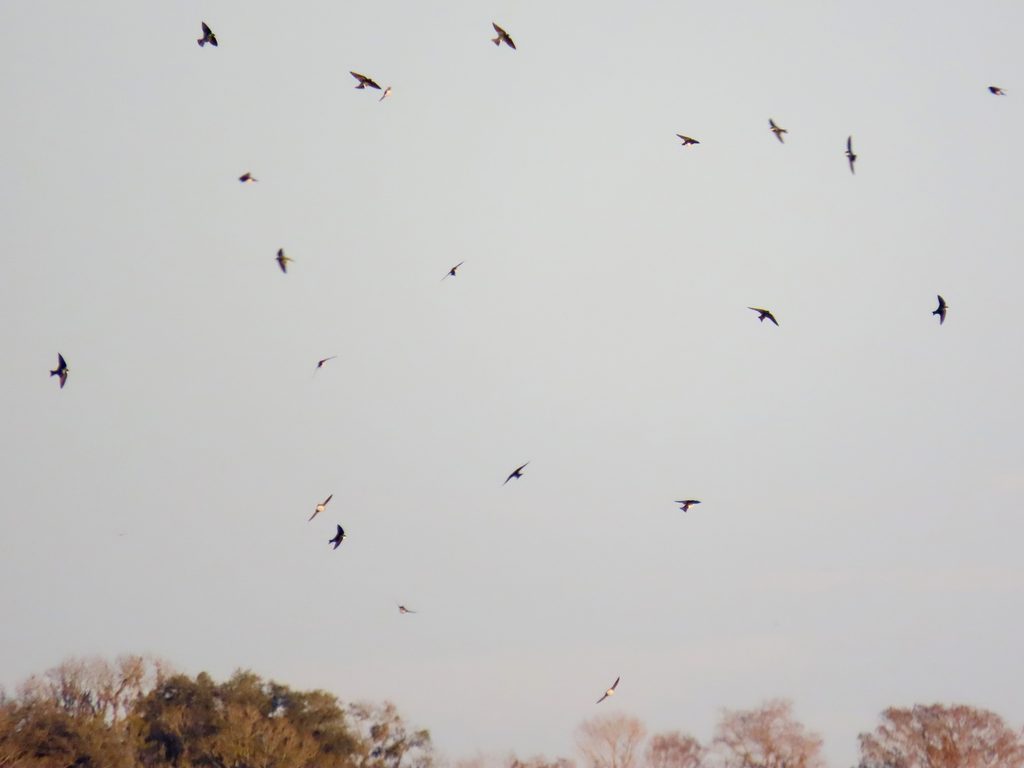
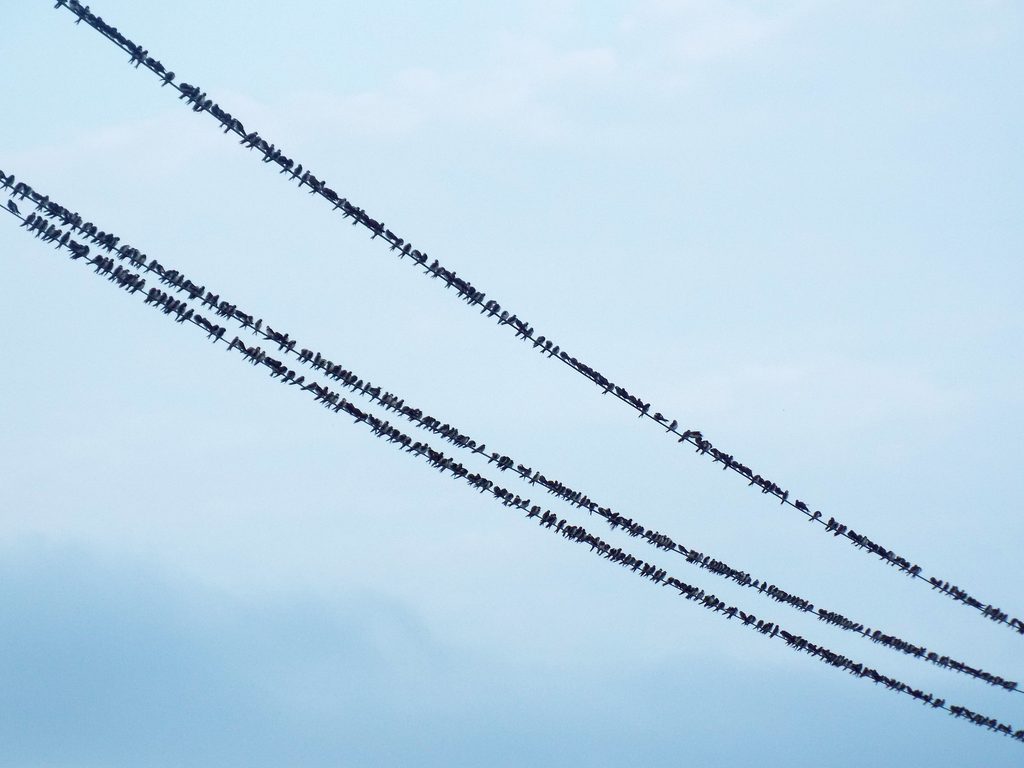
Tree Swallows can be sighted throughout South Carolina and are by far the most numerous Swallow found in the Lowcountry, particularly in winter. In the summer months adults leave South Carolina and fly to the more northern regions of North America to breed. Here they nest in tree cavities, old woodpecker holes, and even make use of nest boxes. Once the kids are grown and their nest is empty, they fly back South and concentrate on Southern beaches. As autumnal days begin to arrive in the Lowcountry, so do droves of Tree Swallows moving down the East Coast. They can be spotted in flocks of dozens, hundreds, and thousands spiraling southward along the Atlantic. These flying flotillas gravitate to the wide-open marshes of the Lowcountry’s Sea Islands. A Tree Swallow’s preferred habitat is open land, fallow and flooded fields, clearcuts, vast marshes, rivers, and freshwater ponds all mosaiced together into a close-knit, diverse landscape. That’s a perfect description of the ACE Basin and Edisto Island! Here in the ACE, Tree Swallow flocks roll and churn in chaotic mass, like fog hanging over the land, filtering out the droves of mosquitoes, bugs, flies, beetles, and moths rising up from the land. Then moving on to scrub the air over the next field, brought briefly alive by the rays of the cold winter sun. Migrating Tree Swallows can occasionally be spotted in fall resting in the sun on the boughs of a dead snag or lining yards of powerline down the roadside.





© 2026 Edisto Island Open Land Trust.
Built by Colophon