
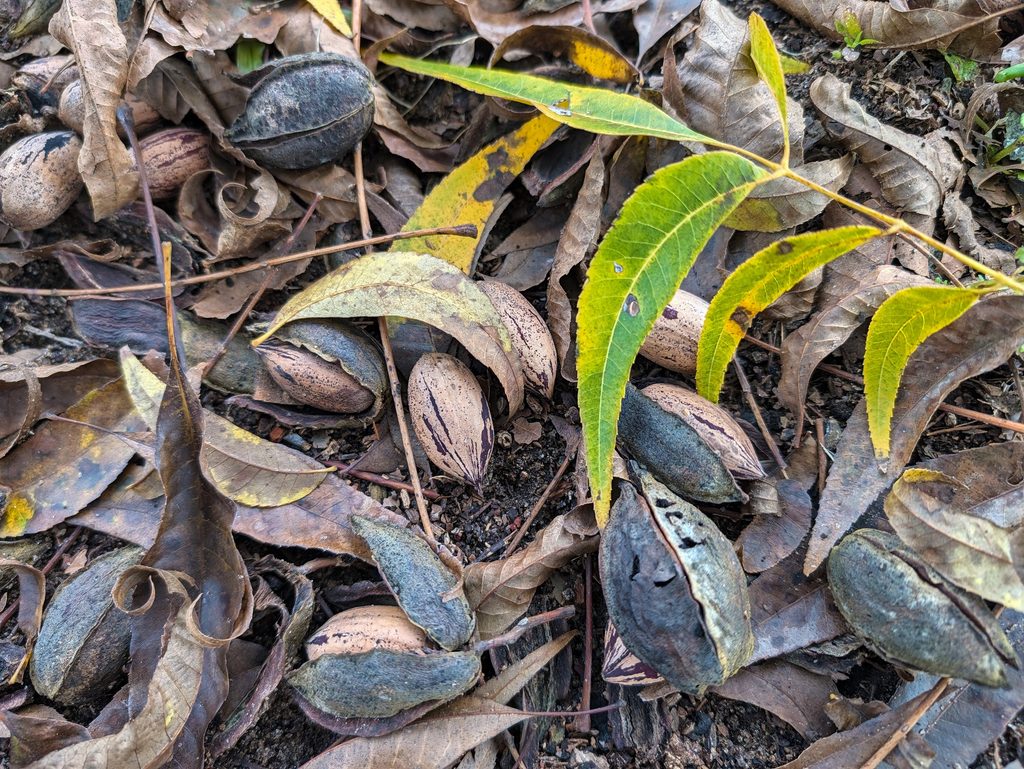
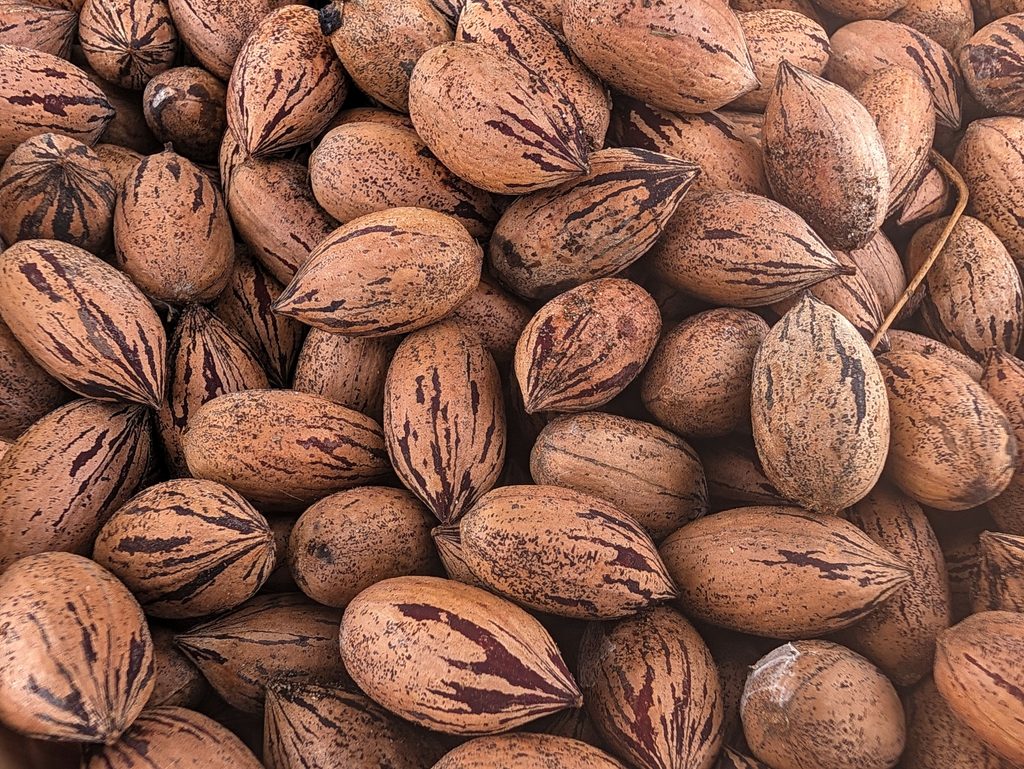
This week for Flora and Fauna Friday we’re giving thanks for the great bounty of the Pecan (Carya illinoinensis).
The Pecan is a stout hardwood tree native to the southeastern United States. Pecans have a deep taproot, which you know if you’ve ever tried to transplant a sapling. They prefer to grow on young fertile soils that are well drained, rarely flood, but have ample access to soil moisture. This includes upper floodplains, bluffs, high levees, and other humid sandy areas near river systems. In South Carolina, they are most common to find where they were planted around old homesites and farms. Here on Edisto Island they can also be found along drainage canals and freshwater wetlands, where they’ve been moved by water and critters into a facsimile of a more natural habitat.
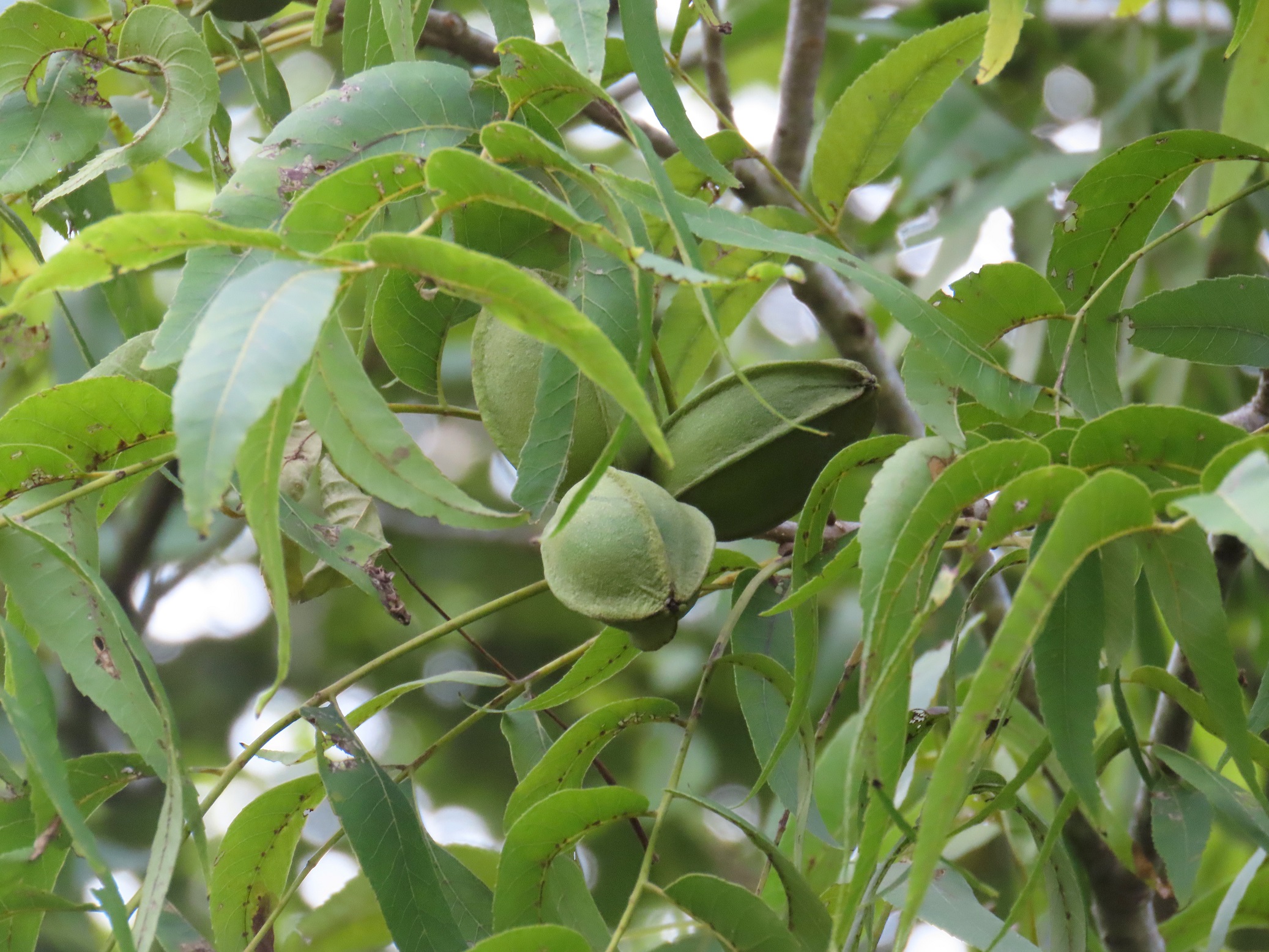
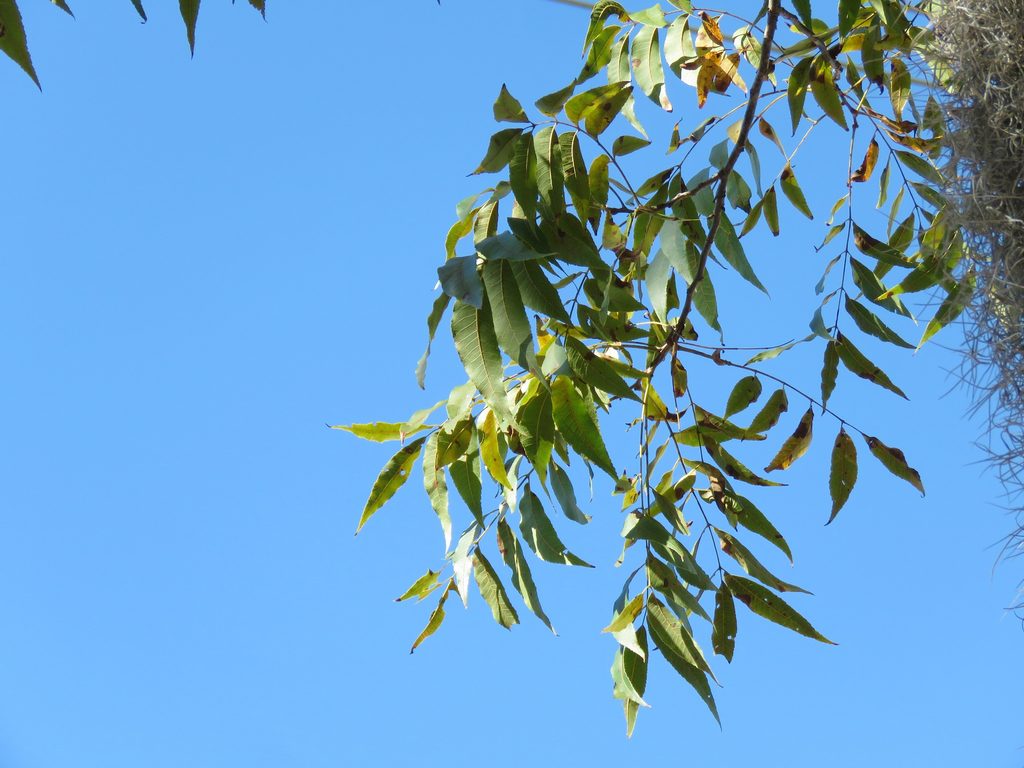
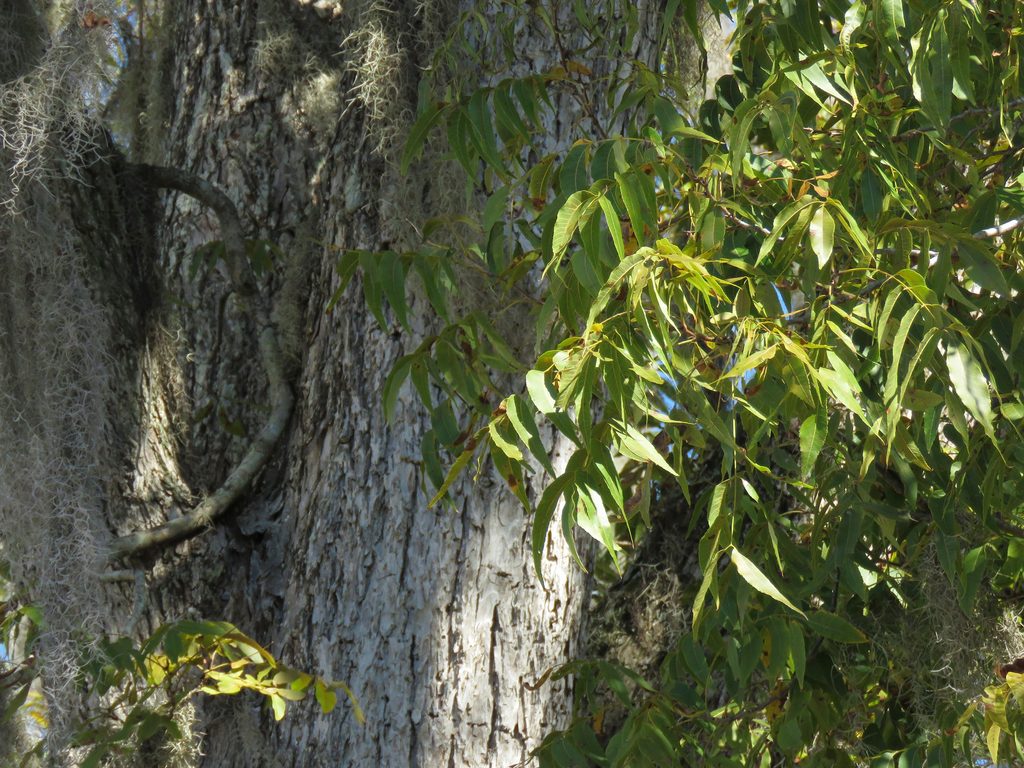
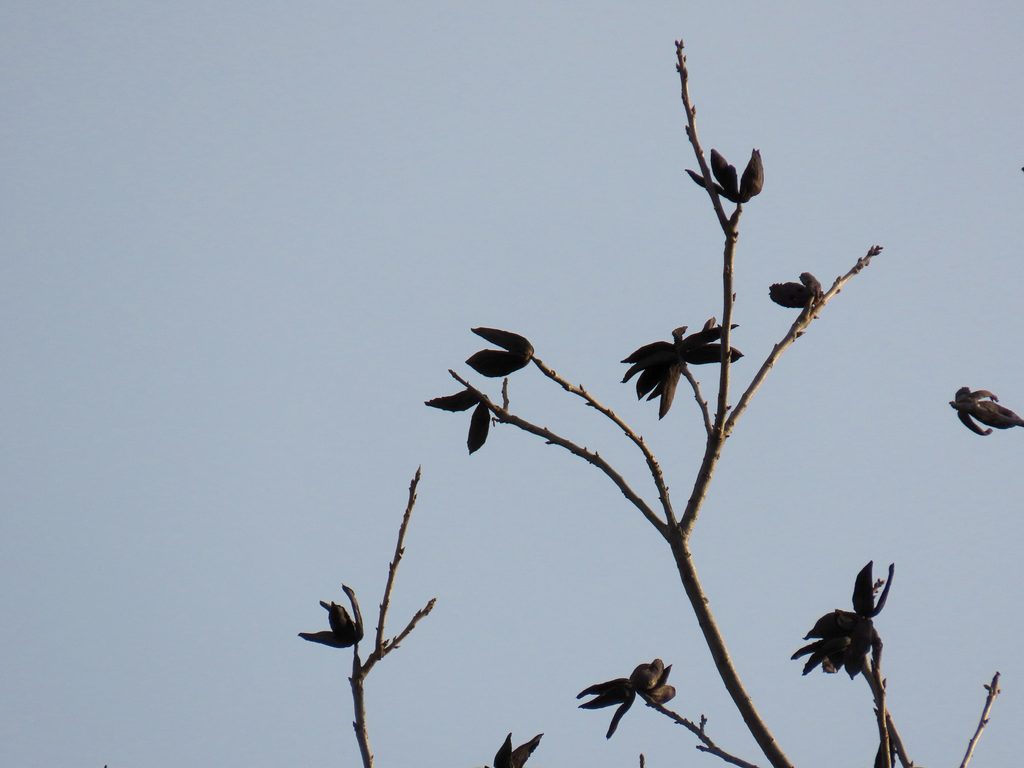
Pecan is a member of the Hickory genus, Carya. Hickories all tend to be straight trunked, broad crowned, heavy limbed, and have either peeling or “chainy” bark. Hickories also have large, alternate, pinnate leaves with at least five leaflets. They produce large rounded nuts with a smooth, but deceptively dense, woody shell. Pecan specifically grows very fast and thick for a Hickory. Their bark is a pale platinum-gray that peels in thin vertical shingles. Its stout limbs are often adorned by Spanish Moss and Resurrection Fern here on the Sea Islands. This ivory bark alone makes Pecan one of our easiest trees to identify in the South. The leaves of Pecan often have nine to thirteen leaflets that bear a slightly yellow shade of green, hook inward slightly, and are free of any obvious hairs or fuzz. Pecans are deciduous and lose their leaves in fall. They’re one of the last trees to revegetate in spring, sometimes not leafing back out until late April. This is an adaptation likely made to help avoid breaking dormancy amid water-logged spring soils and to avoid late season frost nipping flowers and leaves. The nuts of Pecan are roughly thumb-sized, twice as long as they are wide, with an almost rectangular profile, smooth hull, and a ruddy-brown color overall marked by jagged black stripes radiating from the pointed tip.
Hickories are well known for a number of shared characters including impact resistant wood that’s unparalleled for axe and hammer handles, fragrant wood that’s excellent for smoking foods, and large edible nuts. Pecan ticks all those boxes too. It’s not the best tool wood for longer handles, that honor lies with a few other Hickories, but Pecan is often a handsome choice for smaller or lighter duty tools as it brings a more pleasing pattern of grain and color with much the same strength. It also makes quite beautiful paneling, countertops, and furniture when its natural grain is allowed to shine through. Pecan firewood is excellent for smoking as it imparts a mellower but equally complex flavor to meats and other foods. And of course, we all know and love Pecan nuts. From pies, to oil, to toppings, to just fresh cracked nuts on their lonesome, Pecans are an incredible, edible, inseparable stable of the Southern diet and tradition. But just how Southern is Pecan really?
The native plant status of the Pecan here in the Lowcountry is up for debate. That debate is less so “is Pecan native to here” and more on “what is a native plant” and what degree of that question actually matters. Pecan is native to the south-central United States, mainly west of the Mississippi from northeast Texas up to Illinois and Ohio. It is soundly not native to South Carolina, nor really much of what we colloquially know as the Deep South. Native Americans made great use of Pecan nuts as a food source within the tree’s native range. Our local tribes made use of other Hickories here in the Carolinas. The Pecan is believed to have been first (or at least most successfully) brought to the East Coast in the early 1760s by famed naturalist and explorer William Bartram. From thence they spread over several decades throughout the Thirteen Colonies and became a reliable food stuff and minor export throughout the Atlantic coastal plain. Pecan developed into a strong analog to the American Chestnut (Castanea dentata) for coastal climes. Chestnut was an even more prolific and reliable nut tree but was limited to growing in the piedmont and mountains, especially here in South Carolina. Pecan was much the opposite in its regional and habitat preferences. When the American Chestnut was decimated upon decimated by the Chestnut Blight starting in the early 1900s, the Pecan came to dominate the palate and traditions of Southern culture and cuisine. That staple position has been maintained ever since.
So just what is a native plant? That’s an easy question to answer on paper but in practice that can be hard to wholly divine sometimes. Our Pecan is one such tough nut to crack. In a broad sense, Pecan is native to the Southern United States. But that’s a pretty big place. In a more scientific sense, it’s not native to anywhere east of the Appalachians. However, it’s native habitat in the Mississippi River Valley is much the same as the sandy and saturated soils of the Lowcountry’s river valleys and these two regions border each other at the same latitude. Meaning the mammals, birds, and insects that rely and feed upon Pecan, those species that co-evolved right along with it, are much the same between these two sister ecoregions. Further, nearly all the Hickories native to South Carolina range across the Southeast and grow right alongside the Pecan within the Mississippi River Valley. The Mississippi is a mighty river much larger and more powerful than any other river in the United States. So it has unique geology and hydrology, and thus ecological niches, not found here in the Carolinas. This allowed the Pecan to stratify itself into an untapped niche not filled by other Hickories. Thus, Pecan grows well here in the Lowcountry with not much fuss, is well used by our wildlife, doesn’t displace other nut trees as it can only coexist in a narrow niche, and is kept in check by natural forces and parasites, just like any other native Hickory. This puts Pecan in a weird gray area. By strict definition it is not native to South Carolina. Yet it is still native to the Southeast. From a practical standpoint, it behaves like a native plant and originates from an abutting ecoregion. It was just awaiting an opportunity to naturally cross the Alabama River into the East into a suitable river valley. But Europeans brought it over on their own accord some two-hundred and sixty years ago. This places Pecan at the nexus of being something between native, introduced, and adventive. Quite the conundrum. Really this just begs the question, does it matter if Pecan is native here? Personally, I just like eating Pecan pie.
Lastly, the query upon everyone’s minds, one of the great questions of our age, just how should you pronounce Pecan? Is it ‘Pee-Can’ or ‘Puh-Kahn’? Many a Thanksgiving has been ruined in search of some deeper truth through intellectual interrogation of this fracture in the fundament of our reality. Well, how YOU say it is a regional thing mostly based on where you and/or your parents were raised. Around my neck of woods by Edisto, I’ve always heard them as ‘Pee-Can’ and that’s the way I’ve always said it. (The local adage here is you pick ‘Pee-Cans’ down here and sell them as ‘Puh-Kahns’ north of I-95 for twice the price.) If we check the history books, the name Pecan originates directly from the Native American term for the nut, which is often phonetically spelled “Pakaani”. That plainly makes ‘Puh-Kahn’ the more proper pronunciation. Nonetheless, it don’t matter how you say it as long as you enjoy them with good company every fall! But, if you want to be precisely pedantic, you can always say you’re baking a Carya illinoinensis cotyledon pie, then everyone will know exact what you mean.





© 2026 Edisto Island Open Land Trust.
Built by Colophon